
Headlines
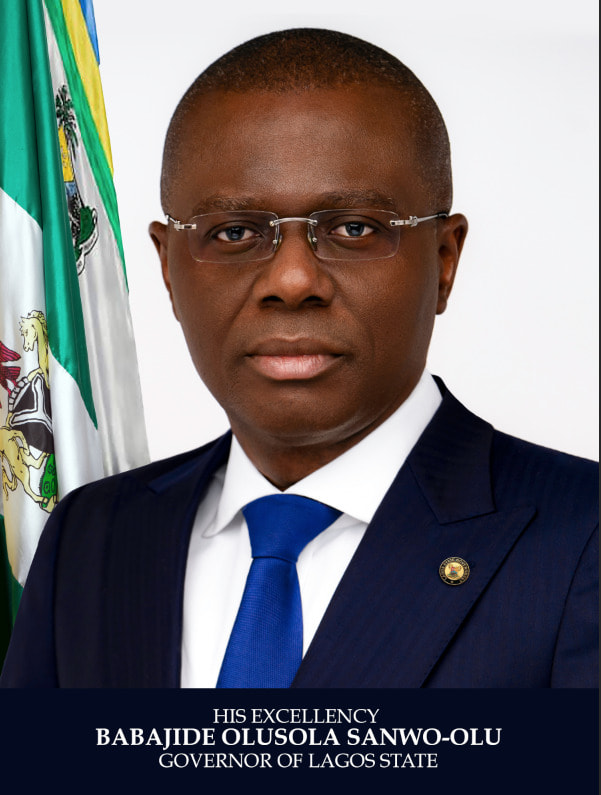
Babajide Sanwo-Olu: 100 Days of Sure, Steady Strides

- /home/rhoncare/pointblank.ng/wp-content/plugins/mvp-social-buttons/mvp-social-buttons.php on line 27
https://pointblank.ng/wp-content/uploads/2019/05/SanwoOlu.-601x600.jpg&description=Babajide Sanwo-Olu: 100 Days of Sure, Steady Strides', 'pinterestShare', 'width=750,height=350'); return false;" title="Pin This Post">
- Share
- Tweet /home/rhoncare/pointblank.ng/wp-content/plugins/mvp-social-buttons/mvp-social-buttons.php on line 69
https://pointblank.ng/wp-content/uploads/2019/05/SanwoOlu.-601x600.jpg&description=Babajide Sanwo-Olu: 100 Days of Sure, Steady Strides', 'pinterestShare', 'width=750,height=350'); return false;" title="Pin This Post">
By Eric Elezuo
“The Babajide Sanwo-Olu you see today shall not change and try to become something I am not. My prayer is only that I grow and improve as your governor to implement good policies and bring the prosperity you deserve”
The 6th of September, 2019 when the much sought after Governor of Lagos State, Mr. Babajide Sanwo-Olu, clocked 100 days on the seat of power, did not come upon Lagosians by accident. They waited for it. They wanted to celebrate it. This is because from day one of his administration, Sanwo-Olu had put mechanisms in motion to create the proverbial ‘greater Lagos’ which formed a major part of his campaign slogan. And true to type, the ever jovial governor did not disappoint. He blessed Lagos State with an avalanche of achievements that most of his counterparts were wondering how he did.
Sanwo-Olu did not mince words when prior to inauguration, he promised to clear the problematic Apapa gridlock within his first 60 days. Today, the Apapa gridlock has undergone creative overhauling that has seen gradual disintegration of the hellish situation.
“In collaboration with the Federal Government, the Task force we set up to remove illegally parked trucks went on tough assignment to return discipline along the Apapa-Oshodi corridor. I am glad to inform you that we have seen tremendous improvement and we are happy with the results in the last 100 days. We will continue to attend to the situation for permanent solution,” the governor said.
Again, the Sanwo-Olu Lagos State Government has set aside N4 billion as grant to Lagosians with “ingenious business ideas”.
This was disclosed by the Commissioner for Information and Strategy, Mr. Gbenga Omotoso, during a media briefing herald the governor’s first 100 days in office.
The grant being handled by the Lagos State Employment Trust Fund Initiative in collaboration with Access Bank Plc., is aimed at promoting ingenious business ideas. Presently, 600 people had already been billed to benefit from the initiative.
The Commissioner added that about 1,700 people have been shortlisted to benefit from a World Bank-assisted agricultural programme, and each of the beneficiaries will receive the sum of N2m, bring to a total of N3.4 billion.
Recall that at inception of his administration, Sanwo-Olu hinted that his government will be making Lagos State the Heaven it is meant to be through the the well thought out vision encapsulated in the Six Pillars of Development, with the acronym, T.H.E.M.E.S. This stands for Traffic Management & Transportation; Health & Environment; Education & Technology; Making Lagos a 21st Century Economy; Entertainment & Tourism and Security & Governance. These were carefully formulated to tackle the problems identified in sectors that are strategic to the growth of Lagos State.
Sanwo-Olu in 100 days is one governor who made a promise, and kept a promise, doing it in style as he took steps to build on the foundations of Asiwaju Bola Tinubu, Mr. Babatunde Fashola and Mr. Akinwunmi Ambode, his predecessors.
Kick starting his administration, Sanwo-Olu dished out an executive order declaring emergency on traffic management and transportation in the Lagos State. This singular act brought about reasonable relief to residents in their day to day activities. Not only that, it saw to the speedy rehabilitation of arterial roads, which has in essence reduced travel time and stress for motorists and commuters.
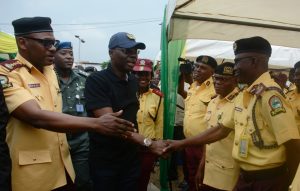
The governor’s Executive Order empowered members of the state’s traffic management agency to increase their shifts so as to control traffic till 11 pm daily. The move has brought an element of sanity on the roads after dark. Their salaries were also enhanced to undertake the great task in a rub my back, I rub your back arrangement. To whom much is given, much is being expected. The synergy has delivered great benefits.
HEALTHCARE
Having a health background as he is married to a medical doctor, Sanwo-Olu has tackled the health sector with the agility of a horse within 100 days.
He has opened a 110-bed Maternal and Childcare Centre (MCC), domiciled in a tastefully built four-storey edifice at Eti Osa Local Government. The whole essence is to prosecute the war against infant and maternal mortality. The end game lies in upgrading the facility to a general hospital. In addition, another 140-bed MCC had been completed in Alimosho area, and will be commissioned anytime soon, and will strengthen the capacity of the state in providing sound maternity care for residents.
For 31 whole days in August, the prolific governor embarked on a festival of surgeries, where a team of volunteer doctors, specialists in diverse areas of medical practice, and other medical practitioners performed thousands of surgeries, especially on children with deformed limbs. This was totally free. The project was christened “Healthy Bee Initiative” and about 25,000 residents benefited.
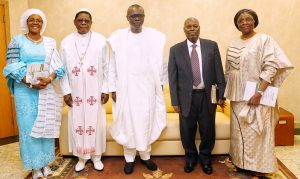
Again, the state-owned Health Insurance Scheme has received boost to extend its services to more than one million residents in order to give them affordable and quality healthcare services.
EDUCATION
In education, Sanwo-Olu has built, in partnership with the Redeemed Christian Church of God (RCCG), Tabernacle of David Parish in Alaguntan village, Eti Osa, a beautiful school, containing 12 blocks of classrooms and other modern learning facilities.
In addition, plans have been concluded to recruit more than 10,000 teachers for various categories of education and learning, just as resources have been appropriated for the upgrade of public schools, as well as equip them with required materials to aid quality learning.
ENVIRONMENT AND WASTE MANAGEMENT
Before now, the environment state of Lagos has become a matter of utmost concern, as the state had became a massive heap of refuse, necessitating drastic measures. These measures included the immediate upgrade of Lagos’ waste management infrastructure fashioned to achieve efficient services in waste disposal towards realising a cleaner environment.
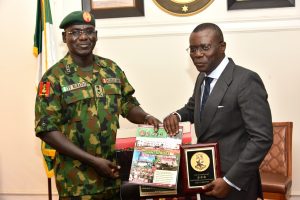
Lagos State Governor, Mr Babajide Sanwo-Olu (right) and Chief of Army Staff, Lieutenant General, Tukur Buratai (left) during a courtesy visit by the Army Chief to the Governor at Lagos House, Alausa, Ikeja,
To this end, Sanwo-Olu, as a matter of urgency improved the capacity of Lagos State Waste Management Authority (LAWMA) to remove heaps of waste that littered streets and highways. This policy saved the state from an imminent outbreak of epidemic occasioned by the indiscriminate dumping of refuse by residents following the disengagement of LAWMA from waste management duties. As a follow-up to environmental management, the government launched the Blue Box Initiative, designed to recyclable waste for the purpose of creating jobs and wealth.
INFRASTRUCTURE
As a chip of the old block, Sanwo-Olu had pledged not to discontinue inherited projects. Therefore, contractors handling construction of various infrastructure projects had return to site and complete them. He has also ensured that work resumed on the Mile 2/Badagry Expressway project, hopefully to be completed by December 2019, among others. This will further boost tourism and international business.
HI-TECH
The administration of Sanwo-Olu has perfected plans to actualise the Smart City initiative, which is billed to hit airwaves in the coming weeks. The high points of the initiative is the deployment of metropolitan fibre optics across the State. The project, when launched would provide Internet infrastructure for the populace to boost aid e-commerce and tech innovation.
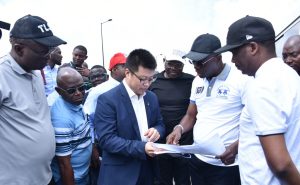
Governor Sanwo-Olu, his Deputy, Dr Obafemi Hamzat and other officials
POWER
The administration has made arrangements with key power distribution firms to distribute 20,000 metres to residents to ease challenges of accessing power.
In his usual modest mien, the governor has has promised that “The coming days will be filled with good governance and more successes.”
Describing the 100 days of the governor, Commissioner for Information and Strategy, Mr. Gbenga Omotoso, said it is “excessively eventful”.
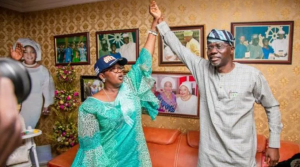
Sanwo-Olu with Iyaloja- General, Chief ( Mrs.) Shade- Tinubu
Babajide Olusola Sanwo-Olu is widely regarded as a public sector expert in
human resources and policy formation a power sector consultant per excellence,
an astute banker, a compelling public speaker and an inspirational leader.
Apart from a robust public sector service experience which spanned over eight years during
which he was Honourable Commissioner for Commerce and Industry, Honourable
Commissioner for Budget and Planning and Honourable Commissioner for
Establishments and Training, Lagos State, at different times, the very dynamic governor
also has an enviable background in the private sector and close to ten years of exemplary
banking experience during which he contributed immensely to the growth and
development of Lead Bank Plc, UBA, and First Atlantic Bank (now First City Monument
Bank) in various critical capacities.
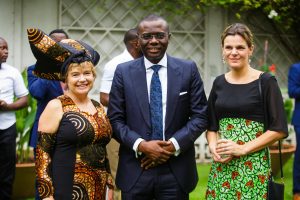
Catriona Laing, Babajide Sanwoolu & Laure Beaufils
He has distinguished himself as a boardroom guru and has since become a widely
recognised force in both the private and public sector, serving as Board member,
Department for International Development, DFID/DEEPEN Fund; Member of the Board
Audit Committee of Caverton Offshore Services Group, PLC and as Director, Light Level
Nigeria Limited, the foremost digital signage company in Nigeria.
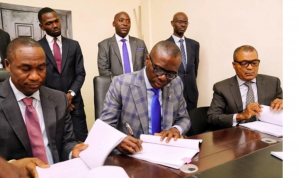
Babajide Sanwo-Olu with Dr Femi Hamzat
A man of admirable social skills, who is generally believed is capable of achieving the greater Lagos initiative, Sanwo-Olu is happily married to Dr. (Mrs.) Ibijoke Sanwo-Olu and they are blessed with children.


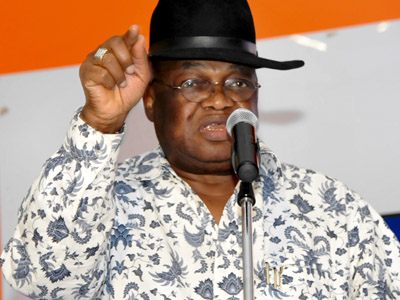
President Bola Tinubu has expressed sadness over the death of Ambassador Patrick Dele Cole, describing him as a distinguished diplomat, journalist, politician and public servant.
Cole died at 86.
In a statement on Saturday, Tinubu said Cole devoted his life to national service and brought distinction to his work in diplomacy, journalism and politics.
“His career reflected the enduring value of dialogue, tact, mutual respect and the pursuit of shared interests in advancing national development and international cooperation,” the President said.
Tinubu noted Cole’s contributions to Nigeria’s media landscape, particularly as Managing Director of the Daily Times, where he upheld the role of the press in holding public officials accountable, speaking truth to power and strengthening democratic governance.
“His legacy in journalism and public life remains an enduring part of our national story,” he said.
The President said at 86, Cole witnessed defining moments in Nigeria’s history and contributed to national development, adding that his life stands as a testament to experience, principled engagement and commitment to public good.
Tinubu extended condolences to Cole’s family, friends, professional associates and all whose lives he touched, praying that memories of his remarkable life will bring comfort and strength.
“May Almighty God grant Ambassador Cole eternal rest and give his family and all who mourn him the fortitude to bear this profound loss,” he said.
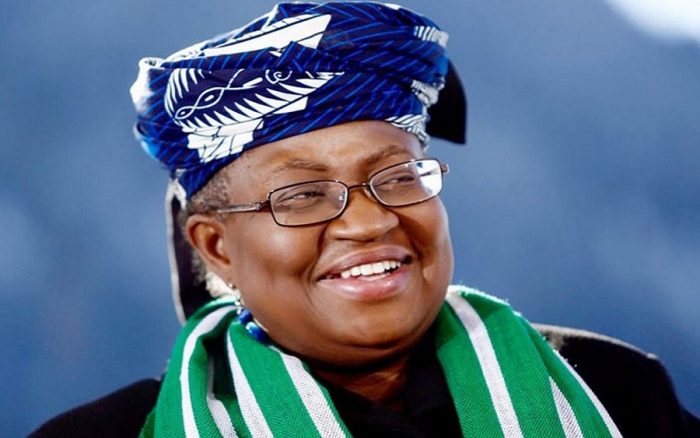
Director-General of the World Trade Organisation (WTO), Mrs. Ngozi Okonjo-Iweala, has said that her probe of an alleged $2.4bn subsidy fraud led to the abduction of her mother.
It would be recalled that the former Finance Minister’s mother, Kamene Okonjo, was kidnapped from her home in Ogwashi-Uku, Delta State, in December 2012.
In a recent interview with Bloomberg, Okonjo-Iweala said the abductors demanded that she resign as minister of finance and leave the country.
The WTO director-general served as Nigeria’s finance minister between 2011 and 2015 under former President Goodluck Jonathan.
She said the subsidy investigation began after her office noticed a sharp increase in claims submitted by petrol importers.
“So I went to the president and said, look, something is going on here. Could we audit the accounts? And he said, yes, go ahead. And we found about $2.4 billion worth of fraud. So, we refused to pay,” she recounted.
She said her mother was abducted shortly after the decision was announced, adding that her captors demanded her resignation as a condition for her release.
“I was told (by the kidnappers) that for her to be released, I should resign and leave the country,” she said.
The former minister described the incident as one of the most traumatic experiences of her life, saying her mother was held in a forest before escaping.
“She was held in the middle of a forest, and one night she escaped. She’s still alive. She’s 96 now,” Okonjo-Iweala said.
“It was a terrible, terrible five-day ordeal. I think the worst in my life.”
“I never dreamt my parents could ever be touched in this way, that people would be that evil,” she added.
Okonjo-Iweala said she considered resigning before her mother regained her freedom, but her father warned her against giving in to the abductors’ demands.
“He said, ‘We don’t give in to blackmail’. And he said, ‘You’ve got to carry on. You’ve got to go to work’,” she recalled.
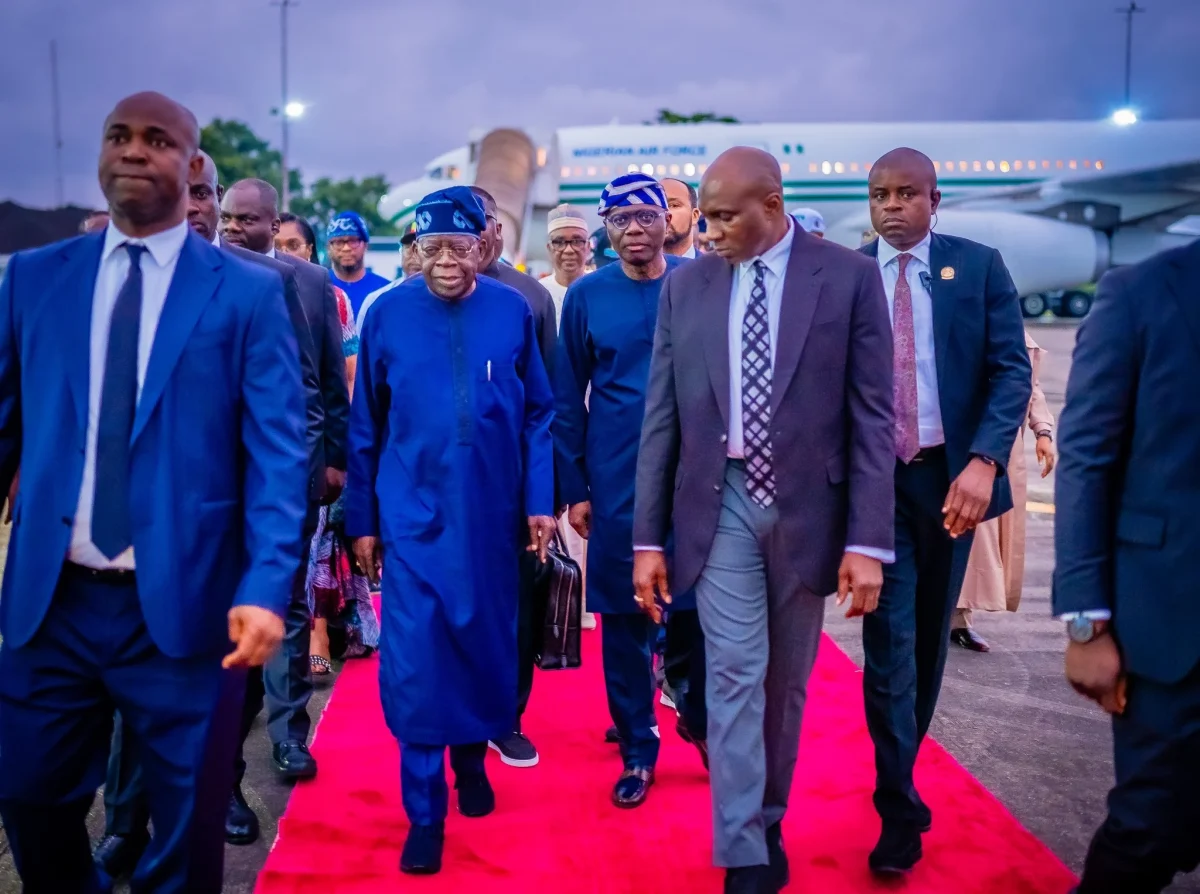
President Bola Tinubu has told members of the All Progressives Congress (APC) Presidential Campaign Council not to expect him to accompany them to every campaign event ahead of the 2027 general election, saying he must remain focused on governance and the country’s economic responsibilities.
Tinubu spoke on Wednesday during the inauguration of the APC Presidential Campaign Council in Abuja, where he urged members to take the party’s message to Nigerians across the states and local government areas while he continues to attend to matters of governance.
The president said he agreed with concerns that the demands of the campaign should not distract him from running the country, adding that Nigeria needs his attention at the moment.
“You’ve warned me not to allow the rigour of the campaign to distract me from governance, I hear you. I am in full agreement with your decision. Nigeria needs more attention now,” Tinubu said.
He told council members to excuse him from accompanying them to every campaign event, noting that his administration has bills to pay and international financial obligations to meet.
“So, you will excuse me from going everywhere with you, we have bills to pay. The American creditors cannot wait,” the President said.
Tinubu also said the government needs to attract investors who would commit to long-term investments in Nigeria and contribute to the future of the country’s children.
“We want those investors to come in, be here to stay, to invest for the future of our children,” he said.
The president, however, assured Nigerians that he would continue to engage them directly even as the campaign council took charge of mobilisation across the country.
“However, I will still make time to speak directly with Nigerians, even as you lead the campaign in the states and local government areas,” he said.
Tinubu described the inauguration of the council as more than a campaign activity, saying it represents a renewed commitment to Nigerians and the responsibilities of the ruling party.
“We have not gathered merely to inaugurate a council. We have gathered to renew a covenant. A covenant with Nigerian people and the historic responsibility they have entrusted to us as Nigeria’s governing party,” he said.
He added that the council is expected to communicate the administration’s vision, achievements and agenda to voters nationwide.
“This council will carry our vision, our records and our agenda to every Nigerian, and it will carry them to victory every ward of this country,” Tinubu said.
The president also commended APC members for completing the party’s congresses, recalling that some had predicted internal crises during the process.
He said the party has overcome the challenges and emerged united, crediting members for participating in the process from the ward level to the national leadership.
“They said there will be implosion. We passed through it. We did not fail. You didn’t let us down. We got here together,” he said.



2 Comments