
Metro
Don’t Destroy My Indian Hemp Farm, Kill Me Instead – Suspect Tells NDLEA


A suspected Indian hemp farmer, Clement Akor, has begged the National Drug Law Enforcement Agency to take his life instead of destroying his 10-hectare cannabis plantation.
Akor, a 42-year-old father of six from Enabo village in the Ankpa Local Government Area of Kogi State, and his accomplice, David Ameh, were arrested by the Kogi State Command of the NDLEA.
Akor, who claimed to have invested so much in the business and could not afford to lose everything, said he learnt dealing in Indian hemp from Owo, Ondo State.
The suspect, who cried profusely and attempted to stop the men of the NDLEA, led by the commander, Alfred Adewumi, from destroying his farm in Oketepe, Okula community, about 10 kilometres from Ejule, said he preferred to die than watch the officers destroy what he worked hard for in the last one year.
He noted that he was aware of the ban on the sale of Indian hemp, but insisted that it was a risky business.
Akor stated, “I am the owner of this farm. I learnt it in Yorubaland. When I cultivated the produce last year, it was stolen. So, this year, I bought the seed from Yorubaland and planted it before I was caught.
“The Indian hemp business is by luck. In this farm, I can get many bags. I do sell one bag for N20,000, depending on the area where I am selling it to. It can be me more. I spent N12,000 on cultivating this farm. It is better for you people to kill me than destroy this farm.”
“This is my business. I spent a lot to allow this plant to grow up to this level. In the next two weeks, I am supposed to harvest it. Now, you people have come here to destroy it. Just kill me so that I won’t see you people destroying what I have laboured for. I am looking for money because I am illiterate. I don’t want to engage in armed robbery or kidnapping, that is why I am into this business of Indian hemp cultivation and sale.”
Adewumi, however, calmed him down but insisted that the war against illicit drug use was on course in the state.
Addressing journalists shortly after the destruction of the farm, Adewumi lamented the increasing wave of cultivation illicit and use of cannabis sativa in the state.
He stated that the two suspects were arrested through intelligent gathering by officers of his command.
The commander noted that the latest breakthrough came three days after the command arrested Endurance Samson and Abah Sunday for alleged possession of 36.2 kilograms of Indian hemp.
Adewumi stated, “What you are seeing today is certainly more than three football fields put together. Just look around that is a huge expanse of cultivated cannabis land. We just left the first farm, which is equally a huge cannabis plantation.
“This is very unfortunate. I am worried about this unfortunate development. I have thought that Kogi State will not descend to this point. As things stand today, it will be self denial to begin to say that Kogi State is not planting cannabis sativa, because the evidence itself suggests the fact that there is high rate of cannabis sativa cultivation in the state.”
He added that the suspects would be charged as soon as investigation was concluded into the case.
The Punch


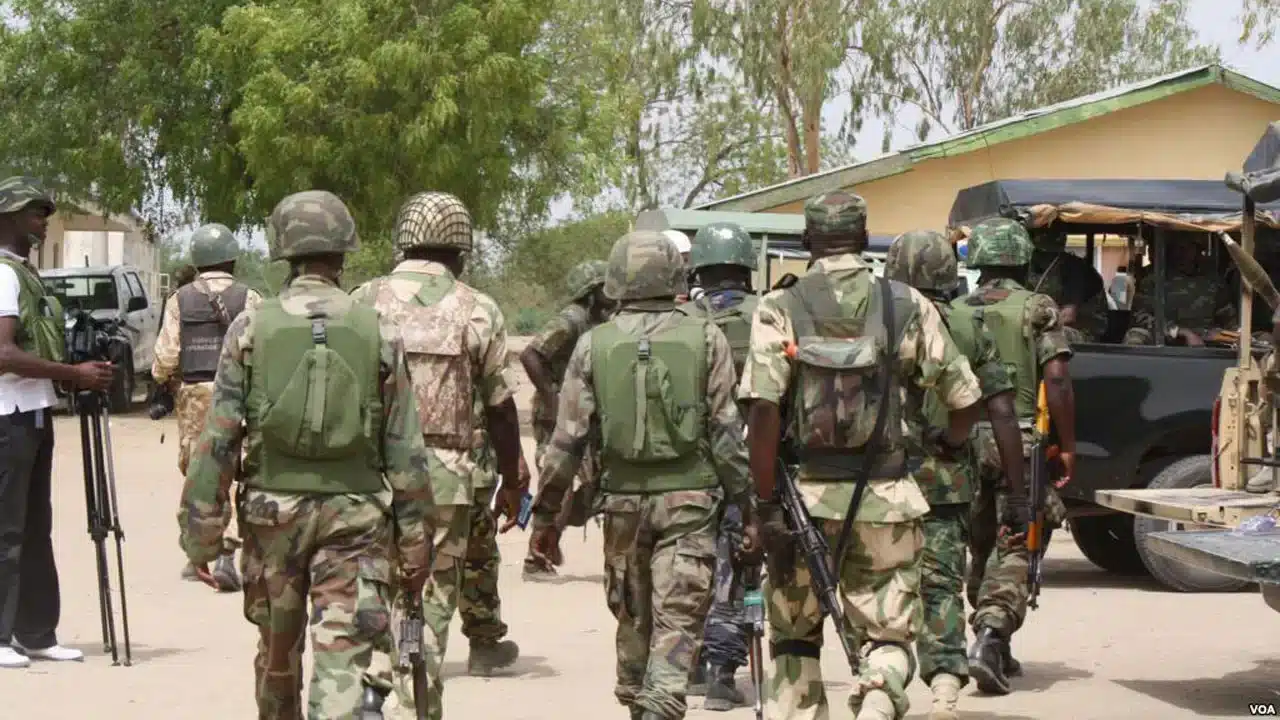
Troops of Operation Hadin Kai have uncovered an underground Boko Haram logistics storage facility stocked with medical supplies, fuel and other critical materials after overrunning several terrorist enclaves in the Timbuktu Triangle area of Borno State.
The discovery followed a series of coordinated, intelligence-led offensives conducted on Sunday across Chilaria, Garin Faruk and Abirma, during which the troops also repelled multiple drone attacks launched by the terrorists.
The Media Information Officer of the Joint Task Force North-East, Operation Hadin Kai, Lt. Col. Uba Sani, disclosed this in a statement issued on Monday.
According to Sani, the operation, carried out under Operation Desert Sanity, resulted in the destruction of several terrorist camps and significantly degraded the logistical and operational capabilities of Boko Haram and ISWAP elements operating in the axis.
“Troops of the Joint Task Force (North-East), Operation HADIN KAI, have recorded further operational successes in the ongoing Operation DESERT SANITY, destroying multiple terrorist camps, recovering arms and equipment, and repelling coordinated attacks by the insurgents in the Timbuktu Triangle,” the statement said.
It added that on Sunday, January 18, 2026, troops advanced from their harbour areas and conducted deliberate, intelligence-driven operations against identified terrorist enclaves in Chilaria, Garin Faruk and Abirma.
Sani explained that the operation was supported by the Air Component of Operation Hadin Kai, which provided persistent Intelligence, Surveillance and Reconnaissance coverage throughout the advance.
He said during the clearance operations, “troops recovered several items of military significance, including Baofeng radios, phones, five AK-47 magazines, several rounds of 7.62 × 39mm special ammunition and 7.62mm NATO belted ammunition.”
Others include “several Boko Haram/ISWAP flags, links of 12.7 × 108 mm ammunition, diesel powered grinding machines, large quantity of medical supplies, several bags of grains, pick-up truck, underground logistics storage and petroleum and oil lubricant dump, which all further degraded the operational and logistical capability of the terrorists.”
He said the “recoveries further degraded the operational and logistical capacity of the terrorists,”.
However, Sani revealed that at about midday, the advancing troops came under armed drone attacks launched by the terrorists.
“Despite this, the troops maintained momentum and continued the offensives. A second drone attack attempted in the evening was also decisively repelled, forcing the terrorists to withdraw and reaffirming the troops’ dominance of the area,” he said.
Sani added that despite sustained engagements, troop morale remains high and fighting efficiency continues to be maintained.
“The general security situation in the area is assessed as calm but unpredictable, with troops remaining vigilant and at a high state of readiness,” he stated.
He concluded that the military high command has reaffirmed its commitment to sustaining the operations, stressing that troops remain resolute in their mission to eliminate terrorist threats, protect civilians and restore lasting peace and stability to the North-East.
The Punch
Metro
FRSC Confirms No Lives Lost in Apapa Fuel Tanker Crash, Advises Residents Against Scooping Fuel

The Federal Road Safety Corps (FRSC) has confirmed a minor lone crash involving a NIPCO truck that occurred in the early hours of Monday on Liverpool Bridge, outward Apapa, saying that no casualties were recorded.
The incident, according to the Public Education Officer, SRC, Damilola Jayeola, occurred at about 0817hrs and was promptly reported and responded to by FRSC operatives. Three adult males were involved in the crash, with no injury or fatality recorded.
Preliminary findings attributed the crash to speeding and reckless driving, despite the road being smooth at the time of the incident.
FRSC operatives, in collaboration with the Nigeria Police Force, Lagos State Traffic Management Authority (LASTMA), the Nigerian Ports Authority (NPA), and the Federal Fire Service, are on ground managing traffic and securing the scene to prevent secondary incidents.
The Lagos State Sector Commander, Corps Commander Kehinde G. Hamzat, has advised members of the public to desist from scooping the spilled fuel and urged motorists to strictly adhere to speed limits and drive responsibly, particularly on bridges and other high-risk corridors, to prevent avoidable crashes.
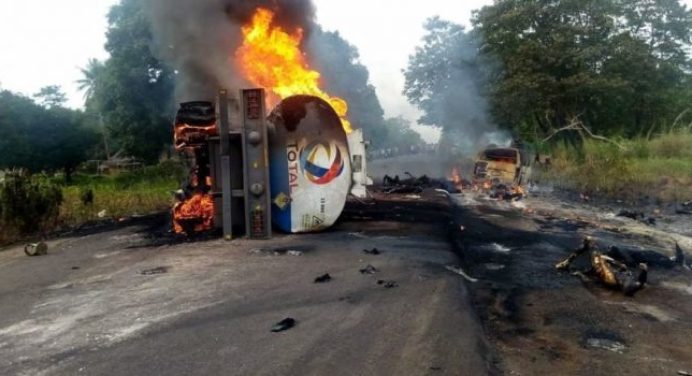
Governor Babajide Sanwo-Olu has described the scooping of fuel by residents at the Apapa Bridge as a “suicide mission,” warning that the Lagos State Government will intensify enforcement to prevent actions capable of triggering mass casualties.
Sanwo-Olu spoke on Monday at the signing of the 2026 Appropriation Bill at the Lagos House, Ikeja, shortly after reports emerged of residents rushing to scoop spilled fuel from a tanker incident at Apapa.
He expressed disappointment at the conduct, stressing that such behaviour places lives at grave risk.
The governor commended the swift intervention of Lagos first responders and the police, who cordoned off the area and brought the situation under control before any explosion or disaster could occur.
He cautioned residents to desist from reckless acts, noting that the State would “leave no stone unturned” in safeguarding lives and property.
Linking the incident to broader issues of indiscipline, Sanwo-Olu said the government would enforce tougher penalties against environmental and safety violations, including indiscriminate dumping of refuse on road medians.
He disclosed that the 2026 budget makes provisions to strengthen the capacity of the Lagos Waste Management Authority (LAWMA) and private sector participants, with plans to expand compactor truck fleets and deploy additional equipment.
“We have instructed LAWMA not only to apprehend offenders but also to ensure they are charged for environmental violations,” the governor said.


