
Business
FirstBank, Rotary Empower 102 Beneficiaries with N20m Start-Up Kits

- /home/rhoncare/pointblank.ng/wp-content/plugins/mvp-social-buttons/mvp-social-buttons.php on line 27
https://pointblank.ng/wp-content/uploads/2019/10/FirstBank_Logo-1-1000x511.jpg&description=FirstBank, Rotary Empower 102 Beneficiaries with N20m Start-Up Kits', 'pinterestShare', 'width=750,height=350'); return false;" title="Pin This Post">
- Share
- Tweet /home/rhoncare/pointblank.ng/wp-content/plugins/mvp-social-buttons/mvp-social-buttons.php on line 69
https://pointblank.ng/wp-content/uploads/2019/10/FirstBank_Logo-1-1000x511.jpg&description=FirstBank, Rotary Empower 102 Beneficiaries with N20m Start-Up Kits', 'pinterestShare', 'width=750,height=350'); return false;" title="Pin This Post">
The First Bank of Nigeria Limited, with Rotary Club International, District 9110, has distributed N20 million worth start-up kits to 102 beneficiaries in Lagos to empower them across various trades.
The News Agency of Nigeria (NAN) reports that start-up kits distributed included: grinding machines, plumbing kits, deep freezers, sewing machines, generators, gas burners and cylinders, barbers and hairdressers kits, among others.
NAN further reports that the community intervention project had beneficiaries from the three major ethnic groups in Nigeria drawn from Lagos, Ogun and Oyo states.
Mrs Helen Ihonre, Unit Head, Other SME Products e-Business and Retail, FirstBank, during the presentation, offered insights on financial management and economic discipline. She emphasised the importance of maintaining records and accessing low-interest loans to support business growth and expansion.
She urged beneficiaries to prioritise saving from the inception of their businesses, while discouraging them from keeping funds at home, which might lead to misuse. “Start saving from the beginning of your business. Don’t wait till you sell then keep the money in your house”, she said.
Rotary District 9110 Governor, Ifeyinwa Ejezie, spoke on the significance of economic empowerment in Rotary’s initiatives and called for government collaboration to reach grassroots communities effectively. She emphasised the role of Rotary in complementing government efforts and stressed the need for recognition and partnership to enhance community development. She added that the N20 million items distributed were the largest the district had done in one empowerment initiative in recent times.
Bukola Bakare, Rotary International District Governor Nominee Designate, explained the process and challenges of raising funds for the project and how they incorporated Rotary from Singapore to absorb shocks from inflation. She said, “everything that has been given here today is free for the beneficiaries”.
She mentioned that FirstBank was a major sponsor for the project, adding that the 102 beneficiaries were chosen based on a needs analysis from Igbos, Hausa and Yorubas resident in Lagos, Ogun and Oyo states.
“FirstBank is our major supporter for this programme” she said.
Mr Babatunde Adewale, Permanent Board Member, Lagos State Universal Basic Education, lauded the empowerment programme, while reeling out contributions and projects of Rotary International to schools in the state. “We really appreciate Rotary and SUBEB will always continue to collaborate with them,” he said.
Mrs Kemi Kalesanwo, Director, Lagos State Agency for Mass Education, said that 22 out of the 102 beneficiaries were from the agency’s vocational training centres. Kalesanwo said that the state government believed in public, private partnership and was happy with the collaboration with Rotary and FirstBank.
She listed projects donated by Rotary to include construction of one of the eight vocational training centres, owned by the agency in Igbogbo area of Lagos. Kalesanwo, therefore, urged other Nigerians to support government programmes.
Otumba Wemmy Osunde, Chairman, Illisan Development Association, Ogun State, pledged personal commitment to ensuring beneficiaries utilise the items for economic gain. Adekunmi Adeniyi, an industrial gas burner and cylinder beneficiary alongside other beneficiaries expressed gratitude to Rotary International and FirstBank for the initiative. He acknowledged the impact on their respective trades and crafts.
Culled from NAN


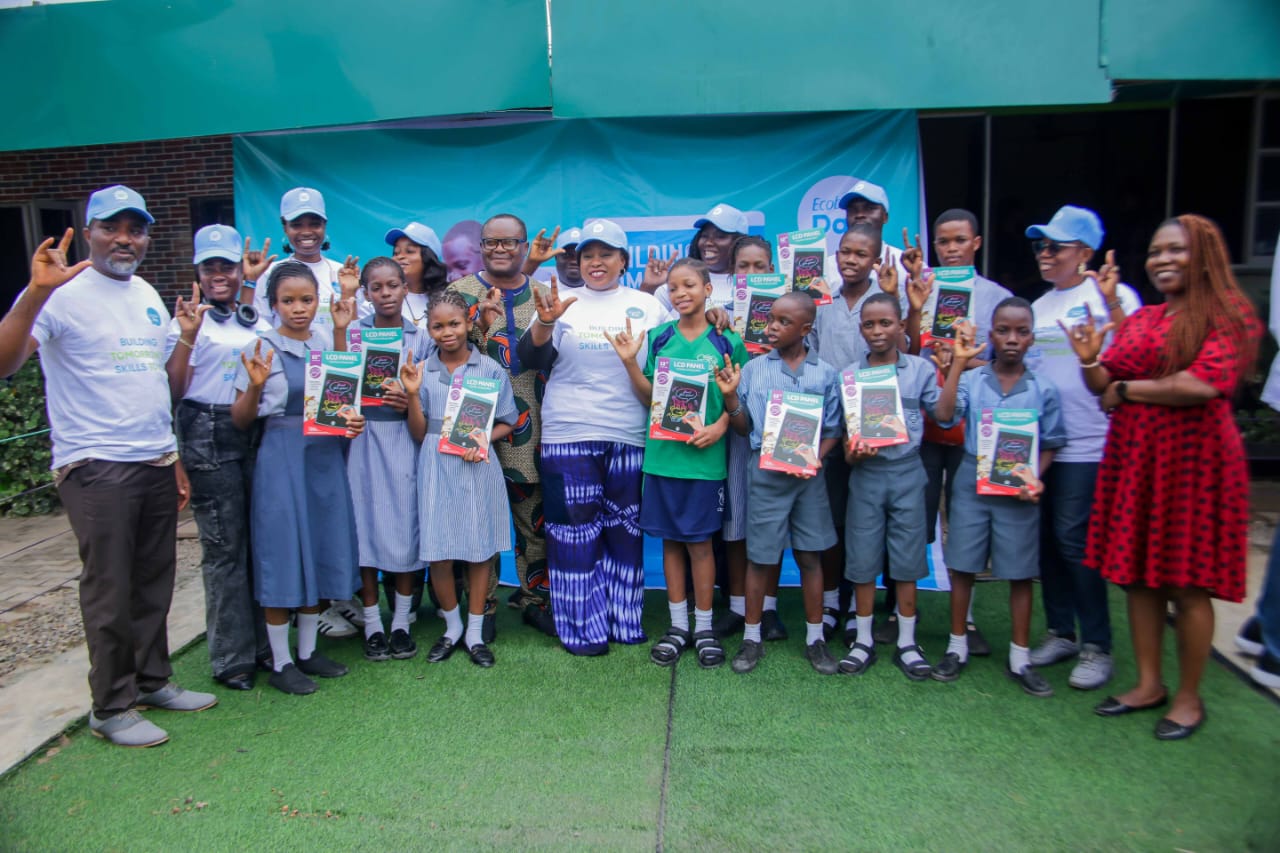
Ecobank Nigeria has commemorated the 14th edition of Ecobank Day, its flagship Group-wide Corporate Social Responsibility (CSR) initiative, across four regions of the country, reaffirming its commitment to empowering communities through education and digital inclusion.
The selected schools include: Hope Fountain Foundation for the Deaf, Agege, Lagos; Ibadan School for the Deaf, Ibadan; Special Secondary School for the Deaf, Odakpu, Onitsha, and Kaduna State Special Education School, Kaduna.
This year’s Ecobank Day was celebrated under the theme, “Digital Education,” with a focus on equipping persons with disabilities and young people with essential digital skills that can enhance their educational, personal, and career development in today’s technology-driven world.
The initiative underscores Ecobank’s commitment to extending its impact beyond banking by helping to equip Africa’s youth with the digital and artificial intelligence (AI) skills required to succeed in the future economy.
As part of the programme, Ecobank employees visited selected schools across the four regions, where they conducted digital literacy sessions and donated learning materials and educational resources to support students’ development and prepare them to thrive in an increasingly digital world.
Speaking during the commemoration, the Managing Director/Regional Executive, Ecobank Nigeria, Bolaji Lawal said: “It is a pleasure to join you today as we commemorate the 14th edition of Ecobank Day, our Group-wide Corporate Social Responsibility initiative dedicated to creating meaningful impact across the communities we serve. “Ecobank Day reflects our commitment to being more than a bank. It demonstrates our dedication to empowering people and contributing to sustainable development across Africa.”
Bolaji noted that digital education has become increasingly important in bridging knowledge gaps and creating opportunities for young people, particularly those living with disabilities, enabling them to participate fully in today’s digital economy.
School proprietors and administrators who participated in the programme commended Ecobank for the initiative, describing it as a timely intervention that will help broaden students’ access to digital knowledge and opportunities.
They expressed appreciation to the Bank for investing in the future of young people and supporting inclusive education within their communities.
For 14 years, Ecobank Day has served as an annual platform for Ecobank employees across Africa to give back to society through impactful volunteer activities that address critical social challenges.
The initiative continues to demonstrate the Bank’s dedication to fostering sustainable development and creating lasting positive change across the communities where it operates.
Fidelity Bank Plc has won two honours at the 2026 BusinessDay Banks and Other Financial Institutions (BAFI) Awards.
The bank’s Managing Director and Chief Executive Officer, Dr Nneka Onyeali-Ikpe, received the Award for Excellence in Banking Leadership, while Fidelity Bank was named Best Bank in Oil and Gas Financing.
The awards were presented at the 14th BAFI Awards held recently at the Civic Centre, Victoria Island, Lagos.
According to BusinessDay Media Limited, the leadership award recognises banking executives who have delivered institutional growth, strengthened shareholder value, promoted innovation and inclusion, and contributed to the development of Nigeria’s financial services sector.
Onyeali-Ikpe thanked the organisers and dedicated the award to Fidelity Bank’s customers, board, management and employees.
“I am deeply honoured to receive the Award for Excellence in Banking Leadership. I sincerely thank BusinessDay Media Limited for this recognition and dedicate it to our valued customers, whose trust and support have strengthened and inspired me throughout my career.
“The African philosophy of Ubuntu teaches us, ‘I am because we are.’ In that spirit, this honour also belongs to the board, management and staff of Fidelity Bank Plc, whose dedication and professionalism continue to drive our vision of a stronger, more innovative and customer-focused financial institution,” she said.
Onyeali-Ikpe has more than three decades of banking experience spanning retail, corporate and commercial banking, treasury and business development. Since becoming the Chief Executive Officer, she has led Fidelity Bank through sustained growth and an expansion of its international operations, including the acquisition of the former Union Bank UK, now FidBank UK Limited.
The Best Bank in Oil and Gas Financing award recognised Fidelity Bank’s support for projects across Nigeria’s energy value chain.
The bank financed the development of an onshore crude oil export terminal at the Otakikpo Marginal Field in Rivers State. It also supported the Pinnacle Oil and Gas Terminal in Lekki and part-financed a 23,000-cubic-metre liquefied petroleum gas carrier for Temile Development Company Limited.
Fidelity Bank also participated in the $3bn SNEPCo Contractor Finance Facility, which provides naira and dollar financing to indigenous contractors working on SNEPCo projects.
The projects are expected to strengthen local participation, petroleum product distribution, gas availability and critical energy infrastructure.
The two awards underscore Fidelity Bank’s growing profile in the financial services industry and its role in financing sectors critical to Nigeria’s economic development.
The United Bank for Africa (UBA) is poised to give five young Nigerians a shot at getting a share of N41million in educational grants towards their university education.
The Bank, through UBA Foundation National Essay Competition (NEC), is the much talked about life changing opportunity and it is back for with the 16th edition, and this year, with even more reason for young writers to put pen to paper and change their lives in the process.
Previously, there was a lot of talk around education not given priority or due reward as against reality shows or ephemeral activities. Now that talk is gone with the wind.
The UBA annual competition is designed to give senior secondary school students across Nigeria a platform to express their ideas, showcase their writing and critical thinking skills, which will see the top five finalists, receive financial support throughout their university education.
Most importantly, the prize pot has just gotten bigger as the first-place winner will receive a N15 million university grant, while the second and third-place winners will receive N10 million and N7.5 million respectively. It gets even more rewarding as the fourth and fifth-place winners – introduced for the first time ever in the competition – will also receive N5 million and N3.5 million each.
Participants will be expected to tackle a question that directly affects Nigeria’s future: “No nation can develop without food security. How can Nigeria deal with this problem?” That means this is a chance not just to write, but to think, question, and propose practical ideas for a challenge that affects everyone.
The opportunity is open to Nigerian every senior secondary school student.
According to a statement made available to this medium, applications close Friday, October 23, 2026.
The essay is expected to be handwritten and in not more than 750 words, with applications submitted through the competition’s digital portal, https://www.ubagroup.com/nec/


