By Eric Elezuo
It was not expected since most arrangements were legit in the body of the pan-Yoruba organisation, Afenifere. Beginning with the official stepping down of the erstwhile leader of the group, Pa Reuben Faroranti in March 2021 and the handing over of the leadership of the group to Chief Ayo Adebanjo, everything seems perfect, and there appeared to be no rancour.
Fasoranti had said during the handover that the development became necessary “as the group needs more than ever before to have an improved organisation with more effective approach to combat the monstrous invasion of our culture and pride as a people.
“Only a more alike and active leadership can achieve this. At 95, I am hardly able to provide such and so, it is time for me to step aside.
“At this junction, I am proud to announce Chief Ayo Adebanjo, a politician of the Awolowo school of thought as acting leader of Afenifere and His Royal Highness, Oba Oladipo Olaitan, the Alaago of Kajola Ago in Atakumosa East Local Government Area, as the Deputy Leader.”
The fragile peace was however, to be destabilised following the endorsement of the Labour Party candidate in the 2023 presidential election, Mr. Peter Obi by the pan-Yoruba. While it was believed that the endorsement received the support of the members of the group, or at least a majority, the visit of the presidential candidate of the ruling All Progressives Congress (APC), Asiwaju Bola Tinubu, to Fasoranti in his Akure residence proved otherwise.
Justifying the group’s endorsement of Peter Obi, Adebanjo revealed during a press conference in Lagos that the group would not compromise the principle of justice, equity and inclusiveness because Tinubu is a Yoruba man.
“The South-West has produced a President and currently sits as Vice President; the South-South has spent a total of six years in the Presidency, but the Igbo people of the South-East have never tasted presidency in Nigeria, and now that the power is due back in the South, equity demands that it be ceded to the Igbo.
“We cannot continue to demand that the Igbo people remain in Nigeria while we, at the same time, continue to brutally marginalise and exclude them from the power dynamics.
“Peter Obi is the person of Igbo extraction that Afenifere has decided to support and back; he is the man we trust to restructure the country back to federalism on the assumption of office.
“We will not compromise this principle of justice, equity and inclusiveness because one of our own, Asiwaju Bola Tinubu, is a frontline candidate. It is on this same principle we condemn the Peoples Democratic Party for sponsoring Atiku Abubakar, a Northern Fulani Muslim to succeed General Muhammadu Buhari another Fulani Muslim,” Adebanjo said.
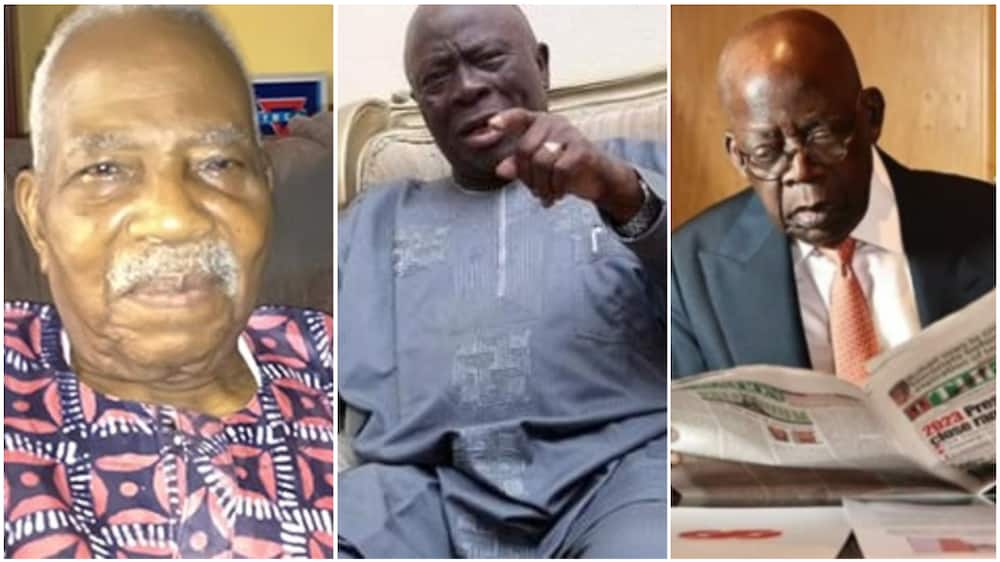
Rather than accepting the decision of the Afenifere, Tinubu and his campaign organisation derided Adebanjo, saying he did speak for the Yoruba. Tinuba was to collect a harmful of Yoruba leaders and supporters, and visited the now retired Pa Fasoranti. To the shock of everyone, Fasoranti blessed Tinubu, and declared him endorsed by Afenifere. He later claimed that he was still the leader of Afenifere, and never resigned as Adebanjo claimed. His claims created a wide in the relative peace hitherto enjoyed by group.
Speaking to The Boss on the ensuing crisis as the two leaders engaged each other in a war of words, a political commentator, who craved anonymity said he was not surprised at the outcome of the whole thing. He said he knew Tinubu was not going to give up even as he knew the position of Afenifere.
“He is not the type to give up without causing a ruckus. He knew as a strategist that the only he could have a chance was to create holes in the Afenifere, and divide it, if possible into tiny bits. That is his stock and trade. If he can’t have it; he will destroy. That is just just typical Tinubu. Just look at the Yoruba Nation Movement; that is his next port of call,” he said.
Much as it was a known fact that leaders of the group held divergent opinions about the way forward in the current political dispensation, their disagreement has remained muffled till Tinubu’s visit to Akure, Ondo State.
“It was not just a visit; it was a masterstroke meant to destabilise the fragile Afenifere unity. And Tinubu and his group quite achieved their aim. Today, Afenifere is in disarray, and that is the basic intention,” the source added.
While Adebanjo has argued that a Tinubu presidency was not in the interest of peace and equity in Nigeria, Fasoranti and his camp gave said that a Tinubu presidency would “usher in a new era of hope, peace, security, harmony, gainful employment for the multitude, economic development, social and political stability,” according a statement by the National Organising Secretary, Abagun Kole Omololu
As the brouhaha lingers, Fasoranti was to appear in a televised interview by Impact TV Africa, stating categorically that he neither resigned nor retired as the leader of Afenifere. A statemnet Adebabnjo objected to, and said he was disappointment.
Stressing that he was still the leader of Afenifere at 96, Fasoranti said “I didn’t resign or retire from leadership. I was misunderstood. I think the best thing is to correct that,” he said
He added, “As you can see, the trend, the approval and the acceptability. You could see what happened when Tinubu came to meet me in Akure. The media carried the whole thing.
“Adebanjo does not have the capacity to warn me not to welcome Tinubu. Can he do that successfully?
“What happened was that Adebanjo took a stand and I took a stand. I didn’t call him and he didn’t call me. We never spoke about the visit.
“As you saw yesterday, it goes without saying that Jagaban was accepted. Obi has no stand in our mind at all.”
In response, Adebanjo, who was not at the meeting in Akure, said he was not ready to enter into any controversy over the decision taken at the meeting.
“In the first place, I was not supposed to be there. In the second place, we have made our position clear. Pa Fasoranti asked me if I was coming, I said if he asked me to come, but (I asked him to) tell him (Tinubu) what the position of Afenifere is. Once he has done that, I’m not going into any controversy about that.
“Afenifere has taken a stance to support Obi. Any other splinter or rebel group…I’m not going into any controversy about that. I regard that as a diversion. What we are going to do now is see that we succeed at the election.”
In the wake of the visit, Fasoranti is claiming that never retired, but still the leader of Afenifere and Adebanjo’s position as acting leader is no longer tenable, while Adebanjo is maintaining that he remains the leader as Fasoranti has retired owing to old age, and therefore has no the power to remove him as he was just an ordinary member of the organisation.
“He has no right, constitutionally or otherwise, to do so. He’s functus officio (no longer in office.) He has resigned and is just an ordinary member of the party.
“Once he has handed over to me, I am the de facto leader of Afenifere. I won’t make it a controversy at all. Let him test his position wherever.
“Where does he derive his authority? Is Afenifere a monarchy? It’s a pity that in his old age he’s being led astray.
“Have you heard of somebody who is out of a process now saying he’s coming back again? It’s a pity he’s making himself a laughing stock,” Adebanjo said.
Again, Fasoranti hinted that the meetings of the group will return to Akure once he converses with the secretary, as meetings are always held at the leader’s country home. Prior to now, meetings were held at Ogbo, Ijebu Ode, Ogun State.
“Yes, that’s the best. The reason the meeting was shifted from here was a misunderstanding, misinterpretation and misconception of some people that I was going senile and that I couldn’t comprehend. So, when I heard that, I reacted and the person who said that regretted saying so. So, no problem,” Fasoranti said.
In response, a livid Adbanjo retorted that “He has no right to say anything about Afenifere, he has resigned. All the powers and authorities of Afenifere have been vested in me. That’s what I’m saying. I’ve never heard of where somebody who resigned from a political party said he was coming back again.”
But in all these, stakeholders have wondered why Afenifere was able to manage its affairs successfully until Tinubu came into the picture. The group, formed as a socio-cultural organization for the Yoruba people of Nigeria, with Chief Abraham Adesanya as its leader and Chief Bola Ige as deputy leader has other founding members as Pa Onasanya, Chief Reuben Fasoranti, Adegbonmire, Okurounmu Femi, Ganiyu Dawodu, Olanihun Ajayi, Olu Falae, Adebayo Adefarati, Alhaji Adeyemo and Ayo Adebanjo. The Alliance for Democracy (AD), formed in 1998, took the Afenifere agenda as its official manifesto.
Cracks appeared on the walls of the group following a poor performance of AD in the April 2003 elections, and there arose a faction, which elected Adebisi Akande was chairman. The crisis degenerated, and in January 2006, the convoy of AD leaders who supported Chief Mojisoluwa Akinfenwa as the party’s national chairman was attacked by thugs in Osogbo, Osun State.
Shortly after, Tinubu pulled out of AD and formed the Action Congress of Nigeria with Akande. This was a move the Adebanjo group considered as a betrayal. Henceforth, the AD died a natural death while Tinubu’s ACN continued to strive across Yorubaland. There is therefore, no love lost between the Adebanjo camp and the Tinubu camp.
“The betrayal of Tinubu against the group remains the bad blood flowing between the two camps till today, and explains why Adebanjo is not interested in the Tinubu presidency. The visit to Akure by Tinubu, however he managed to convince Fasoranti to receive him including the endorsement of Peter Obi are chapters derived from the script of 2003,” another source told The Boss
He added, “Tinubu left Afenifere long ago, and his reappearance today is just to destroy, or at the least divide the group,” he added.