
Headlines
Mamman Daura’s Daughter’s Release of Clip at this Time is Mischievous, Didn’t Share Video Where She Abused the First Lady, Aisha Buhari – Presidency Source

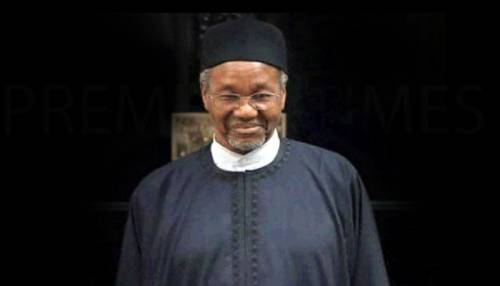
A source within the Presidency has debunked claims made by Fatima, daughter of Mamman Daura who is one of President Buhari’s closest allies on being attacked by First Lady, Aisha Buhari at the Aso Villa, The Nation reports.
Recall that in an interview with BBC, Fatima denied report of her father arranging a second wife for President Buhari. She also denied claims that her dad is allegedly the head of ”a cabal” which controls the Buhari presidency (Aisha Buhari had in the past alleged that some persons have taken control of her husband’s government).
Fatima also revealed that she recorded the viral video of Aisha Buhari screaming at some persons in the Villa in 2017. According to her, she recorded the video to prove that the First Lady was violent to her and her family members after President Buhari asked them to vacate an apartment they were given in the villa after he assumed office in 2015.
However The Nation reported that a Presidential source debunked the claim, alleging that Mamman Daura’s daughter failed to tell the full story on why they were asked to vacate the apartment.
According to the source, the apartment was needed for the then recuperating Yusuf after his Power Bike accident.
She said: “By now the airwaves are awash with Fatima, Mamman Daura’s daughter, consenting to the fact that she indeed shot and leaked the now infamous video clip which showed the wife of the president in a very angry mood.
“The incident happened over a year ago when the wife of the president, on the instructions of the president, asked the Dauras to vacate their living quarters inside the Villa for a sick Yusuf Buhari who was recuperating after an accident.
“For this reason, the quarters were needed and the Dauras were asked to move to another part of the Villa. Long before the accident, Yusuf’s mother had requested in writing for the Dauras to vacate the place because the building is officially designated for the biological children of any serving president.
“The IG of police, DG DSS, NSA and the vice president who was the acting president, were all notified of this request. Despite this, the Dauras deliberately refused to comply with the instructions of the security agencies. Mamman Daura’s daughter, Fatima, did not say this in her interview.
“What really was the intent for the video being released now if not for mischief? Fatima didn’t showcase her part in the drama where the door was locked against the first lady to deny her access to some areas of the Villa, neither did she acknowledge the abuse she first vented before the first lady reacted under the instruction of DG Lawal Daura, who was brought into government by Mamman Daura.”
Source: LIB



World-renowned boxer Anthony Joshua on Monday survived a ghastly road accident in Makun, Ogun State.
Eyewitnesses report that the incident occurred along a busy highway of the Lagos-Ibadan expressway.
The vehicle carrying Joshua, a Lexus Jeep with the number plate, KRD 850 HN, reportedly collided with a stationary truck under circumstances that are still being investigated.
Joshua reportedly sustained minor injuries, while two persons were said to have died on the spot.
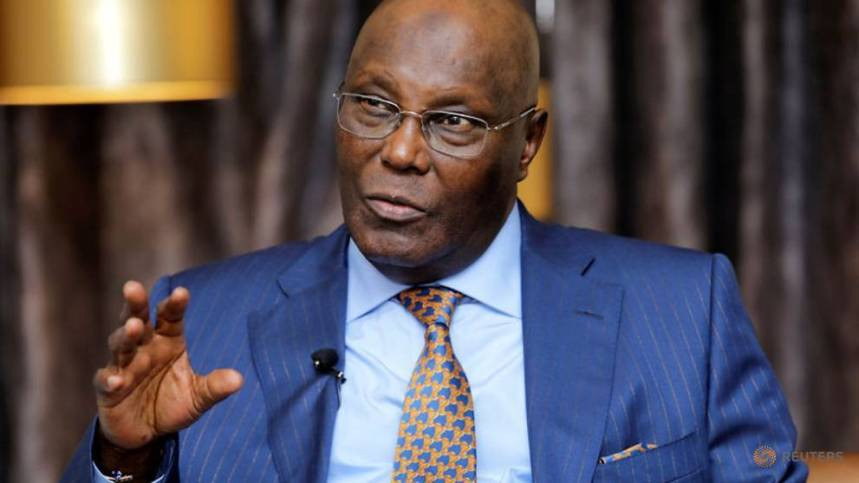
Former Vice President Atiku Abubakar has cautioned that any attempt to hurriedly re‑gazette Nigeria’s new tax laws could undermine parliamentary oversight and set a dangerous constitutional precedent.
Atiku’s warning follows public scrutiny over reports that the Tax Reform Acts signed by President Bola Tinubu differ from the versions passed by the National Assembly. Lawmakers, including Abdussamad Dasuki, raised concerns that the alterations could pose serious legal and constitutional risks, noting that they were not backed by any constitutional framework.
In a statement on X, Atiku said the directive to re-gazette the Acts effectively confirms “that the gazetted version of the Tinubu Tax Act does not reflect what was duly passed by the National Assembly,” calling it “a grave constitutional issue.”
He emphasized that under Section 58 of the 1999 Constitution, a bill only becomes law after passage by both chambers, presidential assent, and gazetting.
“Gazetting is merely an administrative act of publication. It does not create, amend, or validate a law,” Atiku said, adding that any post-passage insertion, deletion, or modification without legislative approval constitutes forgery rather than a clerical error.
Atiku further warned that rushing a re-gazetting while legislative investigations are ongoing “undermines parliamentary oversight and sets a dangerous precedent,” stressing that the only lawful approach is “fresh legislative consideration, re-passage by both chambers, fresh presidential assent, and proper gazetting.”
The former vice president clarified that his position is not opposition to tax reform but a defence of constitutional order.
“This is a defence of the integrity of the legislative process and a rejection of any attempt to normalise constitutional breaches through procedural shortcuts,” he said.
The Federal government has denied wrongdoing, insisting the laws will take effect as scheduled on January 1, 2026, while the National Assembly has directed the issuance of Certified True Copies of the Acts to ensure clarity and accuracy.
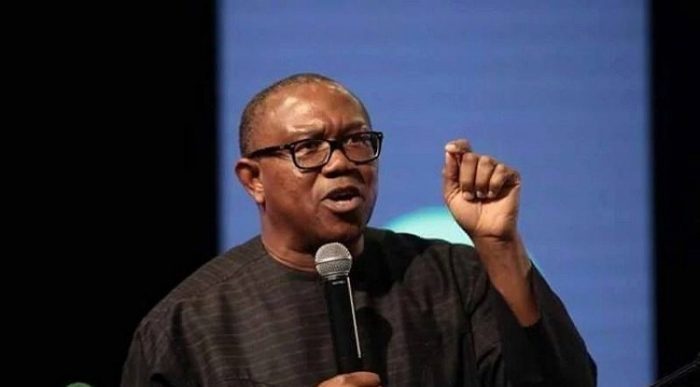
Barring unforeseen circumstances, the Labour Party (LP) Presidential Candidate in the 2023 elections, Mr. Peter Obi, is set to formally join the African Democratic Congress (ADC) on December 31, 2025.
The development would put to rest months of speculation about where the former Governor of Anambra State would pitch his tent in the coming elections.
Reports claim that Obi would be defecting with serving senators and other lawmakers elected on the platform of the LP, as well as remnants of the Peoples’ Democratic Party (PDP) in the South East region.
Specifically, Obi would be defecting alongside the Senator representing Anambra Central, Victor Umeh; that of Anambra North, Tony Nwoye; Abia South, Enyinnaya Abaribe; PDP chieftain Ben Obi; and members of the Obidient movement in the region.
It is not clear if the Abia State governor, Alex Otti, is part of the planned movement to the ADC.
The governor was recently approached by the PDP to join the party and re-contest his current position in 2027.
Further reports quoted Obi’s spokesperson, Valentine Obienyem, as confirming the planned defection of his boss to the ADC.
“Yes, it is true,” he reportedly said on Sunday.
Senator Umeh said the event would hold in Enugu, adding that it would involve all Obi’s supporters across the South East region.
“They will come from Abia, Anambra, Ebonyi and Imo states to join those in Enugu, where this exercise will hold on 31st December,” he reportedly added.
Sources hinted that Obi, who has not hidden his intention to appear on the ballot in 2027, would contest the presidential ticket of the ADC.
On his part, Chief Chekwas Okorie, reportedly said that the expected formal defection of Obi to the ADC is a healthy development that could reshape the thinking and permutations of the 2027 general elections.
“I imagine that he would be defecting along with most of his associates and followers. I believe that a fortified and strong ADC will add value to the opposition and assuage the general fear of a possible one-party option to Nigerians come 2027. The APC, ADC and possibly the PDP locking horns in the 2027 democratic encounter promises a vibrant and robust electioneering campaign that will provide Nigerians the required options to make informed choices in electing their preferred leaders at all levels. I imagine that the APC leadership will return to the drawing table to map out the strategy to confront the emerging challenge. Nigerians are in interesting times,” Okorie stated.
National President of Njiko Igbo Forum (NIF), Rev Okechukwu Obioha, vouched support for Obi to ensure he reaches the pinnacle of his political career. He, however, cautioned that the ADC should not compromise merit and integrity in the choice of its presidential candidate, stressing that Obi remains the “hope for the restoration of the country on the path of greatness.”


