
Business
Nigeria Makes List of Four Top World Bank Debtors


Rising debt has pushed Nigeria up the World Bank’s top 10 International Development Association borrowers’ list.
The World Bank Fiscal Year 2021 audited financial statements, known as the IDA financial statement, showed that Nigeria was rated fifth on the list with $11.7bn IDA debt stock as of June 30, 2021.
However, the newly released World Bank Fiscal Year 2022 audited financial statements for IDA showed that Nigeria has moved to the fourth position on the list, with $13bn IDA debt stock as of June 30, 2022.
This shows that Nigeria accumulated about $1.3bn IDA debt within a fiscal year, with the country taking over the fourth top debtor position from Vietnam.
This debt is different from the outstanding loan of $486m from World Bank’s International Bank for Reconstruction and Development.
The top five countries on the list slightly reduced their IDA debt stock except Nigeria.
India, which is still the first on the list reduced its IDA debt stock from $22bn in the previous fiscal year to $19.7bn, followed by Bangladesh from $18.1bn to $18bn.
It is followed by Pakistan which cut its debt from $16.4bn to $15.8bn, and lastly, Vietnam, which went down the list to fifth position, from $14.1bn to $12.9bn.
Nigeria has the highest IDA debt in Africa, as the top three IDA borrowers (India, Bangladesh and Pakistan) are from Asia. The World Bank disclosed recently that Nigeria’s debt, which may be considered sustainable for now, is vulnerable and costly.
The bank said, “Nigeria’s debt remains sustainable, albeit vulnerable and costly, especially due to large and growing financing from the Central Bank of Nigeria.”
However, the Washington-based global financial institution added that the country’s debt was also at risk of becoming unsustainable in the event of macro-fiscal shocks.
The bank further expressed concerns over the nation’s cost of debt servicing, which according to it, disrupted public investments and critical service delivery spending.
Economists have also raised concerns over the rising debt profile of the Federal Government.
The Fiscal Policy Partner and Africa Tax Leader of PwC, Mr Taiwo Oyedele, expressed his agreement with the World Bank on the high cost of debt servicing.
He said, “I agree with the World Bank. Although the debt to GDP ratio is not too high, if you think about the debt service cost to revenue ratio, it is already over 70 per cent. That’s when you know it’s costly.
“Nigeria borrows at double-digit, and even when we borrow in dollars, the rates are very high and then you devalue the naira and the cost of servicing the debt in naira goes up because it is dollar-dominated debt.
“Put all of that together, and you can easily say to yourself that even though our debt to GDP ratio is very low, our cost of borrowing is unsustainable because it is very high, and therefore, make it very costly.”
A former Deputy Governor of the Central Bank of Nigeria and former presidential candidate, Kingsley Moghalu, also criticised the increasing borrowing tendency of the government, urging the officials to re-consider other ways of generating revenue for the country.
According to Moghalu, it was also not reasonable to borrow for infrastructural development as the government could expand the public-private partnership options for such development.
In a document by the Director General of the Debt Management Office, Patience Oniha, recently obtained by our correspondent, the DMO stated that high debt levels would often lead to high debt services and affect investments in infrastructure.
According to the DMO DG, “High debt levels lead to heavy debt service which reduces resources available for investment in infrastructure and key sectors of the economy.”
The Punch


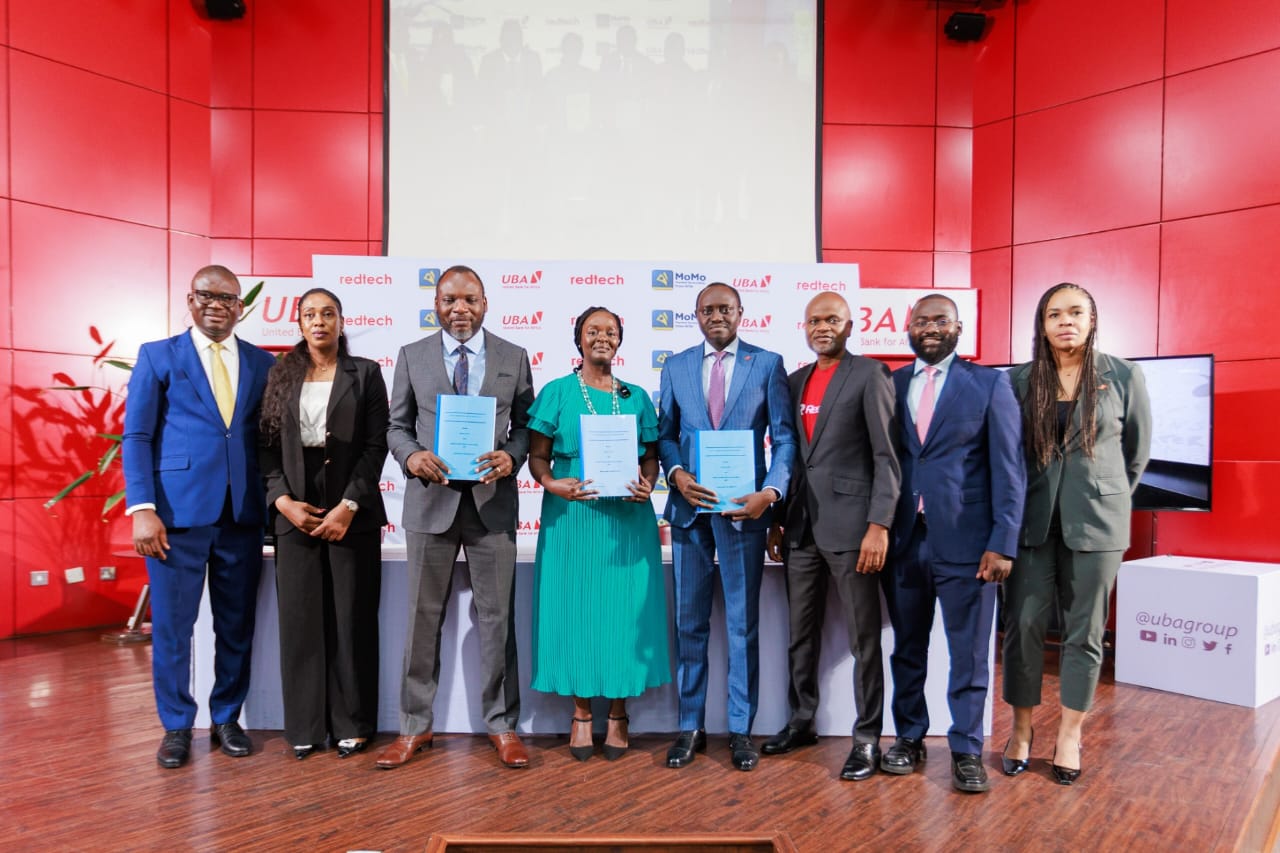
United Bank for Africa (UBA), Redtech, and MoMo PSB have launched a payment interoperability partnership that expands cardless payment access for consumers and merchants across Nigeria. Redtech is backed by Heirs Holdings; MoMo PSB is MTN Nigeria’s fintech subsidiary.
With this development, MoMo PSB customers can now make payments directly from their MoMo wallets at participating UBA merchant locations using the “Pay with MoMo” feature on RedPay POS terminals; they can also visit any UBA branch to make withdrawals and deposits from and into their MoMo accounts. For online shoppers, e-commerce merchants can now receive payments directly from MoMo PSB customers through Redtech’s payment gateway infrastructure.
The partnership brings together Redtech’s payment technology and enablement capabilities, UBA’s merchant-acquiring and distribution layer, and MoMo PSB’s mobile money wallet ecosystem and customer base. Redtech holds licences as a Payment Terminal Service Provider (PTSP) and Payment Solution Service Provider (PSSP) from the Central Bank of Nigeria, authorising it to provide both POS and payment gateway services. Together, the three organisations are addressing a critical gap in Nigeria’s payments market – connecting banking-led merchant acceptance with telco-led mobile money wallets.
For MoMo PSB customers, Pay with MoMo increases the number of places where their wallets can be used for everyday payments. In the case of merchants, it opens access to a wider pool of customers and provides an additional payment option at the point of sale.
UBA’s Head, Digital Banking, Kayode Olubiyi, who spoke during the launch, noted that this partnership represents the solution to the gap identified in cash transactions and card access.
“What this partnership represents is an honest and effective answer to the gap we identified in cash transactions and card access. Our merchants are already serving millions of customers every day through the UBA network. By bringing Pay with MoMo into that network, we are giving those merchants a direct connection to MoMo PSB’s customer base – and giving MoMo PSB customers more places to use their wallets when they shop. That is a clear win for both sides.”
Redtech’s Chief Executive Officer, Emmanuel Ojo, emphasised that the partnership aims to make payments work better together in a way that is practical for everyday commerce.
“This partnership is about making payments work more seamlessly for everyday commerce and most importantly, It aligns with Africapitalism, as championed by the Chairman of Heirs Holdings, Tony Elumelu, CFR. By integrating our RedPay technology with MoMo PSB’s wallets through the UBA network, we will offer merchants and customers greater choice. Our goal is to build the payment infrastructure that ensures a merchant never has to turn away any customer in Nigeria or across Africa because of their preferred payment method. By connecting our technology with MoMo PSB’s wallets through the UBA network, we are giving merchants and customers more options”
Ag. CEO, MoMo PSB, Omolara Michael-Nwadu, who highlighted the barriers to payment in the country, emphasised the importance of partnerships, explaining how integrating MoMo wallets into UBA’s merchant network through Redtech’s infrastructure will unlock additional merchant touchpoints.
“This partnership marks a significant step toward true interoperability in Nigeria’s payments ecosystem. By integrating MoMo wallets into UBA’s merchant network through Redtech’s infrastructure, we are removing barriers between bank-led and mobile money systems while unlocking access to over 55,000 merchant touchpoints. Our focus is on driving usage at scale, enabling more transactions, deeper engagement, and greater value for merchants. At MoMo PSB, we are building a more connected financial ecosystem where payments aren’t tied to platforms but to a seamless customer experience. At MoMo PSB, our focus is on simplifying payments, expanding access to financial services and helping more Nigerians do more every day. Pay with MoMo gives our customers more places to use their wallets, while supporting broader financial inclusion by bringing useful financial services closer to where people live, work and do business.”
UBA’s Group Head, Brands, Marketing and Corporate Communications, Alero Ladipo, captured the broader significance of the moment at the signing ceremony. “Every institution in this room is a giant in its own right. What makes today meaningful is the decision to come together anyway,” she said. Ladipo added, “Financial inclusion is not a slogan to us at UBA. It is a commitment that requires scale, technology, and the willingness to build ecosystems rather than silos. This partnership is that commitment made concrete.”
Pay with MoMo is being introduced through RedPay POS terminals already deployed within UBA’s merchant network. More than 55,000 RedPay POS terminals have been deployed across the network, with the platform having processed over ₦278.47 billion in transaction value and more than 12.23 million transactions to date.
Starting in Nigeria, Pay with MoMo is now live at participating UBA merchant locations, with plans to extend the rollout to selected African markets where both MoMo PSB and UBA operate.

As part of efforts to promote SMEs and strengthen support for operators in the informal sector, Unity Bank has continued to empower small-scale traders and shop owners across Nigeria through its initiative called Shop Collateralised Facility, SHOCOF.
SHOCOF is an innovative loan product, and Unity Bank has disbursed over N500 million to beneficiaries, significantly improving access to financing, and further driving financial inclusion.
Originally introduced as a targeted intervention for traders in Southeast Nigeria, SHOCOF quickly gained traction and broad acceptance for its flexibility and tailored structure, prompting the Bank to expand the product nationwide.
Under the initiative, eligible customers can use their shops as collateral to access financing. The product simplifies access to credit by leveraging the commercial value and stability associated with fixed business locations, enabling traders to secure funds without the stringent collateral requirements associated with traditional lending structures.
The facility provides working capital support that enables beneficiaries to restock goods, increase inventory turnover, improve cash flow, and respond more effectively to market demand.
Recent reports indicate that more than 80 per cent of Nigeria’s small businesses operate informally, with many relying on personal savings and informal borrowing channels due to limited access to Bank credit. SHOCOF was developed to bridge this gap through a lending model tailored to the realities of market traders and small shop owners.
Speaking on the impact of the product, the Group Head, Risk Management, Unity Bank, Olusegun Oladipo, said the Bank recognised the need for financing solutions aligned with the realities of informal sector businesses.
“SHOCOF was created to address a critical gap within the small business ecosystem by providing access to credit through a structure that traders can satisfactorily meet without much ado,” Oladipo said.
He added: “By recognising the value and stability embedded in their businesses, we have been able to support traders with the capital required to sustain and grow their operations.”
Also commenting, Divisional Head, SME & Retail Banking, Unity Bank, Adenike Abimbola, said the nationwide adoption of the product reflects proper market segmentation to meet the growing demand for accessible financing among small business owners.
“What started as a targeted intervention in the Southeast, which quickly gained momentum because the product directly addressed the realities of everyday traders,” Abimbola said.
Over the years, Unity Bank has continued to introduce targeted solutions aimed at empowering entrepreneurs, including its flagship Yanga account package developed to support female entrepreneurs.
The Bank reaffirmed that expanding access to capital for underserved business segments remains critical to boosting trade, strengthening local economies, and driving sustainable economic growth.
Access Holdings Plc has reaffirmed its commitment to longterm shareholder value and sustainable returns, following a strong performance in the 2025 financial year, while providing clarity on the rationale for the nonpayment of dividends for the year ended December 31, 2025.
The clarification was provided during the Group’s Full Year 2025 Investors and Earnings Call, where management addressed shareholder concerns regarding the absence of a dividend declaration despite the Group’s robust earnings growth and balancesheet expansion.
Access Holdings emphasised that the non-payment of dividend for the 2025 financial year was not performance driven, but reflected prudential regulatory alignment matters which required resolution before dividend payments could be effected.
Commenting on the matter, Innocent C. Ike, Group Managing Director/Chief Executive Officer, Access Holdings Plc, said: “Access Holdings has a strong history of consistent dividend payments, and rewarding shareholders remains a core priority for the Board and Management. The nonpayment of dividend for 2025 was not due to earnings weakness or cash flow constraints, but an alignment with regulatory and prudential guidelines.”
For the 2025 financial year, Access Holdings delivered a resilient and diversified performance, underscoring its capacity to generate sustainable shareholder returns. Gross earnings grew by 13.3 percent to ₦5.53 trillion, supported by strong growth in net interest income and a 40.9 percent increase in fees and commissions to ₦585.07 billion. Profit before tax increased by 16.2 percent to ₦1.01 trillion, crossing the ₦1 trillion mark for the first time in the Group’s history.
Total assets expanded by 24.2 percent to ₦51.56 trillion, reflecting scale accretion and the successful integration of recently acquired subsidiaries. The Group’s costtoincome ratio improved significantly from 56.7 percent to 51.7 percent, driven by disciplined cost management and operating leverage. Capital adequacy remained strong at 18.2 percent at the holding company level, while the banking subsidiary ended the year with a capital adequacy ratio of 20.2 percent.
“Our performance in 2025 demonstrates the strength of the franchise and its capacity to generate value for shareholders. Our focus is to ensure that shareholder distributions resume on a sustainable basis once all regulatory conditions are satisfied and the required approvals are obtained,” Ike added.
Access Holdings explained that while dividends were recommended at both halfyear and fullyear in 2025, regulatory approvals were not obtained. At the halfyear stage, the constraint related to Section 7.1 of the CBN Guidelines for Financial Holding Companies, which has since been fully resolved following the successful completion of an approved private placement.
At fullyear, an additional matter arose under Section 19(8)(c) of BOFIA, which places limits on investments in foreign banking subsidiaries relative to shareholders’ funds. The Group has been granted a twelvemonth window to fully remediate this position. The Group noted it will partially divest from some banking subsidiaries but will still retain its super majority shareholding.
According to Ike, maintaining the confidence of our regulators, depositors and stakeholders is fundamental to our operating philosophy. In line with our long-standing culture of prudence and sound governance, the Board remains committed to balance sheet strength and capital resilience, as the basis for sustainable shareholder distributions.”
The Group reassured stakeholders that it remains committed to engaging constructively with all relevant stakeholders to address the matters raised and achieve alignment with applicable requirements within the stipulated timeline. As discussions progress, the Group will continue to provide timely disclosures and transparent updates to the market and investors.
Access Holdings Plc is also strengthening its capital and liquidity buffers to support the sustainable resumption of dividend payments, subject to the fulfillment of the required conditions and approvals.
Reaffirming management’s confidence, Ike stated: “We remain actively engaged with the investment community and focused on resolving the matters raised within the prescribed timeline. Our priority remains delivering sustainable long-term value to shareholders through stronger execution, improved financial performance and disciplined growth. Subject to the successful conclusion of this process and the necessary approvals, our objective is to restore dividend payments on a sustainable basis.”
Concluding, Ike said: “Access Holdings is uniquely positioned to leverage its scale, geographic diversification and strong franchise to deliver resilient earnings growth, stronger returns and enhanced long-term shareholder value.”


