
Headlines
Nigeria’s U-17 Female Team Eliminates USA, Qualifies for Semi-Finals

- /home/rhoncare/pointblank.ng/wp-content/plugins/mvp-social-buttons/mvp-social-buttons.php on line 27
https://pointblank.ng/wp-content/uploads/2019/06/Falcons.jpg&description=Nigeria’s U-17 Female Team Eliminates USA, Qualifies for Semi-Finals', 'pinterestShare', 'width=750,height=350'); return false;" title="Pin This Post">
- Share
- Tweet /home/rhoncare/pointblank.ng/wp-content/plugins/mvp-social-buttons/mvp-social-buttons.php on line 69
https://pointblank.ng/wp-content/uploads/2019/06/Falcons.jpg&description=Nigeria’s U-17 Female Team Eliminates USA, Qualifies for Semi-Finals', 'pinterestShare', 'width=750,height=350'); return false;" title="Pin This Post">
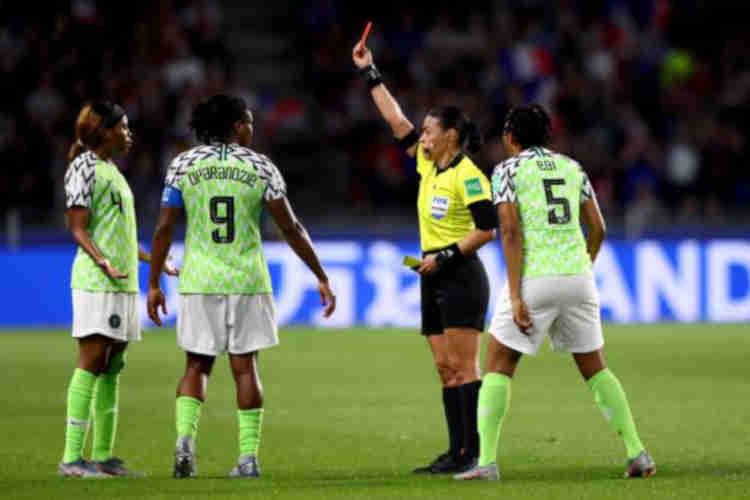
Nigeria’s U-17 women’s national team, the Flamingos, beat USA side in the quarter-finals of the ongoing India 2022 U-17 Women’s World Cup on Friday.
The Flamingos defeated the US on penalty to reach the semi-final.
After a 1-1 draw, the Nigerian women team beat their US opponent 4-3 on the penalty.


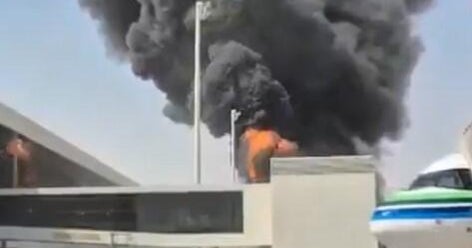
One person has been killed and 11 injured in a second strike on the international airport in the Saudi capital Riyadh, officials have said.
A Saudi military spokesman said a projectile had hit King Khalid International Airport on Sunday, causing a fire in one of its passenger halls. Saudi Arabia’s civil aviation authority said in a statement on X that one person, a Pakistani resident, had been killed in the attack.
It comes a day after a strike on the same airport killed 13 people and injured 308 others, following similar strikes earlier this week.
The Houthis in Yemen said they were behind the attacks and warned airlines and passengers against using Saudi Arabian airports and airspace.
The group said they had targeted the airport with a mix of ballistic and cruise missiles, as well as drones in the past 24 hours.
They also attacked oil facilities and Dammam airport in eastern Saudi Arabia, their military spokesman Brig Gen Yahya Saree said.
He vowed to continue the “escalating operations deep inside Saudi Arabia”, warning that all Saudi airports were potential targets apart from those in the holy cities of Mecca and Medina.
The Houthis have said they are targeting Saudi Arabia over its support for government forces in Yemen’s civil war, as well as an air strike on the airport in Sanaa.
On Sunday Maj Gen Turki al-Maliki, spokesman for the Saudi-led military coalition, said air defences had intercepted a missile near the airport in Riyadh, while authorities were dealing with the fire caused by an “unknown projectile” that hit Passenger Hall No 4.
US President Donald Trump has said the US would “make a decision” and “move very quickly” on whether to strike the Houthis, while UK Defence Secretary Wes Streeting suggested the UK could “potentially” provide more support for Saudi Arabia.
Saturday’s strike was the deadliest single attack on a Gulf Arab country since the war between Israel, the US and Iran began in February. The Saudi-led coalition vowed to respond, calling it a “war crime”.
Four Saudi nationals, two people from Bangladesh and one person each from the US, Jordan, Palestine, Syria, Sudan and Egypt were among the dead, the Saudi civil aviation authority said.
The Indian embassy in Saudi Arabia said on Sunday that an Indian man had succumbed to the injuries he sustained in the attack.
US Secretary of State Marco Rubio condemned the attacks and confirmed that a US citizen was killed in the strikes. Foreign Secretary Ed Miliband said he was “appalled”.
The UK Foreign Office is advising against all travel to parts of Saudi Arabia, including areas within 10km (6.2 miles) of the border with Yemen, while other western embassies have warned their nationals about travel in the region.

Over 1,000 Islamic clerics have urged President Bola Tinubu not to seek re-election in the 2027 presidential election, citing economic crisis, insecurity and other challenges facing the country.
The call was contained in a communique issued at the end of a national conference on “An Assessment of the State of the Nation under President Tinubu and the 2027 General Elections,” held in Kano State on Sunday.
This comes at a time when the Jama’atul Izalatul Bid’a Wa Iqamatussunnah (JIBWIS) and Qadiriyya Sufi sect, among other Islamic groups, endorsed President Bola Ahmed Tinubu and Vice President Kashim Shettima for the 2027 presidential election, urging its members nationwide to support their re-election.
JIBWIS and Qadiriyya allegedly endorsed Tinubu’s candidature during separate visits to their leadership by Senator Abdul’aziz Yari, the Director-General of the All Progressives Congress (APC) Presidential Campaign Council.
However, the Islamic clerics under the umbrella of Ko Da Naka…For the Struggle to Promote Good Governance and Community Development, in collaboration with AFAQ Educational Foundation, expressed dissatisfaction with the manner in which the administration of President Tinubu is running the country.
The clerics unanimously agreed that Tinubu’s economic policies, including the removal of the fuel subsidy, changes to the naira exchange-rate system, increases in electricity tariffs, and tax reforms, have increased the burden of hardship on ordinary citizens.
The conference expressed its dissatisfaction with the manner in which the Tinubu administration is being run, particularly the continued implementation of economic policies which participants unanimously agreed have increased the burden of hardship on ordinary citizens.
“It is unfortunate that the government has continued to insist on pursuing these policies, which are increasing hardship among the people, rather than reviewing and correcting them. The government prioritised the growth of its revenue at a time when the rising cost of living and unemployment are threatening the lives and well-being of citizens.
“Consequently, participants at the conference unanimously agreed that it would be inappropriate to re-elect this government in the forthcoming 2027 general elections if it does not change its harmful economic policies,” the communique reads in part.
Also, the participants of the conference expressed concern over the continued killings and kidnappings by bandits, and other acts of terrorism across the country.
They, therefore, called on the government to take urgent action to address insecurity, particularly in the North-West and other parts of the country.
The communique added, “Alternatively, the President should refrain from contesting the 2027 election. If he refuses to do so, it is incumbent upon citizens to reject his candidacy and allow those whom they believe can provide better leadership.”
Some of the clerics who presented papers at the conference included Dr. Abdulmuɗɗalib Ahmad Giɗaɗo, Prof Muhd Muslim Ibrahim, Sheikh Kabir Bashir Abdulhamid, Dr Aminu Isma’il Sagagi, Dr Najibullah Abdallah Nuhu, Sheikh Abdurrazaq Uba Musa, Sheikh Musa Muhd Ɗan kwano, Brr El-Zubair, Dr Yahuza Getso, Prof Ibrahim Siraj Adhama, Dr. Umar Dokaji and Sheikh Muhd Sani Khamis (Abu Haisam).
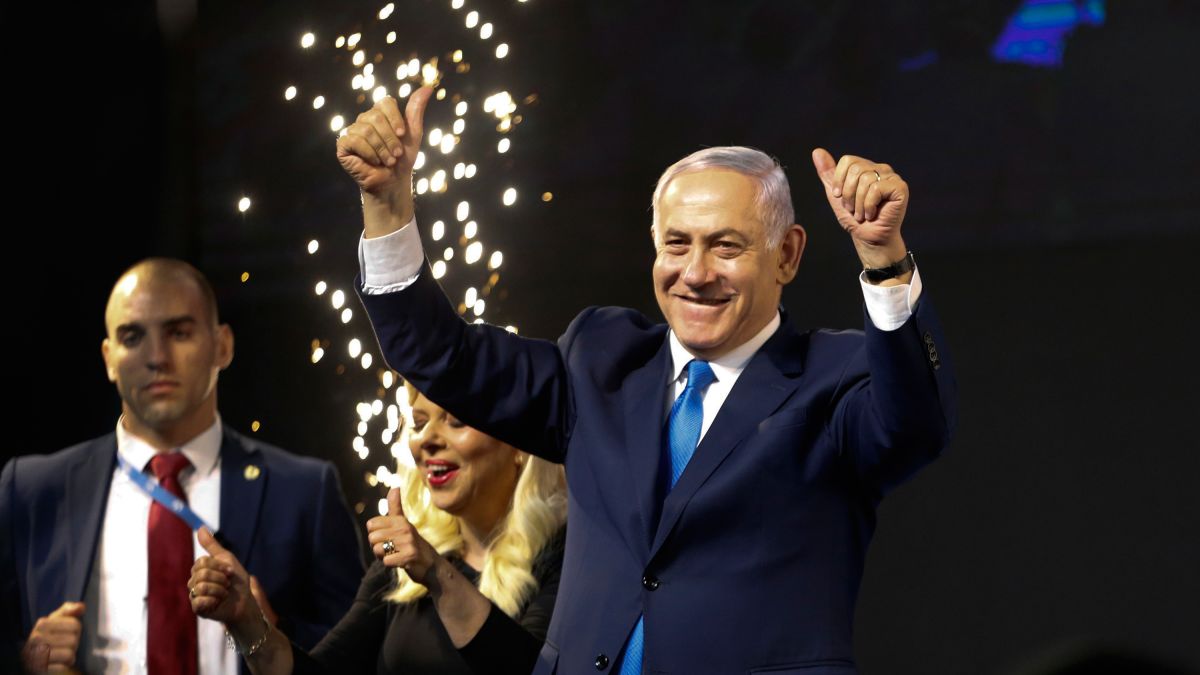
Israelis gathered in silence on Wednesday to mark three years since the October 7, 2023 Hamas-led attacks, while Palestinians in Gaza mourned the destruction and displacement caused by the war that followed.
In Kfar Aza, a kibbutz near the Gaza border that was overrun by Hamas militants three years ago, residents held a vigil for those killed in the attack.
A trumpet played a solemn bugle call as residents stood in silence and a roll call of those killed was read out.
Zion Regev, a community leader in Kfar Aza, said many residents remained displaced and had yet to return to the community.
“This is the first time we are doing all the things here in the kibbutz,” Regev said of the vigil. “It’s a very emotional day, it’s a very difficult day for our community, three years after October 7th.”
The October 7 attacks were the deadliest day in Israel’s history. Militants led by Hamas killed about 1,200 people and took 251 hostages, according to Israeli figures cited by Reuters.
The attacks triggered Israel’s military campaign in Gaza, where more than 74,000 Palestinians have been killed, according to figures cited by Reuters.
The anniversary comes as the conflict remains unresolved despite a ceasefire agreement reached in October 2025 that halted major fighting but has not ended violence or secured the disarmament of Hamas.
In Israel, protesters gathered outside parliament in Jerusalem to demand accountability for the security failures surrounding the October 7 attacks.
Some protesters blamed Prime Minister Benjamin Netanyahu for resisting calls for an independent investigation into how Hamas was able to carry out the assault.
“We need the change and we need hope and we need to know that we have a government that cares about the public and doesn’t work also only for themselves,” protester Shaked Arrad said.
Netanyahu has rejected blame for the security breach and resisted calls for an independent inquiry.
The anniversary is also taking place 20 days before Israel’s scheduled general election, with the war and the government’s handling of the October 7 attack expected to remain major political issues.
In Gaza, Palestinians displaced by the conflict recalled their lives before the war as they continued to live among destroyed buildings and makeshift shelters.
Israel currently controls about two-thirds of the Gaza Strip, while Hamas controls the remaining area, where most of Gaza’s roughly two million residents are living in tents or damaged buildings, according to Reuters.
Umm Mohammad, a mother of five displaced from Gaza City and now living in a tent encampment in Deir Al-Balah, said the conflict had separated her family.
“We were one happy family. The war displaced us. My son left Gaza, the other went to a separate tent, my daughters left with their husbands to other parts of the Strip and we rarely meet,” she said.
On the anniversary, she added: “We recall how happy, despite all problems, we were before the war broke out, destroying everything we loved.”
The latest violence also continued despite the ceasefire. Gaza medics said Israeli strikes on Beit Lahia and Khan Younis killed at least two Palestinians and wounded others on Wednesday.
The Israeli military said it had struck a militant target in Beit Lahia but did not immediately comment on the reported strike in Khan Younis.
Three years after the October 7 attacks, the anniversary has brought renewed mourning in Israel and Gaza, while questions over accountability, security and the future of the conflict remain unresolved.
Reuters


