
Business
Petrol Pump Price Hits N300 Per Litre, Nigerians Groan

- /home/rhoncare/pointblank.ng/wp-content/plugins/mvp-social-buttons/mvp-social-buttons.php on line 27
https://pointblank.ng/wp-content/uploads/2019/04/Fuel-Crisis.jpg&description=Petrol Pump Price Hits N300 Per Litre, Nigerians Groan', 'pinterestShare', 'width=750,height=350'); return false;" title="Pin This Post">
- Share
- Tweet /home/rhoncare/pointblank.ng/wp-content/plugins/mvp-social-buttons/mvp-social-buttons.php on line 69
https://pointblank.ng/wp-content/uploads/2019/04/Fuel-Crisis.jpg&description=Petrol Pump Price Hits N300 Per Litre, Nigerians Groan', 'pinterestShare', 'width=750,height=350'); return false;" title="Pin This Post">
By Punch Reporters
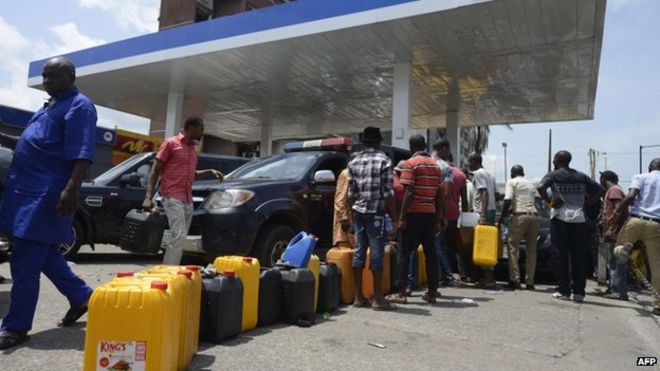
The scarcity of Premium Motor Spirit, popularly called petrol, grew worse across the country on Thursday, as massive queues were witnessed in Abuja, Lagos, Port Harcourt, Calabar, Warri, Nasarawa, Minna, among other places.
Oil marketers stated that the scarcity became worse due to the fact that dealers could hardly access the product from the only two depots that were dispensing the commodity in Lagos State as of Thursday.
The few filling stations, particularly those of independent marketers, that dispensed the commodity on Thursday, sold it at between N250/litre and N300/litre, depending on area of purchase.
Oil marketers told our correspondent that over 1,000 tickets, belonging to marketers which had paid for products, remained unattended to, at the few depots that dispense the commodity in Lagos.
It was gathered that the tickets, which were for over 1,000 tankers, had continued to pile up due to the pressure on the two depots, namely MRS and Pinnacle.
It was also gathered that the cost of petrol could have been increased quietly by the Federal Government, as stations that used to sell the approved price of N179 – N180/litre had raised their prices to between N185 – N190/litre.
Scarcity hits Abuja
The scarcity in Abuja was worse on Thursday, as virtually all retail outlets belonging to independent marketers were shut, while only few stations belonging to the Nigerian National Petroleum Company Limited and major marketers dispensed PMS.
But the very few outlets that dispensed products were greeted with massive queues of motorists who spent hours waiting to buy petrol.
Commenting on the issue, the Secretary, Independent Petroleum Marketers Association of Nigeria, Abuja-Suleja, Mohammed Shuaibu, said the concerns in the downstream sector would continue to linger as long as the government remained the sole importer of petrol into Nigeria.
He said, “The Federal Government, through NNPC, is the only one importing this product and it is subsidising it. And they don’t have the facility to store the product.
“Some time ago we complained about this because when they store in private depots, the price is hiked and some of the depots continue to exploit the masses arbitrarily.
“However, as it is now, the government is bringing in products. But the issue now is that virtually all the depots that belong to major marketers in Apapa axis of Lagos are empty. So there is now pressure on MRS and Pinnacle depots where NNPC drop products.”
Shuaibu added, “So, there are over 1,000 tickets of marketers who have paid to have their trucks loaded, but we don’t know what is happening. Today they will tell you that they are upgrading the system, tomorrow you will hear that the system did not capture.”
He said tickets were piling and “you know that it takes much time to transport this product from the South to the North. Some trucks spend one month, especially when they have problems on the road, others spend two to three weeks.”
The IPMAN official called on the Federal Government to do something about this, adding that it must be done fast.
When asked why were other depots in Apapa and in other locations not selling products, Shuaibu stated that pipeline vandalism, depot upgrade and other issues were the reasons.
He said, “Last time we complained that some depots were exploiting us, and the depots argued that the cost of moving products from one end of their facility to another had Increased, as well as other issues. So we can’t tell whether that is another reason why NNPC stopped supplying some of these depots.
“Things were not worse like this before. As I’m talking to you now, some of our tickets have been there for close to a month. I did payment since but I can’t load. And the story is the same across their 21 depots. We can’t load.”
Meanwhile, Shuabu stated that unconfirmed information on the official pump price of PMS that filtered in on Thursday evening was that the government had quietly raised the cost of petrol.
“I cannot confirm it yet, but we are hearing that they have quietly increased the pump price of petrol, because major marketers in Lagos who used to sell at N179 – N180/litre, are now selling at N185 – N190/litre,” he stated.
Also speaking on the issue, the Public Relations Officer, IPMAN, Chief Ukadike Chinedu, said another reason for the scarcity was the changes being done by NNPC in terms of payment for products by marketers.
He said, “NNPC has moved independent marketers from PPMC Marketers Express to the NNPC Retail portal. That NNPC Retail portal is where marketers will be able to buy their products. However, they told us that the portal is in place now.
“Another concern is that they (NNPC) are also having an issue with the remittance, which, according to them, has been resolved. But the impact of these issues will definitely be felt and it will take some time to clear.
“Marketers are calling on NNPC to supply products to some of the depots where independent marketers can access them since most NNPC depots are not functional because of pipeline vandalism.”


New data from CFA Society Nigeria is reshaping how the country’s financial sector thinks about talent development, with Access emerging as the single largest source of CFA candidates in Nigeria, a distinction industry watchers say signals a deeper shift in how leading institutions are building investment expertise from within.
In its Where Nigeria’s Finance Professionals Work series, published in a national daily, CFA Society Nigeria placed Access first among employers of CFA candidates nationwide, with 82 candidates enrolled in the programme, more than double the 38 recorded at the next-placed institution and well ahead of every other bank or financial services firm on the list.
Access also ranked second among employers of CFA charterholders, with 11 professionals who have completed all three levels of the Programme and met its experience and ethics requirements.
For an industry that has long measured itself by balance sheet size and branch count, the rankings point to a different kind of competition: one over who is building the deepest bench of certified, globally credentialed talent. CFA Society Nigeria compiled the data from its Salesforce Membership Database as at June 2026, and described the exercise as a way of recognising employers whose people “bring rigour, integrity and global best practices into the workplace every day.”
Analysts following the sector say the outcome is notable less for the ranking itself than for what it suggests about talent strategy across Africa’s financial services industry. A single institution developing more aspiring charterholders than the rest of the market combined raises the floor for professional standards nationally, not just within one balance sheet. Every candidate who advances through the CFA Programme adds to a shared pool of ethics-trained, analytically rigorous professionals that Nigeria’s capital markets, pension funds and asset managers all eventually draw from.
Access Holdings Group Chief Executive Officer, Innocent C. Ike, commenting on the rankings, framed the achievement in terms of institution-building rather than recruitment: “Every candidate on that list represents our commitment to building institutions and professionals that endure.” The remark echoes a broader thesis increasingly voiced by market observers, that talent depth, not scale alone, is what will determine which African financial institutions earn lasting global credibility.
That distinction sits at the centre of Access’s stated ambition to become the World’s Most Respected African Financial Services Group. If the CFA numbers are any indication, the Group’s route to that goal runs less through square metres of branch network and more through the calibre of the people sitting inside it, a bet that Nigeria’s finance professionals, and the institutions that will one day hire them, are already placing alongside Access.

Africa’s Global Bank, United Bank for Africa (UBA) Plc, has partnered Mikano Motors to launch an auto financing scheme, themed: ‘Drive Your Dream Today’, specifically designed to ease the purchase of new vehicles by making them more accessible to Nigerians. The flexible Financing solutions Initiative, requires customers to make an initial payment of just 30 percent while the Bank finances the remaining 70 percent.
Unveiled at the Mikano Motors showroom in Victoria Island, Lagos, the scheme allows eligible customers to repay the financed amount in instalments over a period of 36 months at an interest rate of 23 percent.
The financing is available to a broad range of customers, including individuals who are not on a salaried income, providing entrepreneurs, and other eligible Nigerians with a structured pathway to vehicle ownership.
The process begins with a simple eligibility check. Interested customers can visit their nearest UBA branch or email consumerlending@ubagroup.com to confirm their eligibility. Once approved, customers can proceed to Mikano Motors to obtain a proforma invoice for their preferred vehicle and continue with the financing process.
Speaking at the launch, UBA’s Group Executive Director, designate, Personal and Business Banking, Chidi Okpala, said the partnership reflects the Bank’s commitment to making everyday aspirations more attainable while promoting a stronger credit culture and advancing financial inclusion.
“Owning a car should not be out of reach for hardworking Nigerians, and this partnership makes it far more achievable,” Okpala said. “A customer puts down 30 percent, we finance the rest, and they pay us back comfortably over a three years period. By removing the single biggest barrier to vehicle ownership where a customer just commits with an upfront cost, we are showing what customer-first banking looks like in practice, which is making their lives easier, by meeting our customers where they are and helping them get where they want to be.”
Also speaking, UBA’s Group Head, Consumer Lending, Frank Okoh, said the scheme was designed to make vehicle financing straightforward and accessible to both salaried and self-employed customers.
“We have kept the entry simple and the terms clear, whether you earn a salary or run your own business,” Okoh said. “A short eligibility check at any branch or by email is all it takes to begin, and our team guides the customer through every step to the moment they collect their keys.”
For Mikano Motors, the partnership provides an opportunity to extend its vehicle ownership proposition to a wider pool of Nigerians
The company’s General Manager, Tarek Mostafa, said the collaboration aligns with Mikano Motors’ vision of providing customers with a high-end ownership experience supported by reliable after-sales services.
“Mikano Motors was established to give Nigerians a high-end ownership experience, from the showroom to years down the road,” Mostafa said. “The backbone of any automotive business is not just the sale, but the after-sales service that follows. Every vehicle we sell is backed by genuine spare parts, reliable maintenance and quality service available anywhere in the country. Wherever you are we would come meet you at no extra cost”
“Partnering with UBA lets more customers enjoy that experience, and we are proud to build lasting relationships alongside a bank that shares our commitment to service,” he added.
Established in 2018 under Mikano International, Mikano Motors builds on more than 35 years of the group’s presence in Nigeria. The company offers a diversified portfolio of vehicles supported by nationwide sales and after-sales services.
The partnership further strengthens UBA’s consumer lending proposition, providing customers with structured financing solutions designed around accessibility, affordability and convenience. Through partnerships such as this, the Bank continues to expand access to credit while helping customers meet significant personal and lifestyle needs with ease.
United Bank for Africa is one of the largest employers in the financial sector on the African continent, with 25,000 employees group-wide and serving over 45 million customers globally. Operating in twenty African countries, the United Kingdom, the United States of America, France and the United Arab Emirates, UBA provides retail, commercial and institutional banking services, leading financial inclusion and implementing cutting-edge technology.
Access Bank Plc has said that a social media post announcing a shutdown of the bank’s operations, is false and misleading.
In a statement signed by the bank’s management, and made available to the media, the Bank insisted that the notice is the handiwork of mischief makers, who impersonated the bank’s official handle.
It advised members of the public to disregard the notice, and pay attention only to verified information from the verified accounts of the bank.
Below is the full statement:
“A message impersonating Access Bank’s official handle is currently circulating on social media and WhatsApp. It is false and misleading.
“We wish to reassure our customers, partners, stakeholders, and the public that Access Bank is safe, financially strong, and fully operational across all our subsidiaries. Our services continue to run seamlessly, and we remain committed to serving our customers with the highest standards of excellence.
“We are working closely with the relevant regulatory and law enforcement authorities to identify those responsible for creating and spreading this false information to cause panic and business disruption. Appropriate legal action will be taken in accordance with applicable laws and regulations.
“We also remind members of the public that creating, publishing, and disseminating false information capable of causing public alarm, damaging reputations, or undermining confidence in institutions constitutes an offence under Section 24 of the Cybercrimes (Prohibition, Prevention, etc.) (Amendment) Act, 2024.
“If you receive a false and misleading message, please do not share or forward it. Instead, disregard it and rely only on information communicated through Access Bank’s official and verified channels.
“We thank our customers, partners, and stakeholders for their continued trust and confidence in Access Bank.”


