
Headlines
Shocker! Hundreds of Dollars Laundered Out of Nigeria Every Hour, Says INTERPOL

The International Criminal Police Organisation’s (INTERPOL) investigation has shown that every hour, hundreds of thousands of dollars are being laundered out of Nigeria across the world.
This disclosure was made in Abuja on Monday by the INTERPOL Vice President for Africa, Garba Umar, while declaring open a four-day training workshop for Nigerian law enforcement agencies at the Economic and Financial Crimes Commission (EFCC) Academy, Abuja.
According to Umar, money laundering across Africa and the entire world has assumed a monstrous dimension and Interpol has designed Silver Notices to combat the menace.
“Evidence has shown that every hour, hundreds of thousands of dollars are flowing out of Nigeria to the region and across the world, laundered before it reaches the pockets of criminals to enjoy the profits of their crimes, while the hardworking and honest Nigerians pay the price of crime”
“With every successful laundering of criminal money, our country becomes more prone to crime. More drugs, more fraud, more corruption and more violence. Every time criminal money is successfully laundered, our financial institutions take an additional blow,” he said.
He stressed that hard times awaited money launderers as the Silver Notices would make illicit funds more difficult to launder in any part of the world.
Speaking on the theme of the Workshop: Strengthening Capacity and Coordination against Financial Crimes, Umar pointed out that financial crimes had become transnational and law enforcement agencies needed regular training for their workforce to be ahead of fraudsters.
He urged participants at the workshop to make it a duty to discuss and learn about transnational crimes affecting their regions, identify possible solutions through a review of policing capabilities to support the country, and facilitate direct and in-person interaction amongst law enforcement networks across the country.
“In essence, this Workshop will allow us to re-examine the challenges of fighting transnational crimes in the country, reassess our strategies, and reaffirm our determination and unity as a country to provide security to our citizens and by extension the global community,” he said.
Umar charged all participants at the workshop to take collaboration with other law enforcement agencies seriously, to advance their investigations and ensure that criminals do not get to enjoy the fruits of their labour.
“The only way we can move forward as a country is by working together and identifying common problems, jointly devising solutions, and taking coordinated and cohesive action. And now is the time that we need to go far, by going together, he said.
Executive Chairman of the EFCC, Ola Olukoyede in his goodwill message, also harped on the need for enhanced collaboration in tackling financial crimes.
He particularly stressed that the complex nature of corruption across the world could only be broken by the might of collaborative actions by every stakeholder. “The daunting nature of the fight against corruption in Nigeria and the world at large deserve serious collaboration among organizations saddled with the responsibility of fighting corruption”, he said.
Olukoyede, who spoke through the Director, Fraud Risk Assessment and Control, FRAC, of the EFCC, Francis Usani, appraised the pivotal role of the EFCC in tackling corrupt practices, especially its impressive records of convictions and recoveries, and expressed optimism that with the new emphasis on preventive framework in tackling financial crimes by the commission, greater progress would be made.
“Our records of convictions and recoveries stand us out, but we will not rest on our oars, we are committed to doing more and in this commitment, the EFCC is re-strategising its operations with a focus on prevention knowing that it is easier and cheaper to prevent corruption from happening than investigating and prosecuting corruption,” he said.
In his remark, Ambassador Extraordinary and Plenipotentiary of Japan to Nigeria, Kazuyoshi Matsunaga, described the workshop as an important joint initiative between Japan and Nigeria to combat financial crimes.
He explained that in the contemporary globalised world, financial crimes transcended borders and required international cooperation among law enforcement agencies to combat them.
“I am delighted that INTERPOL and the Japanese National Police Agency are an integral part of this project, contributing their expertise. A remarkable collaboration took place three years ago when Japanese and Nigerian law enforcement agencies successfully returned a fund to a Japanese fraud victim, earning immense gratitude. Strengthening our partnership through this project will benefit not only Nigerians but people around the world, including the Japanese,” he said.
Director General and Chief Executive Officer, Nigerian Financial Intelligence Unit, NFIU, Hafsat Bakare, spoke about the imperative of strengthening capacity and coordination against financial crimes, pointing out that “ financial intelligence and financial analysis techniques are key to tackling economic crimes”.
“The NFIU, she said, was sensitive to the interconnected nature of the criminal justice system, the threat of organised crime and cybercrimes being fought by law enforcement agencies.
She expressed optimism that the training law enforcement officers would receive at the Workshop would “ sustain efforts being made to ensure that Nigeria exit the Grey List of the Financial Action Task Force possibly by mid-2025.”
Director, Interpol Financial Crime and Anti-Corruption Centre (IFCACC), Isaac Oginni, said the only way to disrupt organised crimes was by denying fraudsters the financial profit behind their criminal enterprise. Besides, financial intelligence could also be utilised well when investigators recognise its value and use it to build a financial profile around suspects.
He challenged participants and stakeholders at the workshop to collectively work together and fight money laundering.
“Each agency represents a different shape of the puzzle with our different strengths and mandates. Each piece of the puzzle forms part of the bigger picture, and even one missing piece will prevent the whole picture from being developed,” he said.
“Today, we will commence the first phase of the Interpol/JICA workshop, a capacity-building project that aims to strengthen Nigeria’s safety through enhancing law enforcement’s capacity to combat financial crime, as well as through increased national cross-agency collaboration and cooperation,” he said.
The four-day workshop, the first of its kind and hosted by the EFCC was organised by INTERPOL and the Japan International Cooperation Agency, JICA. It drew participants from the Police, EFCC, NFIU, Nigeria Immigration Service and the Nigeria Customs Service.


United States Representative Riley Moors has said further military strikes against Islamic State-linked militants in Nigeria could follow recent operations ordered by President Donald Trump, describing the actions as aimed at improving security and protecting Christian communities facing violence.
Moore made the remarks during a televised interview in which he addressed U.S. military strikes carried out on Christmas Day against militant targets in North-west Nigeria.
The strikes were conducted in coordination with the Nigerian government, according to U.S. and Nigerian officials.
“President Trump is not trying to bring war to Nigeria, he’s bringing peace and security to Nigeria and to the thousands of Christians who face horrific violence and death,” Moore said.
He said the Christmas Day strikes against Islamic State affiliates had provided hope to Christians in Nigeria, particularly in areas affected by repeated attacks during past festive periods.
According to U.S. authorities, the strikes targeted camps used by Islamic State-linked groups operating in parts of north-west Nigeria.
Nigerian officials confirmed that the operation was carried out with intelligence support from Nigerian security agencies as part of ongoing counter-terrorism cooperation between both countries.
The United States Africa Command said the operation was intended to degrade the operational capacity of extremist groups responsible for attacks on civilians and security forces.
Nigerian authorities have described the targeted groups as a threat to national security, noting their involvement in killings, kidnappings and raids on rural communities.
Moore said the strikes marked a shift from previous years in which attacks were carried out against civilians during the Christmas period. He said the U.S. administration was focused on preventing further violence by targeting militant groups before they could launch attacks.
U.S. officials have said the military action was carried out with the consent of the Nigerian government and formed part of broader security cooperation between the two countries. Nigeria has received intelligence, training and logistical support from international partners as it seeks to contain militant activity.
Moore had previously called for stronger international attention to attacks on Christian communities in Nigeria and has urged continued U.S. engagement in addressing extremist violence. He said further action would depend on developments on the ground and continued coordination with Nigerian authorities.
Nigerian officials have maintained that counter-terrorism operations are directed at armed groups threatening civilians, regardless of religion, and have reiterated their commitment to restoring security across affected regions.

World-renowned boxer Anthony Joshua on Monday survived a ghastly road accident in Makun, Ogun State.
Eyewitnesses report that the incident occurred along a busy highway of the Lagos-Ibadan expressway.
The vehicle carrying Joshua, a Lexus Jeep with the number plate, KRD 850 HN, reportedly collided with a stationary truck under circumstances that are still being investigated.
Joshua reportedly sustained minor injuries, while two persons were said to have died on the spot.
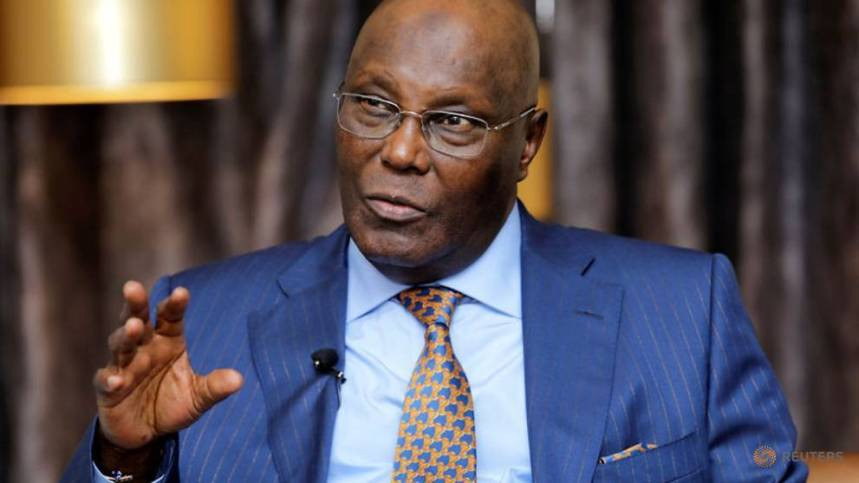
Former Vice President Atiku Abubakar has cautioned that any attempt to hurriedly re‑gazette Nigeria’s new tax laws could undermine parliamentary oversight and set a dangerous constitutional precedent.
Atiku’s warning follows public scrutiny over reports that the Tax Reform Acts signed by President Bola Tinubu differ from the versions passed by the National Assembly. Lawmakers, including Abdussamad Dasuki, raised concerns that the alterations could pose serious legal and constitutional risks, noting that they were not backed by any constitutional framework.
In a statement on X, Atiku said the directive to re-gazette the Acts effectively confirms “that the gazetted version of the Tinubu Tax Act does not reflect what was duly passed by the National Assembly,” calling it “a grave constitutional issue.”
He emphasized that under Section 58 of the 1999 Constitution, a bill only becomes law after passage by both chambers, presidential assent, and gazetting.
“Gazetting is merely an administrative act of publication. It does not create, amend, or validate a law,” Atiku said, adding that any post-passage insertion, deletion, or modification without legislative approval constitutes forgery rather than a clerical error.
Atiku further warned that rushing a re-gazetting while legislative investigations are ongoing “undermines parliamentary oversight and sets a dangerous precedent,” stressing that the only lawful approach is “fresh legislative consideration, re-passage by both chambers, fresh presidential assent, and proper gazetting.”
The former vice president clarified that his position is not opposition to tax reform but a defence of constitutional order.
“This is a defence of the integrity of the legislative process and a rejection of any attempt to normalise constitutional breaches through procedural shortcuts,” he said.
The Federal government has denied wrongdoing, insisting the laws will take effect as scheduled on January 1, 2026, while the National Assembly has directed the issuance of Certified True Copies of the Acts to ensure clarity and accuracy.


