
Headlines
Tribunal Declares Atiku’s Evidence As Drop in the Ocean, Affirms Buhari as Duly Elected


The Presidential Election Petitions Tribunal in Abuja on Wednesday dismissed the petition filed by the Peoples Democratic Party and its presidential candidate, Alhaji Atiku Abubakar, challenging the victory of President Muhammadu Buhari at the February 23, 2019 election.
The five-man bench led by Justice Mohammed Garba unanimously dismissed the case for lacking in merit after resolving all the five issues raised in the case against the petitioners.
Justice Garba, who read the lead judgment, resolved all the five broad issues raised by the petitioners in favour of the respondents.He held that none of the grounds on which the petition was anchored was proved.
Comparing the evidence led by the petitioners to the quantum of their allegations, Justice Garba said, “It is like a drop in the ocean”.
He ruled, “In the final result, I have come to the conclusion, which is inevitable and unavoidable, that the petitioners have not discharged the burden of proof required of any of the grounds of the petition in paragraph 15 of the petition.This petition is accordingly and hereby dismissed in its entirety.”
The tribunal held, among others, that contrary to the contention of the petitioners, Buhari had the educational qualification to contest the presidential election.
It held that the petitioners failed to provide any proof that Buhari did not attend the Provincial Secondary School, Katsina and obtained his West African School Certificate from there in 1961.
“It is established that a candidate is not required under the Electoral Act to attach his certificate to Form CF001 before the candidate is adjudged to have the requisite qualification to contest the election,” Justice Garba said.
Citing a previous Supreme Court judgment, the tribunal said, “Submission of educational certificate is not a requirement to contest election.
“In effect, the 2nd defendant (Buhari) went through secondary education and then proceeded to military school. The military school is higher than secondary education.”
Justice Garba also referred to a statement issued in 2015 by the then Director of Army’s Public Relations, Brigadier-General Olajide Laleye, denying that Buhari’s certificate was with the Army’s board.
According to the judge, the denial by Laleye was only to the effect that Buhari’s certificate was not in his personal file but not to the effect that he did not have a certificate.
He pointed out that from Laleye’s statement the Army had verified Buhari’s results at the point of his enrolment into the Army in 1961.
He said Laleye admitted that Buhari possessed some credits and a pass in his West African School Certificate which qualified him to be commissioned into the Nigerian Army.
He said Buhari’s results mentioned in Laleye’s statement must have been copied from Buhari’s Form 99A submitted to the Army Board at the point of his enrolment into the Nigerian Army in 1962.
Justice Garba held, “The 2nd defendant is not only qualified, but also eminently qualified to contest the February 23, 2019 presidential election,” adding, “The fact that he did not attach his certificate cannot lead to the conclusion that he is not educated up to secondary education.”
The tribunal also dismissed the claim of the petitioners that Provincial Secondary School, Katsina, was not in existence as of 1961 when Buhari claimed to have obtained his West African School Certificate from there.
He ruled, “There is no scintilla of evidence that the school stated in Form CF001 submitted to INEC was not in existence as of that time.
“They have failed to discharge the burden of proof of the allegations of non-qualification or submission of false information which is fundamental in the aid of the qualification of the 2nd defendant to contest the election.”
Justice Garba added, “The onus rests squarely on the petitioners to prove their assertion that the 2nd respondent does not possess the educational qualification to contest the election or that he submitted false information which is fundamental in nature to aid his qualification. This, I have mentioned, that the petitioners failed to prove. The petitioners cannot therefore rely on any failure in the case of the respondents.
“I also have no doubt in my mind that the petitioners have failed to prove that the 2nd respondent does not possess the qualification to contest the election into the office of the President as stipulated in sections 131, 137, 138 of the Constitution.
“I am also of the firm view that the petitioners have failed to prove that the 2nd respondent submitted false information which is fundamental in nature to aid his qualification to contest the election into the Office of the President as prescribed in section 35(1) of the Evidence Act, 2011.”
The tribunal also ruled that the election manual issued by INEC for the conduct of the 2019 presidential election did not provide for electronic transmission of results of the election.
It added that the petitioners failed to prove that election results were transmitted electronically.
It added that petitioners’ Witness 59, David Njorga, from Kenya, did not qualify to be referred to as an expert witness, as he only relied on third party information to make a case for the existence of a server into which the results of the election were allegedly transmitted.
The tribunal held that Njorga relied on hearsay information posted on a website, www.factsdontlie.com, by a purported whistleblower who was never known.
It added that card reader was not used to transmit results during the election but was for mere authentication of ownership of voter cards.
It added that the petitioners merely dumped documents particularly result sheets and voter register on the tribunal without demonstrating them by attaching the evidence of any of their 62 witnesses to the documents in their bid to prove the allegations in their petition.
It held that none of the documents tendered by the petitioners was utilised to prove the allegations, such as over-voting or non-accreditation of voters.
Other members of the panel, Justices Abdul Aboki, Joseph Ikyegh, Samuel Oseji and Peter Ige concurred with the ruling.
The judgment, which lasted over eight hours on Wednesday, started at 9.30am and ended at about 5.58pm when the other members of the panel delivered their supporting opinions.
The Punch


United States Representative Riley Moors has said further military strikes against Islamic State-linked militants in Nigeria could follow recent operations ordered by President Donald Trump, describing the actions as aimed at improving security and protecting Christian communities facing violence.
Moore made the remarks during a televised interview in which he addressed U.S. military strikes carried out on Christmas Day against militant targets in North-west Nigeria.
The strikes were conducted in coordination with the Nigerian government, according to U.S. and Nigerian officials.
“President Trump is not trying to bring war to Nigeria, he’s bringing peace and security to Nigeria and to the thousands of Christians who face horrific violence and death,” Moore said.
He said the Christmas Day strikes against Islamic State affiliates had provided hope to Christians in Nigeria, particularly in areas affected by repeated attacks during past festive periods.
According to U.S. authorities, the strikes targeted camps used by Islamic State-linked groups operating in parts of north-west Nigeria.
Nigerian officials confirmed that the operation was carried out with intelligence support from Nigerian security agencies as part of ongoing counter-terrorism cooperation between both countries.
The United States Africa Command said the operation was intended to degrade the operational capacity of extremist groups responsible for attacks on civilians and security forces.
Nigerian authorities have described the targeted groups as a threat to national security, noting their involvement in killings, kidnappings and raids on rural communities.
Moore said the strikes marked a shift from previous years in which attacks were carried out against civilians during the Christmas period. He said the U.S. administration was focused on preventing further violence by targeting militant groups before they could launch attacks.
U.S. officials have said the military action was carried out with the consent of the Nigerian government and formed part of broader security cooperation between the two countries. Nigeria has received intelligence, training and logistical support from international partners as it seeks to contain militant activity.
Moore had previously called for stronger international attention to attacks on Christian communities in Nigeria and has urged continued U.S. engagement in addressing extremist violence. He said further action would depend on developments on the ground and continued coordination with Nigerian authorities.
Nigerian officials have maintained that counter-terrorism operations are directed at armed groups threatening civilians, regardless of religion, and have reiterated their commitment to restoring security across affected regions.

World-renowned boxer Anthony Joshua on Monday survived a ghastly road accident in Makun, Ogun State.
Eyewitnesses report that the incident occurred along a busy highway of the Lagos-Ibadan expressway.
The vehicle carrying Joshua, a Lexus Jeep with the number plate, KRD 850 HN, reportedly collided with a stationary truck under circumstances that are still being investigated.
Joshua reportedly sustained minor injuries, while two persons were said to have died on the spot.
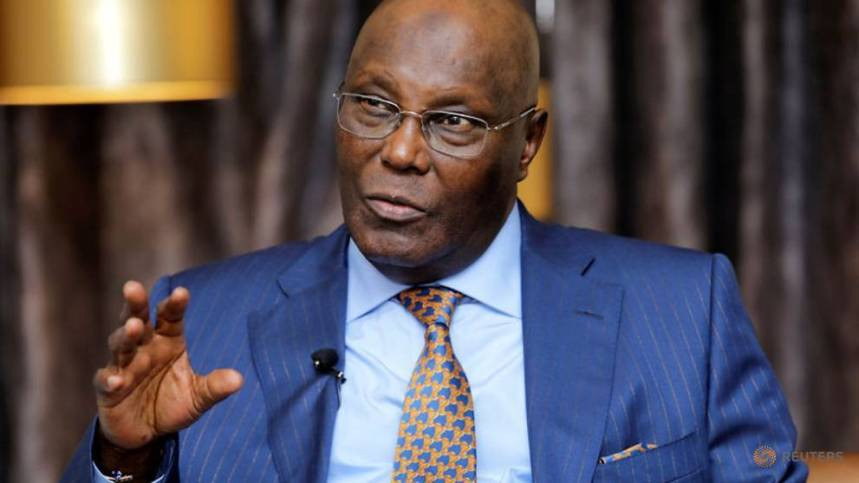
Former Vice President Atiku Abubakar has cautioned that any attempt to hurriedly re‑gazette Nigeria’s new tax laws could undermine parliamentary oversight and set a dangerous constitutional precedent.
Atiku’s warning follows public scrutiny over reports that the Tax Reform Acts signed by President Bola Tinubu differ from the versions passed by the National Assembly. Lawmakers, including Abdussamad Dasuki, raised concerns that the alterations could pose serious legal and constitutional risks, noting that they were not backed by any constitutional framework.
In a statement on X, Atiku said the directive to re-gazette the Acts effectively confirms “that the gazetted version of the Tinubu Tax Act does not reflect what was duly passed by the National Assembly,” calling it “a grave constitutional issue.”
He emphasized that under Section 58 of the 1999 Constitution, a bill only becomes law after passage by both chambers, presidential assent, and gazetting.
“Gazetting is merely an administrative act of publication. It does not create, amend, or validate a law,” Atiku said, adding that any post-passage insertion, deletion, or modification without legislative approval constitutes forgery rather than a clerical error.
Atiku further warned that rushing a re-gazetting while legislative investigations are ongoing “undermines parliamentary oversight and sets a dangerous precedent,” stressing that the only lawful approach is “fresh legislative consideration, re-passage by both chambers, fresh presidential assent, and proper gazetting.”
The former vice president clarified that his position is not opposition to tax reform but a defence of constitutional order.
“This is a defence of the integrity of the legislative process and a rejection of any attempt to normalise constitutional breaches through procedural shortcuts,” he said.
The Federal government has denied wrongdoing, insisting the laws will take effect as scheduled on January 1, 2026, while the National Assembly has directed the issuance of Certified True Copies of the Acts to ensure clarity and accuracy.


