
Headlines
US Electoral College Set to Confirm Biden Win Monday


Long a mere formality, a vote on Monday by members of the Electoral College to formally recognise Joe Biden as the next US president has taken on unusual import this year with Donald Trump refusing to admit defeat.
The results of the November 3 vote have been certified by each of the 50 states and the District of Columbia; the Democrat won with a record 81.3 million votes, or 51.3 percent of those cast, to 74.2 million, and 46.8 percent, for the Republican president.
But in the United States, the occupant of the White House is chosen by indirect universal suffrage, with each state allocating its electors — whose numbers are essentially based on population — to the candidate who carried the state.
The results confirm an easy victory for Biden, with 306 of the 538 electoral votes, to 232 for Trump, with 270 required for election.
Electoral College members meet Monday to formalise the process, though the electors actually meet separately in each state.
Biden will then deliver a speech in the evening to celebrate the latest confirmation of his win and “the strength and resilience” of US democracy — a clear jab at Trump’s unprecedented stance.
Electors are local political officials or activists, civil society figures or friends of candidates.
Most are unknown to the wider public, though national personalities occasionally take part — like Hillary Clinton, who lost to Trump in the 2016 election but who will vote Monday in New York to confirm President-elect Biden and Vice President-elect Kamala Harris.
– No Trump concession –
Although there have been a few “faithless electors” in past years — who cast votes for someone other than the candidate who won their state — there have never been enough to change an election outcome.
So Biden’s victory will become all the more official on Monday.
But Trump, still the legal occupant of the White House until January 20, has continued to make baseless assertions that the November vote was the “MOST CORRUPT ELECTION IN U.S. HISTORY,” as he tweeted yet again on Sunday.
He added, “How do states and politicians confirm an election where corruption and irregularities are documented throughout?”
In fact, his campaign has not been able to document any widespread fraud, and its legal challenges to the vote — in dozens of suits, heard by scores of judges — have virtually all been dismissed, often in scathing language.
– An ultimate humiliation –
In an ultimate humiliation, the US Supreme Court — despite having a conservative majority assured by three Trump appointees — on Friday bluntly refused to even consider two Republican challenges to the vote.
Large numbers of Republican lawmakers are on record as backing Trump’s false claims of fraud.
Some may finally be willing to recognize Biden’s victory once the Electoral College ratifies it.
But with polls showing that as few as one in four Republican voters accept the election results as valid, Trump is not expected to give in anytime soon.
“WE HAVE JUST BEGUN TO FIGHT!!!” he tweeted.
This weekend, when asked on Fox News whether he would attend Biden’s inauguration on January 20 — as demanded by protocol and centuries of tradition — the former real estate magnate snapped, “I don’t want to talk about that.”
The president might yet seek to use America’s drawn-out transition process in one last attempt to reverse the outcome: some elected officials allied with Trump have speculated about contesting the result on January 6 when Congress is to formally validate the Electoral Congress tally.
Such a maneuver is given virtually no chance of succeeding.
Regardless, Trump’s struggle against a repeatedly confirmed result seems sure to leave Biden facing a steep challenge with the country more divided than ever.
(AFP)


United States Representative Riley Moors has said further military strikes against Islamic State-linked militants in Nigeria could follow recent operations ordered by President Donald Trump, describing the actions as aimed at improving security and protecting Christian communities facing violence.
Moore made the remarks during a televised interview in which he addressed U.S. military strikes carried out on Christmas Day against militant targets in North-west Nigeria.
The strikes were conducted in coordination with the Nigerian government, according to U.S. and Nigerian officials.
“President Trump is not trying to bring war to Nigeria, he’s bringing peace and security to Nigeria and to the thousands of Christians who face horrific violence and death,” Moore said.
He said the Christmas Day strikes against Islamic State affiliates had provided hope to Christians in Nigeria, particularly in areas affected by repeated attacks during past festive periods.
According to U.S. authorities, the strikes targeted camps used by Islamic State-linked groups operating in parts of north-west Nigeria.
Nigerian officials confirmed that the operation was carried out with intelligence support from Nigerian security agencies as part of ongoing counter-terrorism cooperation between both countries.
The United States Africa Command said the operation was intended to degrade the operational capacity of extremist groups responsible for attacks on civilians and security forces.
Nigerian authorities have described the targeted groups as a threat to national security, noting their involvement in killings, kidnappings and raids on rural communities.
Moore said the strikes marked a shift from previous years in which attacks were carried out against civilians during the Christmas period. He said the U.S. administration was focused on preventing further violence by targeting militant groups before they could launch attacks.
U.S. officials have said the military action was carried out with the consent of the Nigerian government and formed part of broader security cooperation between the two countries. Nigeria has received intelligence, training and logistical support from international partners as it seeks to contain militant activity.
Moore had previously called for stronger international attention to attacks on Christian communities in Nigeria and has urged continued U.S. engagement in addressing extremist violence. He said further action would depend on developments on the ground and continued coordination with Nigerian authorities.
Nigerian officials have maintained that counter-terrorism operations are directed at armed groups threatening civilians, regardless of religion, and have reiterated their commitment to restoring security across affected regions.

World-renowned boxer Anthony Joshua on Monday survived a ghastly road accident in Makun, Ogun State.
Eyewitnesses report that the incident occurred along a busy highway of the Lagos-Ibadan expressway.
The vehicle carrying Joshua, a Lexus Jeep with the number plate, KRD 850 HN, reportedly collided with a stationary truck under circumstances that are still being investigated.
Joshua reportedly sustained minor injuries, while two persons were said to have died on the spot.
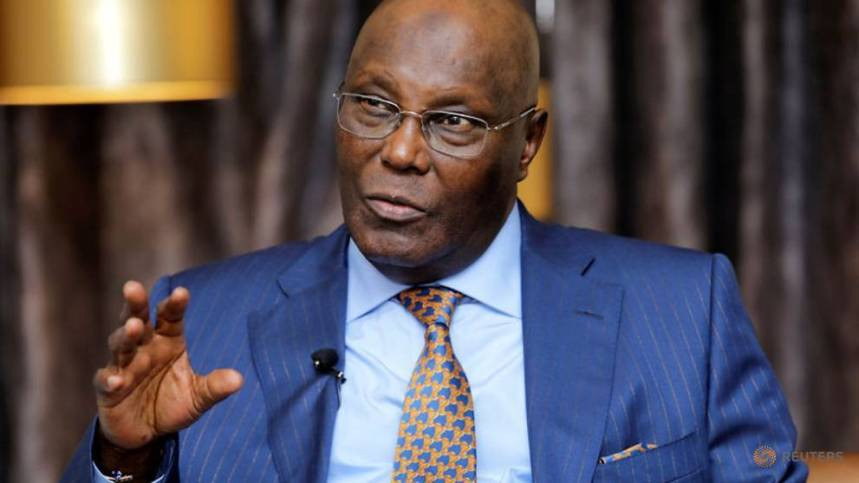
Former Vice President Atiku Abubakar has cautioned that any attempt to hurriedly re‑gazette Nigeria’s new tax laws could undermine parliamentary oversight and set a dangerous constitutional precedent.
Atiku’s warning follows public scrutiny over reports that the Tax Reform Acts signed by President Bola Tinubu differ from the versions passed by the National Assembly. Lawmakers, including Abdussamad Dasuki, raised concerns that the alterations could pose serious legal and constitutional risks, noting that they were not backed by any constitutional framework.
In a statement on X, Atiku said the directive to re-gazette the Acts effectively confirms “that the gazetted version of the Tinubu Tax Act does not reflect what was duly passed by the National Assembly,” calling it “a grave constitutional issue.”
He emphasized that under Section 58 of the 1999 Constitution, a bill only becomes law after passage by both chambers, presidential assent, and gazetting.
“Gazetting is merely an administrative act of publication. It does not create, amend, or validate a law,” Atiku said, adding that any post-passage insertion, deletion, or modification without legislative approval constitutes forgery rather than a clerical error.
Atiku further warned that rushing a re-gazetting while legislative investigations are ongoing “undermines parliamentary oversight and sets a dangerous precedent,” stressing that the only lawful approach is “fresh legislative consideration, re-passage by both chambers, fresh presidential assent, and proper gazetting.”
The former vice president clarified that his position is not opposition to tax reform but a defence of constitutional order.
“This is a defence of the integrity of the legislative process and a rejection of any attempt to normalise constitutional breaches through procedural shortcuts,” he said.
The Federal government has denied wrongdoing, insisting the laws will take effect as scheduled on January 1, 2026, while the National Assembly has directed the issuance of Certified True Copies of the Acts to ensure clarity and accuracy.


