Personality in Focus
Aare Adetola, Wife Bag PCRC’s Golden Grand Patron, Patroness Honours


- /home/rhoncare/pointblank.ng/wp-content/plugins/mvp-social-buttons/mvp-social-buttons.php on line 27
https://pointblank.ng/wp-content/uploads/2024/05/IMG-20240523-WA0010-1000x600.jpg&description=Aare Adetola, Wife Bag PCRC’s Golden Grand Patron, Patroness Honours', 'pinterestShare', 'width=750,height=350'); return false;" title="Pin This Post">
- Share
- Tweet /home/rhoncare/pointblank.ng/wp-content/plugins/mvp-social-buttons/mvp-social-buttons.php on line 69
https://pointblank.ng/wp-content/uploads/2024/05/IMG-20240523-WA0010-1000x600.jpg&description=Aare Adetola, Wife Bag PCRC’s Golden Grand Patron, Patroness Honours', 'pinterestShare', 'width=750,height=350'); return false;" title="Pin This Post">
The Police Community Relations Committee (PCRC) has decorated Aare Adetola Emmanuelking, Chairman/CEO of Adron Homes, and his wife, Yeye Aderonke Emmanuelking, as the Golden Grand National Patron and Grand National Matron for women and youth committees of PCRC in Nigeria and diaspora.
This prestigious honour was bestowed upon the duo during the PCRC’s 40th anniversary celebration, held in Lagos.
The ceremony, which took place in Lagos, was attended by National PCRC chairman, Alhaji Mogaji Ibrahim-Olaniyan and other members of the committee, dignitaries, community leaders, and members of the Nigerian Police Force. The PCRC’s decision to honor the Emmanuelkings highlights their unwavering commitment to community development and their substantial support for initiatives aimed at enhancing public safety and fostering cooperation between law enforcement and the communities they serve.
In his acceptance speech, Aare Adetola Emmanuelking expressed his profound gratitude for the recognition, stating, “This honor is not just for me and my wife but for every Nigerian who believes in the power of community and the importance of working together with our police force to create a safer and more harmonious society.”
In her reaction to the honor, Yeye Aderonke Emmanuelking emphasized the role of women and families in fostering community spirit and resilience. She noted, “Our communities thrive when we all play our part. As National Grand Patrons, we are committed to promoting initiatives that bring the police and the people closer together, ensuring mutual trust and cooperation.”
It will be recalled that the PCRC, established in 1984, by the then IGP, Etim Inyang has played a crucial role in bridging the gap between the Nigerian Police Force and local communities. Over the past four decades, the committee has launched numerous programs aimed at improving communication, trust, and mutual respect. This 40th-anniversary celebration not only commemorated the PCRC’s achievements but also set the stage for future endeavors to strengthen community policing.
The National PCRC chairman, Alhaji Mogaji Ibrahim-Olaniyan, praised the Emmanuelkings for their exceptional support and dedication. He remarked, “The Emmanuelkings have shown exemplary commitment to the ideals of the PCRC. Their leadership and philanthropic efforts have significantly contributed to the enhancement of community policing in Nigeria. Their new roles as National Grand Patrons will undoubtedly inspire further progress in our collective efforts to maintain peace and security.”
The chairman further stated that the decoration of Aare Adetola Emmanuelking and Yeye Aderonke Emmanuelking as National Grand Patrons stands as a testament to the power of community partnership and the enduring impact of dedicated civic leadership.



Kardinal Business Travel, a travel technology company with African and global focus, was among 60 startups that pitched at the 2nd edition of the Economic Community of West African States (ECOWAS) Startup Awards, held at the ECOWAS Commission headquarters in Abuja recently.
The company’s Chief Executive Officer and Founder, Cornelius Ugwunwa, presented the company’s case at the three-day event. The awards was part of an ECOWAS initiative to help West African businesses and startups scale through digital transformation, regional integration and sustainable value chains, with the aim of widening access to global markets.
Temitope Kareem, founder of Nigerian healthtech firm HubPharm Africa, won the top prize of $30,000. Senegal’s Gaynako took home $20,000 as first runner-up, while Steve Bah Blesson’s MyOpinion from Côte d’Ivoire won $15,000 as second runner-up.
Speaking during his pitch, Ugwunwa said Africa needs a new system for business travel. He cited a market with $75 billion in inbound travel spending and a strong business travel component in 2025, while travel and tourism as a whole contributed $228 billion to the regional economy.
“When a company sends its employees across Africa for a business engagement, we at Kardinal noticed the challenges of countless inboxes, spreadsheets and emails, mostly after the trip.
Businesses keep asking: How much did we spend? Who did we spend it on? Was it above or below budget? Can we reconcile everything on one platform?” he said.
He described African business travel as a $30 billion market that is largely fragmented and overly dependent on manual processes.
According to him, many businesses lose over $1 billion to manual travel processing and cannot track spending in real time. “That is why Kardinal exists: to solve this entrenched problem,” he said.
Ugwunwa said GoKardinal is an artificial intelligence-driven platform built to track expenses for African businesses. It brings the entire business travel lifecycle (planning, budgeting, booking, financing and expense tracking) onto one platform, in real time.
“GoKardinal is not another travel platform. It is an infrastructure for business travel, powered by AI for expense management,” he said, adding that the idea is to help businesses move without delay from one location to another to do their best work, expand and make profit.
On the company’s performance, he said the platform serves over 51 businesses in Nigeria and across Africa, with estimated weekly profit of $10,000 and gross merchandise value of over $1 million, growing at 65 per cent annually. he added.
He noted that about 80 per cent of African businesses still run their business travel manually, without any form of expense tracking, in a market worth over $30 billion annually. “African business travel is not just travelling for the fun of it.
It is an ecosystem with the potential to generate over $70 billion when digitalised,” Ugwunwa said.

The President of Security Resources & Risk Management Academy, Lagos, Mr. Matthew Ibadin, has charged officers of the Nigerian Armed Forces and allied nations to practice emotional discipline, warning that unmanaged anger remains a greater threat to a Staff Officer than the enemy.
Ibadin, who is also a doctoral researcher at the Nigerian Defence Academy (NDA) and University of Abuja, stated this on Monday while delivering a lecture on “Emotional Discipline Under Pressure and Anger Management for Staff Officers” to participants of Senior Course 48 at the Armed Forces Command and Staff College (AFCSC), Jaji, Kaduna.
The lecture was attended by 436 officers comprising the Nigerian Army, Nigerian Navy, Nigerian Air Force and officers from eight friendly nations.
Describing anger as “a temporary madness that leaves a permanent record,” Ibadin warned officers that “the line between a respected officer and an inmate is thinner than you can imagine.”
“Anger may enter the room, but must never take command,” he said.
The Lion Principle
Illustrating his point with the parable of the lions, Ibadin noted that while both male and female lions roar, the female roars only when necessary and lives 15-18 years compared to 10-12 years for the male.
“She lives longer not because she is weaker, but because she is more disciplined. Many of us have become male lions in uniform – fighting juniors, spouses, traffic, minor disagreements even when no real threat exists. That constant agitation slowly destroys what you have built,” he said.
He therefore charged officers to “be a female lion in strategy and a male lion only when tactically necessary.”
Five Battlefields Where Anger Destroys
Ibadin identified five battlefields where undisciplined anger destroys officers: Health, Home Front, Office and Command, Career and Prison, and Relationships.
On health, he described anger as a silent killer that triggers hypertension, stroke and cardiac arrest, noting that many officers survive the war front but do not survive peacetime.
“At Jaji, your rank commands respect, but at home your rank is irrelevant. If you win at the office and lose at home, you have lost. An officer whose home is under emotional fire cannot think clearly at the command post,” he cautioned.
He warned that signatures appended in anger to operational orders, procurement papers and personnel assessments could lead to Boards of Inquiry, career ruin and mission failure.
He added that 70 percent of inmates in correctional centres for murder never planned to kill, but acted in a moment of unmanaged anger.
Practical Tools
Ibadin introduced practical tools including the 90-Second Rule and the S.T.O.P Protocol – Stop, Take a Breath (4-4-4), Observe, and Proceed with Discipline – for decisions under pressure.
He adopted Aristotle’s five tests for disciplining anger: Right Person, Right Reason, Right Time, Right Degree, and Right Manner.
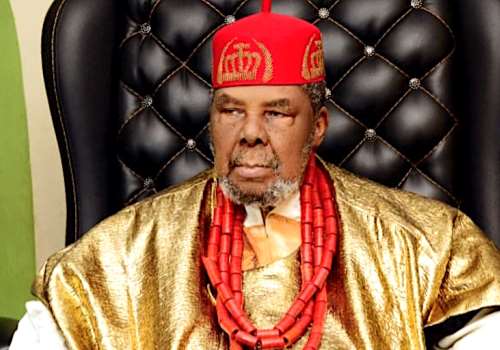
Veteran Nollywood actor, Pete Edochie has declared Chinua Achebe’s 1958 novel ‘Things Fall Apart’ as the greatest African book of all-time.
Speaking in a recent interview with TV3, Edochie explained that ‘Things Fall Apart’ is the greatest African book ever written because it tells the African story.
He stated that the book wouldn’t have been as popular as it is if it were telling the story of the colonisers.
He pointed out that many other African authors have also made efforts in telling African stories since ‘Things Fall Apart’ but none is as “strong” as it.
“The reason why ‘Things Fall Apart’ is the greatest book ever written on the African continent is because it is telling our own story.
“If it had been telling the story of the White man, it won’t be that popular. Many others have made efforts since then but not as strong as ‘Things Fall Apart’,” he said.
He urged African writers and creatives to focus on telling African stories, stressing that it would be their unique strength on the global stage.
The movie star, however, lamented that Africans were allowing their talents to be submerged by embracing foreign influences.
“We Africans permitted our talents to be submerged by overseas influences. I remember once upon a time I was being called Elvis Presley and John Wayne.
“I actually enjoyed answering those names but at some point I had to discard them and pick a name that’s culturally relevant to me. Then I went back to the root and started answering Uwadiegwu,” he added.
Source: DailyPost