
Headlines
ADC Rejects ICPC Report on PFIPC, Queries N1.3bn Budget Allocation to Fake Agency

- /home/rhoncare/pointblank.ng/wp-content/plugins/mvp-social-buttons/mvp-social-buttons.php on line 27
https://pointblank.ng/wp-content/uploads/2026/07/Adeniyi-Adeyemi-in-his-office-768x519-1.webp&description=ADC Rejects ICPC Report on PFIPC, Queries N1.3bn Budget Allocation to Fake Agency', 'pinterestShare', 'width=750,height=350'); return false;" title="Pin This Post">
- Share
- Tweet /home/rhoncare/pointblank.ng/wp-content/plugins/mvp-social-buttons/mvp-social-buttons.php on line 69
https://pointblank.ng/wp-content/uploads/2026/07/Adeniyi-Adeyemi-in-his-office-768x519-1.webp&description=ADC Rejects ICPC Report on PFIPC, Queries N1.3bn Budget Allocation to Fake Agency', 'pinterestShare', 'width=750,height=350'); return false;" title="Pin This Post">
The African Democratic Congress (ADC) has rejected the interim report of the Independent Corrupt Practices and Other Related Offences Commission (ICPC) on the controversial Presidential Foreign Investment Promotion Council (PFIPC), arguing that the findings leave some of the biggest questions surrounding the scandal unanswered.
The opposition party said the report appeared to focus more on limiting political fallout than establishing how a purported government agency allegedly gained access to official institutions, occupied government office space and received other forms of state recognition despite questions over its legal status.
The ADC’s position was contained in a statement issued on Saturday by its National Publicity Secretary, Bolaji Abdullahi.
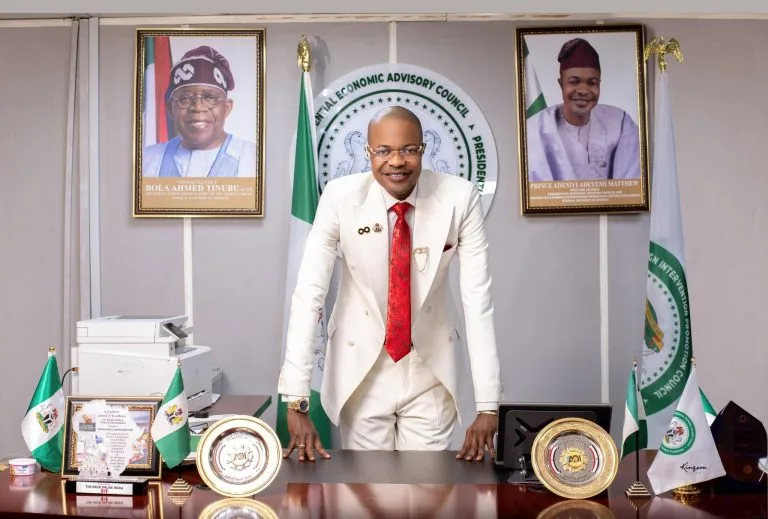
The controversy surrounding the PFIPC has intensified in recent weeks following allegations that the organisation operated as a government agency despite questions over its establishment, with its purported Director-General, Adeniyi Adeyemi, facing scrutiny from law enforcement agencies and lawmakers.
The party said the ICPC’s interim findings had failed to provide satisfactory explanations for how the organisation allegedly secured office accommodation within the Federal Secretariat, attracted civil servants, obtained official recognition and appeared in the 2026 federal budget with a reported allocation of N1.3 billion.
The ADC recalled that it had previously opposed President Bola Tinubu’s decision to assign the investigation to the ICPC, insisting that an independent panel would have been better positioned to investigate the matter without questions about institutional proximity.
According to the opposition party, the interim nature of the ICPC report made it even more difficult to understand why the commission appeared to be pointing responsibility towards Adeyemi while simultaneously maintaining that its investigation was still ongoing.
“The report is not only predictable, it appears more concerned with exonerating government officials rather than providing clear answers to the serious questions that the scandal has raised,” the party said.
The ADC argued that the controversy could not simply be dismissed as an administrative failure.
It maintained that if the PFIPC was indeed established through fraudulent representations, there were still important questions about how those representations allegedly passed through several layers of government without being detected.
“A forgery may explain the first door that was opened. It cannot explain why every subsequent door appears to have opened as well,” the party said.
For the ADC, the central issue is not simply whether Adeyemi allegedly forged documents or misrepresented himself.
The party wants investigators to establish how an organisation whose legitimacy is now being questioned could allegedly secure office accommodation, civil servants, official vehicles and other institutional support.
It argued that such developments would ordinarily require interaction with multiple government departments and officials.
The party therefore questioned whether the alleged activities were facilitated by negligence, institutional failure or possible complicity within government.
The ADC also raised concerns over reports that the ICPC had identified two other allegedly fictitious organisations linked to Adeyemi.
Rather than viewing that development as evidence of an isolated individual operation, the party said it should prompt investigators to widen the scope of their inquiry.
One of the most significant issues raised by the opposition party was the reported N1.3 billion allocation to the PFIPC in the 2026 Appropriation Act.
The ADC argued that a provision of that magnitude should have generated a clear paper trail involving budget submissions, reviews, approvals and verification.
“Budgetary provisions do not materialise by accident,” the party said.
It consequently demanded to know who proposed the allocation, which government officials processed it and who verified the existence and legitimacy of the purported agency before the provision was included in the federal budget.
The party noted that the House of Representatives had already begun its own investigation into how the PFIPC allegedly found its way into the federal budget.
According to the ADC, the legislative inquiry could provide an opportunity to establish whether the budget allocation resulted from deliberate manipulation, administrative negligence or failures within the government’s budgetary verification system.
The opposition party also criticised the reported recommendation that Adeyemi be prosecuted.
It argued that the ICPC’s decision to single out the purported PFIPC director-general appeared premature if, as the commission itself indicated, its investigation remained ongoing.
“If all that the commission had to present was a preliminary report, why not simply present it as a confidential brief to the President instead of making a public drama of it?” the ADC asked.
The party said the investigation should not be structured around finding a convenient individual to blame but should instead establish everyone who may have played a role in allowing the alleged operation to continue.
The ADC described the controversy as a national embarrassment and called on the ICPC to release the full interim report rather than only selected findings.
It also demanded that any public officials whose actions or negligence enabled the purported agency to operate be identified and investigated.
The party stressed that anyone found culpable should face appropriate sanctions after due process.
“What has happened is a national disgrace in the full glare of the entire world. No serious government should be satisfied with identifying one culprit for prosecution,” the party said.
The ADC maintained that Nigerians were not asking investigators to manufacture suspects or reach predetermined conclusions.
Rather, it said, the investigation should follow the evidence wherever it leads — including into government offices if necessary.
At the heart of the controversy, according to the opposition party, is a simple question: if the PFIPC is not a legitimate government agency, how did it allegedly get so far inside the machinery of government without multiple officials noticing?
That, the ADC argued, is the question the ongoing investigations must ultimately answer.


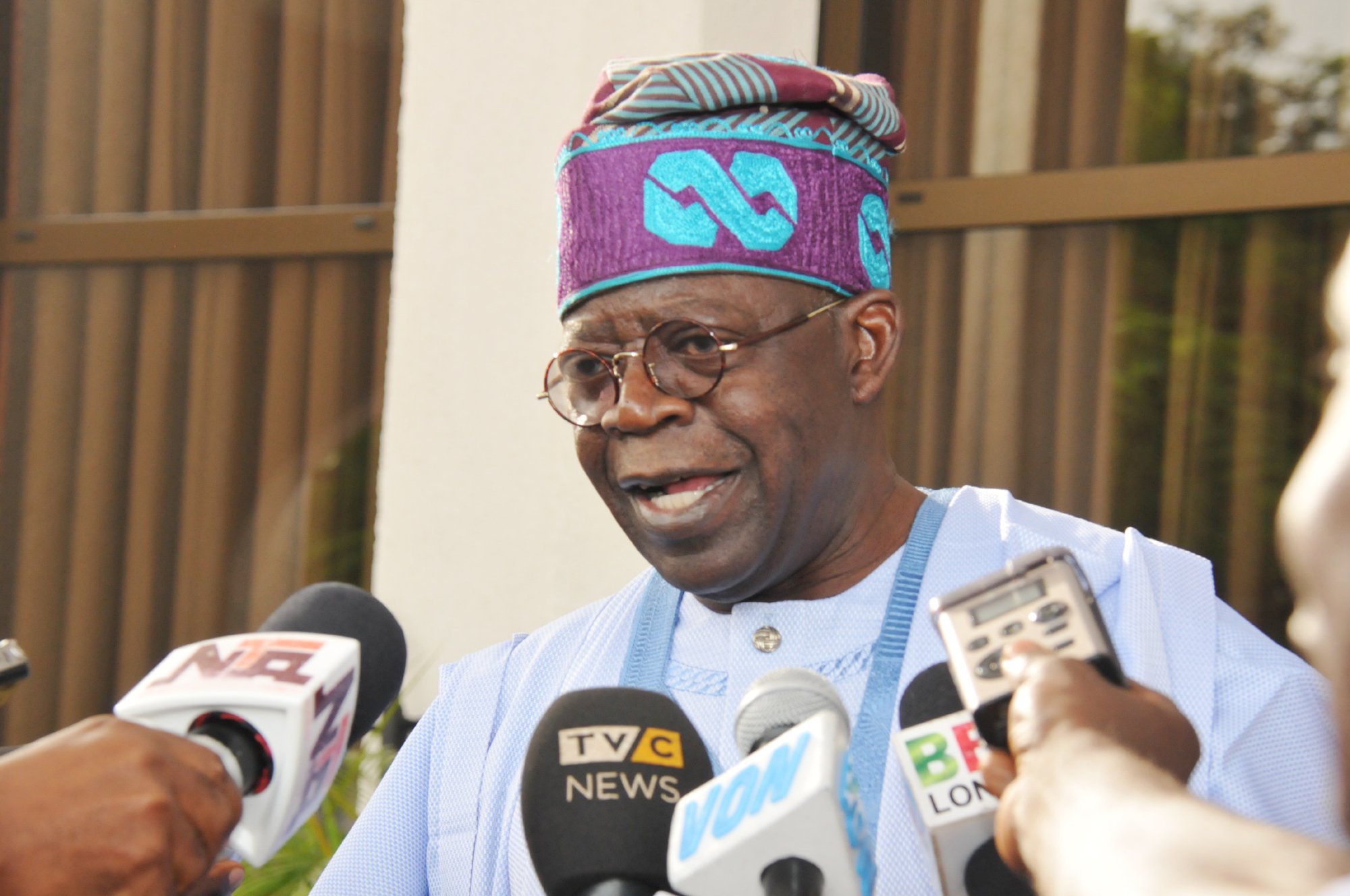
President Bola Tinubu says he has no regrets over the removal of petrol subsidy and other economic reforms introduced by his administration, insisting that Nigeria could not borrow its way to greatness.
Meanwhile, Minister of Finance and Coordinating Minister of the Economy, Taiwo Oyedele, has warned Nigerians against returning to petrol subsidy. He said the backtrack could trigger capital flight, undermining investor confidence and pushing the Naira to N3,000, N3,500 or even N4,000 per dollar.
But the Director of Media and Publicity of the African Democratic Congress (ADC) Presidential Campaign Council (PCC), Kola Ologbondiyan, challenged Oyedele to publish the economic model behind his warning that a return to fuel subsidy could push the naira to N4,000 per dollar.
The President spoke on Monday during the City Boys Movement retreat in Abuja, where he charged members of the group to mobilise support for his administration ahead of the 2027 general elections, insisting that the country’s future mattered more than the ambition of any individual candidate.
“No regrets,” Tinubu said, insisting that his administration would not be pushed back from its reform agenda.
He took a swipe at his political opponents, promising to restore the petrol subsidy, saying Nigeria could no longer afford to pay the fuel subsidy, and warning that reversing the policy would take the country back to an unsustainable economic path.
Defending his decision to remove the subsidy on his first day in office, Tinubu said the country was on the verge of financial collapse and could no longer afford the policy’s cost.
Tinubu also sought to reassure Nigerians about the direction of the economy, arguing that growth was steady and that the sacrifices associated with his reforms would ultimately offer citizens a future worth believing in.
Oyedele disclosed during a press briefing of the International Monetary Fund (IMF) and World Bank Annual Meetings in Bangkok, Thailand, yesterday, that investors had repeatedly questioned whether the government would abandon its reforms ahead of the next election cycle.
Ruling out the reversal of the government’s economic reforms, he maintained that any signal that Tinubu’s administration was contemplating or reinstating the subsidy would immediately affect financial markets, raise borrowing costs and worsen economic pressures on households.
“In all the meetings I have had, I came to a conclusion that the markets, including the domestic market, which you can read from the capital market, and the international market, have largely written off the opposition in Nigeria as unserious.
“If, for any reason, the President were to say we are merely considering the return of fuel subsidy, capital would react immediately, airfares would struggle, the naira would come under severe pressure, potentially moving towards 3,000, 3,500 or even 4,000.
The very fuel people want subsidised would become far more expensive in Naira terms,” Oyedele warned.
However, Ologbondiyan accused the Federal government of using fear to discourage debate on fuel subsidy, insisting that Nigerians deserve evidence, not alarming projections, on the potential economic consequences of restoring the policy.
Speaking to journalists, he described the minister’s warning as scaremongering and demanded that the government explain how it arrived at the projected exchange rate.
“The Minister of Finance is merely scaremongering. He cannot claim that a return to fuel subsidy will cause the naira to depreciate to N4,000 to the dollar without showing Nigerians the model behind that projection,” he said.
He questioned the reliance on investors’ concerns to oppose a subsidy’s return, challenging the government to identify the sources of the projections and disclose their calculations.
President Bola Tinubu has expressed sadness over the death of Ambassador Patrick Dele Cole, describing him as a distinguished diplomat, journalist, politician and public servant.
Cole died at 86.
In a statement on Saturday, Tinubu said Cole devoted his life to national service and brought distinction to his work in diplomacy, journalism and politics.
“His career reflected the enduring value of dialogue, tact, mutual respect and the pursuit of shared interests in advancing national development and international cooperation,” the President said.
Tinubu noted Cole’s contributions to Nigeria’s media landscape, particularly as Managing Director of the Daily Times, where he upheld the role of the press in holding public officials accountable, speaking truth to power and strengthening democratic governance.
“His legacy in journalism and public life remains an enduring part of our national story,” he said.
The President said at 86, Cole witnessed defining moments in Nigeria’s history and contributed to national development, adding that his life stands as a testament to experience, principled engagement and commitment to public good.
Tinubu extended condolences to Cole’s family, friends, professional associates and all whose lives he touched, praying that memories of his remarkable life will bring comfort and strength.
“May Almighty God grant Ambassador Cole eternal rest and give his family and all who mourn him the fortitude to bear this profound loss,” he said.

Director-General of the World Trade Organisation (WTO), Mrs. Ngozi Okonjo-Iweala, has said that her probe of an alleged $2.4bn subsidy fraud led to the abduction of her mother.
It would be recalled that the former Finance Minister’s mother, Kamene Okonjo, was kidnapped from her home in Ogwashi-Uku, Delta State, in December 2012.
In a recent interview with Bloomberg, Okonjo-Iweala said the abductors demanded that she resign as minister of finance and leave the country.
The WTO director-general served as Nigeria’s finance minister between 2011 and 2015 under former President Goodluck Jonathan.
She said the subsidy investigation began after her office noticed a sharp increase in claims submitted by petrol importers.
“So I went to the president and said, look, something is going on here. Could we audit the accounts? And he said, yes, go ahead. And we found about $2.4 billion worth of fraud. So, we refused to pay,” she recounted.
She said her mother was abducted shortly after the decision was announced, adding that her captors demanded her resignation as a condition for her release.
“I was told (by the kidnappers) that for her to be released, I should resign and leave the country,” she said.
The former minister described the incident as one of the most traumatic experiences of her life, saying her mother was held in a forest before escaping.
“She was held in the middle of a forest, and one night she escaped. She’s still alive. She’s 96 now,” Okonjo-Iweala said.
“It was a terrible, terrible five-day ordeal. I think the worst in my life.”
“I never dreamt my parents could ever be touched in this way, that people would be that evil,” she added.
Okonjo-Iweala said she considered resigning before her mother regained her freedom, but her father warned her against giving in to the abductors’ demands.
“He said, ‘We don’t give in to blackmail’. And he said, ‘You’ve got to carry on. You’ve got to go to work’,” she recalled.


