
Metro
Adron Homes: 14 Reasons Nigerians Should Own Property with the Trusted Real Estate Brand


- /home/rhoncare/pointblank.ng/wp-content/plugins/mvp-social-buttons/mvp-social-buttons.php on line 27
https://pointblank.ng/wp-content/uploads/2026/02/970x250.jpg-1-1000x600.jpeg&description=Adron Homes: 14 Reasons Nigerians Should Own Property with the Trusted Real Estate Brand', 'pinterestShare', 'width=750,height=350'); return false;" title="Pin This Post">
- Share
- Tweet /home/rhoncare/pointblank.ng/wp-content/plugins/mvp-social-buttons/mvp-social-buttons.php on line 69
https://pointblank.ng/wp-content/uploads/2026/02/970x250.jpg-1-1000x600.jpeg&description=Adron Homes: 14 Reasons Nigerians Should Own Property with the Trusted Real Estate Brand', 'pinterestShare', 'width=750,height=350'); return false;" title="Pin This Post">
As part of activities marking its 14 years of transforming Nigeria’s real estate landscape, Adron Homes and Properties has unveiled 14 compelling reasons why individuals and families should consider owning property with the company reinforcing its commitment to accessible, stylish, and sustainable homeownership.
In a statement released by the company, Adron Homes described property ownership not just as an investment but as a strategic lifestyle decision rooted in long-term security, wealth creation, and community development. The company noted that over the past 14 years, it has remained consistent in providing affordable housing solutions while delivering well-planned estates that cater to diverse income levels.
According to the statement, Adron Homes’ success is anchored in its strong value proposition, which ranges from affordable pricing and flexible payment structures to prime estate locations nationwide. The company emphasized that its gated communities are designed with security, modern architectural standards, and structured infrastructure that ensure comfort and functionality for residents.
Adron Homes further highlighted its transparent documentation process and verified property titles, which have continued to boost investor confidence and encourage long-term property ownership among Nigerians at home and in the diaspora. The company added that its developments are intentionally designed to promote thriving communities, environmental sustainability, and long-term urban planning.
With a proven track record of helping thousands of customers achieve their property dreams, Adron Homes reaffirmed its commitment to delivering high-value investments that appreciate over time while maintaining strong customer service support from initial inquiry to allocation and beyond.
The organisation also noted its culture of appreciation for clients, partners, and staff through consistent reward programmes and promotional incentives. This strategy has strengthened loyalty and deepened engagement across its growing customer base.
Reflecting on its 14-year journey, Adron Homes reiterated that its mission goes beyond selling land and houses; it focuses on building vibrant communities where families thrive, investments grow, and futures are secured. The company encouraged Nigerians to take advantage of its flexible ownership opportunities, stressing that the best time to invest in property is now.
As it continues to expand its footprint across Nigeria, Adron Homes remains committed to innovation, excellence, and redefining the real estate experience through sustainable developments that stand the test of time.


Controversial cleric, founder and leader of the INRI Evangelical Spiritual Church, Primate Elijah Ayodele, has said that President Bola Tinubu is sick and will not be able to complete a second term if he wins the 2027 presidential election.
“If Tinubu wins the second time, he will not finish it. I stand by my word, he will not finish it. What happened to Yar’Adua or whatever that will make him not to finish it that will lead to emergency government, make Shettima take over from him might happen,” Mr Ayodele said. “Tinubu will not finish his second term, thus says the Lord of hosts.”
Mr Ayodele claimed he was denied access to Tinubu by those Mr Tinubu surrounded himself with, those who do not want him to hear the truth.
“People surrounding Tinubu don’t want him to hear the truth. They don’t want him to hear people like us. I don’t say prophets should not go again. Let them bring one billion alfas. It is a matter of time. You will all see it. If Tinubu wins a second term, he will not finish it. It is not a curse,” the INRI spiritual leader declared.
The cleric called on the president’s family to rally prayers and not let Mr Tinubu die.
“You are not seeing what I am seeing. Tinubu is not OK. He needs prayers. Wife, children of Tinubu, wake up. Seyi! Help Tinubu. Don’t let your father die,” Mr Ayodele said.

A 30-year-old man identified as Emmanuel Okpara has been arrested in Enugu over the alleged murder of his girlfriend, Chinyere.
The suspect, of Olympic Layout, One-Day, Enugu, allegedly beat his girlfriend to death over argument of who between them infected the other with HIV.
Okpara had allegedly after the murder hidden the remains of the lady in his toilet.
However, his neighbours forced the door to his apartment open and discovered the remains and subsequently alerted the police.
The spokesperson for Enugu Command, SP Daniel Ndukwe, confirmed the incident in a statement on Tuesday.
Ndukwe explained that Chinyere’s surname, age and address had yet to be established.
He stated that the suspect was rescued from an angry mob and detained by police operatives attached to Awkunanaw Division at about 6:30pm on September 21.
He added that “the rescue followed information reaching the police that Okpara had allegedly murdered his girlfriend.
“Preliminary investigation indicates that the suspect allegedly killed the victim on September 19, wrapped her remains in a nylon and locked them inside the toilet of his apartment.
“The offensive odour of the decomposing body subsequently attracted neighbours, who forced the door open and apprehended him before the arrival of the police.
“The remains were evacuated to a mortuary for preservation and autopsy, while efforts are ongoing to trace and notify her relatives,” the statement added.
It further stated that during preliminary interrogation, the suspect confessed to the crime.
Ndukwe explained that the suspect confessed that the incident followed an argument between him and the deceased over allegations of who infected the other with HIV.
He further stated that during the argument, Okpara hit the deceased on the head with a pestle, resulting in her death.
He was alleged to have subsequently wrapped and dumped her remains inside his toilet.
According to Ndukwe, the Commissioner of Police, Mr Mamman Giwa, has ordered the State Criminal Investigation Department (SCID) to conduct a discreet and thorough investigation to establish the circumstances surrounding the incident.
The commissioner directed the SCID to ensure that the suspect was arraigned upon the conclusion of investigations.
He cautioned the public, particularly unsuspecting young women, to inform trusted relatives or friends about their whereabouts and exercise caution about whom they visit or spend time with.
NAN
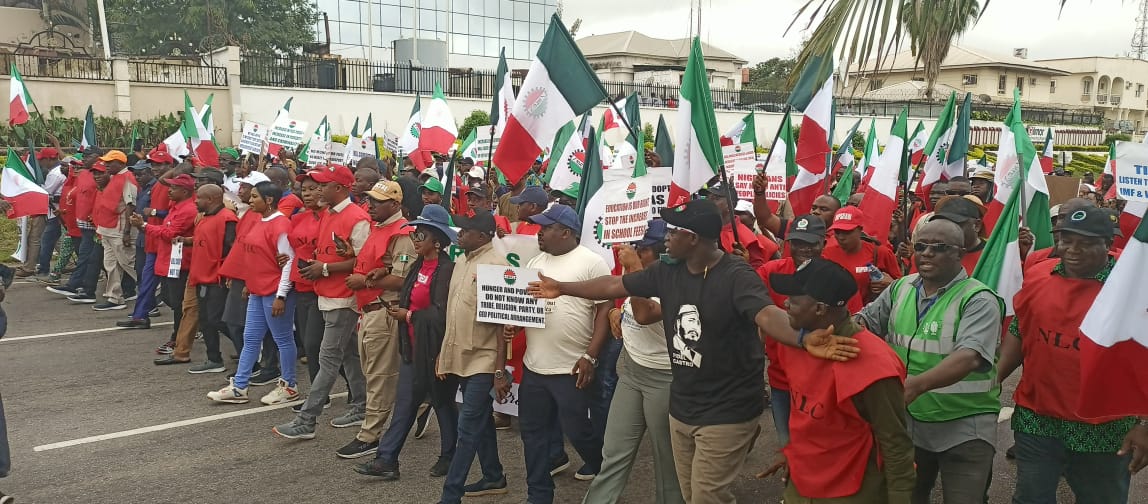
Civil servants under the aegis of Joint National Public Service Negotiating Council, (JNPSNC) trade union side, have written to President Bola Tinubu, seeking an immediate intervention to tackle the worsening economic hardship facing workers.
In a letter addressed to the President, the workers urged the Federal Government to stabilise the price of petrol at N500 per litre, approve an immediate Wage Award and upwardly review salaries and allowances across the public service.
The workers equally demanded the immediate constitution of a committee to negotiate a new National Minimum Wage ahead of January 2027.
According to the workers, the recent increase in fuel prices to N1,430 per litre and above in some locations had further worsened the cost-of-living crisis.
They gave the Federal government until Wednesday, September 30, 2026, to take action on their demands, warning that the prevailing hardship was creating palpable tension among workers and Nigerians.
The workers added that the removal of fuel subsidy three years ago had triggered an astronomical increase in fuel prices and produced multiplier effects on the prices of essential commodities across the economy.
According to the JNPSNC, the situation had made life increasingly unbearable for workers, adding that the provision of food palliatives was not a sustainable solution to the economic crisis.
“It has dawned on Nigerian workers that the provision of palliatives such as bags of rice, Indomie, vegetable oil, garri, among other edible foods, is as good as weaponising Nigerians with poverty because it is a Pyrrhic intervention which is unsustainable, inaccessible to the majority of Nigeria’s population and also limited to political cronies,” the workers said.
They further stressed that a more sustainable intervention would be to reduce the cost of fuel to N500 per litre, stating that the measure would have a multiplier effect across the economy.


