
Headlines
Again, Iran’s Military Closes Strait of Hormuz

- /home/rhoncare/pointblank.ng/wp-content/plugins/mvp-social-buttons/mvp-social-buttons.php on line 27
https://pointblank.ng/wp-content/uploads/2026/04/straitofhormuz-1000x600.png&description=Again, Iran’s Military Closes Strait of Hormuz', 'pinterestShare', 'width=750,height=350'); return false;" title="Pin This Post">
- Share
- Tweet /home/rhoncare/pointblank.ng/wp-content/plugins/mvp-social-buttons/mvp-social-buttons.php on line 69
https://pointblank.ng/wp-content/uploads/2026/04/straitofhormuz-1000x600.png&description=Again, Iran’s Military Closes Strait of Hormuz', 'pinterestShare', 'width=750,height=350'); return false;" title="Pin This Post">
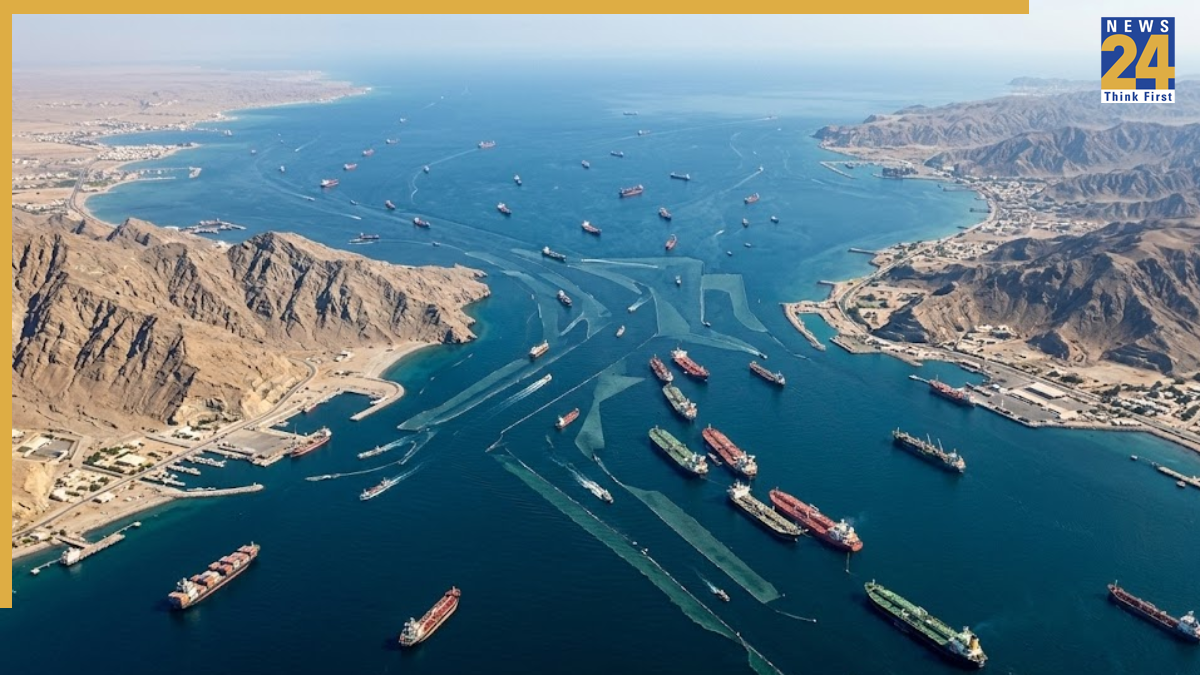
Iran’s military, on Saturday, declared the Strait of Hormuz closed again, hours after reopening it and with more than a dozen commercial ships passing through the vital waterway.
The toing and froing over the strait cast doubt on US President Donald Trump’s optimism the day before, that a peace deal to end the US-Israeli war with Iran was “very close”.
Tehran had on Friday declared the strait, which usually carries a fifth of the world’s oil and liquefied natural gas, open on Friday after a ceasefire was agreed in Lebanon to halt Israel’s war with Hezbollah.
That prompted elation in global markets and sent oil prices plunging, but with Trump insisting that a US naval blockade of Iranian ports would continue until a deal was concluded, Tehran threatened to shutter the strait once more.
Then, late on Saturday morning, citing a statement from military central command, Iranian state TV reported that “control of the Strait of Hormuz has returned to its previous status” and “is under strict management and control of the armed forces”, blaming the continued US blockade.
The announcement came as maritime tracking sites showed several ships making a dash through the narrow waterway, hugging close to Iranian territorial waters as instructed by Tehran and, for some, broadcasting their identity as Indian or Chinese in an apparent attempt to show their neutrality.
The same sites showed that late on Friday, a number of ships began heading for the strait before suddenly turning back amid the uncertainty.
By 0900 GMT on Saturday, several ships had fully transited the strait in both directions, but at least two tankers headed eastwards from the Gulf towards India after loading in UAE ports appeared to have turned around and aborted their journeys.
There are just four days remaining before the end of the two-week ceasefire in the US-Israeli war with Iran, launched by Washington and its ally on February 28.
Nevertheless, President Trump appeared convinced that a deal could be finished shortly.
He declared Friday “GREAT AND BRILLIANT,” and made a series of social media posts praising talks mediator Pakistan.
Islamabad’s powerful military chief, Field Marshal Asim Munir, on Saturday finished a three-day visit to Iran aimed at securing the peace deal, during which he met Iran’s top leadership.
While Munir was in Iran, Pakistani Prime Minister Shehbaz Sharif visited Saudi Arabia, Qatar and Turkey to push the peace process.
Islamabad has emerged as the lead mediator during the conflict, hosting a marathon round of direct peace talks last weekend attended by US Vice President JD Vance.
A second round of talks is expected in the Pakistani capital this coming week, with envoys hoping to end the war that was started by the US and Israel on February 28.
The allies launched a massive wave of surprise attacks on Iran, despite Washington and Tehran being engaged in diplomatic talks, that killed Iranian supreme leader Ali Khamenei and numerous senior leaders.
The war rapidly spread across the region, with Iran targeting US interests in the Gulf and Hezbollah dragging Lebanon into the conflict by launching rockets at Israel.
In a sign that the two-week ceasefire remained stable, Iran’s civil aviation agency declared its airspace was open again, with international flights able to transit Iran via the east of the country.
Nevertheless, two major sticking points in the peace talks — Iran’s stockpile of near-weapons-grade enriched uranium and the future of the Strait of Hormuz — appeared up in the air.
Speaking by phone with AFP on Friday, Trump said “we’re very close to having a deal,” adding that there were “no sticking points at all” left with Tehran.
Later the same day, at an event in Arizona, the president declared that Iran had agreed to hand over its 440 or so kilogrammes of uranium enriched to 60 percent — close to that needed for a bomb.
“We’re going to get it by going in with Iran, with lots of excavators,” he said.
But hours before, Iran’s foreign ministry had said its stockpile, thought to be buried deep under rubble by US bombing in last June’s 12-day war, was not going anywhere.
“Iran’s enriched uranium is not going to be transferred anywhere,” Iranian foreign ministry spokesman Esmaeil Baqaei told state TV.
“Transfer of Iran’s enriched uranium to the US has never been raised in negotiations.”
Ordinary Iranians, meanwhile, remained cut off from the international internet, with monitor netblocks announcing on Saturday that the blackout implemented at the start of the war had reached its 50th day.
AFP


By Eric Elezuo
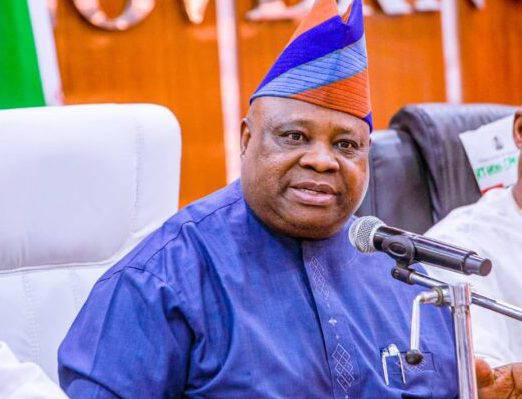
Governor Ademola Adeleke of Osun State has won state’s governorship election. The result was announced by the Returning Officer of the Osun State governorship election, Prof Joshua Olalekan Ogunwale.
The governor polled a total of 511, 067 votes to defeat his closest rival, Bola Oyebamiji of the All Progressives Congress (APC), who score 444, 815 votes. The African Democratic Congress (ADC), Salaam Najid (Iwaloye), came a distant third with 17, 180 votes
Adeleke took an early lead as results uploaded by the Independent National Electoral Commission (INEC) showed him establishing a commanding lead over his closest challenger, and sustained the lead till the final counting
As at 2.06 a.m. on Sunday, INEC had uploaded results from 3,612 polling units, representing 95.99 per cent of the 3,763 polling units in the state, to its Result Viewing Portal (IReV).
With results from only 151 polling units yet to be uploaded, Adeleke, candidate of the Accord Party, had polled 509,057 votes, representing 51.7 per cent of the votes available on IReV.
The emerging outcome came despite a formidable APC campaign effort that drew about 10 governors and leading figures of the ruling party to Osun to canvass support for Oyebamiji.
Eecall that the Senate President Godswill Akpabio and Speaker of the House of Representatives Tajudeen Abbas were among senior APC figures who stormed Osun, and campaigned for the party’s candidate.
Governors who joined the campaign included Hope Uzodimma of Imo State, Monday Okpebholo of Edo State, Usman Ododo of Kogi State, AbdulRahman AbdulRazaq of Kwara State, Babajide Sanwo-Olu of Lagos State, Biodun Oyebanji of Ekiti State, Dapo Abiodun of Ogun State, Mai Mala Buni of Yobe State and Lucky Aiyedatiwa of Ondo State. Delta State Governor Sheriff Oborevwori was represented by his deputy, Monday Onyeme.
By this victory, Adeleke is expected to pilot the affairs of the state for the next four years, till 2031.
Headlines
Atiku Drags Tinubu to Court over Certificate Forgery, Eligibility to Contest 2027 Election
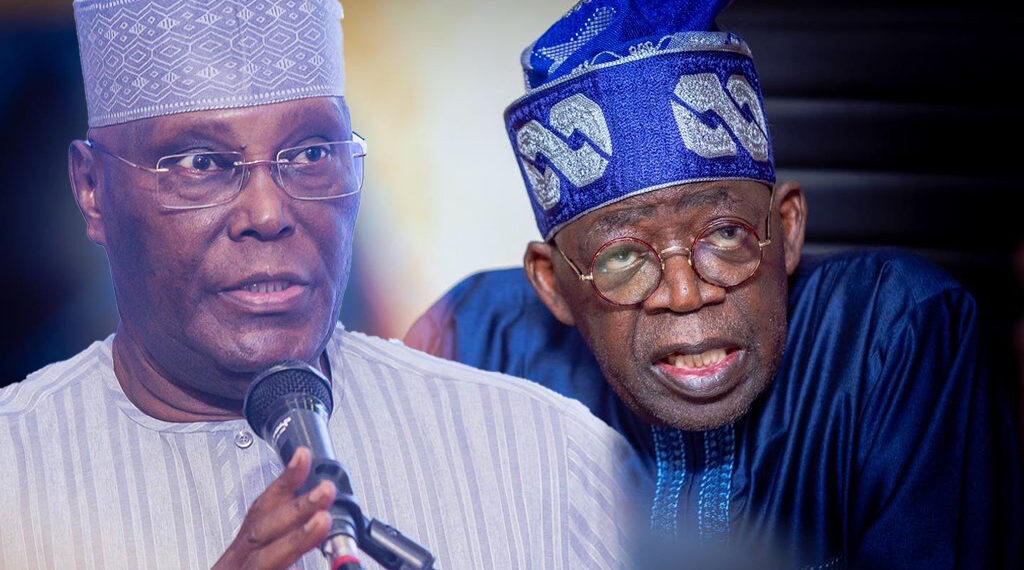
Atiku, who is the presidential candidate of the African Democratic Congress (ADC), personally appeared at the court registry to depose to an affidavit in support of the suit.
The suit was instituted by Atiku and the ADC against President Tinubu, the All Progressives Congress (APC), and the Independent National Electoral Commission (INEC).
It is anchored on Sections 137(1)(j), 139(1)(a)(i), and 285(14)(c) of the 1999 Constitution, as well as provisions of the Electoral Act, 2026.
At the heart of the case is Section 137(1)(j), which disqualifies anyone who presents a forged certificate to INEC from contesting for President.
The plaintiffs are asking the court to determine whether Tinubu and the APC should be disqualified from the 2027 election over allegations that the President submitted an NYSC discharge certificate bearing the name “Tinubu Bola Adekunle” to INEC for both the 2023 and 2027 elections.
According to Atiku’s affidavit, the name on the certificate is different from “Bola Ahmed Tinubu,” and the document was not obtained by the President.
Speaking after taking the oath, Atiku said his personal appearance was to show seriousness.
“I came here personally because the issues before the court go to the heart of our Constitution and the integrity of the office of President… I have therefore put my name, my signature and my oath behind the facts we are presenting to the court. Now it is President Tinubu’s turn to answer them,” he said.
The suit also asks INEC to produce Tinubu’s Form CF001 submitted for the 2023 and 2027 elections.
Atiku said he had applied for certified true copies of the form but got no response before filing.
“This is precisely why we have gone to court. We are not asking Nigerians to decide this matter on social media… We are asking the institution holding the records to produce them and the judiciary to examine the evidence and pronounce on it,” Atiku stated.
“If the certificate belongs to Bola Ahmed Tinubu, let that be established before the court. If ‘Tinubu Bola Adekunle’ and ‘Bola Ahmed Tinubu’ are one and the same person for the purpose of that certificate, let the evidence establish it.”
Beyond the certificate, the ADC and Atiku are also challenging aspects of the Electoral Act, 2026, which they argue restrict pre-election challenges to a candidate’s qualification. They contend that no law can override the Constitution.
“Can an Act of the National Assembly be used as a shield against an express provision of the Constitution?… Our position is that the Constitution remains supreme,” Atiku said.
Among the reliefs sought is an order disqualifying Tinubu and the APC from participating in the 2027 presidential election if the court upholds the plaintiffs’ case.
“Nobody should misunderstand what is at stake. Nigerian graduates cannot complete NYSC documentation with one identity and simply ask employers to ignore discrepancies… The Presidency is not an immunity certificate against constitutional scrutiny,” he added.
Atiku further urged INEC to demonstrate neutrality by making the relevant records available to the court.
“The 2027 election must begin with clarity about the qualification of those seeking the Presidency. Nigerians should not be asked to vote first and investigate later,” he said.
Lead counsel, Joseph Onu Silas, Esq., said the legal team was confident the case would help deepen Nigeria’s electoral jurisprudence.
“This is not about privilege, personalities or presidential power. It is about one Constitution and one standard for every Nigerian. Nobody is above the Constitution — not Atiku Abubakar, not Bola Tinubu, and certainly not the President of the Federal Republic of Nigeria,” Onu said.
Lawyer petitions EU over Tinubu’s qualification, cites ‘subversion of constitution’
Relatedly, a renowned Nigerian lawyer, Kalu Kalu Esq., has submitted a petition to the European Union in Brussels, alleging that President Bola Ahmed Tinubu subverted constitutional order ahead of the 2027 general election.
His remark was shared on Facebook Friday by Paul Ibe, Media Adviser to former Vice President Atiku Abubakar.
Kalu, who spoke at the European Commission headquarters, said the petition seeks the EU’s intervention to “help restore constitutional democracy in Nigeria.”
He accused President Tinubu of submitting false academic credentials to the Independent National Electoral Commission, INEC, and failing to state the primary and secondary schools he attended.
“Mr President, Bola Ahmed Tinubu, has suspended the constitutional order in Nigeria because of his false academic credentials, which he submitted to INEC for the 2027 general election and he did not state the primary school and the secondary school he attended,” Kalu said.
The lawyer cited Section 137(1)(j) of the 1999 Constitution, arguing that presenting a false certificate to INEC disqualifies a candidate.
“Section 1371J says if you have presented a false certificate to INEC, the Independent National Electoral Commission, you will not be qualified to run election and he has submitted forged documents, forged certificates to INEC that made him not to be qualified to run for the 2027 general election,” he stated.
Kalu further alleged that because “they have captured all the power in Nigeria,” the President has “imposed himself on Nigeria, thereby subverting the provisions of the constitution of the Federal Republic of Nigeria as amended, which is a mini-coup, a sub-coup against the people of Nigeria.”
He said the purpose of his visit to Brussels was to formally submit the petition to the EU and solicit support for the restoration of constitutional governance in Nigeria.
“Good afternoon all and good afternoon to the whole world. I am here at the European Commission to submit a petition to the European Union concerning the subversion of constitutional order in Nigeria… So, I’m here to submit the petition to the EU to help restore constitutional democracy in Nigeria,” he said.
As of the time of filing this report, the Presidency and INEC have not responded to the allegations.
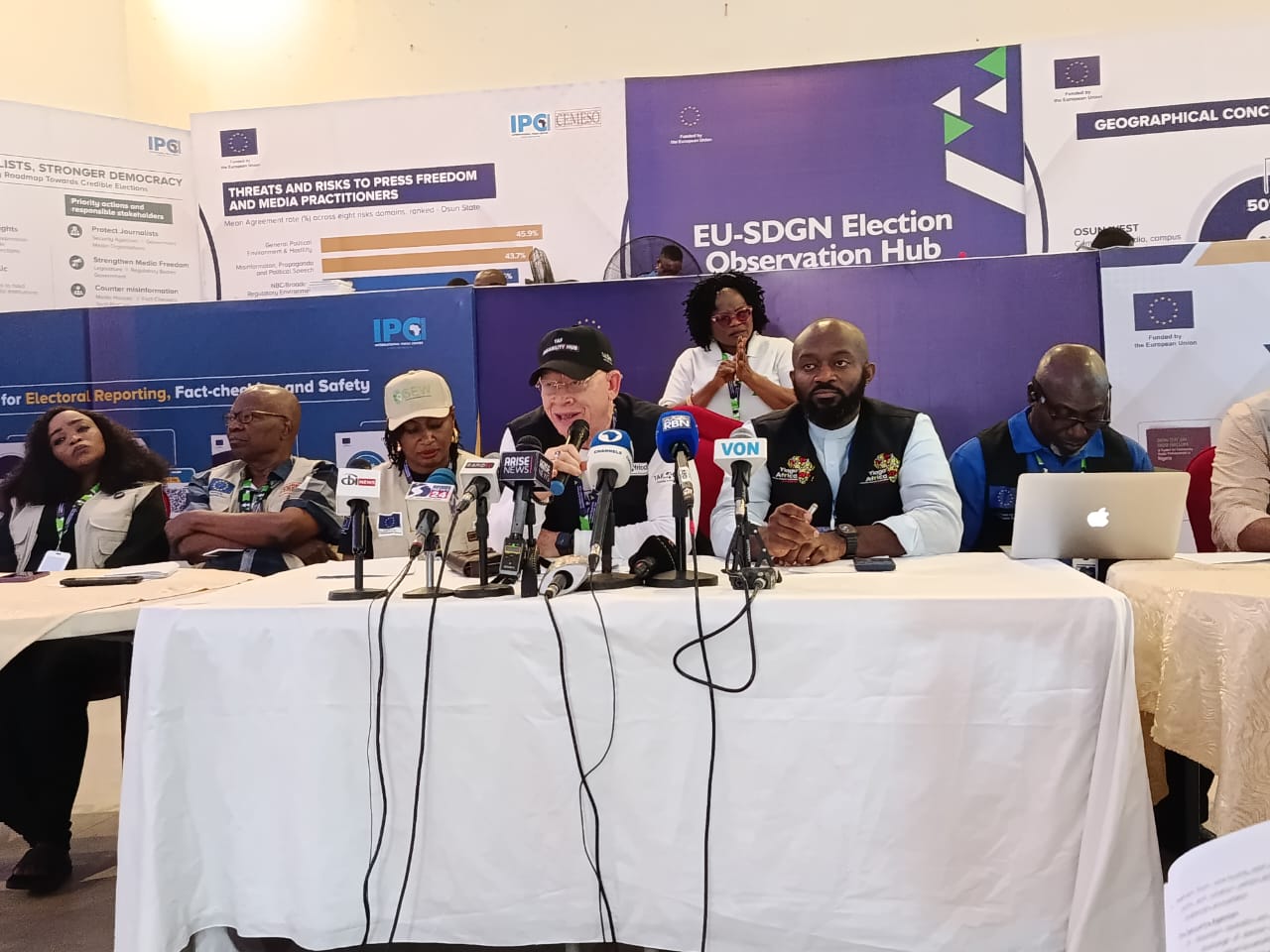
The European Union-Supported Election Observation Group has deployed 843 observers across Osun State for Saturday’s governorship election, as part of efforts to independently assess the conduct of the poll.
The group, comprising the Centre for Media, Society, the International Press Centre, the Nigerian Women’s Trust Fund, the Kukah Centre and Yiaga Africa, disclosed this in its preliminary statement on the election on Friday in Osogbo, the state capital.
Speaking at the event, the Executive Director of Yiaga Africa, Samson Itodo, said the observers would monitor, document and report on the electoral process in line with the principles of independence, impartiality and non-partisanship.
Itodo said; “the election was of significant national importance as it would provide another opportunity to assess the implementation of provisions of the electoral legal framework and offer INEC, security agencies, electoral stakeholders and the public further insight into preparations ahead of the 2027 general election.”
He said, “the group acknowledged INEC’s declared operational, technological and logistical readiness for the election, including the deployment of election materials and personnel.”
The EU group also noted that INEC had increased the number of Bimodal Voter Accreditation System devices following technical challenges identified during the mock accreditation exercise, with additional devices provided as backup.
On result management, however, the group called for greater clarity on the electronic transmission and backend validation of polling unit results.
It urged INEC to make the result transmission process more transparent and verifiable, including providing clearer information on the backend validation process and the use of electronic result sheets.
The group also called on the Commission to ensure smooth electronic transmission of validated polling unit results and maintain adequate live backup of election data to prevent disruptions during accreditation and counting.


