
News
Akpabio Admits Deleting ‘Real-Time’ from Electoral Act, Proffers Defence

- /home/rhoncare/pointblank.ng/wp-content/plugins/mvp-social-buttons/mvp-social-buttons.php on line 27
https://pointblank.ng/wp-content/uploads/2025/11/Akpabio-large-930x620-1-930x600.webp&description=Akpabio Admits Deleting ‘Real-Time’ from Electoral Act, Proffers Defence', 'pinterestShare', 'width=750,height=350'); return false;" title="Pin This Post">
- Share
- Tweet /home/rhoncare/pointblank.ng/wp-content/plugins/mvp-social-buttons/mvp-social-buttons.php on line 69
https://pointblank.ng/wp-content/uploads/2025/11/Akpabio-large-930x620-1-930x600.webp&description=Akpabio Admits Deleting ‘Real-Time’ from Electoral Act, Proffers Defence', 'pinterestShare', 'width=750,height=350'); return false;" title="Pin This Post">
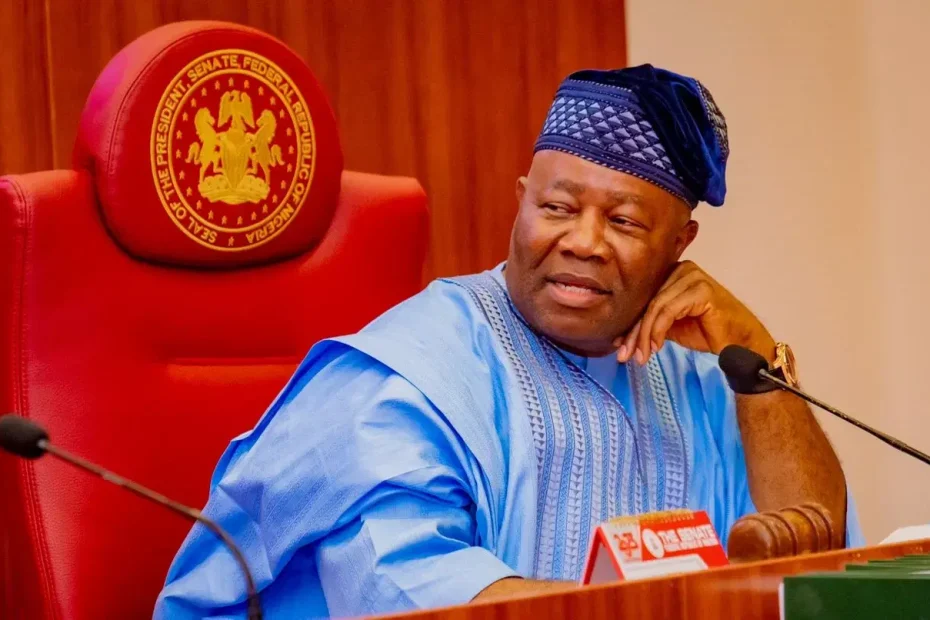
President of the Senate, Godswill Akpabio, on Saturday, admitted that the Senate deliberately deleted the provision for “real-time” transmission of election results from the Electoral Bill, 2026.
Akpabio said the Senate took the decision because it believed that “technology must save and not endanger democracy.”
He spoke in Abuja at the unveiling of a book titled “The Burden of Legislators in Nigeria”, authored by Senator Effiong Bob.
The Senate President likened the issues raised in the book to the challenges faced by lawmakers in the course of their duties, including the controversy and alleged “abuses” directed at the Senate following the passage of the electoral bill.
Defending the removal of real-time electronic transmission from the bill, Akpabio argued that the entire country could be thrown into chaos if, for instance, network or power failure affected the uploading of results.
He insisted that Form EC8A and other official election records should remain the most reliable means of declaring results.
“All we said was to remove the word ‘real-time’ to allow INEC decide the mode of transmission. If you make it mandatory and there is a system failure, there will be a serious problem,” Akpabio told the gathering, further confirming that the bill, as passed, excluded real-time electronic transmission of results.
He gave another example: “Real-time means that if there are nine states where there is no network, does it mean elections will not take place there?
“Or in any part of the country where there is a grid breakdown, does it mean there will be no election?
Reacting to the outrage that trailed the Senate’s action, the Senate President said the legislature would not be “intimidated” into passing a faulty law simply to please opposition political parties, civil society groups and non-governmental organisations (NGOs).
Akpabio criticised NGOs for insisting that because they organised retreats for lawmakers – where ideas were exchanged on the electoral bill – the Senate must adopt their positions, even if such positions did not align with the interests of all segments of the country.
“Why are people setting up panels on television stations and abusing senators? I leave them to God.
“We will not be intimidated but will do what is right for Nigeria, not what one NGO says. A retreat is not law-making.
“Why do you think that the paper you agreed to in Lagos must be what we must approve?” he asked.
Akpabio, who noted that many Nigerians had turned themselves into authorities on legislative matters despite being ignorant of the law-making process, however, softened his stance, promising that there was still a window of opportunity for amendments to the bill.
He cited the Votes and Proceedings of the day’s sitting, explaining that as long as they had not been approved, the bill could still be corrected if the majority of senators supported such changes.
“We have not even completed it until we look at the votes and proceedings. When we bring out the votes and proceedings, any senator has the right to rise and amend it.
“We can amend anything before we approve the votes and proceedings. Why abuse the Senate when what we have is incomplete?
“I can’t talk until they tell me to drop the gavel. In this case, we are yet to complete the process,” he said.
The Senate President also stated that attacks on the Senate were uncalled for, noting that any provision rejected by the Senate could be reinstated by the Conference Committee of the Senate and the House of Representatives. He said there was therefore no need to hastily criticise senators.
However, the National Chairman of the African Democratic Congress (ADC) and former President of the Senate, Senator David Mark, who chaired the occasion, immediately responded, cautioning Akpabio against speaking for the Independent National Electoral Commission (INEC).
“What the ADC is saying is: pass the law and let INEC decide whether it can implement real-time electronic transmission or not. Don’t speak for INEC.
“The position of the ADC is clear: pass the bill and let INEC decide what it will do with it,” Mark insisted.
Several speakers at the event, including Akwa Ibom State governor, Pastor Umo Eno, and the book reviewer, Professor Maxwell Gidado, praised Senator Bob’s courage in writing the book, describing it as a bold effort to highlight the challenges faced by Nigerian legislators in the course of their duties.
The author also outlined some of these challenges, listing electoral battles, conflicts with governors and political godfathers, judicial annulment of electoral victories, addressing private concerns of constituents, and self-inflicted challenges.
“The courage to defend democracy is in the legislature and the legislators,” he said.


Amnesty International Nigeria has urged Nigerian security authorities to investigate allegations of political violence threats made by politicians ahead of the 2027 general elections and ensure that those found responsible are held accountable.
The human rights organisation made the demand in a statement shared on its verified Facebook page on Saturday, following reported remarks attributed to the Edo State Chairman of the All Progressives Congress (APC), Jarret Tenebe.
Amnesty International said Tenebe was reportedly quoted as threatening to deploy the “power of AK-47” against persons allegedly attempting to frustrate the APC’s ambition of securing 2.5 million votes for President Bola Tinubu in the 2027 presidential election.
“Tenebe made the threat during a campaign rally in Edo State, where political violence is already rampant,” Amnesty International said.
The organisation also raised questions over the response of Nigerian security agencies, particularly the Nigeria Police Force and the Department of State Services, to what it described as public threats of violence issued by politicians.
It noted that such remarks were being made “in utter disregard for the rule of law and the nation’s Electoral Act.”
Amnesty International called on the authorities to ensure that politicians and other public figures, irrespective of their political affiliations, are held responsible for actions or statements that incite, threaten or encourage politically, religiously or ethnically motivated violence.
The organisation further stressed that accountability should cover individuals involved in carrying out or promoting violence and human rights violations before, during and after the 2027 general elections.

Gunmen have reduced the ransom demanded for the release of the 20 kidnapped prospective National Youth Service Corps (NYSC) members from N50million to N5million each, bringing the total amount to N100million.
The kidnappers, last Friday, set a 24-hour deadline for the payment of the N50million ransom. The ultimatum expired on Sunday.
One of the affected parents, Alimot Akande, reportedly confirmed that the amount has been reviewed to N5million each.
She stated that the kidnappers established contact with the respective parents of the captives with their mobile telephone lines.
The distraught mother lamented that the victims are being subjected to rigorous torture as they are being asked to impress upon their parents that failure to meet up with their fresh demand may result in something else.
“They are still demanding N5 million. They have come down to N5 million each.”
“The total amount that is being expected to be paid by the affected parents has reduced from one billion naira to one hundred million naira.
Akande, however, said she could not confirm how much had been raised by the families to pay the ransom, explaining that she is not privy to the individual arrangements between the kidnappers and the other parents.
“I cannot say because I do not know how much they have told those people that they have.”
When asked to describe the situation from her perspective, Akande said: “It has been horrible, scary and overwhelming.”
The situation, according to her, became more disturbing after she spoke with her sister and learnt that the abductors had begun beating the victims.
“Sir, we appeal to the government to please assist us in getting them rescued out of that place. When I spoke to my sister, they started beating them since yesterday,” she said.
Asked whether the female corps members were also being assaulted, she said the kidnappers had shown no restraint.
“They are not sparing anybody. They are beating all of them,” she said.
She also disclosed that one of the abducted corps members had been allowed to communicate with his father, but the calls were allegedly being used by the kidnappers as an avenue to monitor the family’s ability to raise money.
According to her, the abductors would alert the victim whenever his father’s call came in and allow him to speak because they believed the father could provide the ransom.
She said, “His father has been communicating with him. The kidnappers give him access to a telephone. Whenever his father calls, they show him that a call came in for you. He would just say, ‘Oh, that’s my father.’
“They know money will come out of father’s hands, so they would just pick it and allow him to talk. And they have been beating him. They have been beating all of them.”
The parent also disclosed that the families have been relying on assurances from the police while efforts continued to secure the money demanded by the abductors.
“The police are telling us to still be buying time. We are still looking for the money. Depending on it, they will see them rescued,” she said.
Asked whether she was also directly affected by the incident, Akande replied: “I am. My sister was abducted.”
She identified her sister as Kehinde Akande and said she is 25 years old.

The Leader of INRI Evangelical Spiritual Church, Primate Elijah Ayodele, on Sunday described President Bola Tinubu as an incompetent leader, stressing that Nigeria has yet to experience what it means to be an independent nation because of bad leadership.
In a statement signed by his media aide, Osho Oluwatosin, Primate Ayodele claimed Nigeria has independence of hardship and hunger, explaining that the government complains more than provides solutions to the nation’s problems.
Primate Ayodele wrote: “We are not fully independent. It’s an independence of stagnancy and hunger. Tinubu isn’t competent to be a president, so there is no way the people will enjoy independence.
“Our government complains a lot when they are supposed to provide solutions. This independence is meant for rethinking, but the president isn’t ready for it.”
The prophet stated that there is no freedom in whatever is happening in Nigeria, noting that a Muslim-Muslim ticket doesn’t indicate freedom but bondage.
He warned that the only way Nigeria can have true independence is by restructuring. He, however, noted that the Nigerian government is not ready for that conversation.
“There is no freedom in whatever we are doing; a Muslim-Muslim ticket is no independence, it is bondage. The only way we can have independence is through restructuring, but the government isn’t ready for that. In terms of infrastructure, health, economy, and other indices, it’s simply bondage,” he said.
Continuing, Primate Ayodele described the Nigerian government as selfish, saying that is the reason citizens have yet to experience what it feels like to be independent.
He further blasted the government for not having plans for the younger generation. “The government is selfish and careless; it is not a government that is arranged or organised, and that is why we are still in the process of independence; we have not fully attained it.
“There is no amount of prayers that can help us if we have bad leadership; our independence has been commercialised and sabotaged. This is a country with no plans for the younger generation.”


