
Business
Ambode Hails Longrich for Siting Manufacturing Plant in Lagos


Gov. Akinwunmi Ambode of Lagos State on Sunday said his administration had performed well.
NAN reports that the outgoing Lagos helmsman spoke at the pre-launch of a $50 million manufacturing plant in the Lekki Free Zone, belonging to Longrich, a Chinese firm.
He said that the facility was another success story of the efforts of the government in attracting investment and an eloquent confirmation of the strategic importance of the free trade zone to the state’s economy.
Ambode noted that no less than 25 companies had set up their manufacturing plants within the zone, saying that it was indeed gratifying that the efforts to drive investments were yielding positive results.
Ambode said that the most important thing to him was that whether in government or outside of government, factories were springing up in the zone, thereby creating job opportunities for the people and improving the economy of the state.
According to the Governor, one of the most fulfilling feelings in life was to see one’s efforts yielding positive results.
Ambode said: ”It gives me immense satisfaction to be here today to witness this pre-launch of Longrich Nigeria Manufacturing Plant to be located in the Lekki Free Zone in Lagos State, Nigeria.
”At the inception of this administration, one of our core focus areas was attracting investments to our state; to create employment opportunities for our people and wealth for our investors.
”Today’s event is one of those crowning moments that confirm that our efforts have been rewarded.”
He commended Longrich Group of Companies for the decision to site the $50million factory in Lagos of all the cities and countries in Africa, saying the state and the country stand to benefit immensely from the investment.
”I have been informed that this Lekki Longrich facility, upon completion, will not only be the hub for the distribution of the products to the African sub-region but will provide employment for at least 1,000 new workers in our state.
”It will boost the nation’s foreign exchange earnings from exportation of manufactured products to other African countries.
”If we go by the success story of Longrich in China and the company’s track record, there is no doubt that Longrich Nigeria will be modelled after the world class LONGLIQI Bio-Industrial Park in China which covers an area of more than 133 hectares and serves as location of LONGLIQI Bio-Science Co., Ltd,” Ambode said.
While describing the firm as a global brand with a range of top class quality products and unique business model, the governor lauded the fact that Longrich had created wealth for over 500,000 people.
These people, he added, were trading in more than 30 brands of the company, with the majority of the traders residing in the state.
Ambode assured the people that the state government would continue to play its role as business enablers, especially by providing the necessary infrastructure and services required to support all investors and businesses who decide to make Lagos their home.
”Our administration has embarked on massive and ambitious projects. We have introduced public sector reforms and policies aimed at making it easier to do business in our state.
”Our governmental institutions like the Ministry of Commerce, Industry and Cooperatives, Office of Public Private Partnership and Office of Overseas Affairs and Investment are more than ever before, in the fore front of providing an enabling business environment for local and foreign investments to thrive.
These are just a few indicators to assure you of our commitment to securing not just Longrich’s investment in the South-West quadrant of Lekki Free Zone but to secure and attract more investments to our state,” he said.
Daily Post


FirstBank and the Ministry of Finance Incorporated (MOFI) have concluded plans to bridge housing deficit and empower citizens with credit to own their own homes of choice in any of the 36 states of the Federation plus Federal Capital Territory (FCT). This is through the FirstBank’s MREIF mortgage loan product, which has proved to be an opportunity waiting for Nigerians to grab.
This laudable initiative considers the importance of shelter to Nigerian citizens especially low and middle income earners that have to save for years before they can build for themselves. It aims at delivering homes to those who would apply without stress, putting smiles on the faces of Nigerians now, and during retirement.
Through MREIF, FirstBank will provide eligible customers with access to loans of up to N100 million with a repayment period of up to 20 years, at an attractive interest rate of 9.75% per annum. This is less than the usual interest rate on regular loans which sit at about 27% or more today. The repayment duration of 20 years makes the loan attractive for customers without stress.
The mortgage facility is available to salary account holders, business owners, and diaspora customers.
Interested customers are required to visit the Bank’s website: https://www.firstbanknigeria.com/personal/loans/mreif-home-loan/ where they can find detailed information and begin their journey toward homeownership.
Leading financial institution, Fidelity Bank Plc, has concluded plans to host a high-level virtual webinar focused on helping public institutions to strengthen revenue systems, improve fiscal transparency, and build smarter digital structures for collections, oversight, and accountability.
This event, with the theme, Digital Fiscal Transparency: Unlocking Sub-national Opportunities for International Partners, is billed for Tuesday, March 24, 2026,
The programme is expected to bring together a cross-section of public sector leaders, development institutions, heads of parastatals and agencies, as well as financial experts, to explore practical solutions for stronger public finance management.
It is expected to offer timely insights into how modern revenue infrastructure can help institutions improve efficiency, drive accountability, and support better fiscal outcomes.
The webinar will address key issues facing many public institutions today, including revenue leakages, fragmented collection channels, weak visibility into revenue performance, poor reconciliation processes, and the growing need for more transparent and technology-driven systems.
“As public institutions seek ways to improve internally generated revenue and strengthen public trust, there has been a renewed focus on fiscal transparency.
“This is particularly important in the face of recent macro and micro economic developments with many public sector agencies under pressure to do more with limited resources,” the Divisional Head of Public Sector at Fidelity Bank, Mr Richard Madiebo, said.
“It is against this background that we have conceptualised this session with a particular focus on how digital platforms can support structured invoicing, seamless collections, payment automation, contractor disbursement transparency, real-time revenue oversight, amongst other pertinent areas of revenue mobilisation and administration in Nigeria,” he added
“The webinar forms part of our commitment to provide practical solutions that support public sector transformation and stronger sub-national development. This is in line with Fidelity Bank’s mandate to help individuals to grow, businesses to thrive, and economies to prosper,” Mr Madiebo further disclosed.
Interested participants may register at www.fidelitybank.ng/publicsectorwebinar.
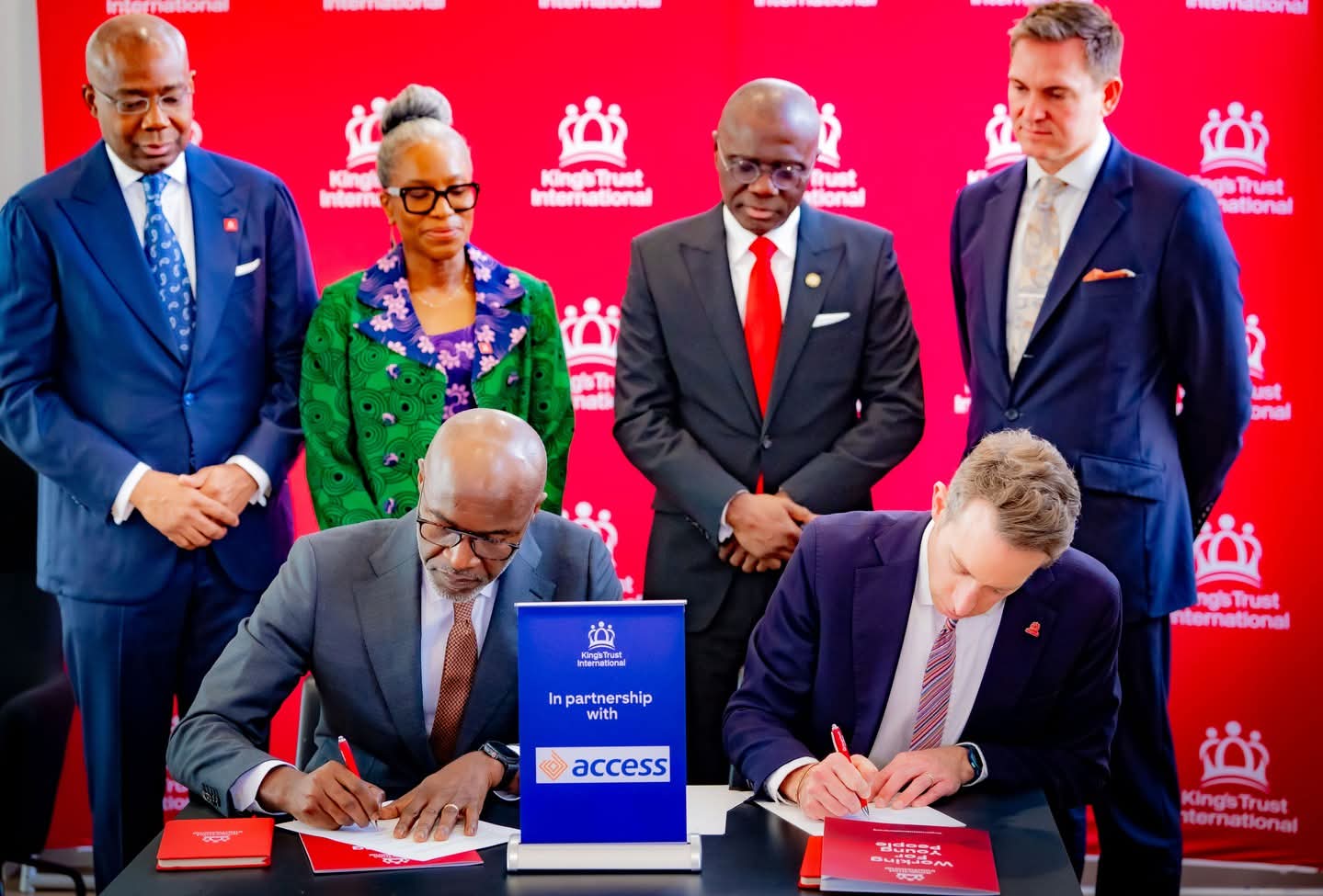
Access Bank Plc and King’s Trust International (KTI) have formally signed a strategic partnership agreement to expand opportunity, entrepreneurship and sustainable livelihoods for young people across Africa.
The partnership agreement was signed by Roosevelt Ogbonna, Managing Director/Chief Executive Officer, Access Bank Plc, for Access Bank, and Will Straw, CBE, Chief Executive Officer of King’s Trust International, on behalf of KTI.
The signing ceremony was witnessed by senior leaders and representatives from both organisations, alongside distinguished guests including Aigboje Aig‑Imoukhuede, CFR, Co-Chair, King’s Trust International Africa Advisory Board and Chairman, Access Holdings Plc; Ofovwe Aig‑Imoukhuede; Co‑Chair, King’s Trust International Africa Advisory Board, and Lagos State Governor, Babajide Sanwo-Olu.
The partnership brings together King’s Trust International’s expertise in youth development with Access Bank’s pan‑African reach and long‑standing commitment to inclusive and sustainable growth. Through this collaboration, the two organisations will work to equip young people with the skills, confidence and support needed to build successful futures through employment and entrepreneurship.
Under the agreement, Access Bank will support the delivery of King’s Trust International programmes that empower young people across several African countries, supporting them to gain skills and find pathways into meaningful employment and self-employment across Africa.
Speaking at the signing, Will Straw CBE, Chief Executive Officer of King’s Trust International, said: “This partnership with Access Bank reflects a shared commitment to unlocking the potential of young people across Africa. By combining our experience in youth development with Access Bank’s scale and leadership across the continent, we can create meaningful pathways to opportunity and long‑term impact.”
Roosevelt Ogbonna, Managing Director/Chief Executive Officer of Access Bank, added: “At Access Bank, we believe that empowering young people is fundamental to Africa’s sustainable growth. Our partnership with King’s Trust International reinforces our commitment to entrepreneurship, job creation and inclusive development, while enabling us to play a purposeful role in shaping the continent’s future.”
The partnership marks a significant milestone in advancing cross‑sector collaboration to address youth unemployment, foster entrepreneurship and drive inclusive growth across Africa.


