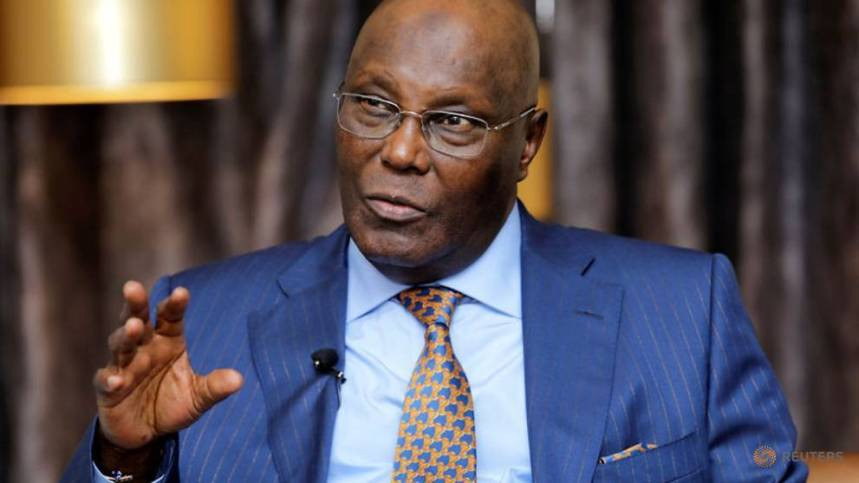
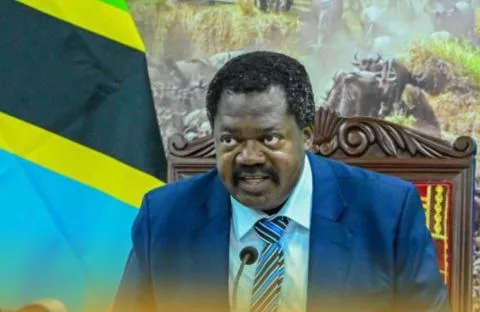
Tanzania’s Vice President, Dr Emmanuel John Nchimbi, has announced his decision to resign from office and retire entirely from public service and active politics, effective September 4, 2026.
In an official public notice dated August 25, 2026, issued from the Office of the Vice President in Dodoma, Dr Nchimbi revealed that he had formally tendered his resignation letter to President Samia Suluhu Hassan.
Dr Nchimbi cited constitutional provisions under Article 50(2)(c) read together with Article 149(2) of the Constitution of the United Republic of Tanzania as the basis for stepping down to allow President Hassan to appoint a new Vice President.
Reflecting on his tenure, Dr Nchimbi referenced a commitment he made to the Head of State a year earlier, stating that he pledged to serve faithfully to the nation and step aside whenever a change was desired.
“On August 27, 2025, I promised Her Excellency President Dr Samia Suluhu Hassan that I would assist her and our country to the best of my ability and with utter faithfulness,” Dr Nchimbi stated.
“I also assured her that whenever she sees the need for another Vice President, I will vacate the position. I am fully satisfied, without any doubt, that Her Excellency the President desires change, and thus I have decided to fulfil my promise.”
Dr Nchimbi expressed gratitude to President Hassan and the ruling party, Chama Cha Mapinduzi (CCM), for their confidence in his leadership.
He also thanked Tanzanians for their support during his time in public office, reassuring the nation that he would remain a patriotic citizen.
Nchimbi’s journey as a seasoned Tanzanian statesman
Born on December 24, 1971, in the Mbeya Region, Dr Emmanuel John Nchimbi grew up in a family rooted in public service. His father, Mzee John Nchimbi, hailing from Songea District, served as an Assistant Commissioner of Police (ACP) and Regional Police Commander for Mtwara.
Beyond his law enforcement career, the elder Nchimbi was actively involved in politics, serving two terms as a National Executive Committee (NEC) member for Chama Cha Mapinduzi (CCM) through the armed forces wing and later as a CCM regional secretary.
Dr Nchimbi began his primary education at Oysterbay Primary School in Dar es Salaam from 1980 to 1986. He pursued his O-Level studies at Uru Secondary School (Form I to III) from 1987 to 1989 before transferring to Sangu Secondary School, where he completed Form IV in 1990.
He then moved to Forest Hill Secondary School in Mbeya for his A-Level education between 1991 and 1993.
Advancing to higher education, Dr Nchimbi earned an Advanced Diploma in Administration from the Institute of Development Management (IDM) Mzumbe in Morogoro between 1994 and 1997.
Upon graduating, his political trajectory accelerated rapidly: he was elected as a member of CCM’s National Executive Committee (NEC), and by 1998, he was elected Chairman of the CCM Youth Wing (Umoja wa Vijana wa Chama cha Mapinduzi – UVCCM).
Alongside his rising political responsibilities, Dr Nchimbi built a professional background in public service and academia. He worked at the National Environment Management Council (NEMC) from 1998 to 2003.
During this period, he pursued further studies, obtaining a Master of Business Administration (MBA) specialising in Banking and Finance from Mzumbe University between 2001 and 2003. He was later appointed District Commissioner for Bunda (2003–2005) and went on to complete a Doctorate (PhD) at Mzumbe University between 2008 and 2011.
Dr Nchimbi launched his parliamentary ambitions in his home region of Songea Town.
In the 2005 General Election, backed by a strong CCM grassroots network, he secured the Songea Town parliamentary seat with 67.6 per cent of the vote against his main rival, Edson Mbogoro of CHADEMA, who garnered 30.5 percent.
Following his election to Parliament, President Jakaya Kikwete appointed him Deputy Minister for Information, Culture, and Sports in January 2006.
He served in that capacity until October 2006, when he was reshuffled to serve as Deputy Minister for Labour, Employment, and Youth Development until February 2008. He subsequently served as Deputy Minister for Defence and National Service until November 2010.
Source: The Star