
Metro
Banana Island Building Collapse: Seven Rescued As Lagos Alleges Structure Lacks Permit

- /home/rhoncare/pointblank.ng/wp-content/plugins/mvp-social-buttons/mvp-social-buttons.php on line 27
https://pointblank.ng/wp-content/uploads/2023/04/Banana-Island.png&description=Banana Island Building Collapse: Seven Rescued As Lagos Alleges Structure Lacks Permit', 'pinterestShare', 'width=750,height=350'); return false;" title="Pin This Post">
- Share
- Tweet /home/rhoncare/pointblank.ng/wp-content/plugins/mvp-social-buttons/mvp-social-buttons.php on line 69
https://pointblank.ng/wp-content/uploads/2023/04/Banana-Island.png&description=Banana Island Building Collapse: Seven Rescued As Lagos Alleges Structure Lacks Permit', 'pinterestShare', 'width=750,height=350'); return false;" title="Pin This Post">
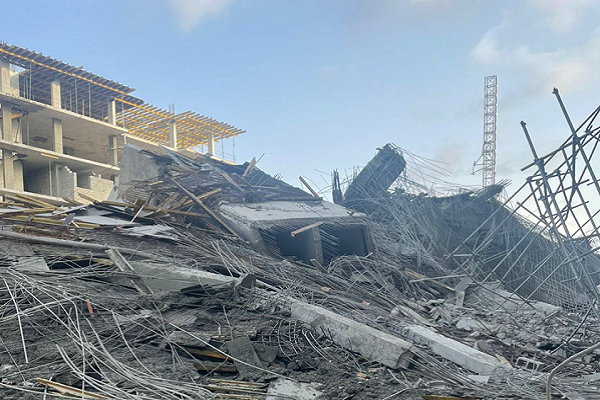
No fewer than seven persons were rescued from the rubble of a seven-storey building under construction that collapsed on Wednesday on First Avenue, in the Banana Island area of Ikoyi, Lagos State.
As of the time of filing this report, emergency responders, who stormed the scene for rescue operation, were said to still be searching for the whereabouts of a victim that had been trapped beneath the rubble of the collapsed structure.
Construction workers, according to The Punch, were performing their daily tasks in the building that had been under construction for months when it suddenly caved in around 4.58pm.
It was learnt that while some of the workers at the site escaped unhurt with some sustaining varying degrees of injury, some other workers, who were unlucky, got trapped beneath the rubble of the collapsed structure.
In a bid to rescue the trapped victims, some eyewitnesses, including construction workers at the site of adjoining buildings within the premises, raised the alarm and alerted relevant emergency agencies who mobilised to the scene to commence rescue operations.
Speaking with one of our correspondents, an eyewitness, who does not want his name mentioned in print for fear of victimisation, said the construction workers were on the sixth floor of the building attempting to lay the seventh floor when the tragedy struck.
He said, “As I speak with you, nobody has been confirmed dead and from the look of things, it is not certain that anybody will die. Only one victim is still trapped under the rubble of the collapsed structure and concerted efforts by emergency responders are ongoing to ensure that the person is rescued alive.
“As the rescue operation is ongoing, the emergency workers are confirming the number of people rescued in line with the registered number of people at the site and also with the involvement of the developers who are on the ground.
“At the site, three buildings were under construction and only one of the three buildings under construction collapsed. The workers were working on the sixth floor and were trying to lay the seventh floor when the building collapsed.”
PUNCH Metro gathered that the two other buildings under construction alongside the collapsed building are still intact but an integrity test would be conducted on the two buildings to prevent another collapse.
However, in a trending video showing moments shortly after the building caved in, eyewitnesses while lamenting over the development, were heard urging people to rush a rescued victim to the hospital for treatment.
The rescued victim, who was seen wailing after surviving the tragedy, said, “I have been going to work but this work is different. I thank God. Nah God I go dey call, I thank God oo.”
Reacting to the development, the General Manager, Lagos State Fire Service, Margaret Adeseye, said no fewer than seven persons were rescued with varying degrees of injury, adding that one person was still trapped.
Adeseye said, “The seven-storey building that collapsed is one out of the three high-rise structures under construction. The other two nine-storey are still standing.
“Seven persons were rescued alive with varying degrees of injury, while one person is still trapped as search-and-rescue operations are still ongoing until ground zero is achieved. An investigation has been ordered to ascertain the cause of the collapse.”
Meanwhile, the Lagos State Ministry of Physical Planning and Urban Development, in a statement posted on its verified Facebook page, said no approval was given for the construction of the collapsed structure.
The ministry’s Deputy Director, Public Affairs, Mukaila Sanusi, in the statement, said an investigation had commenced into the incident.
The statement read, “An unapproved seven-floor building under construction has collapsed in Banana Island, Lagos State, this evening.
“Few who sustained injuries are being treated. There is no fatality. This unfortunate incident happened while casting was being done.
“The Commissioner for Physical Planning and Urban Development, Tayo Bamgbose-Martins, was immediately on site to assess the situation and flag off the investigation. We ask members of the public to remain calm and expect further information from the ministry as we know more.”
However, the building that collapsed in Banana Island on Wednesday adds to a long list of building collapses recorded in the state in recent times.
On January 19, a storey building located at number 12 Aromire Avenue, opposite Dominos Pizza, Ikeja, suddenly collapsed around 6.45pm, killing one person in the process.
According to documents obtained from the Building Collapse Prevention Guild, Lagos State has recorded a staggering 115 building collapses in the past 10 years. In 2022 alone, the state recorded 20 incidents of building collapse.
Reacting, the pioneer President of the Building Collapse Prevention Guild, Kunle Awobodu, said the guild had commenced its own inquiry to ascertain the cause of the collapse.
He said, “Banana Island has a very high value when it comes to property development in the whole of Nigeria. It is a place where nobody anticipated substandard construction or envisaged substandard construction. This is the climax of the building collapse embarrassment, because of that peculiar location. That is our concern.”
Also commenting on the development, the Treasurer, Nigerian Institute of Builders, Lagos State, Philips Ayotunde, said lack of government oversight was responsible for the continuous building collapse episodes recorded in the state.
Philips said, “The government is not ready to do the right thing. If you say a building does not have approval, and yet, you see them commence work. They get to the first, second, third, fourth, all the way to the seventh floor, for heaven’s sake, a seven-storey building will not grow overnight. They have LASBCA officials in every district. What are the officials in that place doing?
“The government cannot exonerate themselves. Where were they when the building was under construction? It is a national shame. I have been getting messages from outside the country for the past hour. This is Banana Island we are talking about. Investors will lose confidence. Both local and international investors will begin to shy away from our real estate sector.”
The Punch



By Tolulope A. Adegoke
Access is the door; character is the key. But manners—manners are the hand that turns it. Turn gently, for every lock has a master, and every master remembers the weight of your touch.
Introduction: The Alchemy of Conduct
In the lexicon of leadership, strategy, vision, and resilience are often heralded as the pillars of success. Yet, beneath these monumental structures lies a more subtle, pervasive, and ultimately decisive foundation: Manners. Far from being mere decorative pleasantries or antiquated social rituals, manners are the operational currency of human interaction. To profess that “Manners give the Manna” is to recognize a profound metaphysical and practical truth—that the quality of one’s conduct directly correlates to the abundance of opportunities, trust, and resources (the “manna”) one receives in a professional and societal context.
This write-up posits that mannerism is not merely etiquette; it is the highest form of Cultural Intelligence (CI). It is the dynamic ability to navigate diverse human ecosystems with empathy, respect, and situational awareness. True leadership, therefore, is not a position of power but a performance of character. When access is treated as a privilege rather than a right, when honor is woven into communication, and when appreciation is rendered with sincerity, the leader transforms from a manager of tasks into an architect of possibilities.
Part I: The Economics of Etiquette—Why “Manners” Yield “Manna”
The adage “Manners give the Manna” is rooted in the economics of social capital. In every organization, the “manna” represents the intangible assets that fuel success: loyalty, discretionary effort, insider information, and collaborative synergy. These are not entitlements; they are gifts granted by subordinates, peers, and superiors based on the perceived worthiness of the receiver.
· Example 1: The Executive and the Elevator. Consider a CEO who steps into a crowded elevator. Instead of ignoring the junior staff member holding the door, the CEO offers a warm acknowledgment, asks about their ongoing project by name, and thanks them for their diligence upon exiting. This 30-second interaction yields “manna” in the form of heightened morale, a sense of visibility, and a narrative of approachability that spreads through the workforce. Conversely, the CEO who stares at their phone in silence harvests resentment. The “manna” of trust is withheld.
· Example 2: The Cross-Cultural Negotiation. A Western executive negotiating with a Japanese corporation arrives early, presents a business card with both hands, and bows slightly upon receipt. This act of cultural mannerism signals profound respect for the host’s hierarchy. It bypasses transactional friction and opens the “door” to relational negotiation. The “manna” here is a contract signed with goodwill, rather than legal rigidity. The executive who ignores these rituals may win the argument but lose the relationship—and thus, the long-term “manna.”
Manners, therefore, are the lubrication that reduces the entropy of human systems. They signal predictability, safety, and mutual regard—conditions under which human beings perform optimally.
Part II: Mannerism as Cultural Intelligence (CI)
Cultural Intelligence (CI) is the capability to relate and work effectively across cultures. However, a significant oversight in contemporary CI training is the reduction of culture to nationality. Culture exists in corporate boardrooms, engineering bays, and creative studios. Mannerism is the practical application of CI.
· Understanding Context (Cognitive CI): Mannerism requires the leader to read the room. In a high-trust Scandinavian startup, mannerism might mean flat hierarchies and first-name basis communication. In a traditional Indian family-run conglomerate, mannerism demands deference to age and tenure. The leader with high CI does not impose a monolithic standard of “politeness” but adapts their behavioral code to honor the prevailing cultural architecture. This is not duplicity; it is the intelligence of adaptation.
· Managing Micro-expressions (Motivational CI): True mannerism is motivational; it stems from the genuine desire to connect. When a leader thanks a team for working late, the mannerism is not in the words “thank you,” but in the tone, the eye contact, and the subsequent action of providing a compensatory day off. This behavioral integrity speaks the universal language of respect, transcending linguistic barriers.
· The Behavioral Index (Behavioral CI): Mannerism is the observable index of one’s cultural intelligence. It is the act of listening without interrupting, the discipline of acknowledging an email within 24 hours, and the grace of giving credit in a public forum. These behaviors indicate that the leader has internalized the cultural values of fairness and dignity.
Part III: “Manners Make the Man”—The Nexus of Character and Identity
“Manners make the Man” is a declarative statement on identity. It suggests that our external conduct is not a mask but a mold—it shapes who we are. A leader who habitually practices courtesy rewires their neural pathways to default to empathy.
· The Construct of Dignity: Manners are the scaffolding of dignity. They prevent the dehumanization of the other. In high-stakes environments, where stress is prevalent, the “Man” (or person) who retains their manners retains their humanity. For instance, during a corporate restructuring, a leader with manners will lay off employees with transparent communication, severance support, and personal acknowledgment of their contributions. This leader maintains their moral standing. The leader who lacks manners treats the layoff as a statistical necessity, reducing humans to numbers. The former preserves their reputation; the latter destroys theirs.
· Character as the Key: The write-up asserts that “men are the doors, but character is the key.” In the professional realm, human beings are the gatekeepers of opportunity. The hiring manager, the client, the mentor—they are the “doors.” No amount of technical skill (the “crowbar”) will open these doors if the character (the “key”) is malformed. Character is the aggregate of one’s manners. It is the consistency of respect, the reliability of word, and the courage to be humble. A leader with impeccable character finds doors swinging open because the gatekeepers trust the hand that turns the key.
Part IV: The Sacred Trust of Access—A Privilege, Not a Right
One of the most dangerous fallacies in leadership is the conflation of access with equality. Access to the CEO, access to confidential data, or access to decision-making corridors is a privilege conferred by the organization or society. It is never an inherent right.
· The Abuse of Familiarity: When a leader assumes that because they have access to a subordinate’s time, they have the right to disregard that subordinate’s personal boundaries, they abuse the privilege. Interrupting a team member’s lunch for a non-urgent query, sending emails at midnight with the expectation of immediate replies, or using positional power to bypass protocols are all abuses of access. This behavior erodes the “manna” of goodwill and replaces it with the “mire” of burnout and attrition.
· The Illusion of Equality: Access does not equal equality. A leader may have the privilege of a private office, but they must treat the cleaner who enters that office with the same dignity as the visiting dignitary. Treating all interactions with dignified honor does not mean treating everyone identically; it means treating everyone with an equivalent standard of respect, tailored to the context. The intern deserves the leader’s full attention during a one-on-one meeting, just as the board member does. The difference is the topic, not the tone.
Part V: The Doorway to All Doors—The Practical Prescription
If “men are the doors,” and “character is the key,” then the leadership prescription is clear: invest relentlessly in the refinement of character through the daily practice of manners.
1. The Prescription of Active Listening: Leadership is often reduced to speaking, but the ultimate manner is silence—the silence that allows others to speak. In board meetings, practice the 70/30 rule: listen 70% of the time, speak 30%. When you listen, you honor the speaker’s presence. This opens the “door” to innovative ideas that the loud leader would never hear.
2. The Prescription of the Handwritten Note: In a digital age, the analog gesture carries disproportionate weight. A leader who sends a handwritten thank-you note to a retiring employee or a successful project lead demonstrates a timeless mannerism. This act of appreciation is a “key” that unlocks immense loyalty. It costs little but yields substantial “manna” in emotional currency.
3. The Prescription of Punctuality and Preparation: Manners are a form of preparation. Arriving on time for a meeting is a statement that you value the other person’s time. Preparing for a discussion shows respect for the intellectual capacity of those attending. This builds a culture of competence and mutual esteem.
4. The Prescription of Public Praise and Private Critique: Criticism must be a gift wrapped in privacy; praise must be a celebration broadcasted publicly. This is a core mannerism of leadership. It protects the dignity of the individual while elevating the standard for the team. When critique is handled with discretion, the “door” of vulnerability remains open for growth.
Part VI: The Abuses and Their Antidotes
Leadership culture across boards often suffers from the “elite syndrome”—the belief that positional power absolves one of basic courtesy.
· The Abuse of Interruption: Leaders frequently interrupt to display intellectual dominance. Antidote: Institute a “no interruption” rule in strategic meetings. Allow the speaker to complete their thought. This forces active listening and often reveals that the “interrupter” had nothing new to add.
· The Abuse of Credit: Leaders often take credit for team successes to bolster their image. Antidote: Practice the art of “Giving the Gold.” Explicitly name the contributors in external communications. When the leader gives away the credit, they gain the far greater reward of trust.
· The Abuse of Emotional Dumping: Leaders sometimes use subordinates as emotional punching bags during stressful periods. Antidote: Cultivate emotional regulation. Establish a “cooling-off” period before responding to aggravating emails or situations. The leader who controls their emotions controls the room.
Part VII: Conclusion—The Synthesis of Civility and Sovereignty
In the final analysis, manners are not soft skills; they are sovereign skills. They are the demarcation between the ruler and the tyrant, the mentor and the demagogue. The ultimate essence of leadership is found not in the magnitude of the decisions one makes, but in the dignity with which one makes them.
We must elevate the narrative: “Manners give the Manna” is not a cliché but a cognitive framework for operational excellence. “Mannerism is Cultural Intelligence” is not a theory but a necessity for the globalized leader. “Manners make the Man” is not a moral judgment but a practical reality—we are what we repeatedly do.
To the leaders of tomorrow: Access is your platform, not your pedestal. Dignity is your armor. Appreciation is your fuel. The character you forge through your daily interactions is the master key that unlocks every door. Lead with the grace that acknowledges the humanity in every handshake, every email, and every glance. In doing so, you will not only harvest the “manna” of success but will cultivate a legacy of honor that outlives your tenure.
This is the concrete solution prescription: To lead is to serve with honor; to serve with honor is to practice impeccable manners; to practice impeccable manners is to secure the key to every door.
We all should further note that: The world does not need more leaders with sharper strategies; it needs leaders with softer hearts and stiffer backbones—leaders who understand that every interaction is an inheritance, and every word is a testament. This write-up, is a written manual, which I have placed in our hands to further turn it into remarkable actions across board, even in generations to come.
Dr. Tolulope A. Adegoke, AMBP-UN is a globally recognized scholar-practitioner and thought leader at the nexus of security, governance, and strategic leadership. His mission is dedicated to advancing ethical governance, strategic human capital development, resilient nation building, and global peace. He can be reached via: tolulopeadegoke01@gmail.com, globalstageimpacts@gmail.com

Osun State Governor, Ademola Adeleke, has announced a N500m Election Violence Victims Endowment Fund for verified victims and families affected by pre-election violence in the state.
Adeleke also disclosed that his family, through the Springtime Development Foundation, would provide full scholarships up to university level for the children and dependants of those who lost their lives in the violence.
The governor made the announcement on Wednesday in a statement issued after receiving his Certificate of Return from the Independent National Electoral Commission following his re-election.
He said the fund would support verified victims and affected families, while a Verification and Relief Committee, chaired by the Speaker of the Osun State House of Assembly, Rt. Hon. Adewale Olumide Egbedun, would oversee the identification of victims and distribution of the support.
“This is not a political intervention. It is a humanitarian responsibility. No eligible victim will be excluded because of political affiliation, religion, ethnicity, gender or social status. In grief, there is no political party. In our common humanity, we are one people,” he said.
The governor also named some of those killed in the violence, including Ezekiel Olapade, Aderogba Ajayi, Remi Abass and Kolade Eluyera.
“We remember Ezekiel Olapade, Aderogba Ajayi, Remi Abass, Kolade Eluyera, and every other victim of electoral violence. Regardless of political affiliation, they were first our brothers, sisters and fellow citizens. To their families, your pain is our pain, and your loved ones will never be reduced to mere statistics,” Adeleke said.
He said the decision to establish the fund followed the loss of lives, injuries, destruction of property and livelihoods recorded during the electoral process.
“It is deeply painful that any family should have to bury a loved one because of politics. No election, political office or ambition is worth the life of a single citizen,” he said.
Adeleke also called for unity in the state following the governorship election, assuring residents who voted for other candidates that he remained governor of the entire state.
“The election is over. The campaign is over. The contest is over. Now is the time to govern, unite, heal and build,” he said.
He added, “To those who voted for me, I thank you. To those who voted for another candidate, I thank you for participating in our democracy. I remain Governor to all, and together we must place Osun State above politics.”
The governor said his administration would continue to focus on infrastructure, healthcare, education, workers’ welfare, youth empowerment and economic development, while strengthening accountability, inclusion and transparency.
Adeleke, who described his renewed mandate as a fresh responsibility to serve the people, said, “You have given me another opportunity to serve, and I accept this responsibility with humility. I will work harder. I will listen more. I will do more.”
He added, “Today, we are grateful for victory, but sober in remembrance. Tomorrow, we return to work.”
Adeleke was declared winner of the governorship election after polling 511,067 votes to defeat the candidate of the All Progressives Congress, Bola Oyebamiji, who scored 409,849 votes.
The governor won in 19 of the state’s 30 local government areas, while Oyebamiji secured victory in 11.
The Punch

The management of the Nnamdi Azikiwe University (UniZik), Awka, Anambra State, has ordered an immediate, comprehensive and impartial investigation after a viral video showing students assaulting a lecturer over an alleged sexual misconduct sparked outrage online.
The incident that occurred on Saturday on the Awka campus.
Footage that circulated widely on social media on Saturday captured some UniZik students physically assaulting and rough-handling a lecturer from the Department of Chinese Studies, Faculty of Arts.
According to witnesses and the circulating videos, the lecturer was allegedly caught attempting to molest a female student within the university premises before students intervened.
The clips have drawn widespread condemnation and calls for a thorough probe, with many Nigerians debating both the allegation and the students’ resort to violence.
The lecturer’s identity has not yet been officially released by the university.
In a statement issued at the weekend, the Director of Information and Public Relations, Aloysius Attah, said the institution is “deeply saddened” by the development.
The management strongly condemned jungle justice and self-help while also taking the sexual misconduct allegation seriously.
“The Management of Nnamdi Azikiwe University, Awka, has received reports of the alleged physical assault and attack on a lecturer in the Department of Chinese Studies, Faculty of Arts, following an allegation of attempted sexual misconduct involving a female student of the University,” the statement read.
Attah confirmed that authorities have directed an immediate investigation to “establish the facts and circumstances surrounding the incident.”
UniZik says the investigation will cover two tracks:
1. The sexual misconduct allegation — to determine if the lecturer attempted to molest the female student.
2. The assault on the lecturer — to identify students involved in the physical attack and address breaches of campus discipline.
“The university remains committed to upholding the highest standards of discipline, academic integrity and the safety and dignity of all members of the university community,” Attah added.
Sexual harassment allegations in Nigerian universities have repeatedly sparked protests and policy reviews. UniZik itself has faced pressure in recent years to strengthen its anti-sexual harassment framework.
At the same time, university authorities are under pressure to curb vigilante actions on campus, warning that mob justice undermines due process and endangers lives.
For now, the lecturer has been taken off active duty pending the outcome of the probe, according to campus sources.
UniZik said further updates will be provided as the investigation progresses and urged students and staff to remain calm and allow due process.


