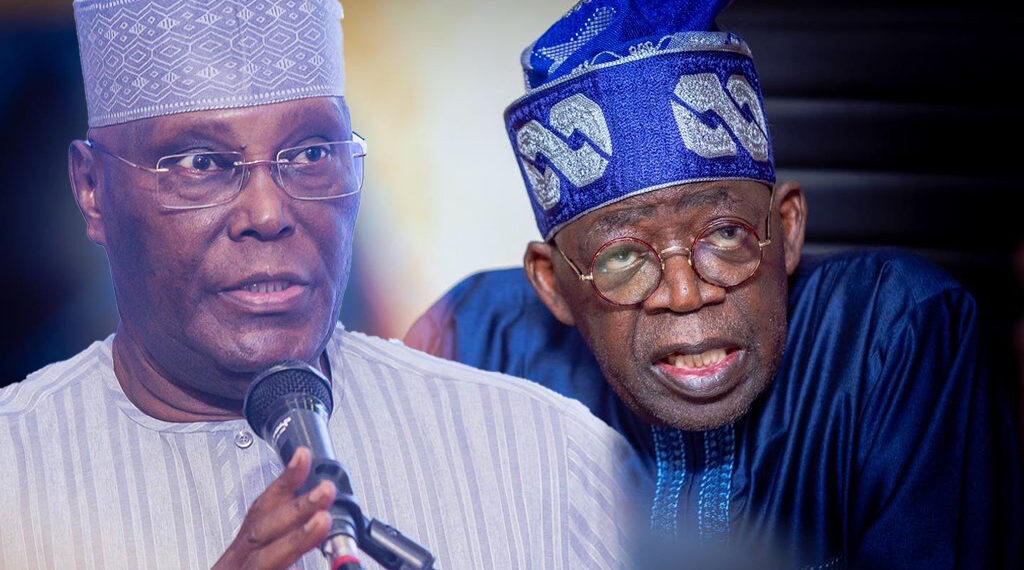
Former Vice President Atiku Abubakar has prayed the Supreme Court to grant his application for leave to tender fresh an additional evidence to support his claim that President Bola Tinubu submitted forged document to the Independent National Electoral Commission (INEC), to contest the February 25 election.
Atiku, who is challenging the victory of President Tinubu in the 2023 presidential poll, said presenting forged documents by any candidate, especially by a candidate for the highest office in the land, is a very grave constitutional issue that must not be encouraged.
The Peoples Democratic Party (PDP) presidential candidate stated this in his reply on point of law to Tinubu’s objection to allow the presentation of fresh evidence before the apex court.
Tinubu had, in his objection to Atiku’s application for additional evidence to support the allegation of certificate forgery, argued that the issue of his qualification to contest the 2023 presidential election “is a pre-election matter” and prayed the court to reject the application.
But, in his reply on point of law, Atiku, while faulting Tinubu, argued that issues of merit ought not to be determined or pronounced upon at the interlocutory stage.
Noting that they are only at this stage merely applying for leave of the Supreme Court to receive the fresh evidence, Atiku submitted that “to refuse to grant the leave as the respondents have argued, will amount to undue technicality.
“The Supreme Court, as the Apex Court and indeed the Policy Court, has intervened time and again to do substantial justice in such matters of great constitutional importance, as it did in the case of Ameachi vs INEC (2008) 5 NWLR (Pt. 1080) 227 and Obi vs. INEC (2007) 11 NWLR (Pt. 1046) 565. The Supreme Court applied the principle of ubi jus ibi remedium to ensure that substantial justice is done in such novel scenarios.
“The need to rebuff, eschew and reject technicality and the duty of Court to ensure substantial justice is very germane in this matter, given the gravity of the constitutional issue involved in deciding whether a candidate for the highest office in the land, the office of President of the Country, presented a forged certificate or not.
“In urging the Honourable Court to overrule the objections of the Respondents, we can do no better than to commend to your noble Lordships the insightful words of the Supreme Court in Assah & Others V. Kara & Others (2014) LPELR-24212(SC), per Rhodes-Vivour, JSC as follows.
“Law is blind. It has no eyes. It cannot see. That explains why a statue of a woman with her eyes covered can be found in front of some High Courts. On the contrary, justice is not blind. It has many eyes, it sees, and sees very well.
“The aim of Courts is to do substantial justice between the parties and any technicality that rears its ugly head to defeat the cause of justice will be rebuffed by the Court.”
The former Vice President made the claims in a 20- paragraph affidavit deposed to in support of the application.
He argued that if the Apex Court grants the application, there would be no need for “any further argument other than the written address in support of same showing that the 2nd Respondent is in violation of the provisions of Section 137 (1) (j) of the Constitution by presenting a certificate disclaimed by the institution from where he purportedly procured same.
“That, contrary to paragraphs 16(xi) of the 2nd Respondent’s Counter-Affidavit, there was no ex parte communication with the Honourable Court, but the letter was forwarded to the Registrar of the Court just as was done in the case of Uzodinma vs. Izunaso (2011) 17 NWLR (Pt. 1275) 30, at 56 (paragraph h of the affidavit on page 56) in which Counsel for the 2nd Respondent and Counsel for the Appellants/Applicants were both involved.”
The deponent, Uyi Giwa-Osagie, further argued that Tinubu’s objection was baseless because he was represented both at the discovery and the depositions, as well as at the court hearing by his Chicago Attorneys, and that the 2nd Respondent never challenged the issue of venue of the discovery and deposition.
“That the presence of the 1st and 3rd Respondents at the discovery and deposition was not necessary. That I know that the 2nd Respondent’s appeal was to prevent the discovery and deposition, and that the said Appeal failed.
“That, I know as a fact that the discovery and deposition were ordered by the District Judge, and was not out-of-court. That the Appellants were not indolent in their pursuit of the discoveries and deposition as it was also the letter tendered as Exhibit XX2 by the 2nd Respondent in the course of his defence purportedly issued by Caleb Westerberg that clearly gave the Appellants/Applicants further reasons to build on the evidence of PW27 by the discovery proceedings for the documents and Deposition on Oath of the same Caleb Westerberg.
“That, the process for the discovery and deposition was commenced by the Appellants/Applicants with several initial preliminary processes by their U.S. Attorneys culminating in their eventually filing a Petition for the issuance of Subpoena, a copy of which is annexed herewith as Exhibit “K”.
“That the process was severely stalled by the vehement opposition of the 2nd Respondent, citing irreparable damage to him, amongst other excuses, and I annex herewith as Exhibit “L” the motion of the 2nd Respondent to quash the subpoena, which application failed.
“That the 2nd Respondent has been in primary possession of all the facts sought in the discovery but took every step to block their release, notwithstanding that the 2nd Respondent had equally applied through his Attorney in the United States, Mr Wole Afolabi, for the release of the said documents, which were released to him as shown is Exhibit “P” presented in the course of the discovery and deposition process.
“That I know as a fact that the Appellants are in this appeal challenging the rulings of the lower court striking out certain paragraphs of their Petition as well as their Replies dealing with aspects of qualifications of the 2nd Respondent.”
Meanwhile, Atiku faulted Tinubu’s submission that he was inconsistent in his names, describing the submission as immaterial and pedestrian, as there is no Petition challenging his qualification.
“That it is immaterial that 1st Respondent had since June 24th 2022 published the factitious credentials of the 2nd Respondent as presentation of a forged certificate by a candidate for election to the office of President of the Federal Republic of Nigeria is a post-election matter under Section 137 (1) (j) of the Constitution”.
Besides, Atiku pointed out that the presentation of a forged certificate disqualifies a candidate for all time, no matter when presented.
“That at the trial, a National Youth Service Corps certificate with serial number 173807 presented by the 2nd Respondent to the 1st Respondent was equally tendered by the Appellants/Applicants at the trial as “Exhibit PBD 1A” with the name Tinubu Bola Adekunle, which is annexed herewith as Exhibit “J”.
President Bola Tinubu has ordered a full and transparent investigation into the deaths of suspected illegal miners detained by the Nigeria Security and Civil Defence Corps (NSCDC) following enforcement operations around Lt. Gen. Mohammed Inuwa Wushishi Estate in Minna, Niger State.
The President, in a statement on Friday, said that the government would not tolerate mass deaths arising from official negligence, dereliction of duty, or failure by public officials to protect the lives placed under their care.
President Tinubu said the life of every Nigerian matters and that no citizen should lose his life while in government custody as a result of negligence, abuse, inhumane treatment, or dereliction of duty, describing the development as a grave matter that requires urgent investigation and accountability.
“While the Federal Government would continue to combat illegal mining and other criminal activities across the country, enforcement operations must be conducted strictly within the law and with full respect for the dignity and fundamental rights of every person in custody,” he was quoted as saying in the statement by his Special Adviser on Information and Strategy, Bayo Onanuga.
“The fact that these individuals were suspected of illegal mining does not in any way remove their right to life, dignity and humane treatment while in government custody. Government will not tolerate mass deaths arising from official negligence, dereliction of duty or failure by public officials to protect the lives placed under their care.”
“Where the investigation establishes that any official, through action, abuse or negligence, contributed to these deaths, such an officer must be arrested and prosecuted in accordance with the law. There must be accountability,” the President added.
He directed the relevant authorities to ensure that the investigation is comprehensive, transparent and unhindered, covering the circumstances of the arrests, the condition of the detainees when they were taken into custody, the conditions under which they were detained, the number of people held in the facility, the medical attention provided and the events leading to their deaths.
“The suspension of officers is only an administrative step and must not substitute for a proper determination of criminal responsibility where the evidence warrants prosecution,” the President said.
He directed the Ministry of Interior and the NSCDC leadership to cooperate fully with all relevant investigative authorities and ensure that no officer interferes with the process or attempts to frustrate the establishment of the truth.
President Tinubu extended his condolences to the families of the deceased and prayed for the repose of their souls.
He also appealed for calm among the families and communities affected by the tragedy, assuring them that the Federal Government would pursue the truth and take appropriate action based on credible evidence.
“We must never allow the pursuit of one form of illegality to create another. The government must enforce the law firmly, but it must also obey the law. The sanctity of human life is non-negotiable,” Tinubu added.
The President’s order came after Thursday’s protest linked to the reported deaths of 37 suspected illegal miners while in the custody of the NSCDC, in Minna.
One of the survivors alleged that the suspects were kept in a small room, adding that an unpleasant substance was sprayed before the cell was locked.
Following the unrest, Governor Umaru Bago declared a 24-hour curfew in Minna, the State capital, saying that the curfew takes effect immediately after the Friday Jumu’ah prayers and would remain in force until further notice.
Bago said the government has constituted a committee of inquiry to investigate the circumstances surrounding the deaths.
The governor also announced the suspension of all mining activities across Niger State pending the conclusion of the ongoing investigations.
Similarly, the Ministry of Interior said it had suspended the state commander of the NSCDC.
Following the opening of applications from eligible candidates living with disabilities, for scholarships to pursue legal qualifications, the Opeoluwa Sotonwa Foundation (OSF), a not-for-profit organisation, founded by US-based philanthropist, Mr. Opeoluwa Sotonwa, and dedicated to expanding educational opportunity, leadership and inclusion, has announced the recipients of its 2026 scholarships, fellowships and academic awards.
Now in its fourth year, OSF has continued to deepen its investment in Nigeria’s deaf and hard-of-hearing community while expanding pathways for students with disabilities in the legal profession.
The 2026 awards also mark a new milestone with the introduction of the Prof. Konyinsola Ajayi, SAN Scholar-Practitioner Award, supporting a legal practitioner pursuing doctoral studies in Law.
Founded in 2022, OSF is grounded in a simple but enduring conviction: talent is universal, but opportunity is not. The Foundation seeks to close that gap by investing not merely in education, but in people whose knowledge, leadership and service can create opportunities for others.
PROF. KONYINSOLA AJAYI, SAN SCHOLAR-PRACTITIONER AWARD
For the first time, OSF is extending its investment in legal education beyond the undergraduate level through the Prof. Konyinsola Ajayi, SAN Scholar-Practitioner Award.
The new award recognizes a legal practitioner pursuing a Ph.D. in Law, bridging two worlds essential to the future of justice: the practical experience of the legal profession and the rigorous inquiry of advanced legal scholarship.
Isioma Osakuni — Ph.D. in Law, University of Ibadan — Inaugural Recipient
The establishment of the Scholar-Practitioner Award represents a natural evolution of the Prof. Konyinsola Ajayi, SAN Fellowship. It broadens OSF’s vision from helping students enter the legal profession to supporting practitioners seeking to contribute to its intellectual development through advanced research and scholarship.
PROF. KONYINSOLA AJAYI, SAN FELLOWSHIP
The Prof. Konyinsola Ajayi, SAN Fellowship is OSF’s flagship investment in developing a more inclusive legal profession. Expanded in 2025 to include law students with disabilities beyond the Deaf and hard-of-hearing community, the fellowship recognizes that the pursuit of justice is strengthened when the legal profession reflects the breadth of the society it serves. The recipients are:
Abubakar Nura — Law, Bayero University Kano
Amala Njelita — Law, University of Calabar
OPEOLUWA SOTONWA FOUNDATION GENERAL SCHOLARSHIP
The Foundation’s core scholarship program continues OSF’s foundational commitment to Deaf and hard-of-hearing students pursuing higher education across Nigeria. The 2026 scholars represent a broad range of disciplines, from education and computer science to political science, entrepreneurship and the arts. The recipients are:
Auwalu Mohammed — English Education, Gombe State University
Wende Terungwa — Special Education/PHE, Federal University of Education Pankshin
Farida Dalhatu — Political Science, Umar Musa Yar’dua University, Katsina
Fuhad Abdulrasaq — History and International Studies, University of Ilorin
Irimiya Samaila — Special Education, University of Calabar
Amina Nasiru — Entrepreneurship, Kaduna State University
Abosede Josephine Akilo — Special Education, Federal College of Education in affiliation with University of Ibadan
Toheeb Olajuwon Balogun — Political Science, Federal College of Education (Special), Oyo
Mujahid Adamu — Education-English, Sule Lamido University Kafin Hausa
Inerepamo Maxwell Pounana — Special Education, Ignatius Ajuru University of Education
Precious Onyinyechi Okonkwo — Special Education, Ignatius Ajuru University of Education
Nneoma Happiness Agbo — Economic Education, Peaceland College of Education Enugu
Yusuf Anas — Educational Management, Abdulkadir Kure University, Minna
Omopariola Opeyemi — Educational Management, Kwara State University
Akinkunmi Sheriff Akinboade — Fine and Applied Arts, Federal College of Education (Special), Oyo
Royal Adeh Obi — Special Education/Tourism, University of Calabar
Oladipupo Emmanuel Adeyeri — Computer Science, Federal College of Education (Special), Oyo
Bello Abubakar — Islamic Studies, Aminu Salah College of Education
MOST OUTSTANDING SCHOLARS 2026
Introduced in 2025, the Most Outstanding Scholar distinction recognizes one female and one male scholar whose academic achievement, leadership and perseverance distinguish them within the OSF community.
Mutiyat Oreoluwa Raheem — Microbiology, University of Ilorin — Female Most Outstanding Scholar
John Nworie Nte — Medicine and Surgery, University of Calabar — Male Most Outstanding Scholar
GRADUATE SCHOLARS
OSF’s commitment does not end with undergraduate education. The Graduate Scholars program supports Deaf and hard-of-hearing scholars advancing into postgraduate study and developing expertise capable of influencing their professions, institutions and communities.
Godwin Agianpuye — PGD/M.Sc., Computer Science, Wesley University, Ondo
Auwalu Salisu Ismaila — M.Ed., Special Education, Bayero University, Kano
Caroline Nwugo Onu — Ph.D., Christian Leadership, The Nigerian Baptist Theological Seminary
VOICES BEYOND SOUND – SOCIAL AND BUSINESS SCHOLARSHIP
Established in partnership with Greg and Annette Hudson, Voices Beyond Sound recognizes Deaf and hard-of-hearing students pursuing studies connected to social and business leadership. First featured in the 2025 awards, the initiative reflects a shared belief that leadership is not defined by how a person communicates, but by the ideas, resilience and impact they bring to society.
Zulaihatu Sani — Business Administration, Gombe State University
Qudus Ajiboye — Economics, National Open University of Nigeria
Taiwo Eneyamire Abdul — Economics, Federal College of Education (Special), Oyo
Taiwo Hassan Alatilehin — Business Education, University of Ilorin
“Four years into this journey, we are seeing what becomes possible when opportunity meets determination,” said Dr. Opeoluwa Sotonwa, Founder of OSF. “Our scholars are studying medicine, law, education, science, technology, business, the arts and other disciplines. Some are beginning their higher-education journeys; others are advancing into master’s and doctoral study. What connects them is not disability, but possibility. Our responsibility as a Foundation is to ensure that talent is given room to become impact.”
“The introduction of the Prof. Konyinsola Ajayi, SAN Scholar-Practitioner Award is especially meaningful. Justice requires not only lawyers who practice the law, but scholars who interrogate it, strengthen it and help imagine what it can become. By investing across that continuum—from the undergraduate law student to the doctoral scholar-practitioner—we are investing in the future of the profession itself.”
For more information about the Opeoluwa Sotonwa Foundation and its programs, visit www.opeoluwasotonwafoundation.org.
About the Opeoluwa Sotonwa Foundation
Established in 2022, the Opeoluwa Sotonwa Foundation (OSF) is a nonprofit organization dedicated to unlocking educational and leadership opportunities for Nigeria’s Deaf and hard-of-hearing communities while advancing targeted opportunities for students with disabilities. Through scholarships, fellowships, mentorship and advocacy, OSF invests in students and emerging leaders with the potential to transform their professions, communities and society.
The Foundation can be reached via:
Cassandra Sotonwa Chief Operating Officer
Opeoluwa Sotonwa Foundation
opeoluwasotonwafoundation@gmail.com
The Foundation wishes all recipients a fruitful academic period.
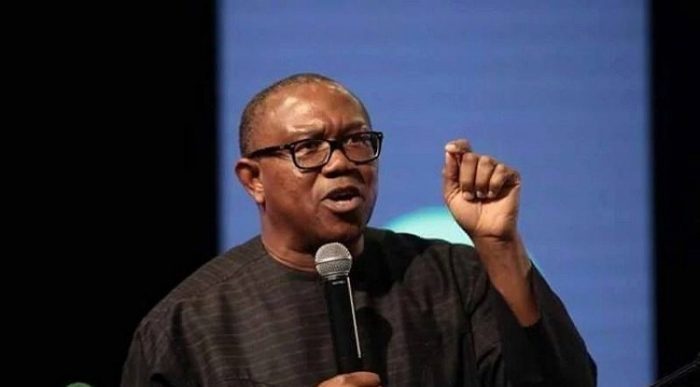
The Nigeria Democratic Congress (NDC) presidential candidate, Peter Obi, has clarified that he did not owe salaries, pensions, gratuities or any money during the period he was Governor of Anambra State.
Obi stated this in response to recent claims by the current government of Anambra State.
The Anambra State Government recently claimed that it is till repaying loans obtained by previous administrations, including those of former governors Obi and Willie Obiano.
According to the government, it has focused largely on paying existing obligations rather than accumulating new debts.
Obi served as the Governor of Anambra State from March 2006 to March 2014.
Reacting to the claim, Obi said: “I left office as Governor nearly 13 years ago. On the day I left office, I was not owing any salaries, pensions, gratuities or any money that the Anambra State Government was supposed to pay.
“I did not owe a single supplier or contractor. If you find even one person I owed, I will end my 2027 campaign today.”