
News
Coronavirus: Over 3,000 Deaths Recorded Globally So Far


- /home/rhoncare/pointblank.ng/wp-content/plugins/mvp-social-buttons/mvp-social-buttons.php on line 27
https://pointblank.ng/wp-content/uploads/2020/01/1800x1200_coronavirus_1-1000x600.jpg&description=Coronavirus: Over 3,000 Deaths Recorded Globally So Far', 'pinterestShare', 'width=750,height=350'); return false;" title="Pin This Post">
- Share
- Tweet /home/rhoncare/pointblank.ng/wp-content/plugins/mvp-social-buttons/mvp-social-buttons.php on line 69
https://pointblank.ng/wp-content/uploads/2020/01/1800x1200_coronavirus_1-1000x600.jpg&description=Coronavirus: Over 3,000 Deaths Recorded Globally So Far', 'pinterestShare', 'width=750,height=350'); return false;" title="Pin This Post">
The Covid-19 (coronavirus) outbreak which started from China is now in 50 countries and things seem to be getting worse.
So far, the number of people killed worldwide by the coronavirus has exceeded 3,000.
As of Monday, almost 90,000 confirmed cases have been reported globally, with the numbers outside China growing faster than inside China.
The disease had spread across China with the Asian country reporting the highest number of cases from the outbreak.
However, things began to change in the last two weeks as cases slowed down in China and started rising in other parts of the world.
China on Monday reported 42 more deaths. Currently, more than 90 per cent of the total deaths are in Hubei, the Chinese province where the virus emerged late last year.
New hotspots
Outside China, new hotspots for the disease are beginning to emerge and travellers from these countries have exported the disease to over 25 countries within two weeks.
The new countries emerging as the hotspots are Italy, Iran and South Korea.
In South Korea, the virus is being spread internally and as of Monday, 476 new cases were reported, bringing the total number of cases to 4,212. The youngest patient there is a 45-day-old baby.
South Korea is the biggest hotspot outside China and has reported 26 deaths.
However, the cases in Iran and Italy differ as the disease is not just being spread within its borders, but has also been exported to other parts of the world including Nigeria.
Nigeria on Friday announced the first confirmed case of COVID-19 which was detected in a 44 years old Italian who had flown into the country on Monday.
Although that is the only confirmed case in Nigeria for now, contract tracing has been intensified by the government to quarantine those who had been in contact with the Italian.
Second-time infected
There has also been cases of second time infections by some of the patients who had earlier recovered from the disease.
Countries like Japan, China reported cases of people who had once been tested positive, treated and discharged, coming down again with the disease.
As the disease pattern is still unknown, there is no explanation yet for second-time infection.
Death
Meanwhile, Iran has reported over 50 deaths while more than 30 have died in Italy.
Eight other countries have also reported at least one death from coronavirus. The U.S. on Sunday reported the second death from the coronavirus outbreak and President Donald Trump has warned Americans that more cases are “likely” to be reported.
The United States has 89 confirmed cases — including 44 evacuated passengers from the Diamond Princess cruise ship, three repatriated from Wuhan, 38 cases that were detected and tested on US soil and four cases “presumed positive.”
The World Health Organisation said on Sunday that the death rate appears to be between 2 per cent and 5 per cent. In comparison, the seasonal flu has an average mortality rate of about 0.1 per cent.
The UN health agency said most Covid-19 patients have only mild symptoms.
It said the seasonal flu is highly infectious – with up to 400,000 people dying from it each year.
“Other strains of coronavirus, such as Severe Acute Respiratory Syndrome (SARS) and Middle East Respiratory Syndrome (MERS), have much higher death rates than Covid-19,” it said.
Pandemic potential
While the world health body is yet to admit that the disease should be declared as pandemic, the WHO chief on Thursday said the Covid-19 outbreak has reached a “decisive point” and has “pandemic potential”.
Tedros Ghebreyesus said no country should assume it won’t get case.
“This virus does not respect borders. It does not distinguish between races or ethnicities. It has no regard for a country’s GDP or level of development.
“It is what is happening around the world that is now our greatest concern.We are at a decisive point,” he said.
He advised countries with new and lesser cases to act aggressively so that they can contain the virus.
“You can prevent people getting sick. You can save lives. So my advice to these countries is to move swiftly,” he said.
Source: Premium Times


National Chairman of the African Democratic Congress (ADC), Davis Mark, has said the party will adhere to electoral rules during the 2027 elections but will resist any attempt to manipulate the process.
Mark spoke on Wednesday in Abuja when the governing council of the Savannah Centre for Diplomacy, Democracy and Development, led by Olukayode Ariwoola, former chief justice of Nigeria, visited him at the ADC headquarters.
“We hold ourselves to the highest standards of good conduct as a political party. We will play by the rules,” Mark said.
The centre’s governing council, known as the council of the wise, was reconstituted in June to engage relevant institutions and political stakeholders towards fostering peaceful, free and credible elections.
The meeting with the ADC chairman was part of the centre’s ongoing engagement with political parties ahead of the elections.
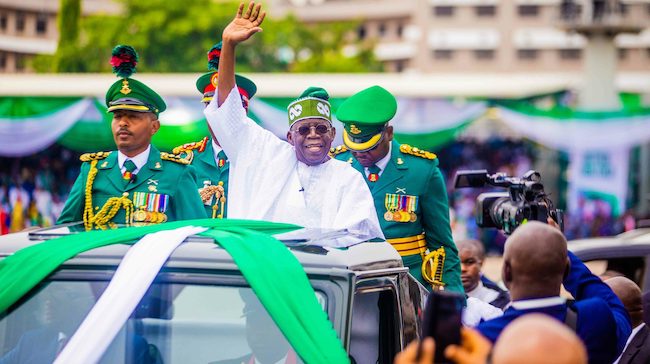
The Presidency has expressed confidence that the growing number of governors backing President Bola Tinubu gives him a stronger political structure and an advantage over opposition candidates ahead of the 2027 presidential election.
The Special Adviser to the President on Policy Communication, Daniel Bwala, said this on Channels Television’s Politics Today, arguing that the political landscape has changed considerably since the 2023 election.
Bwala said the support of governors is significant because they control political structures in their respective states and could translate their backing for Tinubu into grassroots mobilisation ahead of the election.
“Since then, President Bola Tinubu has got how many governors on his side? The governors are the Chief Executive Officers of their respective states. They coordinate the structures of the State. These people say, ‘We are putting our goodwill, our resources, our structure, and our support to the President,’” he said.
He argued that the President’s political position has also been strengthened by people who have benefited from his administration’s policies, including beneficiaries of the Nigerian Education Loan Fund (NELFund), agricultural programmes, manufacturing incentives, CrediCorp and infrastructure projects.
Bwala said the developments constitute “facts, verifiable data” which, in his view, showed that Tinubu had made progress since assuming office in 2023.
He also dismissed suggestions that the administration’s confidence ahead of 2027 is based solely on divisions within the opposition, saying its record in office would form an important part of its campaign.
His comments came amid renewed debate over Tinubu’s popularity and the ability of the opposition to challenge his bid for a second term.
Bwala dismissed an assessment by The Economist that Nigerians may re-elect Tinubu despite disapproval of his administration, arguing that claims about the President’s popularity should be backed by representative opinion surveys.
“When you make a claim that Nigerians don’t like him, without saying, also, that there are a lot of people… one million families that the children have benefited from NELFund, you think they hate him?” he asked.
He similarly cited beneficiaries of agricultural interventions, support for manufacturers and CrediCorp, arguing that such groups should be considered when assessing public sentiment towards the administration.
On concerns over rising poverty and hunger, Bwala acknowledged that more Nigerians had fallen into poverty but attributed the hardship partly to the economic reforms undertaken by the Tinubu administration.
“More people went down to poverty, I acknowledge, I’m not doubting it. But there is a ‘but’ to it. Since when the reform started to today, we have made marked progress,” he insisted.
According to him, the reforms are necessary to address longstanding economic problems, despite the short-term discomfort experienced by Nigerians.
Bwala also defended Tinubu’s statement that Nigeria has moved from the “doldrums” towards prosperity, saying the President is not suggesting that Nigerians would suddenly begin experiencing prosperity from October 1.
He cited NELFund beneficiaries, subsidised healthcare, infrastructure projects and support for small and medium-sized businesses as examples of what he described as prosperity already reaching Nigerians.
“One million families whose children have benefited from the NELFUND programme, what they are benefiting is called prosperity,” he said.
“If you go to an environment or a place where there have been no roads or any form of infrastructure, and we have established infrastructure there, what has come to them is prosperity.”
Bwala further claimed that the opposition has lost several influential political figures who played key roles in their 2023 campaigns.
He said former Vice President Atiku Abubakar no longer has the support of governors who worked for his 2023 campaign, while Peter Obi has also lost some critical political allies.
“In terms of the other candidates who say he will not win, Atiku Abubakar lost close to 25 per cent of key people that you know around him. All the governors that worked for him that time are no longer with him,” Bwala said.
“Peter Obi lost 55 per cent of the critical people that carried his campaign; they’ve all disappeared. And some of them went to Atiku, some of them went wherever they could go to.”
He consequently expressed confidence in Tinubu’s prospects in the 2027 contest, saying the political support around the President was considerably different from what existed before the 2023 election.
News
Globacom Unveils Sponsorship of 2026 Ofala Festival, Promises ‘Never Settle for Less’ Celebration

Globacom has once again demonstrated its commitment to Nigeria’s rich cultural heritage by supporting the 2026 Ofala Festival in Onitsha as the official sponsor.
The partnership, which has continued for over 15 years, highlights Globacom’s dedication to celebrating and sustaining cultural traditions that preserve identity, strengthen communities and contribute to the nation’s social and cultural development.
The 2026 edition, which marks the 25th Ofala of the reign of the Obi of Onitsha, Igwe Nnaemeka Alfred Achebe, is themed “Igba Mbo, Iga N’Iru – Strive and Advance: From Resilience to Progress.” The theme resonates strongly with the history and character of Ndi Onicha, whose story is one of resilience, enterprise, adaptability and an enduring determination to advance.
According to Globacom, its continued association with Ofala reflects the Company’s belief that cultural heritage and national development are complementary forces. “For Globacom, Ofala is more than an annual cultural celebration. It is a living expression of identity, continuity and collective aspiration. Our sustained partnership reflects our belief that preserving heritage and advancing society are not competing imperatives, but mutually reinforcing pillars of a progressive nation,” the Company stated.
The telecommunications giant added that the partnership also aligns with its “Never Settle for Less” philosophy, which encourages Nigerians to honour their foundations while continually pursuing greater possibilities. “Never Settle for Less is a philosophy of progress: to respect the foundations upon which we stand, while seeking to broaden possibilities, deepen impact and move the nation forward. We are proud to support a cultural institution that honours its roots while engaging the future,” Globacom said.
Over the years, Ofala has evolved from a sacred royal rite of renewal into a major platform for cultural affirmation, community engagement and social development. The 2026 programme features the Obi’s sacred period of seclusion and ceremonial emergence, the Medical, Health and Wellbeing Community Outreach, the international Oreze Art Exhibition, the Youth Carnival, and the grand finale of Iru Ofala and Azu Ofala.
For Globacom, supporting Ofala therefore goes beyond conventional sponsorship to represent corporate citizenship and cultural stewardship — an investment in preserving the memory, meaning and continuity of a people. The Company noted that the festival’s ability to draw strength from its ancestral foundations while embracing the future mirrors its own commitment to innovation, connectivity and digital inclusion.
As the people of Onitsha gather to celebrate another chapter in the history of the revered institution, Globacom remains proud to stand alongside them in honouring a heritage that continues to inspire generations.


