
Headlines
Death Toll from Lassa Fever Outbreak Rises to 41


- /home/rhoncare/pointblank.ng/wp-content/plugins/mvp-social-buttons/mvp-social-buttons.php on line 27
https://pointblank.ng/wp-content/uploads/2020/01/Lassa.jpeg&description=Death Toll from Lassa Fever Outbreak Rises to 41', 'pinterestShare', 'width=750,height=350'); return false;" title="Pin This Post">
- Share
- Tweet /home/rhoncare/pointblank.ng/wp-content/plugins/mvp-social-buttons/mvp-social-buttons.php on line 69
https://pointblank.ng/wp-content/uploads/2020/01/Lassa.jpeg&description=Death Toll from Lassa Fever Outbreak Rises to 41', 'pinterestShare', 'width=750,height=350'); return false;" title="Pin This Post">
The death toll from the Lassa fever outbreak in Nigeria has increased to 41, the Nigeria Centre for Disease Control (NCDC) has disclosed.
The NCDC, in its weekly situation update for week four (January 20 to 26), stated that the number of newly confirmed cases and deaths is gradually on the rise.
Although NCDC has activated a National Emergency Operations Centre (EOC) to coordinate the response activities, the number of new confirmed cases increased from 81 cases in week three to 95 cases.
Between January 1 and 26, a total of 689 suspected cases with 258 confirmed cases were reported with 41 deaths.
These cases were reported from 19 states including Ondo, Edo, Ebonyi, Enugu, Kano, Borno, Nasarawa, Kogi, Rivers, Abia, Adamawa, Benue, Kaduna, Delta, Taraba, Plateau, Bauchi, Osun and Ogun.
Five health workers were among the dead: Kano (3), Taraba (1) and Borno (1).
Since the beginning of the outbreak this year, 19 states have recorded at least one confirmed case across 60 local government areas.
Although there has been a spike in the number of cases and deaths reported for the reported week, it is still lower than the numbers reported in the same period in 2019.
However, there is very little difference in the number of deaths recorded: 41 so far in 2020 compared to 42 in the same period in 2019.
The Nigerian health agency in a statement issued on Saturday, said the increase in the number of cases at this time of the year is not unusual, due to ecological factors.
The country has no effective measures to curb the spread of the killer disease and has so far focussed on curative measures.
This is why health agencies embark on contact tracing of persons who have been suspected to be in contact with patients.
This has become a yearly occurrence with hundreds of people infected and dozens of deaths recorded. At present, there is no known vaccine for the prevention of the disease.
Three states, Edo, Ondo and Ebonyi are still the states with the highest prevalent cases among the 19 states with confirmed cases.
Also, there has been no changes in the age group affected.
NCDC said the predominant age-group affected is 11-40 years. The male to female ratio for confirmed cases is 1:1


President Bola Tinubu has requested the Senate to approve the implementation of an external borrowing plan of $7.7 billion.
At an exchange rate of N1,400 to the dollar, the money amounts to about N10.79 trillion
The President said the funds are to part-finance the N20.2 trillion budget deficit.
The new request, according to the Senate President, replaces the $20.52 billion loan request presented last week.
The request has been referred to the Committee on Local and Foreign Debts for further legislative action.
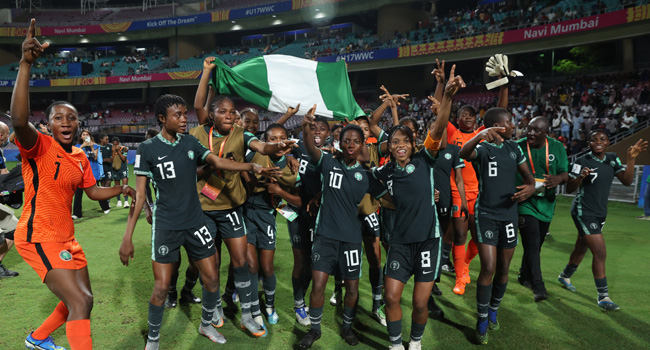
Nigeria’s Flamingos have made history by reaching their first FIFA U-17 Women’s World Cup final, following a commanding 3-1 win over Brazil in their semi-final encounter in Morocco.
After a goalless first half, the Nigerians stepped up after the break, scoring three times to put the contest beyond Brazil before conceding a late consolation goal.
Queen Joseph broke the deadlock in the 56th minute, turning home Oluwakemi Adegubyi’s assist to put the Flamingos ahead.
Nigeria doubled their lead in the 71st minute through Awawu Bashiru, who finished off a pass from Joseph, before completing her brace nine minutes later. This time, Bashiru converted Oluebube Umejiaku’s delivery to give the Flamingos a commanding 3-0 advantage.
Brazil managed to reduce the deficit in the 89th minute through Greise Kelly, who was set up by Yasmin Queiroz, but the late strike did little to change the outcome as Nigeria held on for a memorable victory.
The result takes the Flamingos into their maiden final at the tournament, where they will face Japan, who defeated defending champions North Korea in the other semi-final.
Nigeria’s qualification for the final represents a remarkable recovery after their campaign began with a 2-1 defeat to Poland. They bounced back with a 2-0 win over Puerto Rico, courtesy of goals from Oluwakemi Adegubyi and Precious Oscar, before producing one of their most impressive performances to defeat North Korea 3-1.
That victory was particularly significant, as it ended North Korea’s 18-match unbeaten run in regulation time at the competition. Adegubyi, Umejiaku and Kanyinsola Rodiat Yusuf were on target for Nigeria.
The Flamingos finished second in Group B with six points, having scored six goals and conceded four in three matches, before stepping up their campaign in the knockout rounds.
They began their journey through the last 16 with a 2-1 victory over Mexico. Umejiaku and Mary Dunstan scored in either half, while Emily Delgado’s late effort proved insufficient to prevent the Mexicans from exiting the competition.
Nigeria then secured a place in the semi-finals with a hard-fought 1-0 win over Venezuela. Azeezat Oduntan converted an 89th-minute penalty to settle the quarter-final and set up the last-four meeting with Brazil.
The achievement takes the team beyond their previous best finish at the tournament — third place in 2022 — when they defeated Germany on penalties to claim the bronze medal.
The Flamingos had also arrived in Morocco in impressive form, having swept to the WAFU B U-17 title with a perfect record of five wins from five matches. They scored 17 goals and conceded just once during the regional competition.
Now, with Brazil behind them and Japan standing between them and the title, the Flamingos have an opportunity to crown their historic campaign with Nigeria’s first U-17 Women’s World Cup trophy.

Four Nigerian-Americans have won elective positions in the November 3 midterm elections in the United States, while the outcome of another candidate, Segun Adeyina, remained pending in Georgia as votes were being counted.
The winners are Will Jawando, Junior Ezeonu, Oye Owolewa and Carol Kazeem, who secured positions in local government and State legislatures across Maryland, Texas, Washington, DC, and Pennsylvania.
In Maryland, Jawando, the Democratic candidate, won the race for Montgomery County executive, defeating Republican candidate Esther Wells.
Results published by NBC Washington on Wednesday showed Jawando polling 237,383 votes, representing 78.15 per cent, against Wells’s 66,383 votes, or 21.85 per cent, with 72 per cent of the expected votes counted.
Jawando, who previously served on the Montgomery County Council, is the son of a Nigerian father and an American mother. His Nigerian heritage and political career have featured in reports by The Baltimore Banner and The Washington Post.
In Texas, 27-year-old Ezeonu secured a seat in the state House of Representatives for District 101. He had defeated incumbent Chris Turner in the Democratic primary and was the only candidate on the ballot for the November general election after no Republican entered the race.
According to his campaign biography, Ezeonu was born in Onitsha, Anambra State, and moved to Texas at the age of two.
He was elected to the Grand Prairie City Council in 2021 and later became the city’s youngest mayor pro tempore.
In Washington DC, Owolewa, the Democratic candidate, won an at-large seat on the District of Columbia Council.
Local publication – The 51st – reported that Owolewa secured 69 per cent of the vote, against 21 per cent recorded by independent candidate Elissa Silverman.
Owolewa, a pharmacist and son of Nigerian immigrants from Kwara and Osun states, previously served as the District’s elected shadow representative.
The position allows its holder to advocate for Washington, DC, statehood but does not confer voting rights in the US Congress.
Meanwhile, Kazeem, also a Democrat, retained her seat in the Pennsylvania House of Representatives, representing District 159.
The result of Adeyina’s contest in Georgia had yet to be called as of Wednesday, with votes still being counted.


