News
Don’t Vote for Me If I Fail to Fix Power Comment: Onanuga Claims Tinubu Was Quoted Out of Context

- /home/rhoncare/pointblank.ng/wp-content/plugins/mvp-social-buttons/mvp-social-buttons.php on line 27
https://pointblank.ng/wp-content/uploads/2025/10/Tinubu.webp&description=Don’t Vote for Me If I Fail to Fix Power Comment: Onanuga Claims Tinubu Was Quoted Out of Context', 'pinterestShare', 'width=750,height=350'); return false;" title="Pin This Post">
- Share
- Tweet /home/rhoncare/pointblank.ng/wp-content/plugins/mvp-social-buttons/mvp-social-buttons.php on line 69
https://pointblank.ng/wp-content/uploads/2025/10/Tinubu.webp&description=Don’t Vote for Me If I Fail to Fix Power Comment: Onanuga Claims Tinubu Was Quoted Out of Context', 'pinterestShare', 'width=750,height=350'); return false;" title="Pin This Post">
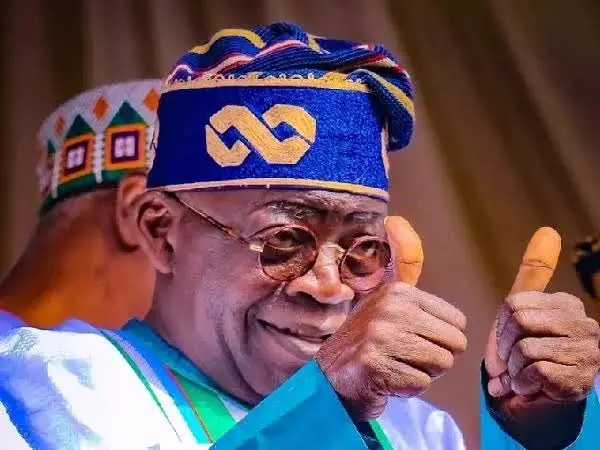
Special Adviser to President Bola Tinubu on Media and Publicity, Bayo Onanuga, has described as ‘out of context’ the assertion that President Bola Tinubu told Nigerians he would not seek re-election if he failed to provide constant power supply for the citizens.
Onanuga dismissed the claims which have recently resurfaced in many circles, and explained that the statement credited to the president was conditional, and not an outright pledge.
Onanuga spoke during an interview on Arise News on Tuesday, where he further insisted that the President’s remarks on power sector reforms had been misrepresented, as it was not an outright pledge to forgo a second term.
Reports had quoted Tinubu during a business luncheon in December 2022 ahead of the 2023 presidential election, to have said: “If I don’t give you constant electricity for four years, when I come back for a second term, don’t vote for me.”
But the presidential aide argued that critics often quote only a portion of the President’s remarks while ignoring the context in which they were made.
Asked whether the President had promised not to seek re-election if the electricity supply did not improve dramatically, Onanuga said: “That is not exactly what he said. He said he will give Nigerians power. I’m paraphrasing now. He said he will also will end the area of estimated billing. A problem that he has largely solved because it should not be his business, but his government is producing meters, asking the DISCOS to give people meters free of charge.
“And he said, if by any chance he has reasons not to give Nigerians adequate power, then they should understand the problem that he inherited.”
When he was told that the President said he should not be reelected if the electricity supply did not improve, Onanuga said, “He didn’t say that way. Let me see if I can open my phone and tell exactly what he said.”
Onanuga argued that Tinubu had demonstrated commitment to power sector reforms since assuming office, citing the signing of the Electricity Act as one of the administration’s major achievements.
“The first thing he did when he came to office was sign the Electricity Act, which enables states to generate power, transmit power and distribute power,” he said.
The presidential spokesman noted that the legislation has opened up the electricity sector and encouraged competition, with several states already taking advantage of the opportunities created by the law.
“That is a good thing. Some of the states are taking advantage of that, and more are going to do so. That will make the electricity sector open and competitive,” he added.
The presidential spokesman also pointed to efforts by the administration to address the metering gap across the country, saying the government had intervened to ensure more Nigerians receive meters free of charge.
“He also learnt the error of estimated billing, a problem that his government is largely solving because the government is producing meters and asking distribution companies to give people free of charge,” Onanuga said.
While acknowledging that electricity supply has yet to reach the level envisioned by the President, Onanuga attributed the challenge to long-standing structural problems in the sector.
“We are not at the level that the President meant it. I can tell you that,” he said.
He explained that although Nigeria has an installed generation capacity of about 13,500 megawatts, constraints such as gas shortages, legacy debts and weak transmission infrastructure have limited performance.
“What people don’t know is that we already have an installed capacity of 13,500 megawatts. What are the problems? No gas. The players in the sector owe the gas companies legacy debts of over four trillion naira,” he said.
According to Onanuga, the Tinubu administration is working to resolve these issues while pursuing reforms aimed at improving generation and transmission capacity.
“The transmission grid is outdated, but that is part of the reforms that need to be put in place,” he said.
He added that the government was exploring additional initiatives to optimise existing power assets and improve electricity delivery across the country.
Onanuga maintained that despite the challenges, the administration remains committed to delivering on its promise of improving electricity supply and strengthening the nation’s power sector.


The African Democratic Congress Presidential Campaign Council (ADC-PCC) has warned Nigerians against waiting for President Bola Tinubu to fulfil his campaign promise of providing reliable electricity.
The Council challenged the President to explain why millions of Nigerians continue to experience poor power supply despite his pledge that voters should not re-elect him if he fails to deliver electricity.
In a statement by its Director of Media and Publicity, Kola Ologbondiyan, the ADC-PCC accused Tinubu of making fresh promises during his recent campaign outings in Kaduna, Rivers and Jigawa states instead of presenting a clear account of his administration’s achievements.
Recalling the President’s campaign promise, the Council quoted him as saying: “If I don’t give you electricity, don’t vote for me for a second term.”
“Tinubu is only repeating his old electricity promise in Jigawa, while Nigerians are still waiting for answers on why reliable power supply remains out of reach,” the Council said.
The Council also questioned the whereabouts and impact of 2,000 tractors reportedly imported from Brazil under the administration’s mechanised farming programme.
It further accused Tinubu of taking credit for projects started by his predecessor, Muhammadu Buhari, while failing to show enough achievements of his own.
The African Democratic Congress Presidential Campaign Council (ADC-PCC) has declared that President Bola Tinubu will lose the 2027 election, insisting that intimidation, violence and manipulation of democratic institutions cannot prevent his exit from office.
In a statement by its Director of Media and Publicity, Kola Ologbondiyan, the Council accused the ruling All Progressives Congress (APC) of manipulating the judiciary and deploying security agencies against opposition parties.
Ologbondiyan warned that growing attacks on opposition members across the country pose a serious threat to Nigeria’s democracy.
He cited the killing of several members of the Nigeria Democratic Congress (NDC) in Delta State, allegedly following an attack on the party’s campaign venue by suspected APC thugs.
He said the incident is part of a disturbing pattern of violence against opposition parties, particularly members of the ADC, NDC and Allied Peoples Movement (APM), in Kaduna, Kogi, Katsina, Kebbi and Sokoto states.
“This is not politics. This is state-sponsored terror against democracy,” he said.
The Council also raised concerns over the preparedness and neutrality of the Independent National Electoral Commission (INEC), alleging that its voter register database had been compromised and that APC sympathisers had been deployed to sensitive positions.
It further alleged that security agencies were being used to harass, arrest and intimidate opposition members.
Ologbondiyan expressed concern over the alleged involvement of a serving director of a security agency in the APC Presidential Campaign Council as co-Director of National Security and Intelligence, describing it as a violation of the law establishing the agency.
“One thing is now very clear to all Nigerians: Tinubu is not preparing for an election. He is preparing for a coronation,” he said.
The ADC-PCC maintained that alleged manipulation of judicial processes and electoral institutions would not guarantee President Tinubu’s re-election, warning that Nigerians would resist any attempt to impose a president through compromised judicial decisions or electoral fraud.
It called on Nigerians to remain vigilant and defend their votes and democratic rights ahead of 2027.
The Council also urged the international community, civil society organisations, religious and traditional institutions to pay closer attention to what it described as the deteriorating political and security environment, warning that silence could embolden those undermining democracy.
It appealed to security agencies to remain politically neutral, stressing that their allegiance should be to the Constitution and the Nigerian people.
“Those who allow themselves to be used as tools of oppression today will answer for their actions tomorrow,” Ologbondiyan warned.
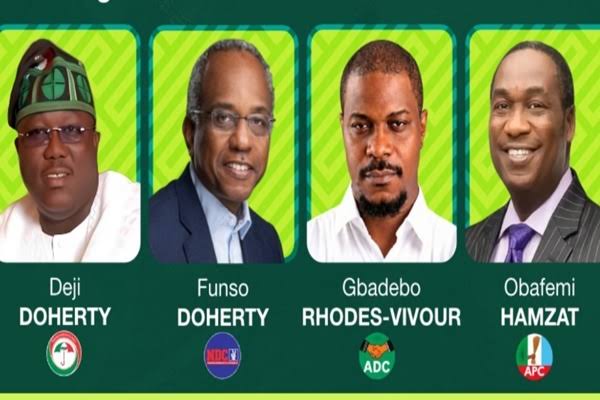
Governorship candidates of the All Progressives Congress (APC), African Democratic Congress (ADC), Nigeria Democratic Congress (NDC) and Peoples Democratic Party (PDP) in Lagos State have outlined contrasting plans to address housing, transportation, education, healthcare and the rising cost of living ahead of the 2027 elections.
At a governorship debate organised by the Nigeria Debate Consortium, the candidates, Dr. Obafemi Hamzat of the APC, Gbadebo Rhodes-Vivour of the ADC, Funsho Doherty of the NDC and Adedeji Doherty of the PDP, presented their policy blueprints and defended their credentials for seeking to govern the State.
While Hamzat, the incumbent deputy governor, pledged to sustain ongoing projects and expand infrastructure, the opposition candidates criticised the State’s development priorities, arguing that its substantial internally generated revenue had not translated into improved living conditions for ordinary residents.
Rhodes-Vivour accused successive administrations of pursuing policies that favoured the wealthy at the expense of vulnerable residents, particularly in housing and urban development.
He said Lagos needs a government that prioritises the interests of ordinary people, adding that his administration would adopt an integrated approach to urban planning, housing, transportation, education, healthcare and waste management.
The ADC candidate promised to deliver 100,000 housing units within his first four years through a combination of social housing, a proposed luxury tax and development of the state’s eastern foreshore.
He also pledged to connect Lagos’ rail lines within two and a half years through a transparent, private-sector-driven arrangement.
Rhodes-Vivour said the proposed housing programme would include a structured system allowing residents to move from smaller accommodation to larger homes as their families and financial capacities grew.
He said: “We want a cleaner Lagos. We want a safer Lagos. We want a more affordable Lagos. I want a Lagos that works for everybody, not just the privileged few.”
On urban safety, he promised to create employment opportunities for young people, particularly at the ward level, to reduce insecurity and address the activities of political thugs.
He also pledged to tackle flooding through wetland protection, improved urban design and the adoption of technologies that would allow water to flow naturally without threatening communities.
Responding to a question on Lagos’ high revenue and its impact on household welfare, Rhodes-Vivour said the government had failed to make its wealth sufficiently beneficial to ordinary residents.
He cited the demolition of structures in Makoko and the development of housing projects beyond the reach of many residents as examples of what he described as exclusionary policies.
According to him, government should concentrate on providing support for people who cannot meet their basic needs, rather than prioritising those who can afford private solutions.
He said his administration would ensure transparent allocation of housing units and prevent individuals from monopolising multiple units at the expense of other applicants.
The candidate also proposed a housing progression scheme under which young people could initially occupy affordable self-contained apartments and move into larger accommodation as their circumstances improved.
The APC candidate said his experience in government has given him an understanding of the State’s administrative systems, residents’ needs and infrastructure challenges.
He said his proposed Lagos Promise agenda is built around seven pillars, with commitments that would be measurable and open to public scrutiny.
Hamzat added that his administration would prioritise transparency, respect for residents and accountability in the implementation of policies.
He said: “I take tonight as a job interview. The job is the government of Lagos State. And you, Lagosians, will be the interviewers and the people that we actually hire.”
On transportation, Hamzat promised to complete the Blue Line to Okokomaiko and extend the Red Line towards the Trade Fair area, while integrating rail, road and water transportation.
He also pledged to provide 4,000 new compressed natural gas buses to improve mass transit and reduce the pressure on commuters.
The APC candidate said the State’s limited land area and growing population make efficient public transportation essential to its development.
On housing, Hamzat said the government has delivered 24,000 housing units over the past eight years, including 18,000 units for residents, while several projects remain ongoing.
He promised to expand access to mortgages, proposing a system requiring a 10 per cent deposit and repayment over 25 years.
According to him, the arrangement would enable residents to acquire homes without having to pay the full cost upfront.
Hamzat said the government would continue existing housing projects, including developments in Ibeju-Lekki, Badagry and other locations.
He argued that mortgage financing is necessary to make homeownership more attainable, noting that many people struggled to build houses because of the high cost of construction.
Funsho Doherty of the NDC said Lagos is operating below its potential despite its substantial revenue base and economic importance.
He argued that residents continue to face rising taxes and levies without corresponding improvements in public services.
Doherty cited the State’s budget, internally generated revenue and long period of APC administration as reasons the government should be held accountable for its performance.
He said Lagos’ challenges include inadequate healthcare, poor educational outcomes, housing affordability, water supply and electricity.
The candidate said his vision is to move the State in a new direction through policies focused on health, education, opportunity, affordable housing, jobs, small businesses and the environment.
Doherty, who said he has spent 30 years in the private sector, argued that government policies should enable residents to develop their skills, earn incomes and build sustainable livelihoods.
He promised to make public education truly free, including removing examination fees and other charges that prevent children from completing their education.
He also pledged to provide pupils in public schools with an affordable daily meal.
On housing, the NDC candidate proposed 150,000 units, supported by an ecosystem of financing, government guarantees and other measures to improve affordability.
He said the objective was to empower residents economically, adding that the prosperity of individuals would translate into the prosperity of the State.
Adedeji Doherty of the PDP said his background as a technocrat, businessman, entrepreneur and industrialist had prepared him to address Lagos’ economic and infrastructure challenges.
He said his experience in the party, which he joined in 1998, has also informed his decision to contest the governorship.
The PDP candidate identified electricity, housing and education as priority areas, arguing that inadequate power supply is limiting industrial development and economic growth.
He promised to establish a research team to develop cheaper building materials and reduce the cost of constructing homes.
Doherty also said he would focus on underserved communities, particularly the islands, which he said lack adequate primary healthcare and other essential services.
He identified the State’s debt burden, bloated ministries, departments and agencies, and inadequate support for local governments as major challenges affecting service delivery.
The candidate said his administration would reduce the number of MDAs and review government expenditure to free up resources for residents.
He argued that local governments should be adequately empowered to address community needs, while savings from reduced administrative costs could be redirected towards improving living conditions.
Doherty also promised to review electricity costs and introduce measures to put money back into residents’ pockets.