
News
Era of Nationwide Fuel Queues Has Come to An End, Says Dangote

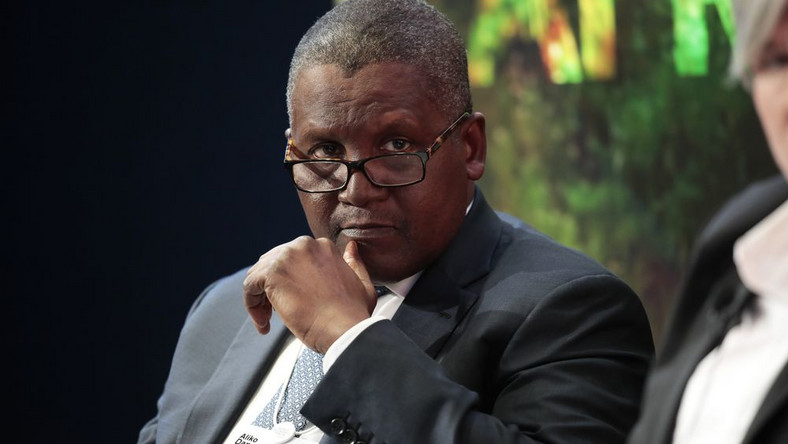
President of Dangote Group, Alhaji Aliko Dangote has assured Nigerians that the era of nationwide fuel queues has come to an end.
He, therefore, pledged uninterrupted petrol supply during yuletide period and beyond.
Addressing newsmen on Friday after a close-door meeting with President Bola Tinubu at the State House, Abuja, Dangote stressed:
“Historically, Nigeria has battled fuel queues since 1972. For the first time, we are eliminating those queues, not through imports but by producing locally. Even when we were servicing the refinery, there were no queues. I can assure you that queues are now history”.
He disclosed that Dangote Refinery has formally notified the Nigerian Midstream and Downstream Petroleum Regulatory Authority (NMDPRA) of its readiness to deliver 50 million litres of Premium Motor Spirit (PMS) daily, far above national consumption.
Dangote stated that the refinery will soon produce surplus volumes, adding that by February it will supply 15–20 million litres more than Nigeria needs.
This, he said, will allow exports to neighbouring countries, reducing the incidence of fuel scarcity across West Africa.
He also disclosed that domestic manufacturers, especially in the plastics industry, will now enjoy reliable access to locally produced feedstock, ending years of reliance on imports estimated at $400 million annually.
On way forward, Dangote announced an expansion programme that will raise the refinery capacity to 1.4 million barrels per day by 2028, surpassing India’s Reliance refinery, the world’s largest, at 1.25 million barrels per day.
His words: “But going forward, what do we really want to do? What we are going to do by 2028 we are going to take this refinery to the largest refinery in the world we’re going to beat reliance. Reliance is 1.25 million barrels per day, we will be at 1.4 million barrels per day. We have already launched that we have signed, and we’re going to start piling for the refinery by January, before January ending, and it will be delivered on time.”
The renowned industrialist also revealed plans to scale up the company’s urea production to 12 million tonnes annually, positioning Nigeria to overtake Russia and Qatar as the world’s leading producer.
“Our goal is to use our fertilizer company to supply the entire African continent,” he said.
Commenting on recent declines in petrol and diesel prices, Dangote attributed the trend to increased competition and a reduction in smuggling.
“Prices are going down because we must compete with imports. Luckily, smuggling has dropped significantly, though not completely”.
He stressed that the refinery business is a long-term national investment, saying “we’re not here to recover $20 billion overnight. The legacy I want to leave is that whatever Nigerians need, fuel, fertilizer, power, we will be part of delivering it.”
Dangote further highlighted logistics constraints affecting Nigeria’s solid minerals sector, particularly the congestion of major ports.
“Apapa is full. Tin Can is full. Lekki is mainly for containers. You cannot export coal or copper if you have nowhere to ship from,” he noted.
To address this, he said the Group is developing what would become West Africa’s largest deep-sea port at Olokola, expected to be completed in two-and-a-half years.
He expressed support for the Tinubu administration’s naira-for-crude initiative, describing it as a patriotic move to strengthen the economy, although he acknowledged pushback from international oil companies.
“It’s a teething problem, but it will be resolved, either through legislation or administrative action,” he said.
On concerns about global competition, Dangote maintained that the refinery will thrive.
“What we want is to make Nigeria the refining hub of Africa. All African countries import fuel. We want what we consume to be produced here”.
He also endorsed the government’s Nigeria-first industrial policy and urged wealthy Nigerians to channel resources into productive investment rather than luxury spending.
“If you have money for a private jet, invest in industries and create jobs,” he said, adding that domestic investors must drive industrialization to attract foreign capital.
Dangote acknowledged past hurdles, policy instability, smuggling, and factory closures, but expressed optimism that the country is now on a stable path toward sustainable industrial growth.
“Domestic investors must lead the way. Once they do, foreign investors will follow. Nobody advertises a good restaurant; when the food is good, word spreads,” he said.
He described his meeting with President Tinubu as a routine consultation on the economy and business environment, noting that it was “a very fruitful meeting.”
AriseNews


President Bola Tinubu has insisted on his earlier directive ordering the withdrawal of police officers from very important persons (VIPs) in the country.
On November 23, Tinubu ordered the immediate withdrawal of police officers attached to VIPs across the country during a security meeting with the inspector-general of police (IGP), the chiefs of army and air staff, and the director-general of the Department of State Services (DSS).
The president said the move was aimed at boosting police presence in communities, especially remote areas where stations are understaffed and citizens remain vulnerable to attacks.
The president ordered Olubunmi Tunji-Ojo, the minister of interior, to make arrangements for the replacement of police officers by civil defence corps.
“If you have any problem because of the nature of your assignments, please contact the IGP and get my clearance,” he said.
“The National Security and Civil Defence Corps are trained for VIP protection, and they are armed too.
“We face challenges here and there of kidnapping, banditry and terrorism. We need all forces utilised. I know some people are exposed; we will make the exceptions. The civil defence is very much around.”
Tinubu said there is a need to mobilise the police appropriately due to the country’s security challenges.

Rivers State governor, Siminalayi Fubara, has defected to the All Progressives Congress (APC) from the Peoples Democratic Party (PDP).
Announcing his defection on Tuesday evening, Fubara said the move is a reciprocity to the overwhelming support, which the State has received from President Bola Tinubu.
The defection ends months of speculation about whether the governor would join the APC, which many believed was part of a peace agreement between him and the President.
Meanwhile, Fubara held a closed-door meeting with President Tinubu at the State House, Abuja, on Monday.
Reports said the governor arrived at around 5pm for the meeting dressed in a deep-blue long-sleeve shirt, black trousers, and a black flat cap.
Minutes earlier, Ebonyi State governor, Francis Nwifuru, had been ushered in for a separate engagement. Details of both meetings were not undisclosed.
But specifically, Fubara’s visit had raised suspicion to the rumour that he might defect from the PDP to the APC following political turbulence in Rivers State.
His announcement on Tuesday has confirmed the rumours.

The Federal High Court in Abuja has denied an application filed by Nnamdi Kanu, the leader of IPOB, seeking his transfer from the Sokoto Correctional Centre to a custodial facility within the Federal Capital Territory or the neighbouring Nasarawa State.
Kanu, represented by the Legal Aid Council, submitted an ex-parte application requesting an order that would direct the Federal Government or the Nigerian Correctional Service (NCoS) to transfer him from the Sokoto facility to either the Kuje Custodial Centre in Abuja or the Keffi Custodial Centre in Nasarawa.
He requested a transfer to any custodial facility within the court’s jurisdiction, such as Suleja or Keffi, to allow him to effectively pursue his appeal.
However, Justice James Omotosho denied the request on Monday, stating that such an order could not be granted without first hearing from the Federal Government.
The judge directed Kanu to convert the ex-parte application into a motion on notice and serve all parties to allow fair hearing.
The case was subsequently fixed January 27, 2026, for the hearing of the motion.


