
Metro
Final Year Ondo Varsity Student Swept Away by Flood

- /home/rhoncare/pointblank.ng/wp-content/plugins/mvp-social-buttons/mvp-social-buttons.php on line 27
https://pointblank.ng/wp-content/uploads/2019/10/Flood.jpeg&description=Final Year Ondo Varsity Student Swept Away by Flood', 'pinterestShare', 'width=750,height=350'); return false;" title="Pin This Post">
- Share
- Tweet /home/rhoncare/pointblank.ng/wp-content/plugins/mvp-social-buttons/mvp-social-buttons.php on line 69
https://pointblank.ng/wp-content/uploads/2019/10/Flood.jpeg&description=Final Year Ondo Varsity Student Swept Away by Flood', 'pinterestShare', 'width=750,height=350'); return false;" title="Pin This Post">
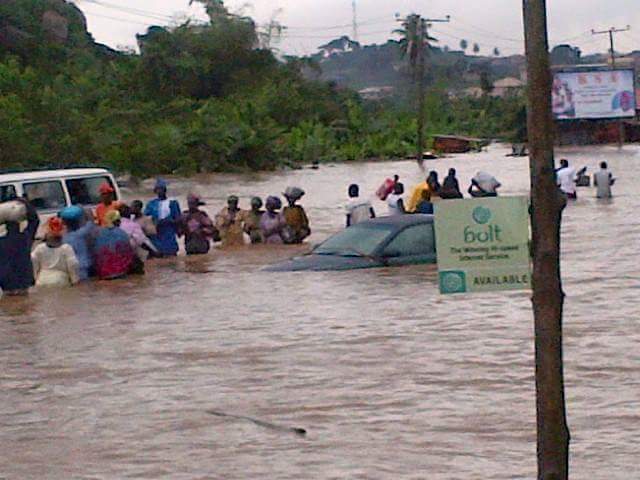
The torrential rainfall of almost eight hours in Ondo State on Monday evening claimed the life of a final year female student of Adekunle Ajasin University, Akungba, Akoko Southwest local government.
The deceased simply called ‘Doyin’, an indigene of Ekiti State, was washed away to an unknown destination by flood from a canal very close to her residence.
Her landlord, Elemukona Ademola, who narrowly escaped the flood, said: “I had to climb cocoa tree when many people thought I had been carried away by the flood.’’
At the scene of the incident, the Ondo Commissioner for Agriculture, Otunba Gboyega Adefarati, warned citizens from building houses very close to canals. He also cautioned those who are in the habit of blocking the drainages with refuse to desist from such act as this practice lead to flooding.
The university authorities yesterday suspended lectures and tests earlier scheduled for Tuesday over the incident. A statement by the institution’s Acting Registrar, Opeolu Akinfemiwa, however, said all students should resume on Wednesday.
According to him: “The university is leaving no stone unturned in the quest to find the missing student. Divers and other volunteers have been sought to search the path of the river in a bid to find the missing under graduate.”
The Divisional Police Officer (DPO) in charge of Akungba, CSP Shakiru Ajibola, confirmed the incident and said three persons including a landlord of the house where the girl was carried away by flood were rescued. He noted that divers were still looking for the undergraduate in the neighbouring rivers.
Already, many roads in Akokoland had become impassable as serious erosion had affected them, especially Jubilee road, Hospital junction, Bankole road Ilepa Ikare, Okoja Awara road,Irun to Ojeka,Irun to Surulere to Oluta and Okeagbe to Afin to Eshe.
Also, travellers and residents coming in and out of Ado Ekiti were yesterday left stranded for several hours as flood again submerged the popular Ureje bridge in the state capital. The bridge is the major link to communities such as Ureje, Federal Polytechnic Ado, Afe Babalola University, some communities in Ekiti and Ondo states.
The flood that submerged the bridge yesterday made it the fourth time the bridge has been overrun by flood in the last two months. Many motorists and commuters were stranded and helpless since there were no alternative routes for them.
The bridge was swept off on the eve of the October 1, the independence day, which led to the palliative work done by the state government to allow temporary use of the bridge. A resident of Oke Ureje, Mrs. Olaniyi Rebecca, lamented that her children had gone to school on the other side of the bridge, wondering how they would return home.
Meanwhile, in Lagos State, residents of Itowolo, Ajegunle, Owode Irawo all along Ikorodu Road have urged the state government to assist concerning the flood that has ravaged the community in recent times. When The Guardian visited the affected areas, many of the residents were having unpleasant times using makeshift bridges and canoes to move freely. Some have temporarily vacated their houses.
Chief Eniola Alabo, who resides in Ajegunle urged government of Lagos and Ogun to meet and discuss on the need not to open the Oyan Dam before October. He said the Atlantic Ocean level rises in October and if the dam is opened around the period, it leads to flooding in the area.
He said: “Some years ago during the Jonathan administration, there was flooding and the president came to our area. He released N700 million to assist us. Fashola was the governor then. The state government wanted us to leave but Jonathan said no. Fashola thereafter created a relief place at Agbowa Ikosi and asked us to relocate. We sensed a foul play that it was a strategy for us to leave and turned the place to government acquired area like Maroko. Till now, we don’t know how the money was spent.
However, the Edo State government on Tuesday distributed relief materials to flood victims in five local government areas across the state, including Igueben, Egor, Oredo, Ovia South-West, Ikpoba-Okha and Uhunmwonde Local government council areas. Some of the distributed items include 500 bags of rice, 300 bags of beans, 300 bags of garri, 2000 cartoons of noodles, gallons of vegetable oil and palm oil.
Addressing journalists during the distribution of materials to officials of the benefitting local councils in Benin City, the governor, Mr. Godwin Obaseki, who was represented by his Special Adviser on Special Duties, Yakubu Gowon, said the gesture was in line with the mandate to ensure that flood victims in the state were given the necessary support to alleviate their plights.
Representative of the chairman of Ikpoba-Okha LGA, Balogban Kingsley, while applauding the governor’s magnanimity, described the distribution of items as timely.
The Guardian



The Osun State Police Command has arrested a woman after a vigilante member, identified as Sunday and popularly known as Apetu, died shortly after having a sexual encounter with her in Ile-Ife, Osun State.
A video circulated on social media showed the man in severe distress at Ooni Ilare Street, where he was heard pleading with the woman to give him urine.
The incident occurred on Sunday around 2:30pm in the Odi-Olokun area of Ile-Ife, after which the woman was taken into custody at the Moore Police Division.
According to a situation report attributed to the Nigeria Security and Civil Defence Corps, Apetu was found gasping, screaming and pleading with the woman while showing signs of severe physical distress after the encounter.
The report said the man eventually died from the incident, while his remains were deposited at the morgue of the Obafemi Awolowo University Teaching Hospitals Complex, Ile-Ife.
The cause of Apetu’s death has not been officially established, despite claims by some residents that he died from what they described as a “thunderbolt.”
Authorities have not confirmed the claim or established any link between the traditional belief and the man’s death.
The belief centres on a traditional claim that a person affected by a supposed “thunderbolt” spell could harm another person through sexual contact. However, the claim has not been established as a medical or scientific explanation for the death.
A senior officer of the Osun State Police Command said the command was aware of the reports circulating on social media but warned members of the public against spreading unverified information.
The incident has drawn attention in Ile-Ife because of the conflicting accounts surrounding the sudden death.
Authorities have urged residents to remain calm and allow the police and relevant medical authorities to establish the actual cause of death.

The Lagos State Police Command has confirmed a mob action which allegedly led to the death of one Basit Kolade.
The victim was allegedly attacked by a group of individuals following a road traffic incident at Freeman Street, Lagos Island, on Wednesday, 2nd September 2026, at about 10:40 p.m, a statement signed by the Public Relations Officer, SP Adebisi Abimbola, and made available to the National Association of Online Security News Publishers (NAOSNP), said.
The Police noted in the stateent as follows:
Preliminary investigation revealed that Basit Kolade was travelling with his spouse, from Ebute Metta towards Lagos Island in a black Lexus Jeep, with registration number KSF 115 JZ, when a motorcycle allegedly collided with the vehicle from behind.
An argument reportedly ensued between both of them. In the course of the incident, the vehicle allegedly reversed and hit the motorcycle, causing the rider and the motorcycle to fall. This reportedly attracted a group of individuals in the area, who allegedly attacked Basit with dangerous weapons. His spouse was rescued by some women in the vicinity, while Kolade was rushed to the Lagos Island General Hospital, where he was subsequently confirmed dead. The motorcycle rider who was allegedly hit in the incident is, however, alive and currently receiving medical treatment in a hospital.
Four (4) suspects have so far been arrested in connection with the attack. They are Khalid Rafiq ‘m’ 20 years; Gafar Rahim ‘m’ 21 years; Ibrahim Azeez ‘m’ 33 years; and Samos Momoh ‘m’ 21 years. Efforts are ongoing to identify and arrest other persons who allegedly participated in the attack.
The Command has commenced an investigation into the incident, which is being treated as a homicide case, and the matter has been transferred to the State Criminal Investigation Department (SCID), Panti, for further investigation and appropriate legal action.
The Command wishes to reiterate that the 1999 Constitution of the Federal Republic of Nigeria, as amended, guarantees every person the fundamental right to life under Section 33. The Constitution permits deprivation of life only in circumstances specifically recognised by law.
Similarly, under the Criminal Law of Lagos State, unlawful killing constitutes an offence of homicide. The law provides that unlawful killing may amount to murder or manslaughter depending on the circumstances. In particular, the provisions on murder cover unlawful killing with the intention to kill or cause grievous harm, with the law prescribing severe punishment upon conviction.
The Command therefore warns members of the public against mob action, jungle justice, and the resort to self-help under any circumstance. No individual or group has the legal authority to arrest, try, convict, or execute another person.
The warning is consistent with the directive of the Inspector-General of Police, IGP Olatunji Rilwan Disu, psc(+), NPM, who has directed Police Commands to treat cases involving mob action resulting in death as homicide and warned that persons who participate in, organise, incite, or support such attacks will face the full weight of the law.
The Command reiterates that suspicion or an allegation of wrongdoing does not confer on anyone the right to take the law into their own hands. Members of the public are urged to promptly report criminal incidents to the Police and allow the law to take its course.
The Commissioner of Police, Lagos State Command, CP Tijani Fatai, psc, mnips, has directed that all persons found culpable in the incident be identified, arrested, and prosecuted in accordance with the law. He assures members of the public that the investigation will be thorough and professional, and that all persons found to have participated in the attack or otherwise contributed to the death will be made to face the law.

By Tolulope A. Adegoke
“When the ground trembles beneath the feet of the unprepared, those who have built upon the rock of foresight shall not only stand but flourish. Goshen was not a place of escape—it was a place of productivity amidst plagues, light amidst darkness, and life amidst death. Prepare not to survive, but to live.” – Tolulope A. Adegoke, PhD
The year 2030 isn’t the end of the world—but it may be the end of the world as you know it. Here’s how to prepare, not just to survive, but to thrive.“
Introduction: Why 2030 Matters More Than You Think
The year 2030 isn’t just another date on the calendar. It’s a convergence point where multiple global forces collide—artificial intelligence reaching mass deployment, climate impacts intensifying, economic systems restructuring, and the United Nations Sustainable Development Goals reaching their target year.
The question isn’t whether these changes will happen. It’s whether you’ll be positioned to flourish when they do.
Goshen wasn’t merely a place of survival—it was a place of productivity, light, and life amidst surrounding darkness. GOSHENOMICS applies that same principle to today’s realities: productive preparation that builds assets, communities, and systems designed to thrive when others merely endure.
This isn’t about fear. It’s about faith, purpose, and proactive action. Let’s explore how.
Part One: Agribusinesses—Food Production as the Foundation
Why Food Security Matters Now More Than Ever
Agriculture remains the bedrock of civilization. Yet smallholder farmers across the globe face systemic barriers—limited irrigation, climate vulnerability, and inadequate access to technology. When these farmers struggle, everyone feels the impact.
“Build skills, understand food, and build redundancy.” This isn’t survivalist rhetoric—it’s strategic foresight.
The GOSHENOMICS Solution: Precision Agriculture
Precision Agriculture at Scale: Integrating machine learning and drone technology transforms smallholder farming from subsistence to surplus. Field research demonstrates significant increases in crop yields alongside substantial reductions in water usage when IoT sensors, weather forecasting platforms, and autonomous drones work together.
Autonomous Irrigation Systems: Collaborative multi-drone systems with swarm intelligence enable real-time, localized irrigation decisions. These systems adapt to changing conditions, conserve water, and optimize crop health continuously.
Software for Forecasting: Build platforms that analyze weather patterns, soil conditions, and market data to inform planting, harvesting, and distribution decisions. This moves agriculture from gambling on climate to managing climate as a calculated variable.
How Drones Are Revolutionizing Agriculture
Drones equipped with multispectral and thermal cameras detect stress from pests, diseases, nutrient deficiencies, and water shortages before problems spread. Drone-based spraying systems apply pesticides and fertilizers with exceptional precision, reducing chemical usage by up to ninety percent while improving efficacy. Drones also track livestock movement, detect illness, and monitor herd health in extensive grazing systems. They generate detailed topographic maps that inform planting patterns, drainage planning, and water management decisions.
The Implementation Roadmap
Start now by identifying local food production gaps and designing scalable interventions. Build redundancy by developing multiple production sites, diverse crop portfolios, and storage systems. Finally, integrate by connecting production to processing, storage, and distribution networks that keep value within communities.
Part Two: Community—The Commonwealth of an Ecosystem
Why Community Matters
Resilience isn’t individual—it’s communal. The Commonwealth of an Ecosystem recognizes that no farm, business, or household is an island. Survival and flourishing depend on interconnected systems of mutual support, shared resources, and collective capability.
Strong communities are the essential social infrastructure that enables individuals and families to weather crises and seize opportunities.
The Evidence
International development programs have demonstrated that grassroots initiatives generate measurable returns. Climate adaptation investments at the community level have restored hundreds of thousands of hectares of degraded land, reached millions of people, and moved communities toward sustainable revenue generation.
The lesson is clear: communities aren’t passive recipients of aid—they’re agents of change.
The GOSHENOMICS Approach
Build local institutions that formalize community governance structures to manage resources, make decisions, and allocate investments transparently. Create resilient networks because social capital—connectedness, trust, networks, and collective capacity—is the infrastructure of community resilience. Self-organizing communities with agency and shared responsibility weather crises more effectively.
Integrate indigenous knowledge with technology because the most sustainable solutions anchor technology in local wisdom and practice. Context-adapted systems demonstrate higher adoption rates and better outcomes. Finally, build capacity and skills by investing in agricultural capabilities, technical competencies, business acumen, and leadership development.
Part Three: Technology—Building the Infrastructure of the Future
Solar Electrification
Solar energy offers a reliable, sustainable, and increasingly cost-effective solution for electricity access. Off-grid standalone solar systems eliminate dependence on fragile grid infrastructure. Solar microgrids provide community-scale power to multiple users through local distribution networks. Solar water pumping delivers water for agriculture without grid electricity or diesel. Solar refrigeration enables cold storage for agricultural products, vaccines, and other temperature-sensitive goods.
The economic benefits are substantial. Solar systems eliminate ongoing fuel costs, reducing operating expenses. Energy independence reduces dependence on imported fuels and vulnerable infrastructure. Reliable electricity enables productive enterprises that create employment and income. Quality of life improves through lighting, communication, education, and health services.
Boreholes and Water Infrastructure
Sustainable groundwater extraction through properly designed boreholes with solar-powered pumps delivers water efficiently without ongoing fuel costs or emissions. Smart irrigation systems—including drip irrigation, automated scheduling, and remote monitoring—optimize water use and improve yields. Water storage through tanks and systems buffers against variable extraction rates and ensures availability during dry periods.
Software and Digital Platforms
Agricultural software includes farm management systems, weather forecasting, yield prediction, and market intelligence. Community software encompasses information sharing platforms, resource management systems, and emergency alert networks. Economic software covers supply chain management, financial services, and market platforms. Forecasting and planning tools include scenario planning, risk assessment, and decision support.
Part Four: The Daniel Principle—Integration Without Compromise
Strategic Engagement and Boundary Setting
Integration isn’t compromise unless you eat the king’s meal. The Daniel Principle—named for the biblical figure who maintained his identity and integrity while serving in a foreign empire—is central to GOSHENOMICS.
Know What to Say No To
Not all technology serves human flourishing. Not all partnerships align with community values. Not all innovations are worth adopting. Discernment is essential.
Build Productive Assets, Not Speculative Ones
Don’t spend the next four years predicting catastrophe while building nothing. When AI is “in vogue,” invest in what endures: skills that enable productive work, community that provides mutual support, food systems that ensure nourishment, energy independence that provides security, and water security that sustains life.
Work Yourself Out of Your Job
True resilience means you’re not irreplaceable—it means the community continues functioning without you. Train successors who can perform your roles. Document knowledge so it can be transferred. Build systems that function with limited supervision. Create redundancy so no single point of failure exists.
Part Five: What to Expect Toward 2030
Artificial Intelligence Deployment
Artificial intelligence will achieve mass adoption across all sectors of economy and society. Labor markets will experience significant shifts as some jobs are eliminated and others transform. Productivity gains will create opportunities and disruption. Energy demand will increase, placing pressure on infrastructure. Governance challenges will require regulation, ethics, and social adaptation.
Climate Impacts
Climate change will bring increasing extremes with more frequent and severe weather events. Agricultural impacts will include shifting growing conditions and production zones. Water scarcity will intensify pressure on resources. Population movements will increase as climate-induced migration grows. Infrastructure will face pressure, requiring investment in resilience.
Economic Shifts
Markets will restructure as some transform or disappear. Investment patterns will shift toward climate adaptation and technology. Value chains will change toward greater resilience and sustainability. Financial systems will adapt to new risks and opportunities.
Healthcare and Demographics
Medical breakthroughs will extend lifespans and improve quality of life. Demographic shifts will create different challenges across regions. Health systems will face increasing pressure as demand grows.
Part Six: The GOSHENOMICS Preparation Strategy
Build with the Ground Beneath Your Feet
Build on local foundations using local resources, knowledge, and capabilities. Invest in physical infrastructure including land, buildings, equipment, water, and energy. Build strong community institutions with robust governance and management systems. Invest in relationships and networks that provide mutual support.
Have Food Growing Around You
Prioritize local food production for local consumption. Build food redundancy through multiple production sources, storage options, and supply channels. Produce nutritious, diverse food that supports health and wellbeing. Ensure food sovereignty so communities have control over their food systems.
Have Technology in Your Palm
Deploy appropriate technology that meets community needs and capabilities. Develop digital literacy skills to use technology effectively. Build technology redundancy through multiple options and backup systems. Maintain data sovereignty so communities control their data and information.
Have Community Beside You
Cultivate strong social networks through connected communities that support one another. Develop shared purpose around common values, vision, and goals. Build capacity for collective action to act together effectively. Establish mutual support systems for community members.
Have Purpose Inside You
Maintain a clear vision of desired future and pathway to achieve it. Sustain commitment and dedication to realizing the vision. Embrace adaptability and willingness to adjust approaches while maintaining purpose. Develop resilience and ability to persevere through challenges.
Part Seven: Your Four-Year Deployment Agenda
Year One: Assessment and Foundation
During the first year, conduct a comprehensive assessment of current conditions, resources, and capabilities. Develop detailed plans for each GOSHENOMICS dimension. Build community awareness, commitment, and participation. Secure necessary resources—financial, technical, and human. Launch demonstration projects in critical areas.
Year Two: Implementation and Learning
In year two, launch full implementation of priority initiatives. Develop necessary skills and capabilities through training. Track progress and learn from experience. Adjust approaches based on emerging insights. Build strategic partnerships with external organizations.
Year Three: Scaling and Integration
Year three focuses on expanding successful initiatives to wider areas. Connect different dimensions into coherent systems. Create backup systems and multiple options. Ensure ongoing operation and maintenance. Prepare for leadership and management transitions.
Year Four: Optimization and Readiness
The final year involves refining systems based on operational experience. Conduct comprehensive evaluation of outcomes and impact. Address remaining gaps and vulnerabilities. Confirm readiness for 2030 challenges. Implement leadership and management transitions.
Conclusion: Deploy GOSHENOMICS—Not for Survival, but for Living
2030 may not be the end of the world, but it may be the end of the world as you know it. When the bubble bursts—and it will—some markets, some systems, some assumptions will change and become strange realities.
It will be negligent if this happens and catches you by surprise with the ground above your feet.
The GOSHENOMICS framework is practical, actionable, and grounded in proven principles while projecting toward future realities. It emphasizes tangible assets, skills, and relationships over speculation and fear.
Don’t spend the next years predicting catastrophe while building nothing. Build productive assets. Build skills. Build community. Build redundancy. Build GOSHEN.
With the ground beneath your feet, with food growing around you, with technology in your palm, and community beside you, and purpose inside you—you’re ready.
Don’t fail in 2030—build for it.
Key Takeaways for Action
Food: Build local, diversified, resilient food systems with precision agriculture.
Community: Strengthen social capital, institutions, and mutual support networks.
Economy: Build productive assets, community-based enterprises, and diversified income.
Technology: Deploy solar, smart irrigation, drones, and digital platforms strategically.
Integration: Engage with external systems without compromising core values.
Redundancy: Build multiple options, backups, and alternatives for critical functions.
Skills: Develop agricultural, technical, business, and leadership capabilities.
Purpose: Maintain clear vision, commitment, adaptability, and resilience.
GOSHENOMICS is not about fear—it’s about faith, purpose, and proactive action.
Build for 2030. Build for flourishing. Build GOSHEN.
“Deploy GOSHENOMICS—not for survival, but for living.”
Dr. Tolulope A. Adegoke, AMBP-UN, is a globally recognized scholar-practitioner and thought leader at the nexus of security, governance, and strategic leadership. His mission is dedicated to advancing ethical governance, strategic human capital development, resilient nation-building, and global peace. He bridges the worlds of academic rigor and practical application, contributing to leadership discourse at the highest levels of policy and practice. He can be reached via: tolulopeadegoke01@gmail.com, globalstageimpacts@gmail.com


