
Headlines
First US Black Secretary of State, Colin Powell, Dies of COVID-19 Complications


- /home/rhoncare/pointblank.ng/wp-content/plugins/mvp-social-buttons/mvp-social-buttons.php on line 27
https://pointblank.ng/wp-content/uploads/2021/10/downloadfile-93.jpg&description=First US Black Secretary of State, Colin Powell, Dies of COVID-19 Complications', 'pinterestShare', 'width=750,height=350'); return false;" title="Pin This Post">
- Share
- Tweet /home/rhoncare/pointblank.ng/wp-content/plugins/mvp-social-buttons/mvp-social-buttons.php on line 69
https://pointblank.ng/wp-content/uploads/2021/10/downloadfile-93.jpg&description=First US Black Secretary of State, Colin Powell, Dies of COVID-19 Complications', 'pinterestShare', 'width=750,height=350'); return false;" title="Pin This Post">
Colin Powell, the son of Jamaican immigrants who became a US war hero and the first Black secretary of state but saw his legacy tarnished when he made the case for war in Iraq in 2003, died on Monday of Covid-19 complications. He was 84.
The retired four-star general and former head of the Joint Chiefs of Staff who served four presidents made his reputation as a man of honor distant from the political fray — an asset in the corridors of power.
“General Powell is an American hero, an American example, and a great American story,” George W. Bush said as he announced Powell’s nomination as secretary of state in 2000.
READ ALSO: Bill Clinton Leaves Hospital After Five Nights
“In directness of speech, his towering integrity, his deep respect for our democracy, and his soldier’s sense of duty and honor, Colin Powell demonstrates … qualities that will make him a great representative of all the people of this country.”
But he found it hard to live down his infamous February 2003 speech to the United Nations Security Council about the alleged existence of weapons of mass destruction in Iraq — the evidence he presented was later proven to be false.
“It’s a blot… and will always be a part of my record. It was painful. It’s painful now,” Powell said in a 2005 interview with ABC News.
From Harlem to Vietnam
Born April 5, 1937 in Harlem, Powell’s “American Journey” — the title of his autobiography — started in New York, where he grew up and earned a degree in geology.
He also participated in the Reserve Officers’ Training Corps (ROTC) in college, and upon his graduation in June 1958, he received a commission as a second lieutenant in the US Army, and was posted in what was then West Germany.
Powell completed two tours of duty in Vietnam — in 1962-63 as one of John F Kennedy’s thousands of military advisors, and again in 1968-69 to investigate the My Lai massacre.
He earned a Purple Heart, but also faced questions about the tone of his report into the hundreds of deaths at My Lai, which to some seemed to dismiss any claims of wrongdoing.
“I was in a unit that was responsible for My Lai. I got there after My Lai happened,” he told interviewer Larry King in 2004.
“So, in war, these sorts of horrible things happen every now and again, but they are still to be deplored.”
Born to serve
Back in Washington, he quickly rose through the ranks to the pinnacle of the national security establishment, serving Ronald Reagan as national security advisor, and both George H.W. Bush and Bill Clinton as chairman of the Joint Chiefs from 1989-93.
Powell’s experiences in Vietnam as a young soldier led him to develop the so-called “Powell Doctrine,” which said that if the United States must intervene in a foreign conflict, it should deploy overwhelming force based on clear political objectives.
For many Americans, he was the public face of the 1991 Gulf War against Iraq.
Powell was initially lukewarm about going into the country, but his reputation soared in the aftermath of the blitzkrieg that ejected Saddam Hussein’s forces from Kuwait.
For a while, he even considered a run for the presidency.
But after retiring from the army in 1993, Powell devoted himself to working on behalf of disadvantaged young people as chairman of America’s Promise, a youth advocacy group.
For a while, he fended off new questions on his desire for public office, until George W. Bush came calling for the popular military man to lead the State Department as the 65th secretary of state.
History at State and war in Iraq
“I hope it will give inspiration to young African Americans,” Powell said in his nomination acceptance speech in 2000, telling them: “There are no limitations upon you.”
His four years at Foggy Bottom (2001-04) were forever marked by the decision to invade Iraq in 2003.
Beforehand, Powell sought a more prudent policy, struggling for traction against hawks in the Bush cabinet while trying to sway allies for their support — all to no avail.
He defended his support for the invasion until the very end of his tenure, and has endured the criticism ever since.
“I knew I didn’t have any choice,” Powell told The New York Times in July 2020. “What choice did I have? He’s the president.”
Liberal Republican
Powell freely admitted his liberal social views made him a strange bedfellow for many Republicans, though the party was often happy to hold him up as an example of its inclusivity.
“I’m still a Republican. And I think the Republican Party needs me more than the Democratic Party needs me,” he told MSNBC in 2014.
“You can be a Republican and still feel strongly about issues such as immigration and improving our education system and doing something about some of the social problems that exist in our society and our country.”
But since 2008, he has endorsed Democrats for the presidency, twice backing Barack Obama, and then Hillary Clinton and Joe Biden.
Powell earned a number of civilian honors, including the Presidential Medal of Freedom — twice from Bush Senior and Clinton.
He married his wife Alma in 1962. They had three children: Michael, Linda and Annemarie.
AFP


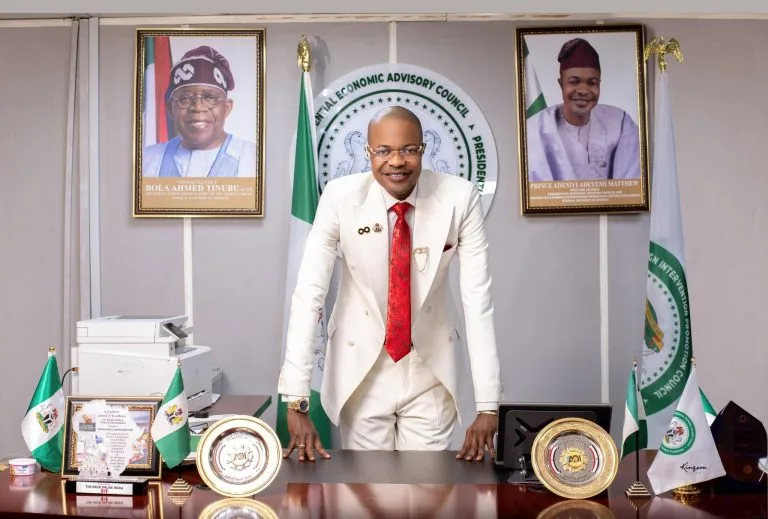
The African Democratic Congress (ADC) has rejected the interim report of the Independent Corrupt Practices and Other Related Offences Commission (ICPC) on the controversial Presidential Foreign Investment Promotion Council (PFIPC), arguing that the findings leave some of the biggest questions surrounding the scandal unanswered.
The opposition party said the report appeared to focus more on limiting political fallout than establishing how a purported government agency allegedly gained access to official institutions, occupied government office space and received other forms of state recognition despite questions over its legal status.
The ADC’s position was contained in a statement issued on Saturday by its National Publicity Secretary, Bolaji Abdullahi.
The controversy surrounding the PFIPC has intensified in recent weeks following allegations that the organisation operated as a government agency despite questions over its establishment, with its purported Director-General, Adeniyi Adeyemi, facing scrutiny from law enforcement agencies and lawmakers.
The party said the ICPC’s interim findings had failed to provide satisfactory explanations for how the organisation allegedly secured office accommodation within the Federal Secretariat, attracted civil servants, obtained official recognition and appeared in the 2026 federal budget with a reported allocation of N1.3 billion.
The ADC recalled that it had previously opposed President Bola Tinubu’s decision to assign the investigation to the ICPC, insisting that an independent panel would have been better positioned to investigate the matter without questions about institutional proximity.
According to the opposition party, the interim nature of the ICPC report made it even more difficult to understand why the commission appeared to be pointing responsibility towards Adeyemi while simultaneously maintaining that its investigation was still ongoing.
“The report is not only predictable, it appears more concerned with exonerating government officials rather than providing clear answers to the serious questions that the scandal has raised,” the party said.
The ADC argued that the controversy could not simply be dismissed as an administrative failure.
It maintained that if the PFIPC was indeed established through fraudulent representations, there were still important questions about how those representations allegedly passed through several layers of government without being detected.
“A forgery may explain the first door that was opened. It cannot explain why every subsequent door appears to have opened as well,” the party said.
For the ADC, the central issue is not simply whether Adeyemi allegedly forged documents or misrepresented himself.
The party wants investigators to establish how an organisation whose legitimacy is now being questioned could allegedly secure office accommodation, civil servants, official vehicles and other institutional support.
It argued that such developments would ordinarily require interaction with multiple government departments and officials.
The party therefore questioned whether the alleged activities were facilitated by negligence, institutional failure or possible complicity within government.
The ADC also raised concerns over reports that the ICPC had identified two other allegedly fictitious organisations linked to Adeyemi.
Rather than viewing that development as evidence of an isolated individual operation, the party said it should prompt investigators to widen the scope of their inquiry.
One of the most significant issues raised by the opposition party was the reported N1.3 billion allocation to the PFIPC in the 2026 Appropriation Act.
The ADC argued that a provision of that magnitude should have generated a clear paper trail involving budget submissions, reviews, approvals and verification.
“Budgetary provisions do not materialise by accident,” the party said.
It consequently demanded to know who proposed the allocation, which government officials processed it and who verified the existence and legitimacy of the purported agency before the provision was included in the federal budget.
The party noted that the House of Representatives had already begun its own investigation into how the PFIPC allegedly found its way into the federal budget.
According to the ADC, the legislative inquiry could provide an opportunity to establish whether the budget allocation resulted from deliberate manipulation, administrative negligence or failures within the government’s budgetary verification system.
The opposition party also criticised the reported recommendation that Adeyemi be prosecuted.
It argued that the ICPC’s decision to single out the purported PFIPC director-general appeared premature if, as the commission itself indicated, its investigation remained ongoing.
“If all that the commission had to present was a preliminary report, why not simply present it as a confidential brief to the President instead of making a public drama of it?” the ADC asked.
The party said the investigation should not be structured around finding a convenient individual to blame but should instead establish everyone who may have played a role in allowing the alleged operation to continue.
The ADC described the controversy as a national embarrassment and called on the ICPC to release the full interim report rather than only selected findings.
It also demanded that any public officials whose actions or negligence enabled the purported agency to operate be identified and investigated.
The party stressed that anyone found culpable should face appropriate sanctions after due process.
“What has happened is a national disgrace in the full glare of the entire world. No serious government should be satisfied with identifying one culprit for prosecution,” the party said.
The ADC maintained that Nigerians were not asking investigators to manufacture suspects or reach predetermined conclusions.
Rather, it said, the investigation should follow the evidence wherever it leads — including into government offices if necessary.
At the heart of the controversy, according to the opposition party, is a simple question: if the PFIPC is not a legitimate government agency, how did it allegedly get so far inside the machinery of government without multiple officials noticing?
That, the ADC argued, is the question the ongoing investigations must ultimately answer.
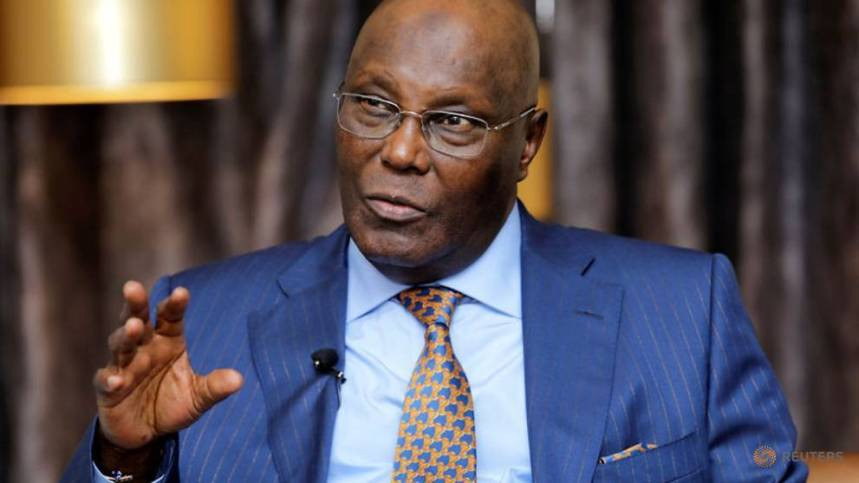
Former Vice President and African Democratic Congress (ADC) Presidential Candidate, Atiku Abubakar, has raised concerns over what he described as a suspicious and unauthorised payment into one of his private bank accounts.
In a statement issued on Friday by his Senior Special Assistant on Public Communication, Phrank Shaibu, Atiku said the transfer originated from an individual or entity unknown to him and carried the narration, “Contribution Electioneering Campaign.”
According to the statement, neither Atiku nor his campaign solicited, authorised or had any knowledge of the payment.
The former Vice President said the account was strictly private and its details were not in the public domain, raising concerns about how the information could have been obtained.
“How did unknown persons obtain the confidential banking details of a private citizen?”
Atiku said the incident raised broader concerns about the security of Nigerians’ financial information, particularly if the private banking details of a former Vice President and presidential candidate could allegedly be accessed without his consent.
“If the private banking information of a former Vice President and a leading presidential candidate can be accessed and deployed for reasons yet unknown, then no Nigerian’s financial privacy is safe.”
He further expressed concern that the alleged disclosure could have involved individuals with privileged access to confidential information.
According to him, if such access is established, it could expose account holders to criminal elements, including kidnappers, terrorists, bandits and fraudsters.
The former Vice President also called the attention of Nigerians and security agencies to the incident, describing it as part of what he termed a series of “suspicious activities” ahead of the 2027 general elections.
“We therefore put the Nigerian public and the security agencies on notice about this latest incident in a litany of suspicious activities leading up to next year’s general elections.”
Atiku also alleged that the incident could be part of an attempt to damage his reputation as political activities intensify ahead of the elections.
He urged Nigerians not to be distracted by what he described as “tired tactics” aimed at character assassination.
“Such desperate antics have failed before and will fail again.”
The ADC presidential candidate said he remained focused on his political agenda and his stated commitment to providing solutions to the country’s challenges.
“The Waziri Adamawa remains focused on offering Nigerians credible leadership and practical solutions to the nation’s challenges.”
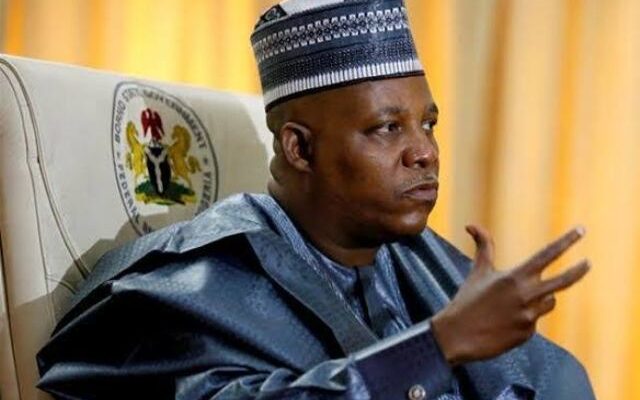
Vice President Kashim Shettima is schedule to begin a two-week leave this Thursday following the approval of President Bola Ahmed Tinubu. This is the Vice President’s first official leave since assuming office on May 29, 2023, according to a statement by the Senior Special Assistant to The President on Media & Communications (Office of The Vice President), Mr. Stanley Nkwocha.
The statement highlighted that during the period of the leave, the Vice President will devote time to study, reflection and intellectual renewal as part of efforts to strengthen his capacity for continued service to the nation.
The leave offers Senator Shettima an opportunity to review the administration’s ongoing programmes, deepen his understanding of emerging national and global policy issues, and prepare for the responsibilities ahead as the Federal Government intensifies the implementation of the Renewed Hope Agenda.
Since assuming office on May 29, 2023, the Vice President has remained actively engaged in the coordination and supervision of several strategic government initiatives, particularly in economic development, food security, humanitarian affairs, digital transformation, job creation and regional cooperation.
He has also chaired the National Economic Council, which brings together the governors of the 36 states, the Governor of the Central Bank of Nigeria and other relevant public officials to deliberate on policies affecting the economy and the welfare of Nigerians.
Beyond his responsibilities within the country, Vice President Shettima has represented President Tinubu at major international and regional engagements, advancing Nigeria’s position on economic integration, peace and security, climate action, investment and sustainable development.
Senator Shettima remains deeply committed to the ideals of loyalty, duty and service that have defined his role in the administration, as well as to supporting President Tinubu’s efforts to build a more secure, productive and prosperous Nigeria.
The Vice President will return to office at the end of the two-week leave period and resume his official responsibilities with renewed energy and dedication to the service of the nation.


