Business
FirstBank Deepens Financial Inclusion Across Nigeria with Record 27,000 Banking Agents


- /home/rhoncare/pointblank.ng/wp-content/plugins/mvp-social-buttons/mvp-social-buttons.php on line 27
https://pointblank.ng/wp-content/uploads/2019/06/FirstBank-2-1000x600.jpg&description=FirstBank Deepens Financial Inclusion Across Nigeria with Record 27,000 Banking Agents', 'pinterestShare', 'width=750,height=350'); return false;" title="Pin This Post">
- Share
- Tweet /home/rhoncare/pointblank.ng/wp-content/plugins/mvp-social-buttons/mvp-social-buttons.php on line 69
https://pointblank.ng/wp-content/uploads/2019/06/FirstBank-2-1000x600.jpg&description=FirstBank Deepens Financial Inclusion Across Nigeria with Record 27,000 Banking Agents', 'pinterestShare', 'width=750,height=350'); return false;" title="Pin This Post">
Nigeria’s premier bank and leading financial services provider, First Bank of Nigeria Limited has announced that it now has over 27,000 Agents on its Firstmonie Agent Network. This feat reinforces the Bank’s steering role at promoting financial inclusion in the country. The over 27,000 Firstmonie Agents are present in almost all Local Government Areas across the country.
In line with the Financial Inclusion objectives of the Central Bank of Nigeria (CBN) to bring financial services closer to Nigerians, Firstmonie Agent Network is a unique channel designed by FirstBank to solve the challenge of access to financial services. Firstmonie Agents are empowered with secured digital channels to provide basic financial services such as account opening, Cash-In, Cash-Out, Funds Transfer, Airtime topup, and Bill payments to customers across the country.
FirstBank, through this Financial Inclusion drive, is making very impressive impact on job creation, women and youth empowerment, and entrepreneurship development – fundamental pillars of overall economic development.
Alhaji Bashir Aliyu Muhammad Rimin-Gado, a Firstmonie Agent operating from Rimin-Gado area in Kano State said, “I have been with Firstmonie since they started and I can say that it has been a life changing experience, I have been able to build trust of the communities around me as many workers in my area have forgotten the last time they visited any bank branch for basic banking services. I am a proud employer of labour and as a result my staff are well paid and comfortable.
Sharing his excitement on the impact FirstBank Agent Banking has had in his immediate community, another Firstmonie Agent in Abia State, Ephraim Osinachi of Jozzy NetComputer Services. Nig Limited, said, “FirstBank’s Firstmonie has created an enabling opportunity for dwellers of my immediate community and neighboring towns to carry out banking transactions with less time, money, resources and risks as people don’t have to waste time embarking on long journeys to the city, added to the dangers of being robbed on the highway.”
“My experience as a Firstmonie Agent has been a rewarding one, as I receive hundreds of Thank You and God bless you from customers each day, because of the relief the Agent Banking gives to them. The people of Ukwa will always remain grateful to CBN and FirstBank for bringing banking to their door step with Agent Banking”, he concluded.
On the back of its drive to deepen inclusion through Agent Banking, FirstBank has also partnered with National Union of Road Transport Workers (NURTW). The (NURTW) partnership seeks to leverage the human traffic and commercial activities at various motor parks across the country to ease access to financial services. First Bank is also in partnership with Azuri Technologies Limited, an off-grid power distribution company to make access to off-grid power easy, especially in rural communities, as well as other institutions, who are seeking to provide resources to cushion the effects of economic and social shocks on low income individuals.
According to the Chief Executive Officer of First Bank of Nigeria Limited, Dr. Adesola Adeduntan “Our Firstmonie Agent Banking network, spread across the nook and cranny of the country, is a demonstration of our resolve to promoting financial inclusion and business in the country. This indeed has been achieved with the concerted effort and commitment of our partners and registered Firstmonie Agents to taking banking to Nigerians regardless of where they are. With them, we are committed to leave no stone unturned at bolstering the economic involvement of many more Nigerians, especially through our robust electronic services like *894# USSD banking, Firstmobile, Firstonline and ChatBanking on WhatsApp”
FirstBank recently announced that over N1 trillion Naira had been processed through the Agent Banking Network. The First Bank to achieve this milestone.



A frustrating international money transfer experience has inspired Nigerian software engineer Tomiwa Lasebikan to co-found Daya, a fintech company developing solutions to simplify cross-border payments for African businesses.
In 2014, Lasebikan attempted to send money to his father in Nigeria but faced transaction charges of nearly 10 per cent, with the transfer taking two weeks to arrive. The experience exposed the inefficiencies of international payments and eventually influenced his decision to return to Nigeria to establish Daya with Paul Joe.
The company is building financial infrastructure that enables African businesses to move money across borders and access liquidity more efficiently.
Daya received early investment backing from Janngo Capital, a venture capital fund supported by the European Investment Bank’s Boost Africa initiative. Beyond funding, the partnership provided access to mentorship, strategic guidance and business networks to support the company’s growth.
The investment highlights how venture capital can help emerging African businesses turn practical challenges into scalable financial solutions.
Read the full story of Daya and other Boost Africa-backed Nigerian companies in the EIB feamentorship: https://www.eib.org/en/stories/boost-africa-nigeria-venture-capital-eu
@all
Business
How Boost Africa-Backed Investment is Supporting Nigeria’s Cross-Border Payments Innovation
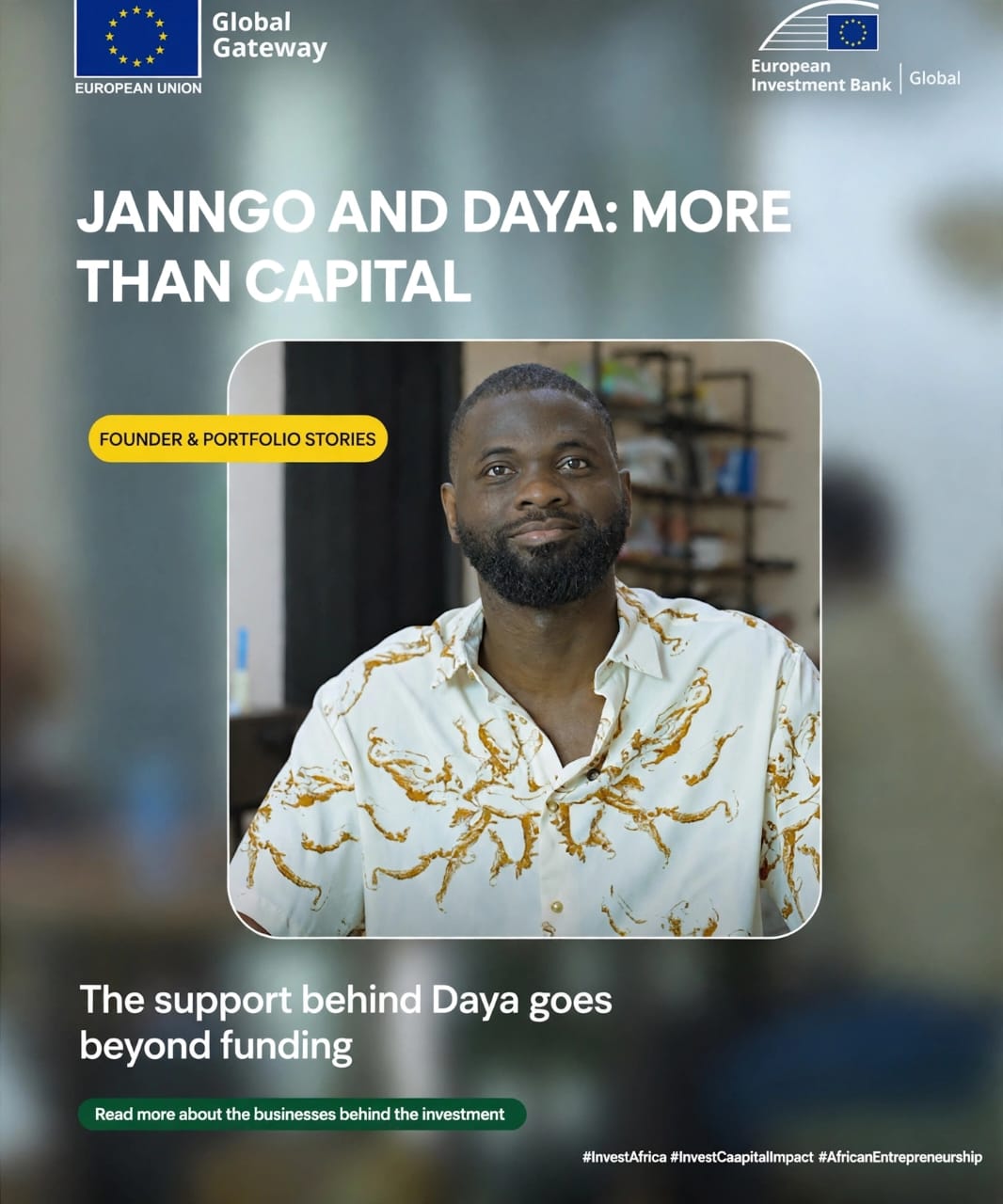
Cross-border payments remain a major challenge for African businesses engaged in international trade, with difficulties moving money and accessing liquidity creating barriers to global commerce.
For Nigerian entrepreneurs Tomiwa Lasebikan and Paul Joe, these challenges inspired the creation of Daya, a fintech company developing international payment and liquidity infrastructure powered by stablecoin-enabled technology.
However, building a solution to address these challenges requires more than an innovative idea. Access to funding, industry expertise and strategic networks is equally important.
Through its Boost Africa initiative, the European Investment Bank (EIB) provides catalytic capital and risk-sharing support to venture capital funds, including Janngo Capital. This model enables fund managers to invest in emerging businesses and support founders developing solutions to critical market challenges.
With backing from venture capital and access to relevant industry networks, Daya is working to improve how businesses move money across borders and manage international payments.
The company’s development highlights the role of investment partnerships in supporting African fintech innovation and connecting local businesses to the global economy.
The EIB’s feature story examines Daya alongside other venture capital-backed Nigerian startups and explores how investment support is helping entrepreneurs turn business challenges into technology-driven solutions.
https://www.eib.org/en/stories/boost-africa-nigeria-venture-capital-eu
Digital Solutions provider, Globacom, has explained how its cost-effective innovative telecommunications and digital services can help corporates, small and medium enterprises (SMEs) and public sector organisations drive business growth.
The company said in a statement released in Lagos on Tuesday that its Enterprise Business arm offers comprehensive information, communications and technology (ICT) and business solutions which help organizations connect better, operate smarter, optimize costs and grow faster.
It noted that Glo Enterprise is equipped to power public sector digitalization, and, therefore, the ideal partner for government ministries and state agencies which require large-scale broadband deployment for e-governance and smart city projects.
“Glo Enterprise improves business efficiency and productivity by providing reliable and integrated telecommunications solutions that enable organizations to communicate, collaborate and operate seamlessly. With dependable voice and data services, businesses can connect employees, offices, customers and business partners more effectively, reducing communication delays and ensuring that important decisions and transactions are carried out promptly.
“Its digital and cloud-enabled solutions also support remote work, secure data management and the smooth running of critical business operations”, the statement said.
Connectivity and cost optimization are other benefits Glo Enterprise offers customers such as banks, oil and gas firms, logistic firms and manufacturing companies. Globacom explained that it provides businesses with solutions designed to meet their different communication and data requirements, helping them stay connected without incurring unnecessary expenses.
According to the statement, Glo Enterprise also facilitates banking operations through dedicated Internet, Leased Lines, and Data Centre solutions, enabling reliable connectivity between branches, supporting digital banking operations and improves customer service.
In addition to this, Glo Enterprise is the go-to partner in the oil and gas industry, where operations are often spread across offices, remote locations and production facilities, providing dependable connectivity and communication solutions that help them coordinate their activities effectively.
In the logistics sector, Glo Enterprise helps in fleet management, vehicle tracking, and coordination of delivery. It helps manufacturers, through stable connectivity, to coordinate production, inventory, suppliers, distribution networks, and liaison between factory and warehouses.