
Metro
Groan to Glory: The Leader’s Sacred Journey of Unlocking Possibilities


- /home/rhoncare/pointblank.ng/wp-content/plugins/mvp-social-buttons/mvp-social-buttons.php on line 27
https://pointblank.ng/wp-content/uploads/2025/08/DR.TOLULOPE-A.-ADEGOKE-AMBP-UN__-1-744x600.jpg&description=Groan to Glory: The Leader’s Sacred Journey of Unlocking Possibilities', 'pinterestShare', 'width=750,height=350'); return false;" title="Pin This Post">
- Share
- Tweet /home/rhoncare/pointblank.ng/wp-content/plugins/mvp-social-buttons/mvp-social-buttons.php on line 69
https://pointblank.ng/wp-content/uploads/2025/08/DR.TOLULOPE-A.-ADEGOKE-AMBP-UN__-1-744x600.jpg&description=Groan to Glory: The Leader’s Sacred Journey of Unlocking Possibilities', 'pinterestShare', 'width=750,height=350'); return false;" title="Pin This Post">
By Tolulope A. Adegoke, PhD
“Leadership is the sacred stewardship of the groan—the courage to lean into the tension of today to midwife the glory of tomorrow for people, corporations, and nations” – Tolulope A. Adegoke, PhD
Introduction: The Universal Sound of Growth
If you have ever led anything—a team, a project, a family, a company, or even a personal dream—you are intimately familiar with the sound. It is not a scream of terror, nor a shout of victory. It is something deeper, more primordial. It is the groan.
It is the late-night sigh over a spreadsheet that refuses to balance. It is the fervent debate in a boardroom about a risky new direction. It is the quiet frustration of a community leader facing systemic injustice. It is the personal cost of upholding integrity when compromise would be easier.
For too long, we have mislabeled this groan as failure, burnout, or a sign to quit. But what if we have it all wrong? What if the groan is not the signal of an ending, but the essential, non-negotiable birth pang of a new beginning?
This profound leadership pattern is revealed in the ancient text of Romans 8:18: “For I consider that the sufferings of this present time are not worth comparing with the glory that is to be revealed to us.”
This passage reframes our struggle. The “groan” is the present suffering; the “glory” is the future revealed. The space between them is where true leadership lives. This is not a passive hope, but an active, gritty, and strategic journey of midwifing possibility into reality for people, corporations, and nations—all as an act of stewardship to God Almighty.
Part 1: Deconstructing “The Groan” – The Leadership Crucible
The groan is the pressure that forms the pearl. It is the tension between vision and current reality. For a leader, ignoring the groan is negligence; understanding it is wisdom; and navigating it is mastery.
A. The Personal Groan: The Weight of the Self
Before we lead others, we must lead ourselves, and this is where the first groans are heard.
· The Groan of Discipline: The 5 a.m. alarm to invest in personal development when comfort beckons.
· The Groan of Failure: The sting of a missed opportunity or a flawed decision that becomes the crucible of resilience.
· The Groan of Loneliness: The burden of confidential decisions that cannot be shared, borne alone in the quiet of one’s office.
· The Glory: This personal groan forges character, wisdom, and resilience. The leader emerges not just smarter, but wiser; not just skilled, but grounded. They become a source of stability for others because they have been refined in their own fire.
B. The Organizational Groan: The Birth Pangs of Innovation
Corporations and institutions do not transform through comfort. They evolve through necessary, and often painful, strain.
· The Groan of Innovation: The financial drain and uncertainty of R&D, where countless ideas die so that one might change the world.
· The Groan of Restructuring: The difficult, people-centric process of dismantling outdated systems to build more agile, future-proof models.
· The Groan of Cultural Shift: The exhausting, long-term work of rooting out toxicity and fostering a culture of trust, accountability, and empowerment.
· The Glory: This organizational groan yields market leadership, sustainable profitability, and a legacy brand. The company transitions from being a mere participant in the market to a shaper of it, creating products and cultures that define excellence.
C. The Societal Groan: The Labor Pains of a Nation
The most complex groans are those of nations and communities. They are collective, historic, and deeply felt.
· The Groan of Justice: The relentless, multi-generational struggle against corruption, inequality, and systemic oppression.
· The Groan of Reform: The short-term political and economic pain endured for long-term national benefit—be it in education, infrastructure, or economic policy.
· The Groan of Unity: The challenging work of forging a common identity and shared purpose out of diverse, and often divided, peoples.
· The Glory: This societal groan builds prosperous, just, and stable nations. It results in a legacy of peace, a high quality of life, and a society where human potential can flourish for generations to come.
Part 2: The Global Landscape: Groans Heard Around the World
This “Groan to Glory” framework is not theoretical; it is actively unfolding on the global stage.
· Local Context (Example: A Community Leader): A small-town mayor groans under the weight of a dying main street and youth exodus. The “glory” is not achieved by a single grant, but through the grueling work of rallying local businesses, attracting new investment, and revitalizing community pride—a glory seen in a thriving, vibrant town a decade later.
· Corporate Context (Example: The Tech Industry): The entire tech sector is in a prolonged “groan” over ethical AI. The tension between breakneck innovation and societal safety is immense. The “glory” will belong to the leaders and corporations who navigate this groan successfully, establishing a new paradigm for responsible and transformative technology.
· Global Context (Example: The Energy Transition): Nations worldwide are groaning through the transition from fossil fuels to renewable energy. This involves economic disruption, geopolitical shifts, and technological hurdles. The “glory” will be a sustainable planet, energy independence, and new frontiers of economic opportunity for those nations that lead the way.
Part 3: The Leader as a Midwife of Glory: A Sacred Stewardship
Our role as leaders in every sector is not to avoid the groan, but to lean into it with purpose and perspective. We are, in the most sacred sense, midwives of possibilities.
Our core function is to “deliver possibilities.” This means:
1. Seeing the Potential: Visioneering the “glory” hidden within the present struggle.
2. Creating the Space: Building cultures and systems where the groan is acknowledged as part of the process, not a sign of failure.
3. Providing the Resources: Equipping our people and our organizations with the tools, trust, and time to persevere.
4. Guiding the Process: Steering the tension with wisdom, making the tough calls, and protecting the vision from short-sighted compromises.
And all of this is “to the glory of God Almighty.”
This is the ultimate “Why” that redefines success. When we lead with this mindset:
· Our ambition is purified. Success is no longer about our ego but about our stewardship. The thriving corporation becomes a testament to God’s principles of order, creativity, and excellence.
· Our endurance is fortified. Knowing that our labor in the Lord is not in vain (1 Corinthians 15:58) provides a resilience that worldly motivation cannot match.
· Our legacy is eternal. The “glory” we help reveal—a transformed life, a righteous organization, and a flourishing nation—becomes part of a story far bigger than our own.
Conclusion: Embracing the Sacred Tension
The journey from groan to glory is not a straight line. It is a cycle, a spiral of continuous growth and challenge. The glory of one achievement simply reveals the next horizon, and with it, a new, necessary groan.
Do not despise the groan. Do not fear it. Name it. Honor it. Lead through it.
For it is in this sacred tension that true leadership is forged. It is here that we partner with the Divine in the holy work of unlocking the God-given possibilities buried within our people, our organizations, and our nations.
The world is waiting for leaders who are not afraid to groan, for they are the only ones who will ever truly see the glory.
Let us lead accordingly.
Dr. Tolulope A. Adegoke, AMBP-UN is a Recipient of the Nigerian Role Models Award (2024), and a Distinguished Ambassador For World Peace (AMBP-UN). He has also gained inclusion in the prestigious compendium, “Nigeria @65: Leaders of Distinction”.



The Edo State Special Criminal Court has sentenced four men to death for their involvement in the kidnapping of a woman at the Vegetable Market along Airport Road in Benin City.
Justice Aigbona Momodu handed down the sentences after finding the defendants guilty on multiple counts connected to the kidnapping case.
The convicts are Marvellous Isaac, Wisdom Michael, Rufus Emete Michael and Gift Raphael.
Isaac and Michael were sentenced to death on counts two through nine. They also received separate prison terms on other counts, including seven years on count one, while Isaac was sentenced to 10 years on count 10 and life imprisonment on count 11.
Rufus Emete Michael was sentenced to death on counts two, three, four, six and seven, in addition to a seven-year prison term on count one.
The fourth defendant, Gift Raphael, was sentenced to death on counts two, four, six and eight and received seven years imprisonment on count one.
Delivering the sentences, Justice Momodu ordered that the death sentences be carried out by hanging or lethal injection, in accordance with the court’s judgment.
The court also ordered the forfeiture of a JoJef pump-action firearm and ammunition tendered as exhibits during the trial.
The firearm, identified as Exhibit M, along with two unused cartridges and two spent cartridges listed as Exhibits E and E1, was ordered to be handed over to the Edo State Police Armourer at the State Criminal Investigation Department for destruction.
Justice Momodu directed that the exhibits be transferred to the police through the Deputy Director of the Criminal Division and destroyed within 30 days.
The convictions bring to an end the trial arising from the abduction of the woman at the Vegetable Market along Airport Road, an incident that added to concerns over kidnapping and armed crime in Benin City.
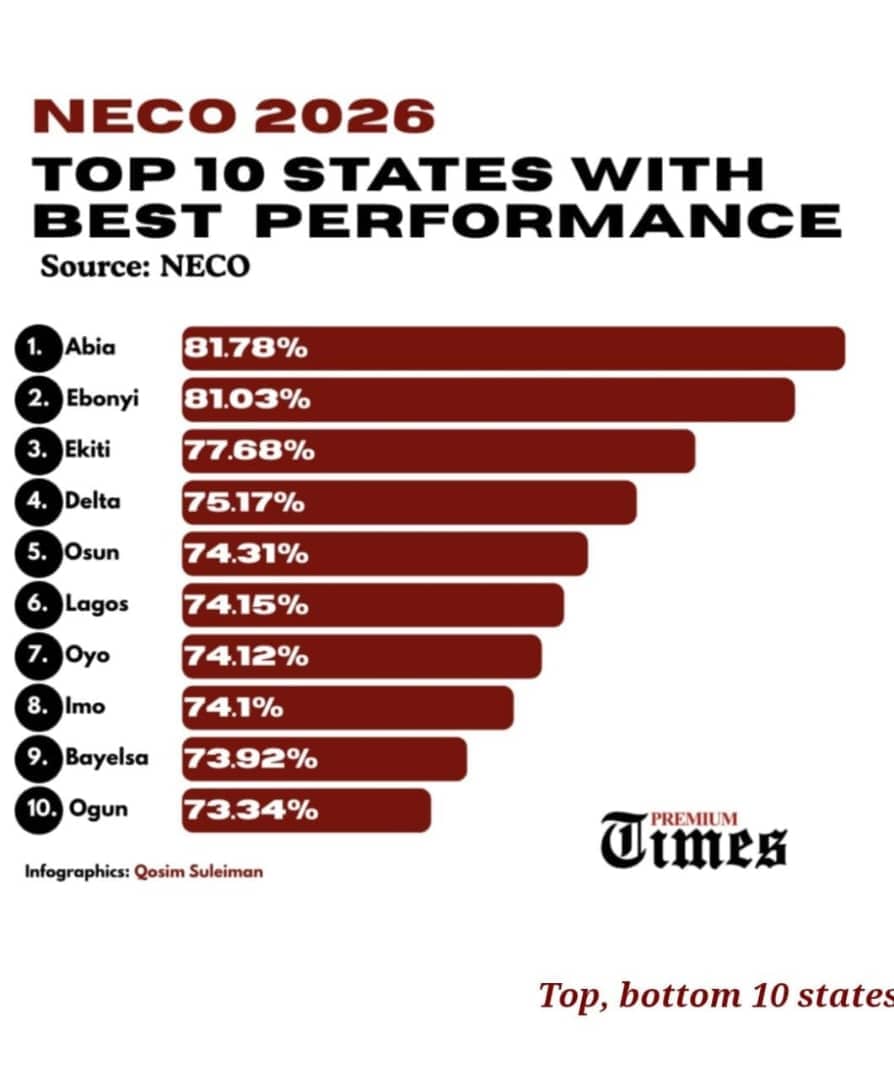
Osun State Governor, Senator Ademola Adeleke, has hailed the state’s strong performance in the 2026 National Examinations Council (NECO) Senior School Certificate Examination, describing the result as a positive reflection of ongoing efforts to reposition education in the state.
Osun placed fifth nationally in the 2026 NECO ranking, with 74.31 per cent of candidates recording at least five credits, including English Language and Mathematics.
While congratulating the students, teachers, parents, school administrators and other stakeholders, the governor noted that the state performance has been improving within a single digit rating for three consecutive years namely 2024, 2025 and 2026.
“Osun has moved from 33rd position in the 2022 NECO ranking to 5th in 2026, while improving its pass rate to 74.31 per cent. This is encouraging, and it shows that our sustained interventions in the education sector are yielding positive results,” the Governor said.
Governor Adeleke said the improved performance reflects his administration’s deliberate investment in the education sector, including the recruitment of additional teachers to strengthen the teaching workforce, while prioritising workers’ welfare and creating a more conducive environment for effective teaching and learning across public schools.
The Governor said the performance reinforces his administration’s determination to continue investing in education, noting that the objective is to build a system that gives every Osun child the knowledge, skills and opportunities needed to succeed.
“This result is encouraging, but we see it as a reason to do more. We will continue to invest in our schools, improve the learning environment, support our teachers and provide our students with the necessary tools to excel.
“We are building an education system that prepares our young people not only for examinations but for life,” the Governor said.
He assured that ongoing interventions in the education sector would be sustained and expanded, while urging students to remain committed to their studies.
His Excellency also commended teachers across the state for their dedication and sacrifices, assuring them that the administration would continue to prioritise measures that strengthen the education system and improve workers’ welfare.
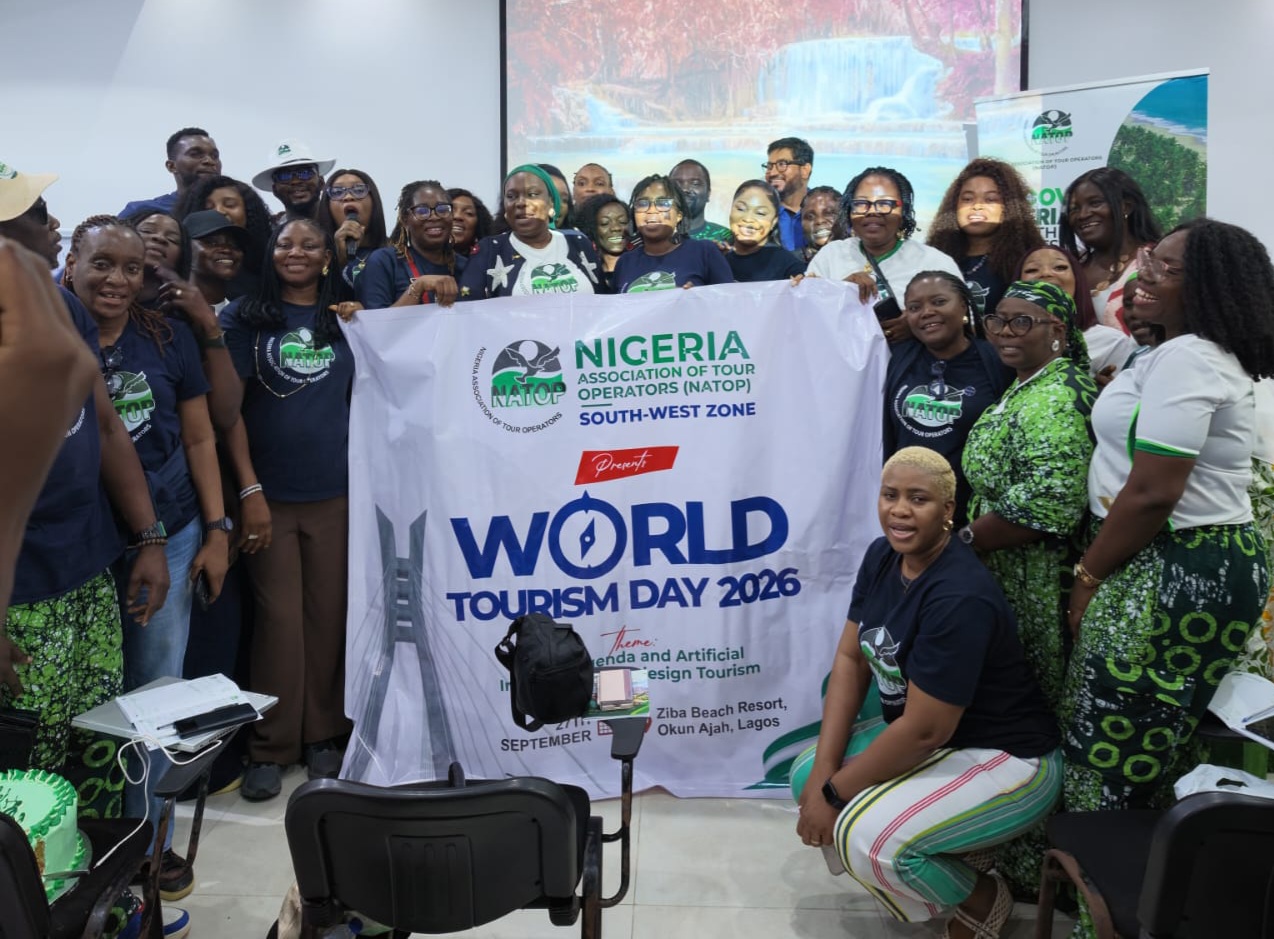
The Nigeria Association of Tour Operators (NATOP) marked the 2026 World Tourism Day with activities which capture capacity building, technology, destination promotion and domestic tourism, and celebration.
In the South West Zone, close to 200 tour operators gathered at Ziba Beach Resort, Lagos, for a special training focused on Artificial Intelligence and its application in tourism, equipping operators with digital tools to improve their businesses and destination marketing.
In Abuja, the FCT and Northern Zone, in collaboration with Naija Adventurers, staged a colourful Tourism Awareness Walk and Hike to the Centre of Nigeria.
The celebration also spread to the South-South Zone, where members marked the day with a destination tour, alongside activities to commemorate with the world tourism day celebrations.
In line with the theme for this year’s WTD celebration: ‘Digital agenda and artificial intelligence to redesign tourism’ the NATOP training on AI and application in tour operation at Ziba Beach Resort Lagos saw a large turnout of the members of the association.
The President of the association, Hajia Bolaji Mustapha explained that the idea for the location and training was to train members on how to do tour business, to know how to promote tourism digitally, using different AI tool and everything so that they will grow their businesses.
She said: “we follow the theme and, you know, blend with the old situation. Let’s do the training so that we attach it to the World Tourism Day with the theme that we have achieved something and also celebrate.”
She said the training will go a long way in helping the tour operators do greater content to digitally tell destination stories using AI, and also using the tool for expression.
Mustapha also explained why the association chose Ziba Beach Resort: “We always attach World Tourism Day to a tourism site. And definitely, if you look at this whole area and this community, that’s why we see that Ziba is a tourism site. We want to explore and of course. The resort newly launched its third phase. So, we will use this opportunity to look at their rooms, look at how we can sell this destination, to showcase it that the resort is actually in Nigeria, not Zanzibar. By using the place, we would kill two birds with one stones.
Facility tour of Ziba Beach Resort
“As tour operators who are willing to tell the good story of our Nigeria, we need to bring ourselves up to the speed, align with the digital revolution. Let everybody go digital. Because we also see the content creators are taking our business, we want to align it with what they do. We are the ones that understand the business and we’ll be able to tell the story better, so that anybody coming to Nigeria will be able to discover Nigeria with the experts.”
Also commenting on the celebration, the NATOP Vice President South West and chairman of the WTD Organizing Committee for the zone, Mrs. Wonuola Olatunde-Lamidi explained why NATOP South West’s usage of the 2026 WTD for training. She said many of the members still have a lot to learn about the tour business, and that some do not understand the foundation of the business, including how to create packages hence the need for the training.
Mrs. Olatunde-Lamidi spoke further: “Many don’t understand the foundation of what it is to create a tour package. And when you have people that are not well-trained in an industry, the industry will not grow. The kind of people that you also have will not have enough earning power to do many things. And because this is an industry that I have been in for 16 years, I run Diamonds and Pearls Travels with my husband. And I’ve seen Diamonds and Pearls Travels metamorphose into a company where people don’t just look at us as travel agents. We have become a Destination Management Company (DMC). We have become a trusted brand. We have become a company that when we talk about a destination, people want to go to that destination because of how we have portrayed the destination. And you may not realize that, as tour operators, you can actually decide where people go. You can make people go to a particular destination by marketing it, by letting them know the benefits of that destination.”
The tour operators had opportunity to tour the resort and unwind during the programme.


