
News
‘He Died a Natural Death’ – Katsina Govt Announces Death of Gen Rabe Abubakar in Kidnappers’ Captivity

- /home/rhoncare/pointblank.ng/wp-content/plugins/mvp-social-buttons/mvp-social-buttons.php on line 27
https://pointblank.ng/wp-content/uploads/2026/06/images-2026-06-13T130038.446-613x500-1.jpg&description=‘He Died a Natural Death’ – Katsina Govt Announces Death of Gen Rabe Abubakar in Kidnappers’ Captivity', 'pinterestShare', 'width=750,height=350'); return false;" title="Pin This Post">
- Share
- Tweet /home/rhoncare/pointblank.ng/wp-content/plugins/mvp-social-buttons/mvp-social-buttons.php on line 69
https://pointblank.ng/wp-content/uploads/2026/06/images-2026-06-13T130038.446-613x500-1.jpg&description=‘He Died a Natural Death’ – Katsina Govt Announces Death of Gen Rabe Abubakar in Kidnappers’ Captivity', 'pinterestShare', 'width=750,height=350'); return false;" title="Pin This Post">
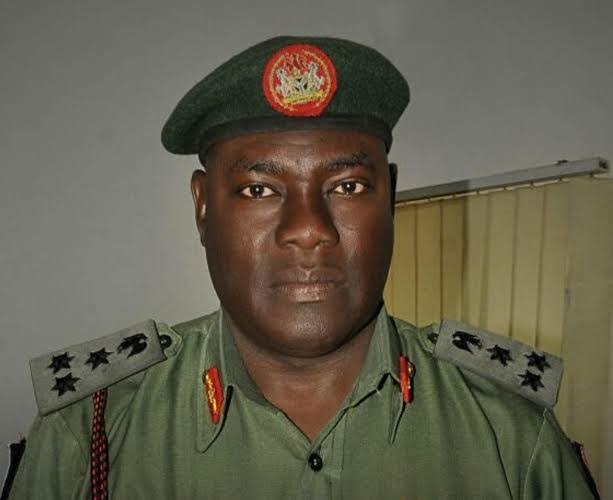
A Retired Major-General and former Director of Defence Information, Rabe Abubakar, is dead.
According to the Katsina state government, Abubakar died in bandits’ captivity.
The retired major-general and his wife were abducted in May while travelling through Katsina.
On June 6, a video showing Abubakar and his wife appealing to the Katsina government for the release of detained bandits and livestock surfaced online.
A statement on Saturday by Nasiru Mu’azu, commissioner for internal security and home affairs, said Abubakar died from complications of diabetes and hypertension.
“It is with profound sadness that we confirm the General’s death while in bandits’ captivity,” the statement reads.
“Despite the relentless and concerted efforts of the State Government and various Security Agencies to secure his safe release, the situation ended in this tragedy.
“The deceased Retired General died a natural death from complications of diabetes and hypertension.
“His abduction and subsequent death are not only a loss to his family and Katsina State but a monumental loss to the entire country.
“His Excellency, the Executive Governor of Katsina State Malam Dikko Umaru Radda, PhD, CON, extends his deepest condolences to the family of the late General and the country at-large.
“The Governor has described this incident as a “dark moment” and a reminder of the urgent need for a collective and intensified front against the criminal elements threatening the peace of our communities.”
The Katsina government added that it remains committed to working with the federal government and security forces to ensure that those responsible for the heinous act are brought to justice.
“We assure the citizens of Katsina State that our resolve to eliminate banditry and ensure the safety of all residents remains unshaken,” the statement added.
“Our thoughts and prayers are with the bereaved family during this difficult time. May the soul of the departed Retired Major General Rabe Abdulakdir rest in eternal peace.”


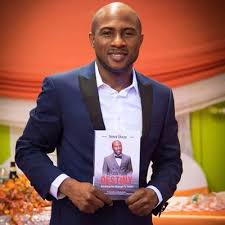
By Henry Ukazu
Dear Destiny Friends,
If you are asked, what’s your calling, what will be your response? If you are asked what your purpose on earth is, what will be your response? If you are asked who you are, what would be your response? These, no doubt, are interesting questions to decipher one’s calling.
Finding one’s calling is the best thing that can happen to anyone. According to one of my most cherished mentors, Dr. Yomi Garnett, the day you find your purpose is the day you become a millionaire. I couldn’t agree more with this saying because it is nothing but the gospel truth. This is because the best thing that can happen to anyone is knowing their calling.
According to Mark Twain, “The two most important days in your life are the day you are born, and the day you find out why. This is a fact. It’s quite unfortunate that many people are just existing as opposed to living. We were not created to exist, we were created to fill a vacuum, and we can only make an impact if we are intentionally answering our call.
Let’s circle back to the question I asked at the beginning of this article, what’s your calling? To answer this question, I would like you to approach it from a spiritual perspective. At creation, God called us to be something in the world, that’s why he gave us gifts and talents and told us to be fruitful and multiply.
Just like we all have names that our parents, friends, children, mentors, etc. call us. These names are reflections of what we mean to them or how they perceive us. Names are symbolic and have deep meanings if we apply reasoning to them. So, if we can answer the names we are called to earth, how about answering the name God called us at birth. I believe that’s the most important call or name we need to answer as human beings. When we answer the name God gave to us, the world will begin to respond to what we say because we have answered the mother’s call.
Why do I say this? Your purpose was made in heaven, but your calling is meant to be fulfilled on earth. It’s sad to see people answering different names they are not called. When God created you, there’s something he had in mind for you to accomplish or solve on earth, but it’s unfortunate that, due to life’s vicissitudes, some of us derail from the path God destined for us, and hence that’s the reason many of struggle because we are not working in the direction and pathway God designed for us to tread.
It should be known that your calling was not a conference call; the call was personal. If God wanted anyone to know your calling or purpose, he would have revealed it to anyone he wants, but he chose to reveal it to you, so the onus is on you to focus on it, follow it religiously and ultimately fulfill it because that’s the only way you can get fulfillment.
I also asked, what’s your purpose? Your purpose is the reason why you do whatever you are doing. In this context, your purpose is your why. According to Dr. Myles Munroe, “When the purpose of a thing is not known, abuse is inevitable.” Your purpose is the reason why you applied for a job, married your partner, started an NGO, a business, relocated/travelled, started school, or even wrote a book. There’s always a reason why we do something. That reason is the inspiration and motivation we need to forge when everything else fails.
Again, I ask you what’s your purpose? If you can’t figure out your purpose, I will strongly advise you to go to your creator (God) and ask him, what’s your purpose because he’s the person that created you. When people desire different interests in different majors, skills, profession, vocation, etc., it’s simply because someone puts the desire and interest inside them.
To understand how purpose works, there’s no problem on earth without a solution. The only problem without a solution is the problem the person with the solution hasn’t arrived.
Let me share a practical example on purpose. There was a story of an old man whose car (Ford) broke down in the middle of the road, all efforts to fix the car proved abortive. An old man was passing by and saw this man struggling to fix the car, he asked him, “What’s the problem?” The old man said, well, my car has refused to start. The stranger told the man to give a minute. The man initially refused saying who is this old man to fix what I have been working on for hours.
On second thought, he said, what will I lose if I give him a chance. He decided to listen to the old man who told him to give me a minute to check out the car. This stranger didn’t do much, he just touched a particular side of the engine and told the old man to start the car, and immediately the car cranked back to her life. The man was surprised and asked him, who are you? ” The stranger said, “I am Henry Ford, the owner of Ford Motors.
The moral of this story is, Henry Ford, the founder of Ford motors, knows his car more than everyone. So, if a mere mortal can know much, how much about the creator who will not know about our purpose?
When you find your purpose, you find your why, but when you find your why you must find your purpose.
The final question I asked: “Who are you? To answer these questions, I need you to focus on the inmate quality you are blessed with as opposed to what people think about you. What people think about you is your reputation, but who you are is your character. Some people associate titles to who they are. I think that’s the wrong interpretation. One might be a doctor, lawyer, Chief Operating Officer, professor, or even the governor or president, but that doesn’t make them good people with good traits, qualities, values and charismatic inmate abilities.
To lead one must have empathy, compassion, and heart of service. It is through these traits; one can see who a person really is and not the cloth of title they are showing the world.
So, to find one’s calling, here’s my sample suggestion: ask your creator (God), inquire what makes you happy, what you love to do, what do people compliment you on, what do you do with relative ease if you are woken from sleep? What is one thing you can do for free?
In conclusion, finding one’s calling is the best thing that can happen to anyone. The day you find your calling is the day you will begin to live your best life because you will begin to bless the world with your calling.
Henry Ukazu writes from New York. He works with the New York City Department of Correction as the Legal Coordinator. He’s the founder of Gloemi. He’s a Transformative Human Capacity and Mindset coach. He is also a public speaker, youth advocate, creative writer, and author of Design Your Destiny- Actualizing Your Birthright to Success, Unleash Your Destiny, and The Six Pillars of Success. He can be reached via info@gloemi.com

A chieftain of the African Democratic Congress (ADC), Chief Dele Momodu, has said no political permutation will save President Bola Tinubu in the 2027 presidential election, insisting that widespread hunger and hardship will determine the outcome.
Momodu stated this on Thursday during an appearance on Channels Television’s Politics Today, anchored by Seun Okinbaloye.
According to him, Nigerians across all regions and ethnic lines are united by economic hardship, which no amount of money or political calculation can overcome.
“The common factor now is the hunger in the land. No permutation can beat hunger. The Yorubas are suffering, the Hausas are suffering, the Igbos are suffering, everybody is suffering,” he said.
He argued that President Tinubu cannot buy the entire country, even if he was able to deploy money effectively in Lagos State politics in the past.
“Tinubu believes he can buy the whole of Nigeria, but my personal belief is that if he could buy the whole of Lagos, I doubt if he can use money to buy the whole of Nigeria,” Momodu stated.
The Ovation Publisher said Nigerians had become wiser and would collect any money offered to them during elections but still vote according to their conscience.
He cited the Osun State governorship election as a case study, noting that, despite the huge funds allegedly deployed, the people voted for Governor Ademola Adeleke.
“And a lot of people will take the money like they took it in Osun State. People’s eyes are wide open now. They brought a lot of money to Osun State, but they still lost the election to Ademola Adeleke,” he said.
Momodu also recalled that Tinubu lost Lagos State to Mr Peter Obi of the Labour Party in the 2023 presidential election, which he said proves that incumbency and financial muscle do not guarantee victory.
He maintained that President Tinubu would not win in 2027, claiming that many Nigerians could not imagine a second term for the administration.
“If you ask an average Nigerian today, do you trust Tinubu to conduct a free and fair election? 90 per cent will say no. Nobody trusts Tinubu, including his own supporters,” Momodu said.
On the detention of former Kaduna State Governor, Mallam Nasir El-Rufai, Momodu described him as a “prisoner of conscience” who is being persecuted because of his political influence.
“Nasir El-Rufai is a lion. They caged him because he is a lion. Even when a lion is caged, it is still a lion. They want him locked up until after 2027 because they fear his influence,” he said.
He disclosed that El-Rufai’s appointment as Deputy Chairman of the Atiku Abubakar Presidential Campaign Council was in honour of his sacrifice and resilience.
“It is a way of honouring his sacrifice because his travails are quite political in nature. That is why Nasir has become a prisoner of conscience. He is in the hands of a government that he helped to midwife,” Momodu added.
He said the 2027 election would be a referendum on hunger, hardship and governance, and not on political permutations.
Meanwhile, the Senior Special Assistant to the President on Digital Communications, Engagement and New Media Strategy, O’tega Ogra, has faulted Momodu’s comments.
Reacting to the interview, Ogra accused the opposition of embracing “perpetual negativity” and opposing government policies without objective assessment.
He said Momodu’s assertion ignored ongoing reforms and improvements recorded in key economic indicators, including foreign reserves, power generation and inflation management.
Ogra urged opposition figures to offer constructive criticism rather than painting a picture of total failure, stressing that President Tinubu would ultimately be judged by his reforms and track record.
The Tribune
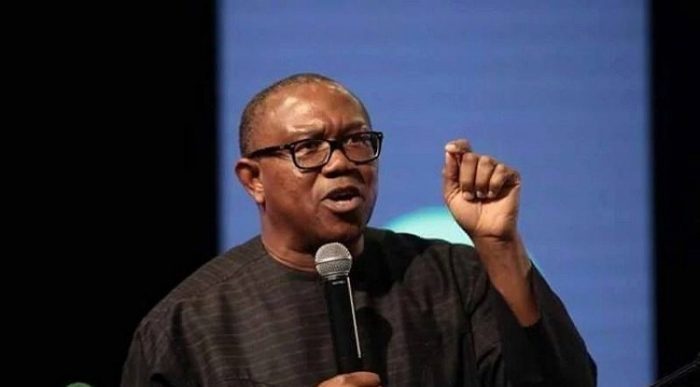
The Nigeria Democratic Congress (NDC) presidential candidate, Peter Obi, has denied asking Nigerians living in the United Kingdom to abandon relatives who depend on them for financial support, saying his message about hardship in Nigeria was distorted by political opponents.
Obi said he appreciates Nigerians in the Diaspora who make sacrifices to support their families at home, stressing that his concern is the country’s dependence on remittances to meet basic needs.
In a statement titled; “My Message Has Been Twisted”, posted on X on Tuesday, the former Governor of Anambra State clarified that he never asked Nigerians abroad to stop supporting their loved ones.
“I deeply appreciate Nigerians in the diaspora who work tirelessly and make enormous sacrifices to support their families back home,” he said.
“Their remittances pay for school fees, hospital bills, rent, and feeding expenses. Their patriotism and sacrifices deserve our profound respect. I never asked them to abandon their loved ones.”
Obi said his message was aimed at drawing attention to the economic conditions forcing millions of Nigerians to rely on relatives abroad for their survival.
“My concern is that Nigeria should not remain a country where millions depend on relatives abroad for basic survival,” he said.
“Our goal must be to build a nation that provides jobs, affordable healthcare, quality education, and economic opportunities for its citizens.”
He accused political opponents of misrepresenting his comments, insisting that his position is about addressing the causes of hardship rather than discouraging financial assistance to families.
“Political opponents may twist my message, but the truth remains clear: I am not asking Nigerians abroad to abandon their families. I am advocating for a Nigeria that will no longer abandon its own people,” he said.
The clarification followed backlash over comments Obi made during a town hall meeting with Diaspora supporters in Manchester on Sunday.
In a video that went viral, Obi urged Nigerians in the UK to think twice before giving money to relatives and others at home who ask them for financial assistance, arguing that such support could ease hardship without addressing its underlying causes.
“You have people at home in Nigeria today who are begging you for money. Tell them no!” he said.
Obi attributed the country’s economic difficulties to poor leadership, urging Nigerians abroad to encourage their relatives and friends at home to vote for leaders who would prioritise productivity and economic opportunities.


