Metro
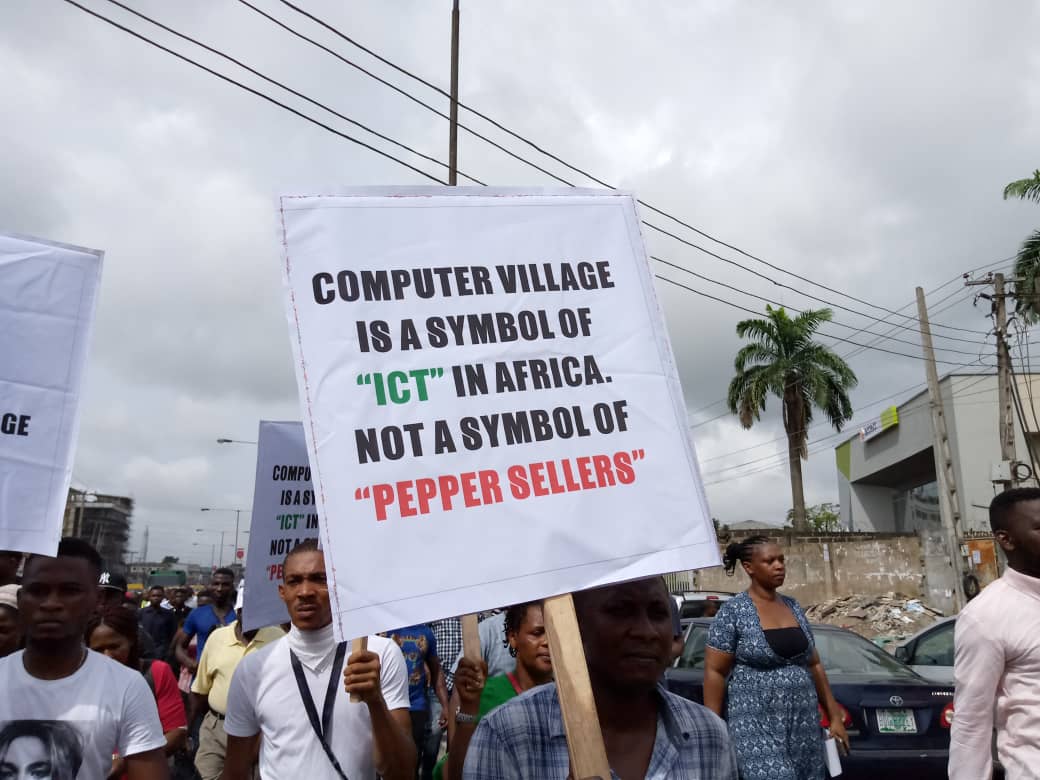
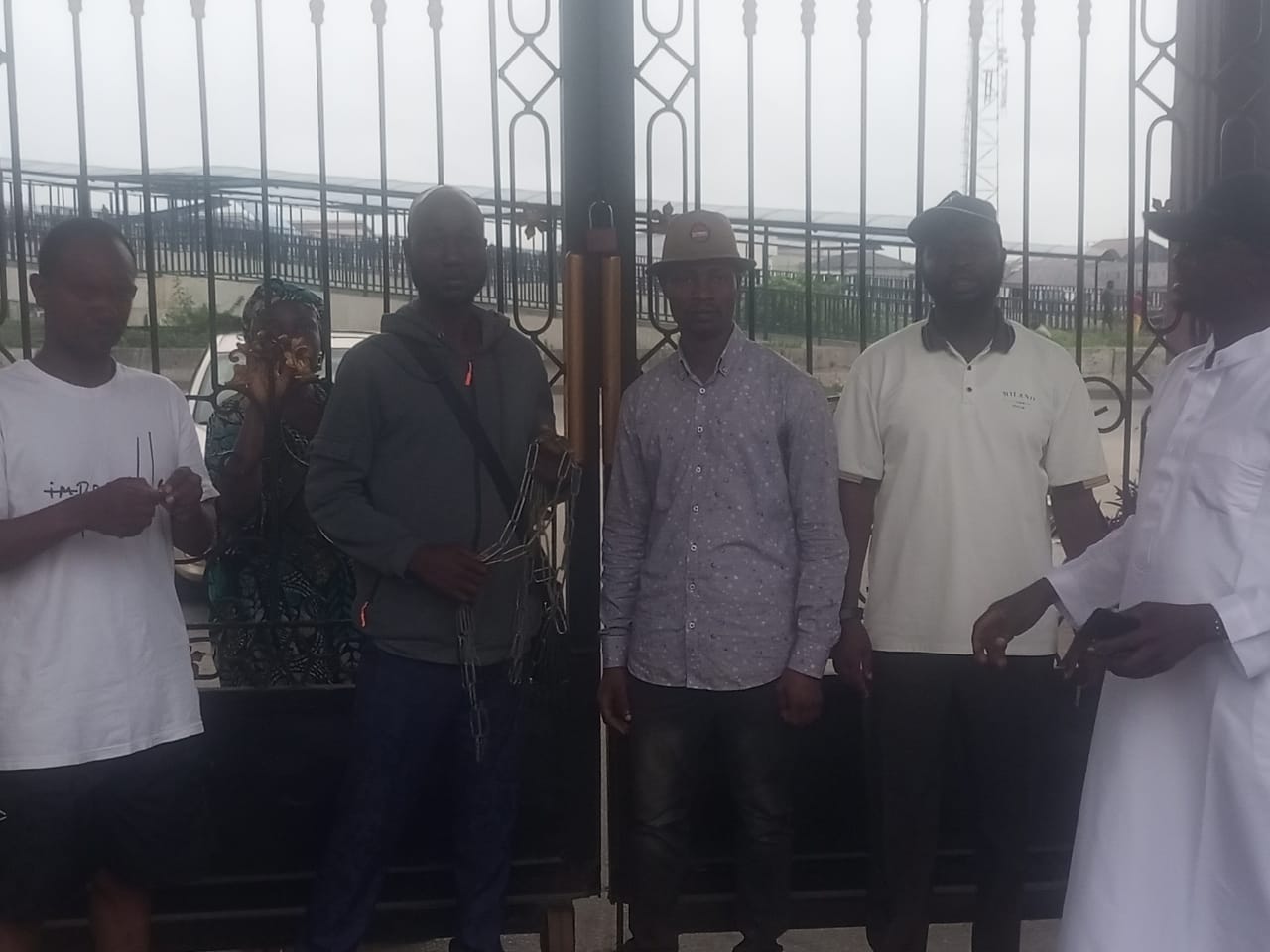
Installation of “Iyaoloja”: Computer Village Traders Protest, Shut Down Market
- /home/rhoncare/pointblank.ng/wp-content/plugins/mvp-social-buttons/mvp-social-buttons.php on line 27
https://pointblank.ng/wp-content/uploads/2019/04/Protest-1000x600.jpeg&description=Installation of “Iyaoloja”: Computer Village Traders Protest, Shut Down Market', 'pinterestShare', 'width=750,height=350'); return false;" title="Pin This Post">
- Share
- Tweet /home/rhoncare/pointblank.ng/wp-content/plugins/mvp-social-buttons/mvp-social-buttons.php on line 69
https://pointblank.ng/wp-content/uploads/2019/04/Protest-1000x600.jpeg&description=Installation of “Iyaoloja”: Computer Village Traders Protest, Shut Down Market', 'pinterestShare', 'width=750,height=350'); return false;" title="Pin This Post">
Traders in the Computer Village, Ikeja, Lagos State, on Tuesday shut down activities to protest the planned installation of female and male market leaders “Iyaoloja” and “Babaloja” respectively in the hub.
The traders told a Correspondent of the News Agency of Nigeria covering the protest that the computer village was an international market that did not need such imposition of Iyaoloja.
Mr Wasiu Agbaje, an Information Communication Technology Engineer, said that hub was not like the regular markets where such should be imposed.
Agbaje said that installing such would undermine the hub because there was no relationship between technology and Iyaoloja.
“What do the Iyaoloja and Babaloja have to offer, what value are they going to add to the hub? And what technological innovations are they bringing?
‘“The computer village is not like any other street market where pepper and other things are sold.
“It is an international technology hub and it should be treated as such,” he said.
Also, a businessman who preferred anonymity told NAN that the computer village was an international market and should be treated as such.
According to him, it will undermine the position of computer village internationally as the biggest technological hub in West Africa.
He said installing such Iyaoloja and Babaloja would contradict what the hub was known for and breach the peace there because it was not a regular market.
A Software developer, Mr Joseph Efosa, said that such installation would disturb the 25 years of peaceful existence of the hub.
Efosa said that the computer village was not a regular market and such installation was not needed.
(NAN)
Metro
The GOSHENOMICS: Productive Preparation for Crisis Resilience
By Tolulope A. Adegoke
“When the ground trembles beneath the feet of the unprepared, those who have built upon the rock of foresight shall not only stand but flourish. Goshen was not a place of escape—it was a place of productivity amidst plagues, light amidst darkness, and life amidst death. Prepare not to survive, but to live.” – Tolulope A. Adegoke, PhD
The year 2030 isn’t the end of the world—but it may be the end of the world as you know it. Here’s how to prepare, not just to survive, but to thrive.“
Introduction: Why 2030 Matters More Than You Think
The year 2030 isn’t just another date on the calendar. It’s a convergence point where multiple global forces collide—artificial intelligence reaching mass deployment, climate impacts intensifying, economic systems restructuring, and the United Nations Sustainable Development Goals reaching their target year.
The question isn’t whether these changes will happen. It’s whether you’ll be positioned to flourish when they do.
Goshen wasn’t merely a place of survival—it was a place of productivity, light, and life amidst surrounding darkness. GOSHENOMICS applies that same principle to today’s realities: productive preparation that builds assets, communities, and systems designed to thrive when others merely endure.
This isn’t about fear. It’s about faith, purpose, and proactive action. Let’s explore how.
Part One: Agribusinesses—Food Production as the Foundation
Why Food Security Matters Now More Than Ever
Agriculture remains the bedrock of civilization. Yet smallholder farmers across the globe face systemic barriers—limited irrigation, climate vulnerability, and inadequate access to technology. When these farmers struggle, everyone feels the impact.
“Build skills, understand food, and build redundancy.” This isn’t survivalist rhetoric—it’s strategic foresight.
The GOSHENOMICS Solution: Precision Agriculture
Precision Agriculture at Scale: Integrating machine learning and drone technology transforms smallholder farming from subsistence to surplus. Field research demonstrates significant increases in crop yields alongside substantial reductions in water usage when IoT sensors, weather forecasting platforms, and autonomous drones work together.
Autonomous Irrigation Systems: Collaborative multi-drone systems with swarm intelligence enable real-time, localized irrigation decisions. These systems adapt to changing conditions, conserve water, and optimize crop health continuously.
Software for Forecasting: Build platforms that analyze weather patterns, soil conditions, and market data to inform planting, harvesting, and distribution decisions. This moves agriculture from gambling on climate to managing climate as a calculated variable.
How Drones Are Revolutionizing Agriculture
Drones equipped with multispectral and thermal cameras detect stress from pests, diseases, nutrient deficiencies, and water shortages before problems spread. Drone-based spraying systems apply pesticides and fertilizers with exceptional precision, reducing chemical usage by up to ninety percent while improving efficacy. Drones also track livestock movement, detect illness, and monitor herd health in extensive grazing systems. They generate detailed topographic maps that inform planting patterns, drainage planning, and water management decisions.
The Implementation Roadmap
Start now by identifying local food production gaps and designing scalable interventions. Build redundancy by developing multiple production sites, diverse crop portfolios, and storage systems. Finally, integrate by connecting production to processing, storage, and distribution networks that keep value within communities.
Part Two: Community—The Commonwealth of an Ecosystem
Why Community Matters
Resilience isn’t individual—it’s communal. The Commonwealth of an Ecosystem recognizes that no farm, business, or household is an island. Survival and flourishing depend on interconnected systems of mutual support, shared resources, and collective capability.
Strong communities are the essential social infrastructure that enables individuals and families to weather crises and seize opportunities.
The Evidence
International development programs have demonstrated that grassroots initiatives generate measurable returns. Climate adaptation investments at the community level have restored hundreds of thousands of hectares of degraded land, reached millions of people, and moved communities toward sustainable revenue generation.
The lesson is clear: communities aren’t passive recipients of aid—they’re agents of change.
The GOSHENOMICS Approach
Build local institutions that formalize community governance structures to manage resources, make decisions, and allocate investments transparently. Create resilient networks because social capital—connectedness, trust, networks, and collective capacity—is the infrastructure of community resilience. Self-organizing communities with agency and shared responsibility weather crises more effectively.
Integrate indigenous knowledge with technology because the most sustainable solutions anchor technology in local wisdom and practice. Context-adapted systems demonstrate higher adoption rates and better outcomes. Finally, build capacity and skills by investing in agricultural capabilities, technical competencies, business acumen, and leadership development.
Part Three: Technology—Building the Infrastructure of the Future
Solar Electrification
Solar energy offers a reliable, sustainable, and increasingly cost-effective solution for electricity access. Off-grid standalone solar systems eliminate dependence on fragile grid infrastructure. Solar microgrids provide community-scale power to multiple users through local distribution networks. Solar water pumping delivers water for agriculture without grid electricity or diesel. Solar refrigeration enables cold storage for agricultural products, vaccines, and other temperature-sensitive goods.
The economic benefits are substantial. Solar systems eliminate ongoing fuel costs, reducing operating expenses. Energy independence reduces dependence on imported fuels and vulnerable infrastructure. Reliable electricity enables productive enterprises that create employment and income. Quality of life improves through lighting, communication, education, and health services.
Boreholes and Water Infrastructure
Sustainable groundwater extraction through properly designed boreholes with solar-powered pumps delivers water efficiently without ongoing fuel costs or emissions. Smart irrigation systems—including drip irrigation, automated scheduling, and remote monitoring—optimize water use and improve yields. Water storage through tanks and systems buffers against variable extraction rates and ensures availability during dry periods.
Software and Digital Platforms
Agricultural software includes farm management systems, weather forecasting, yield prediction, and market intelligence. Community software encompasses information sharing platforms, resource management systems, and emergency alert networks. Economic software covers supply chain management, financial services, and market platforms. Forecasting and planning tools include scenario planning, risk assessment, and decision support.
Part Four: The Daniel Principle—Integration Without Compromise
Strategic Engagement and Boundary Setting
Integration isn’t compromise unless you eat the king’s meal. The Daniel Principle—named for the biblical figure who maintained his identity and integrity while serving in a foreign empire—is central to GOSHENOMICS.
Know What to Say No To
Not all technology serves human flourishing. Not all partnerships align with community values. Not all innovations are worth adopting. Discernment is essential.
Build Productive Assets, Not Speculative Ones
Don’t spend the next four years predicting catastrophe while building nothing. When AI is “in vogue,” invest in what endures: skills that enable productive work, community that provides mutual support, food systems that ensure nourishment, energy independence that provides security, and water security that sustains life.
Work Yourself Out of Your Job
True resilience means you’re not irreplaceable—it means the community continues functioning without you. Train successors who can perform your roles. Document knowledge so it can be transferred. Build systems that function with limited supervision. Create redundancy so no single point of failure exists.
Part Five: What to Expect Toward 2030
Artificial Intelligence Deployment
Artificial intelligence will achieve mass adoption across all sectors of economy and society. Labor markets will experience significant shifts as some jobs are eliminated and others transform. Productivity gains will create opportunities and disruption. Energy demand will increase, placing pressure on infrastructure. Governance challenges will require regulation, ethics, and social adaptation.
Climate Impacts
Climate change will bring increasing extremes with more frequent and severe weather events. Agricultural impacts will include shifting growing conditions and production zones. Water scarcity will intensify pressure on resources. Population movements will increase as climate-induced migration grows. Infrastructure will face pressure, requiring investment in resilience.
Economic Shifts
Markets will restructure as some transform or disappear. Investment patterns will shift toward climate adaptation and technology. Value chains will change toward greater resilience and sustainability. Financial systems will adapt to new risks and opportunities.
Healthcare and Demographics
Medical breakthroughs will extend lifespans and improve quality of life. Demographic shifts will create different challenges across regions. Health systems will face increasing pressure as demand grows.
Part Six: The GOSHENOMICS Preparation Strategy
Build with the Ground Beneath Your Feet
Build on local foundations using local resources, knowledge, and capabilities. Invest in physical infrastructure including land, buildings, equipment, water, and energy. Build strong community institutions with robust governance and management systems. Invest in relationships and networks that provide mutual support.
Have Food Growing Around You
Prioritize local food production for local consumption. Build food redundancy through multiple production sources, storage options, and supply channels. Produce nutritious, diverse food that supports health and wellbeing. Ensure food sovereignty so communities have control over their food systems.
Have Technology in Your Palm
Deploy appropriate technology that meets community needs and capabilities. Develop digital literacy skills to use technology effectively. Build technology redundancy through multiple options and backup systems. Maintain data sovereignty so communities control their data and information.
Have Community Beside You
Cultivate strong social networks through connected communities that support one another. Develop shared purpose around common values, vision, and goals. Build capacity for collective action to act together effectively. Establish mutual support systems for community members.
Have Purpose Inside You
Maintain a clear vision of desired future and pathway to achieve it. Sustain commitment and dedication to realizing the vision. Embrace adaptability and willingness to adjust approaches while maintaining purpose. Develop resilience and ability to persevere through challenges.
Part Seven: Your Four-Year Deployment Agenda
Year One: Assessment and Foundation
During the first year, conduct a comprehensive assessment of current conditions, resources, and capabilities. Develop detailed plans for each GOSHENOMICS dimension. Build community awareness, commitment, and participation. Secure necessary resources—financial, technical, and human. Launch demonstration projects in critical areas.
Year Two: Implementation and Learning
In year two, launch full implementation of priority initiatives. Develop necessary skills and capabilities through training. Track progress and learn from experience. Adjust approaches based on emerging insights. Build strategic partnerships with external organizations.
Year Three: Scaling and Integration
Year three focuses on expanding successful initiatives to wider areas. Connect different dimensions into coherent systems. Create backup systems and multiple options. Ensure ongoing operation and maintenance. Prepare for leadership and management transitions.
Year Four: Optimization and Readiness
The final year involves refining systems based on operational experience. Conduct comprehensive evaluation of outcomes and impact. Address remaining gaps and vulnerabilities. Confirm readiness for 2030 challenges. Implement leadership and management transitions.
Conclusion: Deploy GOSHENOMICS—Not for Survival, but for Living
2030 may not be the end of the world, but it may be the end of the world as you know it. When the bubble bursts—and it will—some markets, some systems, some assumptions will change and become strange realities.
It will be negligent if this happens and catches you by surprise with the ground above your feet.
The GOSHENOMICS framework is practical, actionable, and grounded in proven principles while projecting toward future realities. It emphasizes tangible assets, skills, and relationships over speculation and fear.
Don’t spend the next years predicting catastrophe while building nothing. Build productive assets. Build skills. Build community. Build redundancy. Build GOSHEN.
With the ground beneath your feet, with food growing around you, with technology in your palm, and community beside you, and purpose inside you—you’re ready.
Don’t fail in 2030—build for it.
Key Takeaways for Action
Food: Build local, diversified, resilient food systems with precision agriculture.
Community: Strengthen social capital, institutions, and mutual support networks.
Economy: Build productive assets, community-based enterprises, and diversified income.
Technology: Deploy solar, smart irrigation, drones, and digital platforms strategically.
Integration: Engage with external systems without compromising core values.
Redundancy: Build multiple options, backups, and alternatives for critical functions.
Skills: Develop agricultural, technical, business, and leadership capabilities.
Purpose: Maintain clear vision, commitment, adaptability, and resilience.
GOSHENOMICS is not about fear—it’s about faith, purpose, and proactive action.
Build for 2030. Build for flourishing. Build GOSHEN.
“Deploy GOSHENOMICS—not for survival, but for living.”
Dr. Tolulope A. Adegoke, AMBP-UN, is a globally recognized scholar-practitioner and thought leader at the nexus of security, governance, and strategic leadership. His mission is dedicated to advancing ethical governance, strategic human capital development, resilient nation-building, and global peace. He bridges the worlds of academic rigor and practical application, contributing to leadership discourse at the highest levels of policy and practice. He can be reached via: tolulopeadegoke01@gmail.com, globalstageimpacts@gmail.com
Metro
Parenting Advocate, Blessing Amos Bauna, Unveils New Book on Raising Godly Sons and Daughters
Author, parenting advocate and humanitarian, Mrs. Blessing Amos Bauna, on Sunday, August 30, 2026, launched her new book, Raising Her King, Preparing His Queen, in Abuja.
The book launch is scheduled for 4:00 p.m. at ECWA Grace Church, 1st Avenue, Gwarinpa, Abuja, and will bring together family, friends, parents, faith leaders, educators, mentors and supporters of the author’s work.
Raising Her King, Preparing His Queen is a two-part publication comprising Raising a King for His Queen and Raising a Queen for Her King. It offers a Bible-based and practical approach to preparing children and young people for responsibility, relationships, leadership, adulthood and family life.
The book was inspired by the author’s experiences as a parenting mentor and Sunday School teacher. One incident involved a boy who declined to help with routine classroom duties, insisting that such responsibilities were “not my job. I am a boy.” Another involved a newly married woman who found herself struggling with aspects of family life because she had not acquired some basic practical skills while growing up.
For Mrs.Bauna, the experiences highlighted a broader challenge: children need more than academic preparation. They also require intentional guidance in character, responsibility, relationships, practical living and values.
The book therefore challenges parents and caregivers to move beyond simply providing for children and become more deliberate about preparing them for the adults they will eventually become.
It addresses servant leadership, godly character, healthy relationships, practical life skills and a Christ-centred understanding of marriage and family, while providing guidance that can also benefit teenagers and young adults.
“Our children are tomorrow’s husbands, wives, fathers, mothers, and leaders. If we prepare them well today, they will become a blessing to their families, communities, and society,” she said.
Beyond her writing, Blessing is a mother of three and humanitarian with a longstanding interest in supporting children and vulnerable people. She serves as Trustee and Abuja Coordinator of the Pad Me A Girl Empowerment Foundation and runs Moment with AuntyB, an online platform focused on parenting and Christian family values.
The book launch marks the culmination of a vision and burden to contribute to intentional parenting and the development of a responsible next generation.
Metro
The Diplomacy of Dignity 2: Transcending Manners to Master the Art of Noble Leadership
By Tolulope A. Adegoke
Manners are the scaffolding; character is the structure; legacy is the edifice. Build not for the applause of the present, but for the shelter of generations yet unborn. For every handshake plants a seed, every word echoes through time, and every glance holds the power to heal or to harm. Lead as though the universe is watching—because it is.
Introduction: The Unfinished Symphony of Leadership
The first articulation of The Diplomacy of Dignity established a foundational truth: that manners yield manna, that character is the key to every door, and that access is a privilege demanding profound respect. Yet, as with all profound truths, the initial revelation is but the threshold to a vast and unexplored continent.
Part II does not merely revisit these principles; it transcends them. It moves beyond the mechanics of mannerism to the metaphysics of influence. It transitions from teaching leaders how to behave to illuminating why such behavior shapes the very fabric of organizational and societal reality.
This expanded treatise posits that leadership is not merely a role but a sacred stewardship—a temporary custodianship of human potential, organizational resources, and societal trust. When manners are practiced as a spiritual discipline, when cultural intelligence evolves into cultural wisdom, and when access is governed by an unshakeable ethical compass, leadership ceases to be a transactional exchange and becomes a transformative covenant.
Part II is crafted for the leader who has mastered the basics and now seeks the sublime. It is for the mentor who wishes to leave a legacy, the executive who desires to build institutions that outlast them, and the human being who yearns to contribute to the flourishing of all.
Part I: The Metaphysics of Mannerism—Beyond Behavior to Being
1.1 The Ontology of Conduct
To understand the deepest essence of manners, we must move beyond the behavioral to the ontological—beyond what we do to who we are. Manners are not a superficial veneer applied to a pre-existing self; they are the very process through which the self is continually forged and revealed.
In existential philosophy, existence precedes essence—we are what we make of ourselves through our choices. In the realm of leadership, mannerism precedes identity. The leader who consistently practices patience becomes patient. The leader who consistently practices gratitude becomes grateful. The leader who consistently practices humility becomes humble. Conduct is not the expression of character; it is the crucible in which character is refined.
The Mirror Principle: Every interaction is a mirror reflecting back to the leader the state of their own soul. When a leader treats a subordinate with disdain, they are not diminishing the subordinate; they are diminishing themselves. When a leader treats a rival with generosity, they are not weakening their position; they are strengthening their spirit. The ontological truth is this: how you treat the least among you is how you treat your own soul.
1.2 The Physics of Human Connection
Science affirms what philosophy has long intuited: human beings are interconnected in ways that transcend the physical. The phenomenon of emotional contagion—the transmission of affect from one individual to another—is a well-documented neurological reality. Mirror neurons fire not only when we perform an action but when we observe another performing it. We are, quite literally, wired for empathy.
This neuroscientific reality elevates manners from mere social convention to biological imperative. A leader’s demeanor is not a private affair; it is a public health issue for the organization. A leader who radiates calm, respect, and optimism literally rewires the neural architecture of their team toward creativity and resilience. A leader who radiates anxiety, contempt, and pessimism rewires their team toward fear, defensiveness, and burnout.
The Leadership Ecosystem: Organizations are not machines; they are ecosystems. In an ecosystem, every action has a ripple effect. A single act of incivility from a leader can cascade downward, infecting entire departments with distrust and disengagement. Conversely, a single act of genuine acknowledgment can multiply into a culture of appreciation that permeates every level of the hierarchy.
Part II: Cultural Wisdom—The Evolution of Cultural Intelligence
2.1 From Cultural Intelligence to Cultural Wisdom
Cultural Intelligence (CI) is the capacity to function effectively across diverse cultural contexts. It is, as established in Part I, a critical competency for the modern leader. Yet, CI alone is insufficient. It is possible to be culturally intelligent and yet culturally indifferent—to understand the rules of engagement without genuinely caring about the people involved.
Cultural Wisdom (CW) is the transcendence of CI. It is CI infused with compassion, humility, and a profound respect for the inherent dignity of every cultural expression. Cultural Wisdom asks not merely, “What is the appropriate behavior in this context?” but rather, “What is the honorable behavior in this context? What will honor the humanity of this person while respecting the integrity of their tradition?”
2.2 The Three Dimensions of Cultural Wisdom
Cognitive Wisdom:
Definition: The deep understanding of cultural patterns, not as stereotypes but as living, evolving narratives.
Leadership Application: The leader studies not just the customs but the stories—the historical wounds, the collective aspirations, the unspoken anxieties of the cultures they navigate.
Affective Wisdom:
Definition: The capacity to genuinely feel respect, empathy, and solidarity across cultural boundaries.
Leadership Application: The leader does not merely perform respect; they cultivate it. They engage in practices (reading, travel, dialogue) that expand their emotional repertoire.
Behavioral Wisdom:
Definition: The ability to adapt behavior with authenticity, not as a chameleon but as a bridge-builder.
Leadership Application: The leader adapts not to manipulate but to connect. Their adaptation is transparent and grounded in genuine regard for the other.
2.3 The Dangers of Cultural Narcissism
When leaders possess CI without CW, they risk descending into cultural narcissism—the belief that one’s own cultural framework is superior, and that cultural adaptation is merely a strategic tool to achieve one’s own ends. The culturally narcissistic leader learns the rituals of another culture not to honor it, but to exploit it.
The Antidote: Genuine curiosity. The culturally wise leader approaches every cultural encounter as a student, not a conqueror. They ask questions that betray a desire to understand, not to judge. They listen to understand, not to respond. They are perpetually aware that their own cultural lens is but one among many, and that true wisdom lies in the humility to learn.
Part III: The Geometry of Access—Understanding the Architecture of Opportunity
3.1 Access as a Multi-Dimensional Construct
Part I established that access is a privilege, not a right. Part II expands this understanding by examining the geometry of access—its multiple dimensions and the complex dynamics that govern it.
Access exists on three planes:
1. Vertical Access: The ability to reach upward in the hierarchy—to speak with senior leaders, to influence strategic decisions, to access resources and information.
2. Horizontal Access: The ability to connect across silos—to collaborate with peers in different functions, geographies, or disciplines.
3. Inner Access: The most profound but most neglected dimension—the ability to access one’s own inner resources, including self-awareness, emotional regulation, and moral clarity.
3.2 The Paradox of Access
The paradox of access is this: the more access one has, the more one must constrain its use. The leader with unfettered access to information, resources, and decision-making power must exercise the greatest restraint. Unconstrained access inevitably corrupts. It breeds entitlement, blinds the leader to alternative perspectives, and creates a detachment from the lived realities of those without such access.
The Access Protocol: Wise leaders develop an internal protocol governing their use of access. This protocol asks:
· Is this access necessary for the common good, or merely convenient for my personal agenda?
· Am I using this access to elevate others or to aggrandize myself?
· Am I remaining connected to the realities of those without this access?
3.3 The Democratization of Access in the Digital Age
The digital age has fundamentally transformed the geometry of access. Social media, instant messaging, and virtual collaboration tools have flattened hierarchies and created unprecedented opportunities for connection. Yet, this democratization brings its own dangers:
The Illusion of Intimacy:
Digital access creates the illusion of closeness without the substance of relationship. A leader may have thousands of LinkedIn connections and yet have no genuine human bonds.
The Tyranny of the Urgent:
Constant access creates constant pressure. Leaders find themselves tethered to their devices, responding to endless demands on their time and attention.
The Erosion of Boundaries:
Digital access erodes the boundaries between professional and personal life, work and rest, public and private self.
The Antidote: Intentional digital discipline. The wise leader establishes protocols for digital engagement—scheduled times for email review, boundaries around after-hours communication, and intentional practices of disconnection for reflection and renewal.
Part IV: The Architecture of Honor—Building Institutions of Dignity
4.1 Honor as Organizational Infrastructure
In Part I, we explored honor as a personal attribute. In Part II, we elevate honor to the level of organizational infrastructure. An institution that is built on honor does not merely rely on the good character of its individual members; it embeds honor into its systems, processes, and culture.
The Pillars of an Honor-Based Institution:
Transparency:
Description: Openness in decision-making, communication, and resource allocation.
Tangible Manifestation: Publicly accessible meeting minutes, clear criteria for promotions, transparent budget processes.
Accountability:
Description: Systems that hold all members—especially leaders—accountable for their conduct.
Tangible Manifestation: Independent ethics committees, anonymous reporting mechanisms, clear consequences for misconduct.
Civility:
Description: A culture that expects and reinforces respectful interaction.
Tangible Manifestation: Codes of conduct, civility training, recognition programs for exemplary behavior.
Inclusion:
Description: Active efforts to ensure all voices are heard and valued.
Tangible Manifestation: Diverse hiring practices, inclusive meeting protocols, mentorship programs for underrepresented groups.
Restoration:
Description: Processes for repairing harm and restoring relationships after conflicts.
Tangible Manifestation: Mediation programs, restorative justice practices, pathways for forgiveness and reconciliation.
4.2 The Economics of Honor
Honor is not merely an ethical aspiration; it is an economic imperative. Organizations that embed honor into their infrastructure consistently outperform those that do not. The data is compelling:
Lower Turnover: Employees in honor-based cultures report significantly higher job satisfaction and are less likely to leave.
Higher Productivity: Trust and respect reduce friction, enabling faster decision-making and more effective collaboration.
Better Reputation: Honor-based organizations attract top talent, loyal customers, and supportive investors.
Greater Resilience: When crises occur—and they always do—honor-based organizations navigate them with greater integrity and emerge with their reputations intact.
4.3 The Cost of Dishonor
Conversely, the cost of dishonor is staggering. Organizations that tolerate incivility, abuse of access, and ethical lapses pay a heavy price:
Legal and Regulatory Fines: Ethical breaches often result in financial penalties.
Reputational Damage: Loss of trust among customers, employees, and the public.
Talent Drain: High-performing employees are the first to leave toxic cultures.
Internal Dysfunction: Fear and mistrust create silos, stifle innovation, and breed mediocrity.
Part V: The Temporality of Leadership—Legacy and the Long View
5.1 The Arc of Leadership
Leadership is not a moment; it is an arc that stretches across time. The wise leader understands that their tenure is but a brief chapter in the ongoing story of their organization, their community, and their family. This temporal awareness fundamentally transforms how they lead.
The Five Horizons of Leadership:
Horizon 1: Immediate (Days)
Focus: Operational effectiveness, crisis management.
Horizon 2: Short-term (Months)
Focus: Goal achievement, performance optimization.
Horizon 3: Medium-term (Years)
Focus: Strategic positioning, organizational development.
Horizon 4: Long-term (Decades)
Focus: Institutional legacy, succession planning.
Horizon 5: Eternal (Generations)
Focus: Contribution to human flourishing, enduring values.
The leader who operates only in Horizons 1 and 2 is a manager, not a leader. The leader who reaches Horizon 5 understands that their ultimate responsibility is to leave the world—and their organization—better than they found it.
5.2 The Succession Imperative
One of the deepest expressions of honor in leadership is the commitment to succession. The leader who genuinely cares about their organization does not cling to power; they cultivate their successors. They invest time and resources in developing the next generation of leaders, ensuring that the institution’s values and capabilities are preserved and enhanced.
The Succession Protocol:
Identify: Actively seek out talent, recognizing potential in unexpected places.
Mentor: Invest deeply in the development of emerging leaders, sharing wisdom and experience.
Empower: Delegate real authority, allowing successors to learn through experience.
Release: When the time is right, step aside with grace, supporting the transition with humility and generosity.
5.3 The Unwritten Legacy
The most enduring legacy a leader leaves is not written in annual reports or etched on plaques; it is written in the hearts and minds of those they have touched. The leader who remembers names, who acknowledges efforts, who offers encouragement in moments of doubt—this leader leaves a legacy that no financial report can capture.
The Test of Legacy: In twenty years, when your tenure is a distant memory, what will people remember about you? Will they remember your financial results, or will they remember how you made them feel? Will they remember your titles, or will they remember your kindness? Will they remember your speeches, or will they remember your silences—the times you listened when it would have been easier to speak?
Part VI: The Ethical Laboratory—Navigating the Complexities of Moral Leadership
6.1 The Landscape of Ethical Dilemmas
Leadership is inevitably conducted in the gray spaces between absolutes. The wise leader must navigate a landscape of ethical dilemmas that defy simple solutions. These dilemmas arise when:
Values Conflict: The leader must choose between two equally valid but incompatible principles.
Stakeholders Diverge: The leader must make decisions that benefit some while disadvantaging others.
Information is Incomplete: The leader must act without full knowledge of consequences.
Long-term and Short-term Clash: The leader must balance immediate needs against future consequences.
6.2 The Compass of Ethical Decision-Making
In navigating these dilemmas, the leader requires a reliable compass—a set of principles that provide direction even when the map is unclear.
The Compass Principles:
1. The Dignity Principle: Every decision must respect the inherent dignity of every human being affected.
2. The Transparency Principle: Decisions should be made with the maximum possible transparency, with clear communication of reasoning and trade-offs.
3. The Accountability Principle: Leaders must be willing to be held accountable for the consequences of their decisions.
4. The Humility Principle: Leaders must recognize the limits of their own wisdom and be open to correction and alternative perspectives.
5. The Legacy Principle: Decisions should be evaluated not only by their immediate impact but by their long-term consequences for the organization and society.
6.3 The Practice of Moral Courage
Ethical leadership requires not only wisdom but courage—the willingness to act on one’s principles even when it is costly. Moral courage is the bridge between ethical insight and ethical action.
Barriers to Moral Courage:
Fear of retribution or career damage
Social pressure to conform
Rationalization and self-deception
The diffusion of responsibility within groups
Cultivating Moral Courage:
Preparation: Anticipate ethical dilemmas and rehearse responses in advance.
Support: Build networks of trusted colleagues who share your commitment to integrity.
Reflection: Regularly examine your decisions and motivations, seeking feedback and self-knowledge.
Practice: Start with small acts of courage; these build the capacity for larger ones.
Part VII: The Global Leader—Navigating the Multipolar World
7.1 The Context of Global Leadership
The contemporary leader operates in a world that is simultaneously interconnected and fragmented. Globalization has created unprecedented economic integration, yet geopolitical tensions, cultural conflicts, and ideological divisions persist. The global leader must navigate this complexity with sophistication and grace.
7.2 The Dimensions of Global Leadership Competence
Global Mindset:
Description: The ability to think beyond national boundaries, recognizing interconnections and systems dynamics.
Developmental Practices: Study of global history, economics, and geopolitics; engagement with diverse perspectives.
Cultural Fluency:
Description: The ability to communicate and relate effectively across cultural contexts.
Developmental Practices: Language learning, cultural immersion, cross-cultural dialogue.
Geopolitical Awareness:
Description: Understanding of the political, economic, and security dynamics shaping the global environment.
Developmental Practices: Regular engagement with global news, analysis, and expert briefings.
Ethical Universalism:
Description: Commitment to ethical principles that transcend cultural boundaries.
Developmental Practices: Study of global ethical frameworks, engagement with diverse moral traditions.
7.3 The Responsibility of Global Influence
The global leader holds a position of extraordinary influence. Their decisions affect not only their organization but communities, economies, and ecosystems around the world. This influence demands a corresponding sense of responsibility.
The Global Leadership Covenant:
As a global leader, I commit to:
· Steward the planet by making decisions that consider environmental sustainability.
· Honor human dignity by respecting the rights and aspirations of all peoples.
· Promote peace by resolving conflicts through dialogue and diplomacy.
· Reduce inequality by creating opportunities for the marginalized and excluded.
· Build bridges by fostering understanding across cultures and civilizations.
Part VIII: The Inner Citadel—Leadership and the Soul
8.1 The Neglected Dimension
In the discourse on leadership, the inner life is often neglected. We speak of competencies, strategies, and results, but rarely of the soul. Yet, the deepest source of a leader’s conduct is their internal state. The leader who is anxious, resentful, or unfulfilled will inevitably transmit these states to their organization.
8.2 The Practices of Inner Mastery
The Practice of Silence:
In a world of constant noise, the leader must cultivate the discipline of silence. Silence allows for reflection, self-awareness, and connection to deeper sources of wisdom.
The Practice of Stillness:
Beyond silence is stillness—a state of inner peace that transcends external circumstances. Stillness enables the leader to respond rather than react, to choose rather than be driven.
The Practice of Service:
The deepest paradox of leadership is that true fulfillment comes not from being served but from serving. The leader who serves with genuine humility finds a satisfaction that positional power can never provide.
The Practice of Gratitude:
In the relentless pursuit of goals, leaders often forget to pause and appreciate what they have. Gratitude is not merely pleasant; it is essential. It grounds the leader in what is good, prevents entitlement, and opens the heart to generosity.
8.3 The Integration of Inner and Outer
The ultimate task of leadership is the integration of inner and outer life. The leader who is integrated is the same person in private as in public, in moments of stress as in moments of calm, in times of success as in times of failure. This integration is not achieved overnight; it is the work of a lifetime.
The Integrated Life:
Authenticity: The integration of inner values and outer actions.
Integrity: The alignment of words and deeds.
Consistency: The manifestation of the same virtues in all contexts.
Wholeness: The recognition that professional and personal life are not separate but deeply intertwined.
Part IX: The Legacy of Dignity—A Call to Generations
9.1 The Intergenerational Covenant
Leadership is not for the present alone; it is for the future. The decisions we make today will shape the world our children and grandchildren inherit. This is the intergenerational covenant—the recognition that we are temporary stewards of a legacy that belongs to those who will come after us.
9.2 The Enduring Principles
As we conclude this expanded treatise, we return to the principles that have guided us:
1. Manners are sovereign skills.
They are not optional; they are essential to the health of organizations and societies.
2. Cultural wisdom transcends cultural intelligence.
It is knowledge infused with compassion and humility.
3. Access is a privilege to be stewarded with honor.
The leader who abuses access betrays their trust.
4. Character is the ultimate currency.
It is the foundation upon which all other leadership capabilities are built.
5. Legacy is the measure of true success.
What survives is not what we achieved but what we contributed to the flourishing of others.
9.3 The Final Charge
To the leaders of today and tomorrow:
Build institutions that honor human dignity. Create cultures where every voice is heard, every contribution valued, and every person treated with respect.
Navigate complexity with wisdom and courage. In a world of uncertainty, be an anchor of integrity. In a world of division, be a bridge of understanding.
Lead with your soul. Do not merely manage tasks; inspire hope. Do not merely execute strategies; cultivate meaning. Do not merely achieve results; build relationships that transcend transactions.
Remember the epigraph with which we began: “Manners are the scaffolding; character is the structure; legacy is the edifice.”
Your scaffolding may be invisible, but it supports everything. Your structure may be unadorned, but it must be sound. And your edifice—your legacy—will stand long after you have passed through these doors. Build wisely. Build honorably. Build for the generations yet unborn.
Conclusion: The Unfinished Work
This write-up, like leadership itself, is an unfinished work. It is a contribution to an ongoing conversation—a conversation that has been unfolding since the dawn of human civilization and will continue long after we have left the stage. You, dear reader, are not merely a recipient of this wisdom; you are an active participant in its evolution.
Your charge: Take these principles and apply them in your unique context. Adapt them to your circumstances. Test them, refine them, and contribute your own wisdom to the collective enterprise. For leadership is not a destination; it is a journey. And the journey continues with you.
The world does not need more leaders with sharper strategies; it needs leaders with softer hearts and stiffer backbones—leaders who understand that every interaction is an inheritance, and every word is a testament. This is the diplomacy of dignity. This is the architecture of influence. This is the legacy of noble leadership.
Dr. Tolulope A. Adegoke, AMBP-UN, is a globally recognized scholar-practitioner and thought leader at the nexus of security, governance, and strategic leadership. His mission is dedicated to advancing ethical governance, strategic human capital development, resilient nation-building, and global peace. He bridges the worlds of academic rigor and practical application, contributing to leadership discourse at the highest levels of policy and practice. He can be reached via: tolulopeadegoke01@gmail.com, globalstageimpacts@gmail.com