
Personality in Focus
IPADA: The President is Just Being Nice


- /home/rhoncare/pointblank.ng/wp-content/plugins/mvp-social-buttons/mvp-social-buttons.php on line 27
https://pointblank.ng/wp-content/uploads/2024/09/IMG-20240920-WA0053.jpg&description=IPADA: The President is Just Being Nice', 'pinterestShare', 'width=750,height=350'); return false;" title="Pin This Post">
- Share
- Tweet /home/rhoncare/pointblank.ng/wp-content/plugins/mvp-social-buttons/mvp-social-buttons.php on line 69
https://pointblank.ng/wp-content/uploads/2024/09/IMG-20240920-WA0053.jpg&description=IPADA: The President is Just Being Nice', 'pinterestShare', 'width=750,height=350'); return false;" title="Pin This Post">
By Frank Meke
In the Nigerian tourism space, the Federal Government has always been nice to the sector. They usually pat us on the back; good boys, they chorus, you all are doing well!
The industry, the cultural tourism sector, is not only being “managed and accommodated” as an orphan, It has always been visited with expired politicians seeking just any place to fluent their borrowed agbada or a place for jobs for the boys.
During the military era, cultural tourism sector was dubbed a mere “preferred” sector, meaning it’s time and season is on hold until a more better and serious economic players like oil, commerce, transportation, banking and aviation sectors have been properly situated, grounded and funded before Nigeria can bet its assets and strength on the “come and enjoy” platforms of cultural tourism.
As it’s at the federal level, our state governments, which are mere copy cats of the confusion at the centre, takes the deceptive shenanigans to a mundane level, and in most states, treats the business as a special purpose vehicle of corruption.
If you have been around in this sector, it would amount to a story retold that some so called state commissioners of culture, or tourism and some fanciful appendages, hardly have the ears of their governors, with some operating from offices( shanties) not befitting even pigs.
Let us not go back in history as we are not known to stay long on printed words but on figures, particularly when such figures( money) empower our vanities. In the past eight years, we have danced from one confusion to another with both the federal government and states, doing their magics in the name of tourism development.
The eight years of President Muhammadu Buhari basically gleaned the hairy scalp of the sector with a Mohammed that chose the valley than the mountain top of tourism.
We laboured hard to have the then president who was buffeted by insecurity in the nation to publicly identify with the sector and up our global integrity ranking.
The larger number of about 200 million Nigerians took to outbound visitations, putting pressures on our foreign exchange reserves, ignoring our goddamme forsaken tourism sites and festivals for packaged lollipops of Europe and the sweet wine valleys of south Africa.
Foreign embassies were besieged by holiday hungry Nigerians, with many of them willing to escape to Alsaka or any strange corner of the earth in order to have a foreign visa stamp on their maligned travel passport.
Just like in the aviation sector in Nigeria, where foreign airlines dominate our airspace without a reciprocal presence elsewhere, Nigerians swelled the tourism arrival and expenditure figures of most countries in the world while we shouted redemption from our corners.
Back home, we have more Nigerians telling stories of Spanish adventurers and explorers than the history of Badagry or Opobo. We forgot that tourism is about telling stories of nations and peoples, and trust our very miserable ministers and commissioners, who are usually at the behest of foreign trips to understudy civilizations which our ancestors bequeathed to the world through arts and crafts. The ancient Benin kingdom dates back in centuries before the marauding colonialists came plundering our huge cultural tourism assets. Do our children know that!
Evidently, today, and after making billions of dollars out of our ancestral heritage, the “wise men” thieving descendents of our troublers from Europe and America are now falling over themselves to return the loots and since we don’t have records of what was actually stolen from us, particularly from the Benin kingdom, we now have a concerned governor who has refused to pay the Ogba Zoo 36 million naira arbitration judgment awarded in favour of the zoo management over six years ago, now fighting the reverred Oba of Benin over the custody of the returned looted artifacts.
Just as the stories and history of our plundered cultural and natural resources are steeped in deep mystery, the history of slavery and socioeconomic impact is still not fully told.
Late Nigeria business mogul and pro democracy advocate, moshood kashimawo Abiola deployed his huge financial muscle and international connection in the 90’s to seek reparations cost to Africa, based on the very damaging plundering in human history by white colonialists through slavery and neo colonialism.
Those who love printed words, history, and traditions of the African black person should go read up the Abuja proclamation.
It was a painful, tears bearing story of how these white beings, damaged the lives of Nigerians and Africans whom they herded into ships and sold as slaves in America and all parts of Europe and even in the Arabian peninsula.
The late Abiola built integrity around the quest for reparations through the Organisation of African unity( OAU), now known as the African union ( AU) but we the black nations flunderred because we have a different story line to the reparation agenda.
Like I said earlier, we won’t waste so much ink on reparation but won’t leave the subject matter without drawing attention to the history of slavery through the shahel deserts. The story of slavery in Nigeria , no doubt, is dominated by the brutish and heartless human merchandise through the Atlantic waters of Nigeria. The desert variation is equally worth mentioning.
Recently, there has been some great noise about an “IPADA” ( home coming ) tourism project tied around the slave trade history of Nigeria. Our tourism minister, Mrs lola Ade John, is so upbeat about it and has shuttled between lagos and Abuja to push it as a Nigerian tourism story.
As usual, the process as much as it may bear fruit to our quest to reinvent our cultural tourism narratives, fell short of enjoying nationwide integrity support because it was still tied to apron strings of the initiator and founder.
First, in our complex nation as Nigerians and with each each region and people with different and diverse narratives of the slave trade, IPADA, which is a Yoruba word for ( welcome or return ( home), will have a tough buy in by other Nigerians from a Minister who is Yoruba, a founder, ( Yoruba) a president who is also Yoruba!.
Indeed, the haste to which the project itself was pushed forward without defining the parameters of the IPADA agenda within the complexities of the slave trade and cultural history of Nigeria and the tourism content gives it away as a castle in the air.
For those who may take to name calling, IPADA should have been clearly defined as a tourism agenda, focal to projecting, and attracting the Yoruba diaspora, which is one of the best documented and profiled Nigerian sub nation found across West Africa, Brazil and even in the United States, with their own colonies patterned after the traditional and cultural ecosystem as found in modern Nigeria.
At the villa introduction of the IPADA agenda, our president was nowhere to be found, and that rankled me. Is it a sign that the project does not have enough sociopolitical and economic values? Is it shortsighted on hosting venue and security integrity? Where were the governors, too busy for the IPADA agenda? Even if other state governors outside the southwest did not see the larger picture of the tourism content of IPADA, those from the south West nko?
For the first time, I would want to differ on the president absence at the event right within his expansive office, and I am sure the few diplomats , particularly from West Africa, noticed too.
When a father invites guests to the wedding ceremony of his son in his own house, not a rented public facility, he must show up even if he is too busy with his farm works because he is the chief celebrant and must let his guests and in-laws know that his son is close to his heart.
I am an unrepentant admirer of President Ahmed Tinubu political sagacity. His support to our media family is legendary, and I had expected the same integrity support and presence for the IPADA project even though there may be some noticeable shortcomings which can be corrected once the project gains traction.
To simply commend otunba wanle Akinboboye is not just good enough. There was nowhere in the president ” speech ” promising financial muscles to project.
Every tourism project is very expensive, I mean very expensive, so to merely provide the cosy facilities at the villa without the president and even his vice president showing up, tells me that our cultural tourism economy is still an orphan.
The president should take a second look at the IPADA agenda and give it a national outlook. Wanle Akinboboye has provided the ingredients deserving a national cultural tourism road map, but it takes the financial might and international muscle of the president, Federal Republic of Nigeria, to attract the attention of the world to Nigeria.
That is my take, except the minister, Mrs lola Ade John, just wanted to build a castle in the air with the IPADA villa adventure or maybe, maybe and maybe!



Kardinal Business Travel, a travel technology company with African and global focus, was among 60 startups that pitched at the 2nd edition of the Economic Community of West African States (ECOWAS) Startup Awards, held at the ECOWAS Commission headquarters in Abuja recently.
The company’s Chief Executive Officer and Founder, Cornelius Ugwunwa, presented the company’s case at the three-day event. The awards was part of an ECOWAS initiative to help West African businesses and startups scale through digital transformation, regional integration and sustainable value chains, with the aim of widening access to global markets.
Temitope Kareem, founder of Nigerian healthtech firm HubPharm Africa, won the top prize of $30,000. Senegal’s Gaynako took home $20,000 as first runner-up, while Steve Bah Blesson’s MyOpinion from Côte d’Ivoire won $15,000 as second runner-up.
Speaking during his pitch, Ugwunwa said Africa needs a new system for business travel. He cited a market with $75 billion in inbound travel spending and a strong business travel component in 2025, while travel and tourism as a whole contributed $228 billion to the regional economy.
“When a company sends its employees across Africa for a business engagement, we at Kardinal noticed the challenges of countless inboxes, spreadsheets and emails, mostly after the trip.
Businesses keep asking: How much did we spend? Who did we spend it on? Was it above or below budget? Can we reconcile everything on one platform?” he said.
He described African business travel as a $30 billion market that is largely fragmented and overly dependent on manual processes.
According to him, many businesses lose over $1 billion to manual travel processing and cannot track spending in real time. “That is why Kardinal exists: to solve this entrenched problem,” he said.
Ugwunwa said GoKardinal is an artificial intelligence-driven platform built to track expenses for African businesses. It brings the entire business travel lifecycle (planning, budgeting, booking, financing and expense tracking) onto one platform, in real time.
“GoKardinal is not another travel platform. It is an infrastructure for business travel, powered by AI for expense management,” he said, adding that the idea is to help businesses move without delay from one location to another to do their best work, expand and make profit.
On the company’s performance, he said the platform serves over 51 businesses in Nigeria and across Africa, with estimated weekly profit of $10,000 and gross merchandise value of over $1 million, growing at 65 per cent annually. he added.
He noted that about 80 per cent of African businesses still run their business travel manually, without any form of expense tracking, in a market worth over $30 billion annually. “African business travel is not just travelling for the fun of it.
It is an ecosystem with the potential to generate over $70 billion when digitalised,” Ugwunwa said.

The President of Security Resources & Risk Management Academy, Lagos, Mr. Matthew Ibadin, has charged officers of the Nigerian Armed Forces and allied nations to practice emotional discipline, warning that unmanaged anger remains a greater threat to a Staff Officer than the enemy.
Ibadin, who is also a doctoral researcher at the Nigerian Defence Academy (NDA) and University of Abuja, stated this on Monday while delivering a lecture on “Emotional Discipline Under Pressure and Anger Management for Staff Officers” to participants of Senior Course 48 at the Armed Forces Command and Staff College (AFCSC), Jaji, Kaduna.
The lecture was attended by 436 officers comprising the Nigerian Army, Nigerian Navy, Nigerian Air Force and officers from eight friendly nations.
Describing anger as “a temporary madness that leaves a permanent record,” Ibadin warned officers that “the line between a respected officer and an inmate is thinner than you can imagine.”
“Anger may enter the room, but must never take command,” he said.
The Lion Principle
Illustrating his point with the parable of the lions, Ibadin noted that while both male and female lions roar, the female roars only when necessary and lives 15-18 years compared to 10-12 years for the male.
“She lives longer not because she is weaker, but because she is more disciplined. Many of us have become male lions in uniform – fighting juniors, spouses, traffic, minor disagreements even when no real threat exists. That constant agitation slowly destroys what you have built,” he said.
He therefore charged officers to “be a female lion in strategy and a male lion only when tactically necessary.”
Five Battlefields Where Anger Destroys
Ibadin identified five battlefields where undisciplined anger destroys officers: Health, Home Front, Office and Command, Career and Prison, and Relationships.
On health, he described anger as a silent killer that triggers hypertension, stroke and cardiac arrest, noting that many officers survive the war front but do not survive peacetime.
“At Jaji, your rank commands respect, but at home your rank is irrelevant. If you win at the office and lose at home, you have lost. An officer whose home is under emotional fire cannot think clearly at the command post,” he cautioned.
He warned that signatures appended in anger to operational orders, procurement papers and personnel assessments could lead to Boards of Inquiry, career ruin and mission failure.
He added that 70 percent of inmates in correctional centres for murder never planned to kill, but acted in a moment of unmanaged anger.
Practical Tools
Ibadin introduced practical tools including the 90-Second Rule and the S.T.O.P Protocol – Stop, Take a Breath (4-4-4), Observe, and Proceed with Discipline – for decisions under pressure.
He adopted Aristotle’s five tests for disciplining anger: Right Person, Right Reason, Right Time, Right Degree, and Right Manner.
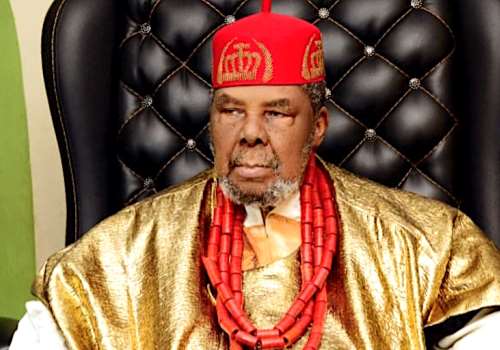
Veteran Nollywood actor, Pete Edochie has declared Chinua Achebe’s 1958 novel ‘Things Fall Apart’ as the greatest African book of all-time.
Speaking in a recent interview with TV3, Edochie explained that ‘Things Fall Apart’ is the greatest African book ever written because it tells the African story.
He stated that the book wouldn’t have been as popular as it is if it were telling the story of the colonisers.
He pointed out that many other African authors have also made efforts in telling African stories since ‘Things Fall Apart’ but none is as “strong” as it.
“The reason why ‘Things Fall Apart’ is the greatest book ever written on the African continent is because it is telling our own story.
“If it had been telling the story of the White man, it won’t be that popular. Many others have made efforts since then but not as strong as ‘Things Fall Apart’,” he said.
He urged African writers and creatives to focus on telling African stories, stressing that it would be their unique strength on the global stage.
The movie star, however, lamented that Africans were allowing their talents to be submerged by embracing foreign influences.
“We Africans permitted our talents to be submerged by overseas influences. I remember once upon a time I was being called Elvis Presley and John Wayne.
“I actually enjoyed answering those names but at some point I had to discard them and pick a name that’s culturally relevant to me. Then I went back to the root and started answering Uwadiegwu,” he added.
Source: DailyPost


