
Headlines
Nnamdi Kanu Opts for Out of Court Settlement, Seeks to Negotiate with FG

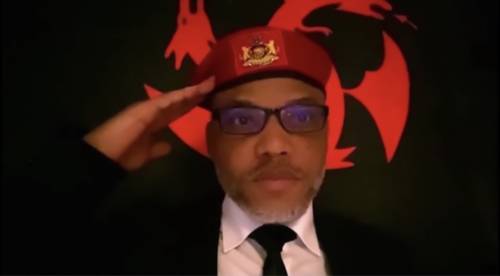
Nnamdi Kanu, detained leader of the proscribed Indigenous People of Biafra (IPOB), has expressed his readiness to enter into a negotiation with the Federal government to secure his freedom.
Kanu took the position on Wednesday during the resumed proceeding on the seven-count terrorism and treasonable felony charge, which the government entered against him before the Federal High Court sitting in Abuja.
His team of lawyers, led by Mr. Alloy Ejimakor, noted that Section 17 of the Federal High Court Act, made provision for amicable resolution of such matters.
Ejimakor notified the court of the decision of his team to explore the option, after he moved two applications that were filed by his client.
Whereas one of the applications, sought the committal of the Director General of the Department of State Services (DSS), Mr. Yusuf Bichi, to prison for contempt of court, the second motion challenged the jurisdiction of the court to continue with the trial.
According to Kanu’s lawyer, he would be left with no option but to activate section 17 of the FHC Act, in the event that the court dismisses the two applications he moved on behalf of his client.
“Section 17 of Federal High Court Rules, states that in any proceedings, the court may consider reconciliation and settlement,” Ejimakor added.
On his part, the government’s lawyer, Chief Adegboyega Awomolo (SAN), said he had earlier informed the defendant that he lacks the powers to embark on such negotiation as it is not part of the Fiat that was issued to him by the Attorney-General of the Federation and Minister of Justice.
He maintained that only the AGF has the authority to negotiate or take further steps in relation to the matter, noting that the case borders on alleged terrorism.
“If he is interested in negotiating, he knows the right place, the Attorney General of the Federation office,” Adegboyega, stated.
Reacting to the development, trial Justice Binta Nyako said the duty of the court was to hear the matter that was brought before it and not to act as a solicitor for any of the parties.
He said it was left for the parties to agree on the way they want the matter to go.
“If you want to discuss with the AGF, no problem at all,” Justice Nyako added.
It will be recalled that Kanu was first arrested in Lagos on October 14, 2015, upon his return to the country from the United Kingdom, UK.


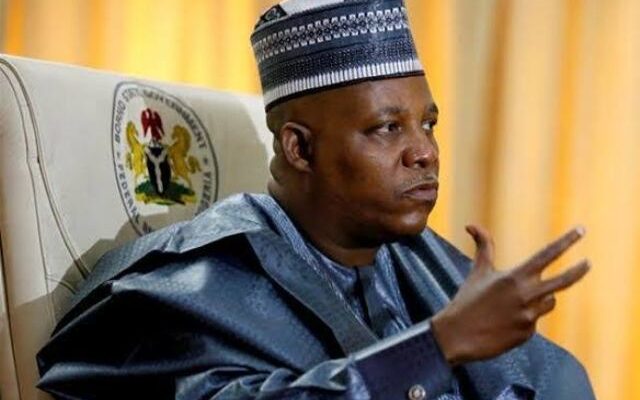
The Presidency has dismissed claims that Vice President Kashim Shettima’s recent comments were directed at the political situation in Rivers State or President Bola Ahmed Tinubu’s constitutional decisions on the matter.
In a statement on Friday by the Senior Special Assistant to the President on Media and Communications (Office of the Vice President), Stanley Nkwocha, the Presidency described the reports as a “gross misrepresentation.”
The statement clarified that Vice President Shettima’s remarks at the public presentation of a book by former Attorney General of the Federation, Mohammed Bello Adoke (SAN), were misconstrued by some online platforms and individuals.
“These reports have distorted the Vice President’s comments in pursuit of a mischievous agenda,” it stated.
“They twisted his account of how the administration of former President Jonathan considered removing him as Borno Governor during the insurgency to falsely link it with current events in Rivers State.”
The Vice President, who spoke at the launch of OPL 245: The Inside Story of the $1.3 Billion Oil Block in Abuja on Thursday, was said to have referenced the past solely to commend Adoke’s professionalism while in office, and to reflect on Nigeria’s constitutional evolution regarding federal and state relations.
“For the avoidance of doubt, President Tinubu did not remove Governor Fubara from office. The constitutional measure implemented was a suspension, not an outright removal.
“This action was taken in response to the grave political crisis in Rivers State at the time, with the governor facing a looming impeachment and the State Assembly complex under demolition,” Nkwocha clarified.
The Presidency insisted that the action taken by President Tinubu in declaring a state of emergency and suspending the Governor was fully in line with Section 305 of the 1999 Constitution (as amended), which authorises such measures when there is a breakdown of public order requiring extraordinary intervention.
According to the statement, the President’s proclamation invoking Section 305(2) was subsequently ratified by an overwhelming bipartisan majority in the National Assembly, confirming the legitimacy and constitutional propriety of the decision.
“The action of President Tinubu in suspending Mr. Fubara and others from exercising the functions of office averted the governor’s outright removal. To conflate suspension with removal is misleading,” the statement further noted.
Nkwocha also stressed that Vice President Shettima’s comments were delivered extemporaneously and intended to underline the importance of public accountability and historical documentation.
He referenced the Vice President’s mention of past public servants, including Adoke and former Speaker Aminu Waziri Tambuwal, to illustrate principled leadership.
“His remarks were not in any way a criticism of President Tinubu’s actions, which the Vice President and the entire administration fully support and stand by without reservation,” the spokesman stated.
The Vice President, the statement added, remains in “loyal concert” with President Tinubu and is committed to implementing all constitutional measures necessary to safeguard democracy and uphold order across the country.
Concluding, the Presidency called on media organisations and political actors to desist from misrepresenting public remarks for sensational or partisan purposes.
“We urge media organisations and political actors to desist from the destructive practice of wrenching statements from context in order to fabricate nonexistent conflicts,” Nkwocha said.
Headlines
Akpabio Relieves Natasha of Committee Chairmanship Position, Appoints Akwa Ibom Senator As Replacement
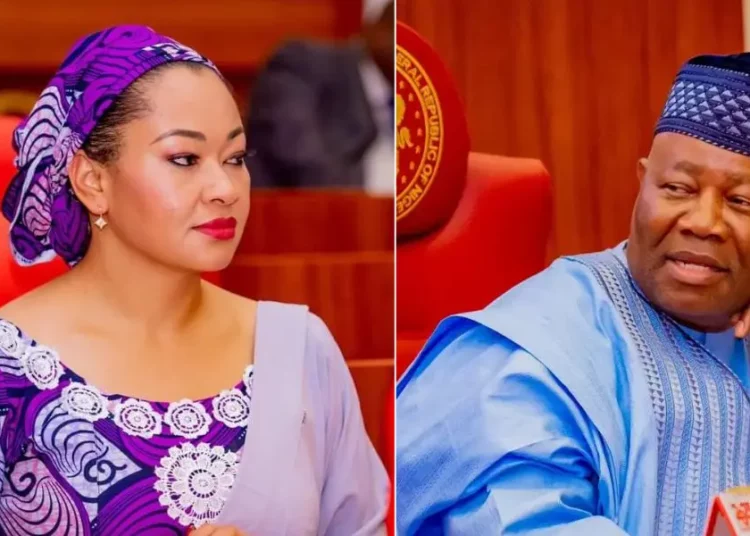
Senate President, Godswill Akpabio, has replaced suspended Senator Natasha Akpoti-Uduaghan, as the Chairman, Senate Committee on Diaspora/Non-Governmental Organisations.
In her place, Akpabio named Senator Bassey Aniekun Etim (Akwa Ibom -East).
The Senate President, who made the announcement on the floor in Abuja on Thursday, did not give any reasons.
The committee position had remained vacant since March when the Senate suspended the Kogi-Central Senatorial District lawmaker for six months for flouting the Senate’s rule on the seating arrangement and seat allocation.
The suspended lawmaker, at a point, chaired the Senate Committee on Local Content before Akpabio reassigned her to the Committee on Diaspora/NGO, shortly before she ran into trouble with the Senate over her conduct on seat allocation.

The Supreme Court has affirmed the 2024 governorship election victory of Governor Monday Okpebholo of the All Progressives Congress (APC), dismissing the appeal filed by the Peoples Democratic Party (PDP) candidate, Asuerinme Ighodalo.
In a unanimous decision by a five-member panel led by Justice Mohammed Garba, the apex court ruled that the appeal lacked merit. It upheld the earlier judgments of the Court of Appeal and the Edo State Governorship Election Petition Tribunal, which had both declared Okpebholo the validly elected governor.


