By Eric Elezuo
By all means, the last has not been heard of the imbroglio between the Governor Godwin Obaseki-led Edo State government and the Nigeria Senate over who has absolute right or rather who is right or wrong in the crisis bedevilling the state House of Assembly.
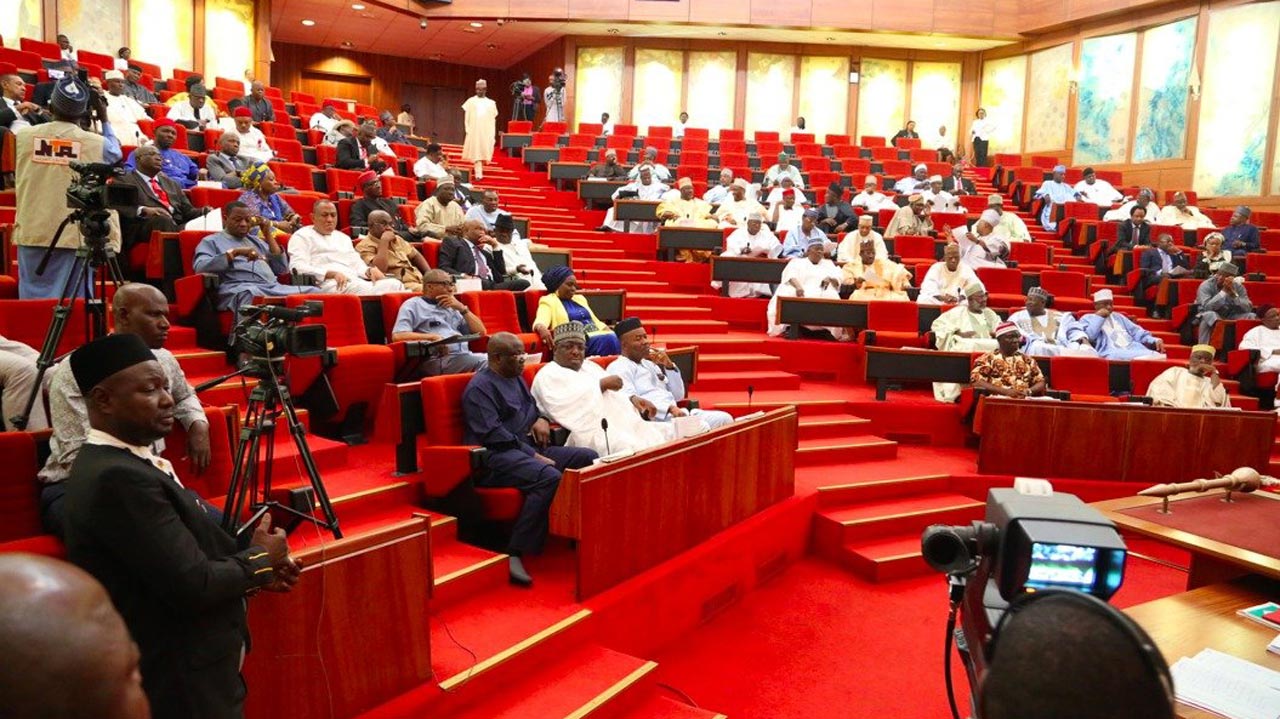
On Tuesday, July 30, 2019, during plenary, the Senate, against all odds, ruled that the Edo State government, through Governor Godwin Obaseki, must issue a fresh proclamation with all the 24 members of the state House of Assembly present. The order set the stage for a fresh crisis – this time, a crisis of power tussle.
It was initially believed that the crisis which engulfed the House of Assembly in the past few weeks was pitched between the state governor, Mr. Godwin Obaseki and his hitherto godfather and the All Progressives Congress (APC) National Chairman, Comrade Adams Oshiomhole. However, events have taken a dramatic turn ever since the National Assembly took over and investigated the matter that prompted the proclamation of the Edo House of Assembly with only nine members, purportedly loyal to the governor, in attendance.
Contrary to expectation, the Senate took sides with the group alleged to be sponsored by Comrade Oshiomhole, and issued a one week ultimatum, asking Governor Obaseki to issue a fresh ultimatum or risk take over of the business of the Assembly by the Senate. That order did not go down well with the Edo State government, and they have vowed never to play along thereby creating a new rift between the national lawmaking body and the government in Edo State.
It was the former Imo State Governor, Rochas Okorocha, who stood against the senate’s recommendation, describing it as “an insult” on the state governor, adding that the crisis is a family matter as it involves members of the All Progressives Congress. But his contribution was not necessary as the Senate President, Ahmed Lawan, already insisted on the ultimatum.
Notable personalities such the Niger Delta leader, Chief Edwin Clark and other human rights groups also condemned the Senate’s decision, describing it as illegal.
A statement by Secretary to the State Government, Osarodion Ogie, noted that the move by the Senate to take over the house was premeditated, blaming high profile political pressure on the Senate to the disadvantage of Edo people.
“This is borne out by the recorded statements made by one Seid Oshiomhole (a Member-elect and younger brother of the National Chairman of the All Progressives Congress Comrade Adams Oshiomhole) wherein he boasted that both the Senate President Senator Ahmed Lawan and the Speaker of the House of Representatives Rt. Hon. Femi Gbajabiamila have been instructed on what to do in this matter,” he said in the statement.
The SSG alleged that the Ad-Hoc committee sent to monitor events in the state only played to the gallery, and “failed to inform the senate of the existence of a valid injunction in Suit NO FHC/B/OS/70/2019 wherein the Federal High Court restrained various parties from interfering in any manner with the activities of the Edo State House of Assembly which said order had been brought to their attention in the course of their visit to Edo State.”
The government is holding on to the fact that a High Court judgement has ruled maintenance of status quo as at July 25, 2019, and as result, the National Assembly has no mandate whatsoever to take over the business of the Edo House. Any action therefore, taken by NASS will be regarded as subjudice since the matter is already a subject of litigation.
“It is unfortunate that the Distinguished Senate would act in flagrant breach of these various court orders and purport to come to factual and legal conclusions concerning a matter in which the parties are already before the courts and therefore subjudice,” the statement noted.
The Edo State government further observed that members of the Senate are busy acting out a script as they have displayed little or no regard for the principles of separation of power.
“We are also concerned that the Members of the Distinguished Senate appear to have very scant regards for the principle of separation of powers as enshrined in our constitution which is manifested by their taking over the functions of the judiciary in dispute resolution and giving directives to a Government of a state who is certainly not subject to the supervision of the National Assembly,” the government stressed.
The Senate, on its part, has insisted on the one week ultimatum, hanging on the constitutional provision embedded in Section 11(4) of the 1999 Constitution of the Federal Republic of Nigeria which allows it take over the functions of the state assembly.
It asked the governor to as a matter of urgency, formally inform all the 24 members-elect of the new proclamation via print and electronic media platforms.
The amended section of the constitution provides that “at any time when any House of Assembly of a State is unable to perform its functions by reason of the situation prevailing in that State, the National Assembly may make such laws for the peace, order and good government of that State with respect to matters on which a House of Assembly may make laws as may appear to the National Assembly to be necessary or expedient until such time as the House of Assembly is able to resume its functions;
“And any such laws enacted by the National Assembly pursuant to this section shall have effect as if they were laws enacted by the House of Assembly of the State: Provided that nothing in this section shall be construed as conferring on the National Assembly power to remove the Governor or the Deputy Governor of the State from office.”
However, in a twist of fate, a Port Harcourt High Friday ruled that the National Assembly, the Police or the Department of State Service (DSS) has no right to take over or interfere with the activities of the Edo State House of Assembly. This brings to a partial end of the brouhaha, but at the same time raises standards for counter attack from the Senate.
The High Court, which also restrained Governor Obaseki from issuing another proclamation letter, ruled that all orders are permanent until the determination of the case. A typical case of stalemate, at least for the Senate.
The crisis in the Edo State House of Assembly is centred on its inauguration and the election of a new speaker in the person of Mr. Francis Okiye.
Although all the 24 members of the state assembly belong to the APC, they are however, divided in loyalty.
The Edo Assembly crisis became pronounced when nine members out of the 24-member legislature,, allegedly prompted by the state governor, hurriedly met at night to inaugurate the House and also elect a speaker.
The other lawmakers-elect were supposedly excluded in order to prevent Oshiomhole’s loyalists from taking control of the legislature.
Stakeholders have blamed the crisis on the issue of succession. A former Chairman of the APC, Chief Odigie-Oyegun, who spoke through his Special Assistant on Political Affairs, Chief Ray Murphy, noted that Oshiomhole is after Obaseki because he does not want him in office by 2020.
“Today, there are all kinds of rancour coming from Edo State. They all boil down to attempt by godfather and godfatherism heating up the polity in the state.
“To what purpose is this idea of the APC chairman putting the state under tension? Ask anybody from Edo state: what is Obaseki’s biggest distraction and they will tell you that his distraction is not whether he has governed well or not, but from his immediate predecessor, Adams Oshiomhole.
“What has been trending is how his predecessor who happens to be the party chairman doesn’t want him back in the office,” Odigie said.
In his response, Oshiomhole denied having personal issues with Obaseki. He said that as a ‘democrat’, he is more concerned with good governance.
“For me, it’s very embarrassing if any state governor, particularly of APC extraction, will do anything that is less than what the constitution says and the example that our president has set,” Oshiomhole stressed.
As the senate’s ultimatum expires on Tuesday, August 6, 2019, and with a court injunction restraining any form of takeover, it would be recalled that the Members of the House of Representatives had on July 17, given a one-week ultimatum to the Edo State Governor to issue a fresh proclamation for the Edo State House of Assembly, a development that is yet to yield fruit as the ultimatum has since expired. It is not even known how the Senate intends to run the Edo as it has embarked on a two months recess.
While both the Senate and the Edo State government (Obaseki) have legitimate grounds to make their cases, time will tell whose muscle will be strong enough to intimidate the other.