
Personality in Focus
Odinkalu Dismisses Ahmed Bako’s Lecture As Worse Than Anti-Climax

- /home/rhoncare/pointblank.ng/wp-content/plugins/mvp-social-buttons/mvp-social-buttons.php on line 27
https://pointblank.ng/wp-content/uploads/2024/09/Chidi-Odinkalu-1000x600.png&description=Odinkalu Dismisses Ahmed Bako’s Lecture As Worse Than Anti-Climax', 'pinterestShare', 'width=750,height=350'); return false;" title="Pin This Post">
- Share
- Tweet /home/rhoncare/pointblank.ng/wp-content/plugins/mvp-social-buttons/mvp-social-buttons.php on line 69
https://pointblank.ng/wp-content/uploads/2024/09/Chidi-Odinkalu-1000x600.png&description=Odinkalu Dismisses Ahmed Bako’s Lecture As Worse Than Anti-Climax', 'pinterestShare', 'width=750,height=350'); return false;" title="Pin This Post">
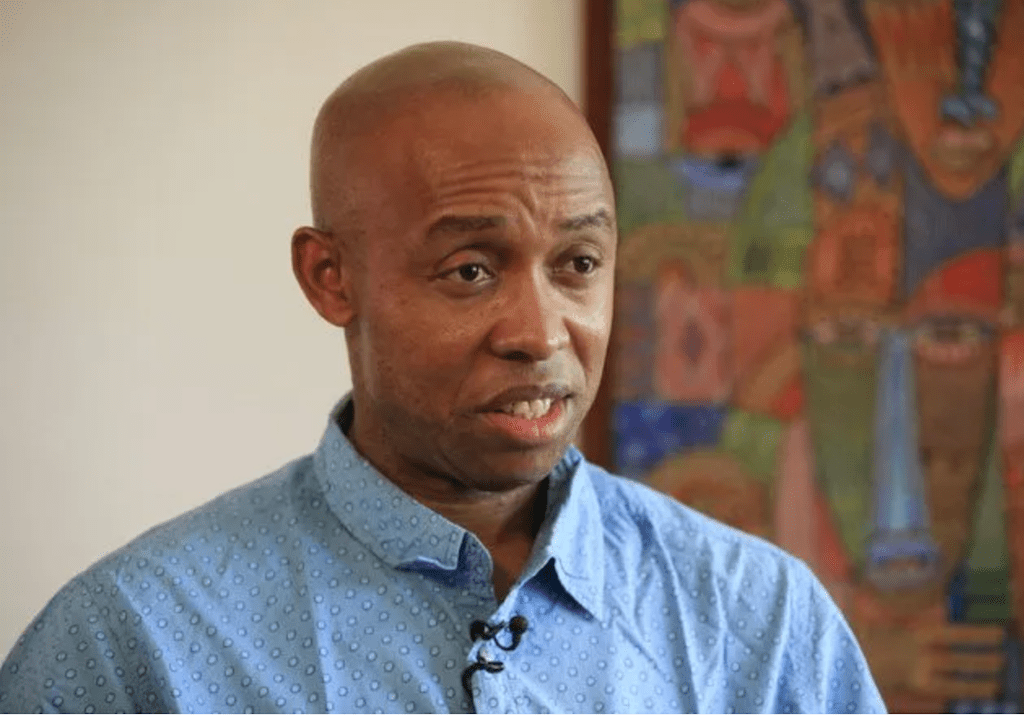
Legal practitioner and human rights activist, Mr. Chidi Odinkalu, has come hard on Professor Ahmed Bako, describing his recently delivered inaugural lecture as an exercise worse than an anti-climax.
In a lengthy writeup that reviewed the totality of Bako’s lecture, Odinkalu revealed as follows:
Thanks to (all) who have offered up views on Prof. (Ahmed) Bako’s Inaugural.
I was honestly minded to un-look after reading it twice for reasons that will follow shortly. But given the depth of your effort, I want to offer a limited and deliberately narrow complement.
For a relatively short Inaugural Lecture delivered on the eve of retirement after nearly 45 yrs teaching & researching Nigerian history, this text is riddled with distressing errors of text, context, sub-text, & texture.
I say nothing of errors of intellectual method – it explores no alternative explanations or interpretations for its limited sourcing & evidence. So the lecture seems to be embarrassingly devoid of basic intellectual curiosity too.
One major error that caught my eye on p. 13: “The Igbos embarrassed modern education….” I presume he meant to say “embraced”.
That is 10 pages after he puts Ohanaeze Ndigbo in the category of Igbo “separatist” groups on p. 3. It goes on…. If this was an error of commission, it’s evidence of prejudice. If it is one of omission, it is worse than embarrassing. Either way, it is totemic of the lecture.
All over the text, you see such and worse embarrassments.
On pp. 45-46, in support of his suggestion that the Igbo drove host-community competitors from the marketplace, he cites a rental incident, claiming that rent in 1974 and 1986 was in ££:
“My view is that because of ethnic solidarity, Igbo traders gradually marginalized or even displace (sic) large number of Hausa traders. A typical example of a Hausa man displaced by the Igbo was Alhaji Abubakar Makwarari. He became a textile retailer in 1974 in a stall he rented from Alhaji Salisu Barau Zage at the cost of *£6,000* per annum. In 1986 he was ejected due to his failure to pay the new rent of *£30,000* . Chief David Obi Oknokwo (sic) paid the stated amount and occupied the stall. Many other Hausa traders such as Lawal Sulaiman (Minister), Alhaji Yahya etc were displaced by the Igbo who were ready to pay high rents….”
On the face of this text, this is evidence of his pursuit of a pre-determined single narrative: Alhaji Salisu Barau Zage who on this evidence shafted his own brother in order to collect the Igbo man’s money lacked agency or responsibility. He fell victim to the presumed sorcery or wickedness of the blighted Igbo man.
That is a segue to the substantive issues. Underlying his thesis is the claim that the Igbo embraced education for purposes of domination and not development. Avoiding for the moment any contest over meaning here, he provides no authority or evidence for this claim. He takes this over the top on pp.39-40: “What needs emphasis during this time was the fact that searching for economic power and dominance make the Igbo to be desperate and aggressive. Desperation is what make (sic) them to not only be disliked by host communities in several of the areas of their dominance in Northern Nigeria but to pushed (sic) some young Igbo into criminal activities.”
He asserts this as fact with no effort to back it up with evidence, authority, or comparison. And the text is littered with such carefree attitude to prejudice as fact.
He also complains somewhat about the insularity of the Igbo and how that has been a source of blowback. But yet he also explains – without appearing to know that that was what he was doing – that this was an outcome of colonial-era segregations which effectively rendered Sabon-Gari into an ethnic ghetto.
Interestingly, the exception to the treatment of Sabon-Gari as a ghetto was Mal. Abacha Maiduguri, the father of Gen. Abacha. That is no accident because the Kanuri were also outsiders among the Karnawa and that has some antiquity. That is another story altogether.
On the whole, the lecture is worse than an anti-climax. If this is what passes for history and what has been taught for over 4 decades, one can only lean back with the jaws askew.
But I also don’t want to be too unkind about the lecture. The man has done his best. Now and again, there are some accidental nuggets in parts of the paper (such as the reference to the Ajie Ukpabi Asika interview of 1971 or the Newswatch interviews with survivors of 1985 but they appear entirely accidental and not followed up or developed. So, it is a useful read and a useful source of intelligence: If a university professor supposedly specialized in history offers this up, the rest can be imagined.
In the end, an Inaugural in my view and experience is essentially a celebration of a thread of intellectual forage. The reason I was minded to un-look is that I will not knowingly rejoin to a paper to which it is impossible to attribute a quote of more than one sentence without two [sics].
Of course, there is no rejoinder to the fact that the Pound was abolished in Nigeria in 1973 and, therefore, that in 1974, rent in Kano was not rendered in £££.
And if he believes that Ohanaeze Ndigbo is a separatist organisation, that is his view. But that would, presumably also, be applicable to Arewa, or the Egbe or MBF or any number of ethnically defined associational groups in Nigeria; which would then beg the question: why does the Igbo one call for any form of his attention if he is not going to make the effort to distinguish those others from Ohanaeze.
If a man – or anyone at that – has spent over 40 years of his life spouting this kind of stuff even with the best of intentions as seems evident on the face of this paper, I will take pity on him and pity even more the students who endured it.



Kardinal Business Travel, a travel technology company with African and global focus, was among 60 startups that pitched at the 2nd edition of the Economic Community of West African States (ECOWAS) Startup Awards, held at the ECOWAS Commission headquarters in Abuja recently.
The company’s Chief Executive Officer and Founder, Cornelius Ugwunwa, presented the company’s case at the three-day event. The awards was part of an ECOWAS initiative to help West African businesses and startups scale through digital transformation, regional integration and sustainable value chains, with the aim of widening access to global markets.
Temitope Kareem, founder of Nigerian healthtech firm HubPharm Africa, won the top prize of $30,000. Senegal’s Gaynako took home $20,000 as first runner-up, while Steve Bah Blesson’s MyOpinion from Côte d’Ivoire won $15,000 as second runner-up.
Speaking during his pitch, Ugwunwa said Africa needs a new system for business travel. He cited a market with $75 billion in inbound travel spending and a strong business travel component in 2025, while travel and tourism as a whole contributed $228 billion to the regional economy.
“When a company sends its employees across Africa for a business engagement, we at Kardinal noticed the challenges of countless inboxes, spreadsheets and emails, mostly after the trip.
Businesses keep asking: How much did we spend? Who did we spend it on? Was it above or below budget? Can we reconcile everything on one platform?” he said.
He described African business travel as a $30 billion market that is largely fragmented and overly dependent on manual processes.
According to him, many businesses lose over $1 billion to manual travel processing and cannot track spending in real time. “That is why Kardinal exists: to solve this entrenched problem,” he said.
Ugwunwa said GoKardinal is an artificial intelligence-driven platform built to track expenses for African businesses. It brings the entire business travel lifecycle (planning, budgeting, booking, financing and expense tracking) onto one platform, in real time.
“GoKardinal is not another travel platform. It is an infrastructure for business travel, powered by AI for expense management,” he said, adding that the idea is to help businesses move without delay from one location to another to do their best work, expand and make profit.
On the company’s performance, he said the platform serves over 51 businesses in Nigeria and across Africa, with estimated weekly profit of $10,000 and gross merchandise value of over $1 million, growing at 65 per cent annually. he added.
He noted that about 80 per cent of African businesses still run their business travel manually, without any form of expense tracking, in a market worth over $30 billion annually. “African business travel is not just travelling for the fun of it.
It is an ecosystem with the potential to generate over $70 billion when digitalised,” Ugwunwa said.

The President of Security Resources & Risk Management Academy, Lagos, Mr. Matthew Ibadin, has charged officers of the Nigerian Armed Forces and allied nations to practice emotional discipline, warning that unmanaged anger remains a greater threat to a Staff Officer than the enemy.
Ibadin, who is also a doctoral researcher at the Nigerian Defence Academy (NDA) and University of Abuja, stated this on Monday while delivering a lecture on “Emotional Discipline Under Pressure and Anger Management for Staff Officers” to participants of Senior Course 48 at the Armed Forces Command and Staff College (AFCSC), Jaji, Kaduna.
The lecture was attended by 436 officers comprising the Nigerian Army, Nigerian Navy, Nigerian Air Force and officers from eight friendly nations.
Describing anger as “a temporary madness that leaves a permanent record,” Ibadin warned officers that “the line between a respected officer and an inmate is thinner than you can imagine.”
“Anger may enter the room, but must never take command,” he said.
The Lion Principle
Illustrating his point with the parable of the lions, Ibadin noted that while both male and female lions roar, the female roars only when necessary and lives 15-18 years compared to 10-12 years for the male.
“She lives longer not because she is weaker, but because she is more disciplined. Many of us have become male lions in uniform – fighting juniors, spouses, traffic, minor disagreements even when no real threat exists. That constant agitation slowly destroys what you have built,” he said.
He therefore charged officers to “be a female lion in strategy and a male lion only when tactically necessary.”
Five Battlefields Where Anger Destroys
Ibadin identified five battlefields where undisciplined anger destroys officers: Health, Home Front, Office and Command, Career and Prison, and Relationships.
On health, he described anger as a silent killer that triggers hypertension, stroke and cardiac arrest, noting that many officers survive the war front but do not survive peacetime.
“At Jaji, your rank commands respect, but at home your rank is irrelevant. If you win at the office and lose at home, you have lost. An officer whose home is under emotional fire cannot think clearly at the command post,” he cautioned.
He warned that signatures appended in anger to operational orders, procurement papers and personnel assessments could lead to Boards of Inquiry, career ruin and mission failure.
He added that 70 percent of inmates in correctional centres for murder never planned to kill, but acted in a moment of unmanaged anger.
Practical Tools
Ibadin introduced practical tools including the 90-Second Rule and the S.T.O.P Protocol – Stop, Take a Breath (4-4-4), Observe, and Proceed with Discipline – for decisions under pressure.
He adopted Aristotle’s five tests for disciplining anger: Right Person, Right Reason, Right Time, Right Degree, and Right Manner.
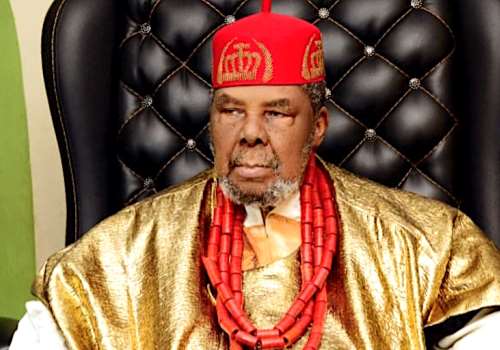
Veteran Nollywood actor, Pete Edochie has declared Chinua Achebe’s 1958 novel ‘Things Fall Apart’ as the greatest African book of all-time.
Speaking in a recent interview with TV3, Edochie explained that ‘Things Fall Apart’ is the greatest African book ever written because it tells the African story.
He stated that the book wouldn’t have been as popular as it is if it were telling the story of the colonisers.
He pointed out that many other African authors have also made efforts in telling African stories since ‘Things Fall Apart’ but none is as “strong” as it.
“The reason why ‘Things Fall Apart’ is the greatest book ever written on the African continent is because it is telling our own story.
“If it had been telling the story of the White man, it won’t be that popular. Many others have made efforts since then but not as strong as ‘Things Fall Apart’,” he said.
He urged African writers and creatives to focus on telling African stories, stressing that it would be their unique strength on the global stage.
The movie star, however, lamented that Africans were allowing their talents to be submerged by embracing foreign influences.
“We Africans permitted our talents to be submerged by overseas influences. I remember once upon a time I was being called Elvis Presley and John Wayne.
“I actually enjoyed answering those names but at some point I had to discard them and pick a name that’s culturally relevant to me. Then I went back to the root and started answering Uwadiegwu,” he added.
Source: DailyPost


