
Headlines
Our Nation is Grieving, Mahama, Ghanaians Mourn Helicopter Crash Victims

- /home/rhoncare/pointblank.ng/wp-content/plugins/mvp-social-buttons/mvp-social-buttons.php on line 27
https://pointblank.ng/wp-content/uploads/2025/08/1f763f30-73ea-11f0-9a5e-8f810868f5c0.jpg.webp&description=Our Nation is Grieving, Mahama, Ghanaians Mourn Helicopter Crash Victims', 'pinterestShare', 'width=750,height=350'); return false;" title="Pin This Post">
- Share
- Tweet /home/rhoncare/pointblank.ng/wp-content/plugins/mvp-social-buttons/mvp-social-buttons.php on line 69
https://pointblank.ng/wp-content/uploads/2025/08/1f763f30-73ea-11f0-9a5e-8f810868f5c0.jpg.webp&description=Our Nation is Grieving, Mahama, Ghanaians Mourn Helicopter Crash Victims', 'pinterestShare', 'width=750,height=350'); return false;" title="Pin This Post">
Ghana’s President John Mahama has promised a full investigation into Wednesday’s helicopter crash that killed two government ministers and six other people.
Defence Minister Edward Omane Boamah and Environment, Science and Technology Minister Ibrahim Murtala Muhammed, both 50, were among those killed when a military aircraft crashed in the central Ashanti region.
In a televised address to the nation, Mahama said the crash represented “a personal loss” for him.
The president confirmed that the flight data and cockpit voice recorders – often referred to as the “black boxes” – had been retrieved and that the armed forces had “initiated a full and transparent investigation”.
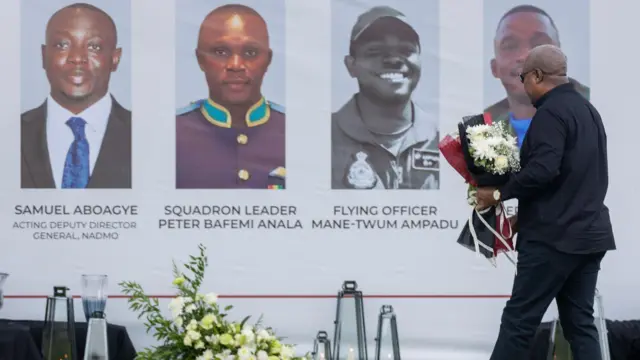
“I shared a bond with many of those who died. Our nation is grieving,” Mahama told Ghanaians.
The Z9 helicopter, carrying three crew and five passengers, came down in a dense forest as it was flying from the capital, Accra, to the town of Obuasi for an event to tackle illegal mining. There were no survivors.
The bodies of the eight deceased have been recovered from the crash site, and samples have been sent to South Africa for forensic identification and analysis.
Ghana’s Deputy National Security Coordinator and former Agriculture Minister Alhaji Muniru Mohammed was also among the dead, along with Samuel Sarpong, Vice-Chairman of the governing National Democratic Congress party.
A state funeral will be held on 15 August for the victims, AFP reported.
What caused the crash?
Authorities have not confirmed the cause of the crash.
Ghana’s meteorological agency had forecast unusually cold weather for August, with recent rains and light showers causing foggy conditions in many forest areas. Local farmers near the crash site reported morning fog as the helicopter flew overhead.
One eyewitness told the BBC the helicopter was flying at an “unusually low altitude” and the weather was bad.
He said he heard the sound of the helicopter passing by, followed by a “loud sound” and then a “bang”.
“That’s when I realised that the helicopter had exploded. So I hurried to the place to see if I could find survivors,” he said.
The farmer said when he got to the scene there was “no-one to be rescued”.
This is the most deadly of three separate emergency incidents involving Ghana Air Force helicopters in recent years.
In 2020, a Ghana Air Force Harbin Z-9 helicopter made an emergency landing near Tamale Airport, and last year, another Ghana Air Force helicopter made an emergency landing at Bonsukrom in Ghana’s Western Region.
Three days of national mourning
Many Ghanaians are shocked by the news and are still struggling to come to terms with the news. Images purportedly showing the charred remains of the helicopter have been circulating on social media.
President Mahama has suspended all his scheduled activities for the rest of the week and declared three days of mourning starting from Thursday.
The country’s flags are flying at half-mast.
The crew members were named as Squadron Leader Peter Bafemi Anala, Flying Officer Manin Twum-Ampadu, and Sergeant Ernest Addo Mensah.
Who was Edward Omane Boamah?
Boamah served under Mahama’s previous government as communications minister and before that he was minister of environment. As defence minster he tackled jihadist activity that was brewing in the northern border in Burkina Faso.
In 2022, a France-based NGO, Promediation, said its research showed that jihadist groups had recruited between 200 and 300 young Ghanaians.
Violence in the area has also been on the rise, with concerns that jihadists may be trying to exploit communal in-fighting between rival communities in northern Ghana.
Boamah’s book A Peaceful Man In An African Democracy, about former president John Atta Mills, was due to come out later in the year.
Who was Ibrahim Murtala Muhammed?
Muhammed was at the forefront of the battle against illegal gold mining, which has wrecked the environment and contaminated rivers and lakes.
Protests against the practice, known locally as Galamsey, peaked during Mahama’s run for the presidency last year.
Culled from BBC


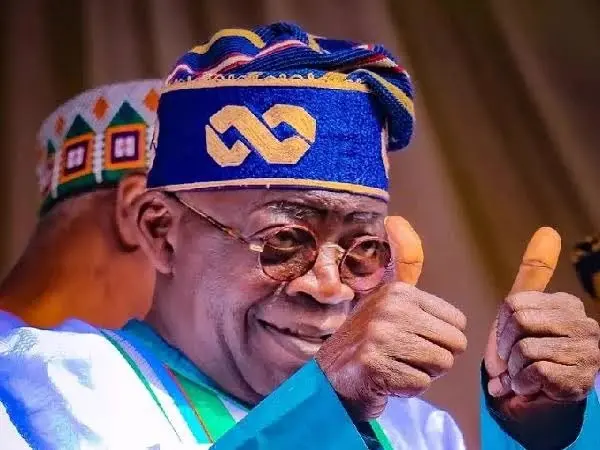
Over 1,000 Islamic clerics have urged President Bola Tinubu not to seek re-election in the 2027 presidential election, citing economic crisis, insecurity and other challenges facing the country.
The call was contained in a communique issued at the end of a national conference on “An Assessment of the State of the Nation under President Tinubu and the 2027 General Elections,” held in Kano State on Sunday.
This comes at a time when the Jama’atul Izalatul Bid’a Wa Iqamatussunnah (JIBWIS) and Qadiriyya Sufi sect, among other Islamic groups, endorsed President Bola Ahmed Tinubu and Vice President Kashim Shettima for the 2027 presidential election, urging its members nationwide to support their re-election.
JIBWIS and Qadiriyya allegedly endorsed Tinubu’s candidature during separate visits to their leadership by Senator Abdul’aziz Yari, the Director-General of the All Progressives Congress (APC) Presidential Campaign Council.
However, the Islamic clerics under the umbrella of Ko Da Naka…For the Struggle to Promote Good Governance and Community Development, in collaboration with AFAQ Educational Foundation, expressed dissatisfaction with the manner in which the administration of President Tinubu is running the country.
The clerics unanimously agreed that Tinubu’s economic policies, including the removal of the fuel subsidy, changes to the naira exchange-rate system, increases in electricity tariffs, and tax reforms, have increased the burden of hardship on ordinary citizens.
The conference expressed its dissatisfaction with the manner in which the Tinubu administration is being run, particularly the continued implementation of economic policies which participants unanimously agreed have increased the burden of hardship on ordinary citizens.
“It is unfortunate that the government has continued to insist on pursuing these policies, which are increasing hardship among the people, rather than reviewing and correcting them. The government prioritised the growth of its revenue at a time when the rising cost of living and unemployment are threatening the lives and well-being of citizens.
“Consequently, participants at the conference unanimously agreed that it would be inappropriate to re-elect this government in the forthcoming 2027 general elections if it does not change its harmful economic policies,” the communique reads in part.
Also, the participants of the conference expressed concern over the continued killings and kidnappings by bandits, and other acts of terrorism across the country.
They, therefore, called on the government to take urgent action to address insecurity, particularly in the North-West and other parts of the country.
The communique added, “Alternatively, the President should refrain from contesting the 2027 election. If he refuses to do so, it is incumbent upon citizens to reject his candidacy and allow those whom they believe can provide better leadership.”
Some of the clerics who presented papers at the conference included Dr. Abdulmuɗɗalib Ahmad Giɗaɗo, Prof Muhd Muslim Ibrahim, Sheikh Kabir Bashir Abdulhamid, Dr Aminu Isma’il Sagagi, Dr Najibullah Abdallah Nuhu, Sheikh Abdurrazaq Uba Musa, Sheikh Musa Muhd Ɗan kwano, Brr El-Zubair, Dr Yahuza Getso, Prof Ibrahim Siraj Adhama, Dr. Umar Dokaji and Sheikh Muhd Sani Khamis (Abu Haisam).
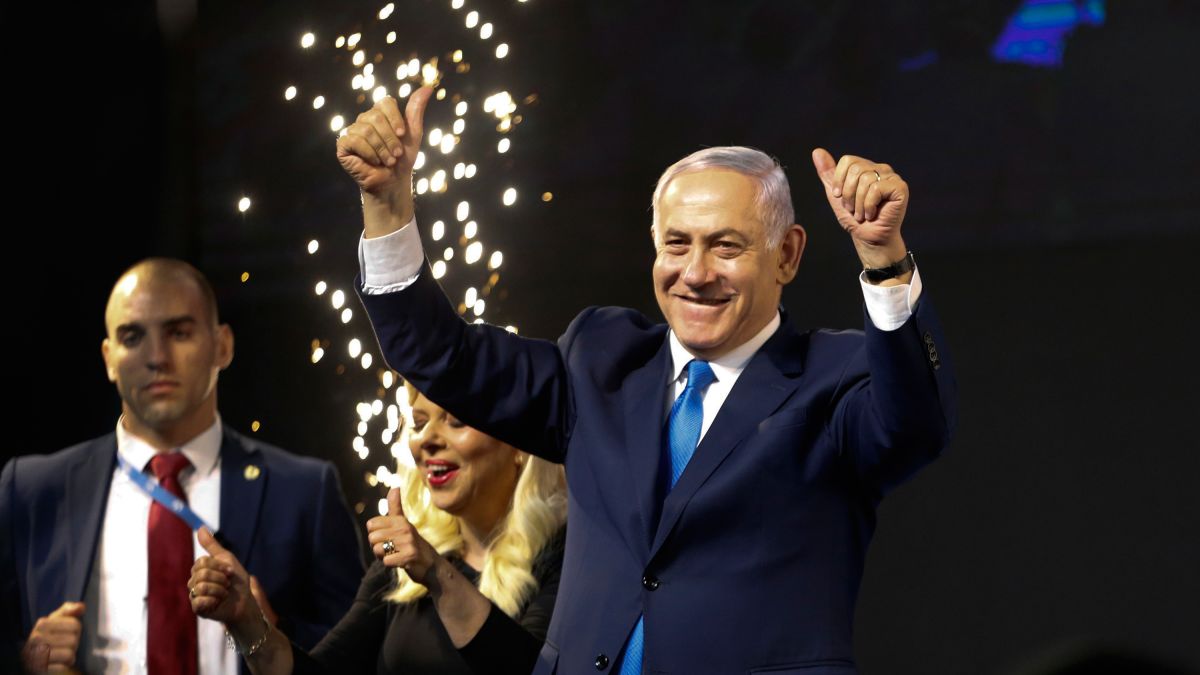
Israelis gathered in silence on Wednesday to mark three years since the October 7, 2023 Hamas-led attacks, while Palestinians in Gaza mourned the destruction and displacement caused by the war that followed.
In Kfar Aza, a kibbutz near the Gaza border that was overrun by Hamas militants three years ago, residents held a vigil for those killed in the attack.
A trumpet played a solemn bugle call as residents stood in silence and a roll call of those killed was read out.
Zion Regev, a community leader in Kfar Aza, said many residents remained displaced and had yet to return to the community.
“This is the first time we are doing all the things here in the kibbutz,” Regev said of the vigil. “It’s a very emotional day, it’s a very difficult day for our community, three years after October 7th.”
The October 7 attacks were the deadliest day in Israel’s history. Militants led by Hamas killed about 1,200 people and took 251 hostages, according to Israeli figures cited by Reuters.
The attacks triggered Israel’s military campaign in Gaza, where more than 74,000 Palestinians have been killed, according to figures cited by Reuters.
The anniversary comes as the conflict remains unresolved despite a ceasefire agreement reached in October 2025 that halted major fighting but has not ended violence or secured the disarmament of Hamas.
In Israel, protesters gathered outside parliament in Jerusalem to demand accountability for the security failures surrounding the October 7 attacks.
Some protesters blamed Prime Minister Benjamin Netanyahu for resisting calls for an independent investigation into how Hamas was able to carry out the assault.
“We need the change and we need hope and we need to know that we have a government that cares about the public and doesn’t work also only for themselves,” protester Shaked Arrad said.
Netanyahu has rejected blame for the security breach and resisted calls for an independent inquiry.
The anniversary is also taking place 20 days before Israel’s scheduled general election, with the war and the government’s handling of the October 7 attack expected to remain major political issues.
In Gaza, Palestinians displaced by the conflict recalled their lives before the war as they continued to live among destroyed buildings and makeshift shelters.
Israel currently controls about two-thirds of the Gaza Strip, while Hamas controls the remaining area, where most of Gaza’s roughly two million residents are living in tents or damaged buildings, according to Reuters.
Umm Mohammad, a mother of five displaced from Gaza City and now living in a tent encampment in Deir Al-Balah, said the conflict had separated her family.
“We were one happy family. The war displaced us. My son left Gaza, the other went to a separate tent, my daughters left with their husbands to other parts of the Strip and we rarely meet,” she said.
On the anniversary, she added: “We recall how happy, despite all problems, we were before the war broke out, destroying everything we loved.”
The latest violence also continued despite the ceasefire. Gaza medics said Israeli strikes on Beit Lahia and Khan Younis killed at least two Palestinians and wounded others on Wednesday.
The Israeli military said it had struck a militant target in Beit Lahia but did not immediately comment on the reported strike in Khan Younis.
Three years after the October 7 attacks, the anniversary has brought renewed mourning in Israel and Gaza, while questions over accountability, security and the future of the conflict remain unresolved.
Reuters
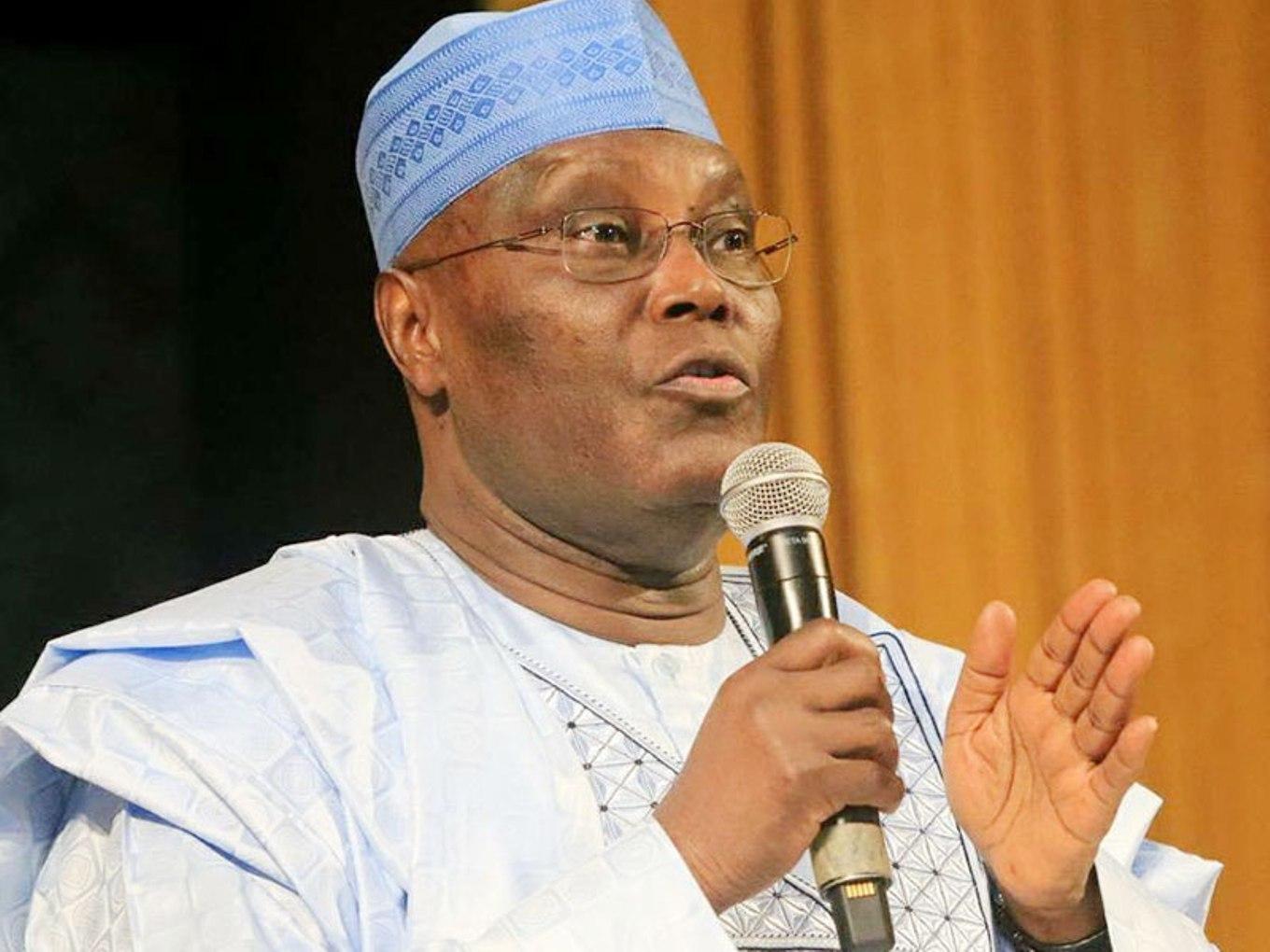
Former Vice President and ADC presidential candidate Atiku Abubakar has accused President Bola Tinubu of presiding over a collapse in agricultural export earnings while farmers struggle with insecurity and manufacturers confront punishing production costs. He said an administration that promised to build a productive economy has left Nigeria selling crops abroad without capturing enough of the processing jobs and value they can generate at home.
“Tinubu cannot call this reform when the people who grow our food and the businesses that should process it are being squeezed from both sides,” Atiku said.
In a statement issued by Phrank Shaibu, Director of Strategic Communication of the ADC Presidential Campaign Council, Atiku said the trade figures expose the scale of the failure. Nigeria’s agricultural trade swung from a ₦740.27 billion surplus in the first half of 2025 to a ₦56.13 billion deficit in the first half of 2026—a ₦796.40 billion reversal in one year. Agricultural exports fell by 33.3 per cent, far faster than imports, which also declined.
“The excuse that Nigerians simply imported too much will not stand. Tinubu’s government must answer for the collapse in what Nigeria sold to the world. The country is losing export earnings, and the President owes farmers, workers and businesses more than another speech about prosperity.
“What has his administration done to make it safer to farm, cheaper to move produce, easier to keep a processing plant running or more profitable to sell a finished Nigerian product abroad? Farmers cannot cultivate promises. Manufacturers cannot power factories with speeches. Workers cannot feed their families on assurances that prosperity is coming.”
Atiku said Nigeria’s leading agricultural exports still include cashew nuts in shell and cocoa beans, illustrating the value the country could retain by expanding domestic processing.
“We grow the crop. Someone else does more of the processing, builds a business around it and earns the larger return. Then Tinubu speaks of jobs while Nigerian factories struggle to compete. He has made production expensive and called the resulting hardship reform.
“A trade deficit alone does not explain every problem on our farms. But after more than three years in office, the President owns the decisions that have left farmers exposed and producers burdened. He cannot claim credit for every favourable statistic and disown a ₦796.40 billion reversal when the figures turn against him.”
Atiku said his proposed production subsidy for petroleum products refined in Nigeria follows the same principle: keep more production, work and value at home. The support would cover qualifying products from Nigerian refineries, including modular refineries. Imported products would not qualify. It would be capped, budgeted and independently audited, with measures to track whether savings reach consumers and businesses.
He said the Tinubu administration’s CNG initiative had failed abysmally as a relief measure: the cost of converting vehicles is beyond the reach of many poor Nigerians, conversion kits are difficult to access, and the buses presented as palliatives remain unavailable to many of the people who need them.
“Local refining is about more than the price at the petrol pump. Aviation fuel affects fares. LPG affects the cost of cooking. Petroleum products and feedstocks affect industries and the people they employ. Nigerians need practical relief they can actually access—not schemes whose costs and shortages put the promised benefits out of reach. The value of our resources must reach Nigerians beyond the refinery gate.
“My administration will begin restoring a transparent production subsidy from Day One. We will back farmers and processors with the same determination. Grow it here. Process it here. Refine it here. Create the jobs here. Make life affordable here.
“Tinubu’s record is becoming painfully clear: Nigeria supplies raw crops and crude oil while Nigerians pay dearly for finished goods. A government that cannot turn our resources into affordable products and decent jobs has failed the people it was elected to serve.”


