Metro
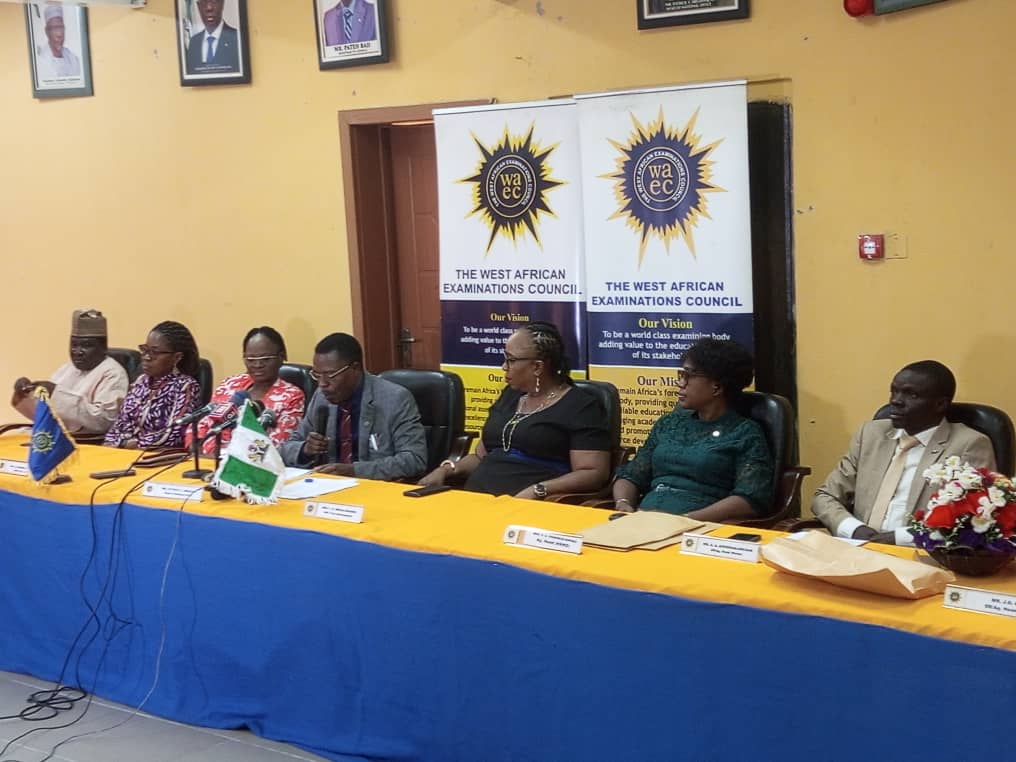
Play by the Rules, WAEC Tells Parents, Stakeholders, Students As 2023 SSCE Begins

- /home/rhoncare/pointblank.ng/wp-content/plugins/mvp-social-buttons/mvp-social-buttons.php on line 27
https://pointblank.ng/wp-content/uploads/2023/05/IMG-20230504-WA0027-1000x600.jpg&description=Play by the Rules, WAEC Tells Parents, Stakeholders, Students As 2023 SSCE Begins', 'pinterestShare', 'width=750,height=350'); return false;" title="Pin This Post">
- Share
- Tweet /home/rhoncare/pointblank.ng/wp-content/plugins/mvp-social-buttons/mvp-social-buttons.php on line 69
https://pointblank.ng/wp-content/uploads/2023/05/IMG-20230504-WA0027-1000x600.jpg&description=Play by the Rules, WAEC Tells Parents, Stakeholders, Students As 2023 SSCE Begins', 'pinterestShare', 'width=750,height=350'); return false;" title="Pin This Post">
By Eric Elezuo
The West African Examinations Council (WAEC) has told parents, students, stakeholders and every one involve to play by the rules of the body as the 2023 Secondary Secondary Certificate Examinations begin on May 8.
The charge was given on Thursday by the Head of National Office, Nigeria, Patrick Areghan, while addressing the press on the conduct of the 2023 West African exams.
“We shall do our best to monitor and inspect the conduct of the examination at all centres. We appeal to all schools, authorities and supervisors to co-operate with us,” he said
Flanked by Senior management staff of the Council, Areghan noted that the exams have finally adjusted to the May/June Period for which it is known, stressing that on inception by Monday 8, the exams will end on Friday, June 23, spanning seven straight weeks.
“This is remarkable. The significance of this landmark is that the West African Examinations Council (WAEC) and the various member States, with the exception of Ghana, have now again found a common ground in respect of their academic calendars. This shows a massive recovery from the devastating effects of the COVID-19 Pandemic,” Areghan noted.
Stressing that a total of 76 subjects, spread into 197 papers will be tested this year, Areghan also informed that “a total of One Million, Six Hundred and Twenty-one Thousand, Eight Hundred and Fifty-three (1,621,853) candidates from Twenty Thousand, Eight Hundred and Fifty-one, (20,851) secondary schools have registered for the examination. Out of this number, Seven Hundred and Ninety-eight Thousand, Eight Hundred and Ten (798,810) are males, amounting to 49.25%, while Eight Hundred and Twenty-three Thousand, and Forty-three (823,043) are females, which is 50.75% of the total candidature.”
The Council has also set aside 30,000 practicing teachers drawn from across schools as supervisors, adding that all teachers will function as invigilators in their various schools throughout the seven weeks duration of the exams, just as a self-service system for candidates, through the CHATBOT Platform, to enable them access their entries, which in most cases, the schools do not allow them to see, contrary to instructions, have been established.
The Candidate Self-Service allows students to confirm data uploaded for them by schools in order to make necessary corrections (if any) on such data. It provides two key services on the Request Management System which include Confirmation of Entry/Registration and Confirmation of Continuous Assessment Score (CASS).
The Council also warned schools on the importance of CASS, saying it is a major component in the computation of grades for candidates in the WASSCE (SC) examination. It added that no school will have any result without complete CASS upload.
WAEC also explained that considering the insecurity situation in the country, it has liaise with the Inspector General of Police, Brigade Commanders, other security agencies and the various State governments as well as the intervention of the Hon Minister of Education, to provide security in order to ensure that the examination is conducted under a secure and safe environment.
The Council read the riot act to perpetrators of exam malpractice and ‘miracle centres’, saying they will be decisively dealt with while also rolling out several awareness campaigns to sensitize stakeholders on the evils of malpractice.
“The penalties for involvement in examination mal practice will always, without compromise, be meted out to erring candidates, invigilators, supervisors, schools, WAEC officials, etc, as would be approved by the Nigeria Examinations Committee (NEC), which is the highest decision-making organ of the Council that sits on examination matters in Nigeria,” Areghan said.
The Council assured that results of the exam will be released 45 days after the last day paper while printed certificates will be released to schools 90 days after the release of the results.



Several people are feared missing after a boat conveying mourners from a burial ceremony in Ukubie community, Southern Ijaw Local Government Area of Bayelsa State, sank on Friday near Oweikorogha community, throwing passengers into the river.
The incident, which has plunged the affected communities into panic and grief, involved a vessel popularly known as a Love Boat.
Reports said that the boat was conveying people who had attended a burial ceremony in Ukubie when it capsized shortly after passing Oweikorogha community.
Information emerging from the area indicated that several passengers were feared missing following the accident, although the exact number of people aboard the vessel and those unaccounted for had yet to be established as of the time of filing this report.
The incident has sparked anxiety among families and residents of Ukubie and Oweikorogha, as efforts continue to establish the fate of those who were travelling on the boat.
Residents and community members have mobilised to assist in the search for passengers who may have survived the accident.
The rescue efforts were said to be ongoing, with residents joining hands to locate those who were thrown into the water when the vessel went down.
However, the number of survivors, if any, had not been officially confirmed at the time of this report.
Families of the passengers were said to be anxiously awaiting information about their loved ones, as the incident cast a pall of mourning over the two communities.
The circumstances surrounding the boat mishap remain unclear, as authorities are yet to issue an official statement explaining what caused the vessel to sink.
It was also not immediately established how many passengers were aboard the boat or whether the vessel encountered mechanical difficulties or other challenges before capsizing.
Southern Ijaw is one of the major riverine local government areas in Bayelsa State, with several communities relying heavily on waterways for transportation because of the limited road network.
Boat transportation remains a major means of movement for residents travelling between riverine settlements, particularly during social gatherings, burial ceremonies and other community activities.

The Lagos State High Court has restrained Jimmy Odukoyafrom parading himself as the senior pastor and spiritual head of the Fountain of Life Church, following a legal challenge by the church’s board of trustees.
Justice O.O. Adewunmi-Oshin issued the order on Wednesday after hearing an application filed by the incorporated trustees of the church, who are seeking to prevent Jimmy from acting in the capacity of senior pastor.
The trustees told the court that Jimmy had ceased to occupy the position following the appointment of a successor by the church’s late founder, Pastor Taiwo Odukoya, who died in 2023.
In their application, the trustees sought an injunction to prevent Jimmy, either personally or through representatives, from interfering in the church’s administration and activities while the legal process continues.
According to reports, part of the order read: “A Pre-emptive Order of Injunction restraining the Respondent, whether acting personally or through any proxies in any alleged capacity as the Senior Pastor of the Church from interfering, disrupting, meddling with and or obstructing the activities, governance and any other business of the Church pending the Applicant’s full compliance with the High Court of Lagos State (Expeditious Disposal of Civil Cases) Practice Directions No. 2 of 2019 on Pre-action Protocol.”
The court also granted the trustees permission to commence the action under the pre-action protocol provided for in the Lagos State High Court’s practice directions.
In his ruling, the judge said: “Leave is hereby granted to the Applicant to commence this action under the Pre-Action Protocol pursuant to Paragraph 4 of the High Court of Lagos State (Expeditious Disposal of Civil Cases) Practice Direction No. 2 of 2019.”
The court proceedings came a day after the church’s board of trustees announced Jimmy’s removal as senior pastor, alleging that his appointment did not reflect the succession arrangements made by his late father.
The board explained that its decision followed a review of the church’s constitution and instructions allegedly documented by Taiwo before his death.
According to the trustees, they recently uncovered a video recording made by the late founder in December 2021, in which he outlined his preferred succession arrangement.
They further claimed that the recording was not made available to the board before Jimmy’s appointment, which they subsequently described as wrongful.

Access to reliable suppliers, working capital, inventory management and technology are critical to helping Africa’s neighbourhood retailers build sustainable businesses, according to a new Boost Africa feature highlighting TradeDepot.
For millions of small retailers across Africa, keeping products on their shelves is only one part of running a successful business. Access to affordable goods may bring customers through the door, but sustainable growth requires much more than having products available for sale.
From limited working capital and inconsistent supplies to the time spent sourcing goods from multiple distributors, small business owners face challenges that affect their ability to serve customers, expand inventory and remain competitive.
Consider a neighbourhood shop owner who understands what customers want but cannot afford to purchase enough stock to meet demand. Another retailer may spend hours contacting different suppliers and negotiating purchases, leaving little time to focus on customers and other aspects of the business.
These challenges highlight why small retailers need more comprehensive support systems to grow.
According to a feature by Boost Africa, sustainable retail growth depends on reliable access to suppliers, sufficient working capital, efficient operations and technology that helps business owners make informed decisions.
The initiative identifies several areas where small retailers need support, including access to products at competitive prices, inventory management, timely stock replenishment, financing and tools that reduce the cost and time involved in sourcing goods.
Technology is increasingly emerging as an important part of addressing these challenges.
Nigerian technology company TradeDepot is working to improve how small retailers access products by connecting them with manufacturers and distributors through its digital platform.
The company’s approach reflects a broader shift in retail distribution, moving beyond the supply of goods towards building an ecosystem that helps small businesses operate more efficiently.
Access to finance also remains a major part of this conversation.
Through Boost Africa, the European Investment Bank (EIB) invested €10 million in Partech Africa Fund, which subsequently backed TradeDepot.
The investment highlights how development finance and venture capital can support innovative African businesses working to address practical challenges across the continent.
Boost Africa supports investment in businesses developing solutions to economic and social challenges, with the potential to create wider opportunities for growth and development.
For neighbourhood retailers, the bigger issue is no longer just where to find products. It is how to access the finance, technology, supply networks and business support needed to turn small shops into sustainable enterprises.
As Africa’s retail sector continues to evolve, strengthening the businesses that serve communities every day could play an important role in building a more inclusive and efficient economy.
Watch the video: TradeDepot brings commerce closer to communities with Boost Africa.