Connect with us

Headlines

Prove Tinubu’s Certificate Forgery Allegation Beyond Reasonable Doubt, S’Court Tells Atiku

Published

on

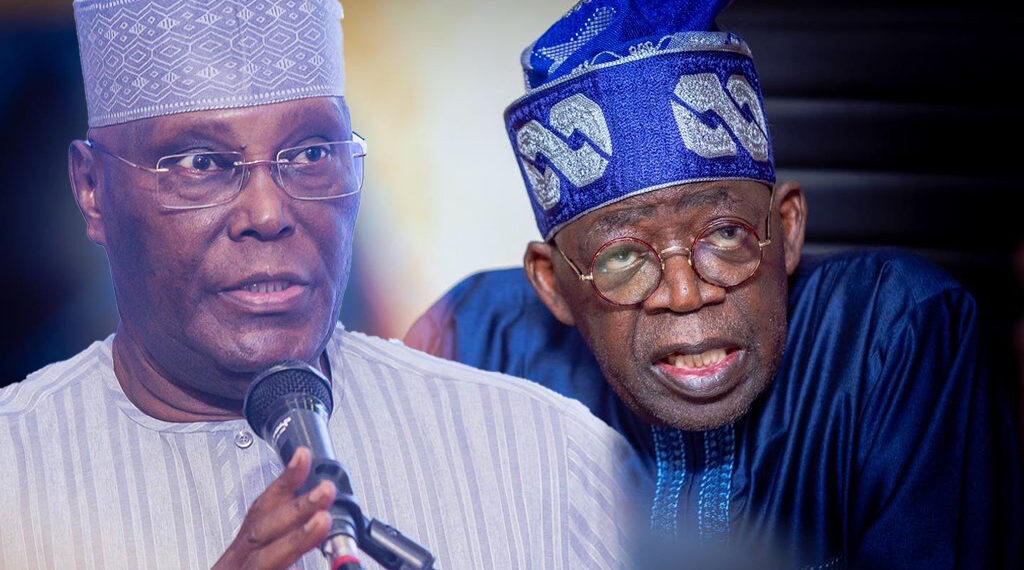
The Chairman of the Supreme Court panel hearing the appeals against the election of President Bola Tinubu, Justice John Okoro, said on Monday that the Peoples Democratic Party standard bearer in the February presidential election, Atiku Abubakar, must prove the allegation of certificate forgery levelled against the ex-Lagos State governor beyond reasonable doubt.

Okoro handed down the admonition during the hearing of the election petition appeals filed by Atiku and Peter Obi of the Labour Party.

He stated this following the submission of Atiku’s lead counsel, Chris Uche, SAN, urging the court to admit the fresh evidence brought by the petitioners.

In his bid to nullify Tinubu’s victory and prove the allegation that he was not qualified to contest the presidential poll, Atiku had prayed to an Illinois Chicago district court to order the Chicago State University to release the President’s academic records.

The former vice-president had accused Tinubu of falsifying the CSU diploma of Bachelor of Science in Business Administration awarded in 1979 that he submitted to the Independent National Electoral Commission.

He demanded a copy of any diploma issued by CSU in 1979, a copy of the diploma the CSU gave to Tinubu in 1979, and copies of diplomas with the same font, seal, signatures, and wording awarded to other students that are similar to what CSU awarded to him in 1979.

Atiku’s application was opposed by Tinubu’s lawyers, citing privacy concerns even as they conceded that only the certificate should be released and not other privileged records.

Academic record

But the United States court ordered the release of the ex-Lagos State governor’s academic records which Atiku filed in support of his election petition appeal at the Supreme Court.

Addressing the apex court on Monday, Uche insisted that the issue of Tinubu’s academic records was a weighty matter and urged the Supreme Court to admit it as fresh evidence.

The senior lawyer said, “The issue involving Tinubu’s certificate is a weighty, grave, and constitutional one, which the Supreme Court should admit. I urge the court to admit the fresh evidence of President Tinubu’s academic records from CSU presented by Atiku.

“The court should take a look at Tinubu’s records and reach a decision devoid of technicality. As a policy court, the court has a duty to look at it and should side-step technicalities. ”

Atiku’s lead counsel also said the issue of 180 days should not tie the hands of the court.

But Justice Okoro, while describing the matter as criminal in nature, said it must be proven beyond reasonable doubt.

He observed that there were two conflicting letters from Chicago State University.

According to him, one of the letters authenticated the President’s certificate and the other discredited it.

He said, “This is a criminal matter that has to be proved beyond reasonable doubt. There are two conflicting letters from the CSU: one authenticating the president’s certificate and another discrediting it.”

Another panel member, Justice Emmanuel Agim observed that the deposition Atiku was seeking to tender as evidence was done in the chambers of Atiku’s lawyer and not in the courtroom.

“I expected the college to write disclaiming the documents in dispute. Does a stenographer have the legal authority to administer oaths? We are dealing with a matter that touches on national interest,’’ he noted.

But Uche argued that the depositions were done in the presence of Tinubu’s US lawyers, adding that there was no dispute about it.

The counsel to the All Progressives Congress, Akin Olujinmi, SAN, told the court that Atiku should not be allowed to bring in documents not presented at the tribunal.

He said, “You cannot smuggle in a document into the Supreme Court without first tendering the same at the trial court. The appeal is misconceived and lacks merit. It should be outright dismissed.”

In his response to Uche’s arguments, the lawyer to the President, Wole Olanipekun, SAN, similarly urged the court not to admit the fresh documents, adding that INEC was not a party to it.

“The depositions are not admissible in the USA. It is akin to deposition which we have in Nigeria. The deposition was not done in court and INEC was not a party to it. The deposition must be adopted by the individual that deposed to it before it can be admitted as evidence before the court,“ he reasoned.

He also said the 180 days stipulated for the conclusion of election petition cases “is like a rock of Gibraltar, it cannot be moved.’’

INEC’s lawyer, Abubakar Mahmoud, asked the court to interpret section 285 of the constitution and also urged the court to dismiss the appeal.

The Punch

Continue Reading
Advertisement


Click to comment

Leave a Reply

Your email address will not be published. Required fields are marked *

Headlines

Tinubu Orders Recovered Loot, Unclaimed Dividends, ‘Dormant Funds’ Sent to NELFund

Published

on

President Bola Tinubu has directed that all cleared and unencumbered looted funds recovered by the Economic and Financial Crimes Commission (EFCC) be channeled to the Nigerian Education Loan Fund (NELFund) to strengthen the financing of tertiary education.

The President also directed that funds in the Unclaimed Dividends Trust Fund and the Dormant Accounts Trust Fund be mobilised for NELFund, subject to compliance with the laws establishing the two funds.

The Minister of Education, Dr. Tunji Alausa, disclosed this on Wednesday while briefing journalists at the State House, Abuja, after the fourth Federal Executive Council (FEC) meeting of the year, presided over by President Tinubu.

Alausa, who described the decisions as a major boost for Nigerian students, clarified that the directive concerning EFCC recoveries applies strictly to liquid funds that have been legally recovered and are no longer subject to litigation.

He stressed that seized properties, assets, or funds still encumbered by court cases would not be transferred to NELFund.

According to him, the President directed the Attorney-General of the Federation and Minister of Justice, Minister of Finance, Ministry of Education, the Debt Management Office and other relevant agencies to work out the legal and operational frameworks for transferring the affected funds.

The Attorney-General, he added, would also work with the EFCC Chairman to identify recovered funds that are legally available for transfer.

“The President was very clear: not seized properties, all recovered looted funds, liquid funds recovered by the EFCC will now be transferred to NELFUND”, the minister said.

Alausa explained that the government would similarly examine the existing legislation governing the Unclaimed Dividends Trust Fund and Dormant Accounts Trust Fund to determine the appropriate legal steps required to make the resources available to NELFund.

He said President Tinubu insisted that only funds free of legal encumbrances would be affected by the directive.

“Every single fund that is still subject to a legal challenge will not be part of the money that will be transferred to NELFUND. The funds that will be transferred will be all cleared funds, unencumbered funds that were looted, funds that legally belonged to Nigeria, to Nigerians,” he said.

The minister said the President considered education one of the most productive uses for recovered public funds, especially as the administration seeks to build the human capital required to drive its ambition of growing Nigeria into a $1 trillion economy.

According to him, the decision is intended to put NELFund on a sustainable financial footing as demand for the student loan scheme continues to expand.

Alausa said more than 1.2 million Nigerian students are currently benefiting from NELFund, adding that the agency has disbursed more than N93 billion as upkeep allowances to students in Federal and State-owned public institutions.

He said more than N250 billion had also been disbursed as institutional fees to public tertiary institutions across the country.

“The education of our children cannot wait; it is of utmost importance to him, and he will do anything and everything to protect the future of every single Nigerian child, every single Nigerian student”, Alausa said of the President.

He described the student loan programme as fulfilment of one of Tinubu’s campaign promises to broaden access to tertiary education irrespective of students’ financial backgrounds.

The minister also addressed complaints about institutions withholding refunds from students who had already paid school fees before NELFund subsequently remitted their institutional charges.

He said the government had established a framework requiring institutions to refund affected students within a stipulated period, saying the widespread difficulties reported during the early stages of the scheme had been resolved.

According to him, any outstanding individual case brought to the ministry’s attention would be investigated.

Meanwhile, the FEC approved an augmentation of about N118.31 billion to complete the long-abandoned National Library of Nigeria headquarters complex in Abuja, as well as about N37 billion to furnish it.

Alausa said the National Library project, which commenced on April 29, 2006 and was originally scheduled for completion within two years, had remained abandoned since work stopped in October 2008.

He said President Tinubu had directed the ministry to mobilise resources to revive the project, including funding sourced through the Tertiary Education Trust Fund (TETFund).

The minister also acknowledged the contribution of First Lady, Senator Oluremi Tinubu, who had requested that gifts for her birthday be directed toward completing the National Library.

According to him, the initiative raised about N25 billion towards the project.

“The council today approved the augmentation of the existing contract for the completion of the construction of the National Library of Nigeria headquarters building complex in Abuja”, he said, adding that the government hoped construction would resume within the next few months.

Alausa said FEC also approved the establishment of the Nigerian Academy for the Gifted and Talented, which would emerge from the transformation of the existing Suleja Academy.

He explained that Suleja Academy was established to identify and nurture exceptionally gifted Nigerian children but had, over the years, operated largely like one of the Federal Government Colleges, preventing it from fully achieving its original mandate.

Under the proposed arrangement, the institution would become an autonomous academy with its own governing structure and diversified funding sources, including federal appropriation, endowments, and gifts.

According to the minister, the academy would identify gifted children across the country and provide an environment in which their abilities could be developed for innovation and national development.

FEC consequently approved the preparation of an executive bill by the Attorney-General of the Federation for transmission to the National Assembly to give legal effect to the transformation.

“We have to look for every single genius in this country and bring them in, nurture them, and let them help create the Nigeria of tomorrow,” Alausa said.

Council also approved the deployment and implementation of an Entrepreneurship, Innovation and Business Incubation Certification programme in selected Nigerian universities.

Alausa described the initiative as a technology-driven programme designed to equip university students with entrepreneurship, innovation, business incubation, enterprise development and digital skills, backed by certification, mentorship and incubation support.

He said the programme, which had already been tested at the University of Lagos, was designed to change the orientation of graduates from merely seeking employment to becoming entrepreneurs, innovators and job creators.

According to him, the programme will begin this year in 14 federal universities before being expanded to other tertiary institutions.

The initial participating institutions are: Ahmadu Bello University, Zaria; Bayero University, Kano; Nnamdi Azikiwe University, Awka; Obafemi Awolowo University, Ile-Ife; University of Abuja; University of Benin; University of Ibadan; University of Ilorin; University of Jos; University of Lagos; University of Maiduguri; University of Nigeria, Nsukka; University of Port Harcourt; and Usmanu Danfodiyo University, Sokoto.

Alausa said the approvals reflected the administration’s determination to position education at the centre of Nigeria’s economic transformation and ensure that young Nigerians acquire both academic knowledge and practical capabilities required to participate in the emerging economy.

He said President Tinubu has given the education ministry a clear mandate to ensure that every Nigerian child has access to education of a quality comparable with standards obtainable elsewhere in the world.

Continue Reading

Headlines

US Lawmaker Moore Insists Nigeria’ll Remain on CPC List, Gives Reasons

Published

on

A United States Congressman, Rep Riley Moore, has reiterated why America cannot lift Nigeria from its Country of Particular Concern (CPC) designation.

In a Tuesday post on his verified X handle, Moore insisted that Christians are being slaughtered across the Middle Belt of Nigeria with impunity.

His remark stemmed from the recent attack in Plateau State, where at least 23 persons were brutally killed after gunmen invaded a community in the state.

“This is exactly why the US Department of State cannot lift Nigeria’s CPC designation. Christians are being slaughtered across the Middle Belt with impunity.

“There may be progress in the north, but nothing has changed in the Middle Belt, where most attacks against Christians occur.

“We cannot make the same mistake the Biden administration made. Biden removed the CPC designation from Nigeria after President Trump’s first term and all hell broke loose on Christians. We must stop the genocide,” he tweeted.

The United States last year declared Nigeria a Country of Particular Concern due to the persistent killing of Christians in the country.

Continue Reading

Headlines

2027: Amupitan Assures Candidates, Parties of Level Playing Ground

Published

on

Chairman of the Independent National Electoral Commission (INEC), Prof. Joash Amupitan, has assured political parties and Nigerians that the commission will not favour any candidate in the 2027 general elections.

Prof. Joash Amupitan gave the assurance on Tuesday at the formal signing of the First National Peace Accord to commit candidates and political parties to issue-based campaigns for the 2027 general election.

The event was organised by the National Peace Committee in partnership with The Kukah Centre.

Amupitan said INEC has no interest in determining who wins or loses the election, stressing that its responsibility was to provide a transparent, credible and level playing field for all contestants.

“Let me state unequivocally that INEC has no interest in who wins or loses any election. The Commission does not have a candidate, nor does it favour any political platform.

“Our only interest is a lawful, transparent, credible, and inclusive process. We will act as an uncompromising, impartial umpire, ensuring a level playing field for all contestants,” Amupitan said.

He pledged that the commission would remain an “uncompromising, impartial umpire,” committed to ensuring a lawful, transparent, credible and inclusive electoral process.

 The INEC chairman also urged political parties and candidates to ensure that the 2027 campaigns focused on issues affecting Nigerians rather than personal attacks, character assassination and inflammatory rhetoric.

He said the signing of the Peace Accord was particularly significant as campaigns for the presidential and National Assembly elections are scheduled to commence on Wednesday, August 19, 2026.

Amupitan said the timing of the accord provided an opportunity for political actors to establish the ethical boundaries of the electoral contest before campaigns officially begin.

He described electoral contests in a constitutional democracy as “competitive job interviews before the electorate,” stressing that Nigerians deserved substantive debates on the country’s challenges.

He urged candidates to present clear and measurable programmes on economic growth, national security, infrastructure, healthcare, education and social inclusion.

Amupitan also warned political parties against the spread of misinformation and disinformation, particularly through their digital media teams, spokespersons and online supporters.

He said unverified and premature declarations of election results could trigger panic and undermine public confidence in the electoral process.

 The INEC chairman warned against incitement, identity-based provocation and the deployment of private armed groups, saying such actions could compromise the electoral process even before Election Day.

He said the commission’s preparations for the 2027 elections were progressing, noting that INEC was scaling up its logistics to manage about 1.4 million ad-hoc personnel across more than 176,000 polling units nationwide.

According to him, the commission had spent the past eight months refining its technology, improving logistics and training personnel, with lessons from recent elections in Anambra, the FCT, Ekiti and Osun states contributing to its preparations.

Amupitan stressed that INEC could not deliver a credible election alone.

“As I have often said, INEC cannot deliver a perfect election alone. An election is a multi-stakeholder venture. We provide the pitch and the refereeing, but the quality of the game depends on the players,” he said.

Amupitan also disclosed that the commission was introducing further transparency measures in the result-management process to improve the credibility of the 2027 elections.

He called on political actors to compete vigorously but peacefully, warning that no candidate or party would truly win if Nigeria emerged weakened from the electoral process.

“Peace is not the absence of competition; it is the presence of rules and the willingness to abide by them. Let us compete vigorously, but let us compete decently. Let us remember that at the end of this exercise, there will be no winners if Nigeria is the loser,” he said.

Continue Reading