
Metro
Reimagining the African Leadership Paradigm: A Comprehensive Blueprint


- /home/rhoncare/pointblank.ng/wp-content/plugins/mvp-social-buttons/mvp-social-buttons.php on line 27
https://pointblank.ng/wp-content/uploads/2025/08/DR.TOLULOPE-A.-ADEGOKE-AMBP-UN__-1-744x600.jpg&description=Reimagining the African Leadership Paradigm: A Comprehensive Blueprint', 'pinterestShare', 'width=750,height=350'); return false;" title="Pin This Post">
- Share
- Tweet /home/rhoncare/pointblank.ng/wp-content/plugins/mvp-social-buttons/mvp-social-buttons.php on line 69
https://pointblank.ng/wp-content/uploads/2025/08/DR.TOLULOPE-A.-ADEGOKE-AMBP-UN__-1-744x600.jpg&description=Reimagining the African Leadership Paradigm: A Comprehensive Blueprint', 'pinterestShare', 'width=750,height=350'); return false;" title="Pin This Post">
By Tolulope A. Adegoke PhD
“To lead Africa forward is to move from transactional authority to transformational stewardship—where institutions outlive individuals, data informs vision, and service is the only valid currency of governance” – Tolulope A. Adegoke, PhD
The narrative of African leadership in the 21st century stands at a critical intersection of profound potential and persistent paradox. The continent, pulsating with the world’s youngest demographic and endowed with immense natural wealth, nonetheless contends with systemic challenges that stifle its ascent. This divergence between capacity and outcome signals not merely a failure of policy, but a deeper crisis of leadership philosophy and practice. As the global order undergoes seismic shifts, the imperative for African nations to fundamentally re-strategize their approach to governance has transitioned from an intellectual exercise to an existential necessity. Nigeria, by virtue of its demographic heft, economic scale, and cultural influence, serves as the continent’s most significant crucible for this transformation. The journey of Nigerian leadership from its current state to its potential apex offers a blueprint not only for its own 200 million citizens but for an entire continent in search of a new compass.
Deconstructing the Legacy Model: A Diagnosis of Systemic Failure
To construct a resilient future, we must first undertake an unflinching diagnosis of the present. The prevailing leadership archetype across much of Africa, with clear manifestations in Nigeria’s political economy, is built upon a foundation that has proven tragically unfit for purpose. This model is characterized by several interlocking dysfunctions:
· The Primacy of Transactional Politics Over Transformational Vision: Governance has too often been reduced to a complex system of transactions—votes exchanged for short-term patronage, positions awarded for loyalty over competence, and resource allocation serving political expediency rather than national strategy. This erodes public trust and makes long-term, cohesive planning impossible.
· The Tyranny of the Short-Term Electoral Cycle: Leadership decisions are frequently held hostage to the next election, sacrificing strategic investments in education, infrastructure, and industrialization on the altar of immediate, visible—yet fleeting—gains. This creates a perpetual cycle of reactive governance, preventing the execution of decade-spanning national projects.
· Administrative Silos and Bureaucratic Inertia: Government ministries and agencies often operate as isolated fiefdoms, with limited inter-departmental collaboration. This siloed approach fragments policy implementation, leads to contradictory initiatives, and renders the state apparatus inefficient and unresponsive to complex, cross-sectoral challenges like climate change, public health, and national security.
· The Demographic Disconnect: Africa’s most potent asset is its youth. Yet, a vast governance gap separates a dynamic, digitally-native, and globally-aware generation from political structures that remain opaque, paternalistic, and slow to adapt. This disconnect fuels alienation, brain drain, and social unrest.
· The Weakness of Institutions and the Cult of Personality: When the strength of a state is vested in individuals rather than institutions, it creates systemic vulnerability. Independent judiciaries, professional civil services, and credible electoral commissions are weakened, leading to arbitrariness in the application of law, erosion of meritocracy, and a deep-seated crisis of public confidence.
The tangible outcomes of this flawed model are the headlines that define the continent’s challenges: infrastructure deficits that strangle commerce, public education and healthcare systems in states of distress, jobless economic growth, multifaceted security threats, and the chronic hemorrhage of human capital. To re-strategize leadership is to directly address these outputs by redesigning the very system that produces them.
Pillars of a Reformed Leadership Architecture: A Holistic Framework
The new leadership paradigm must be constructed not as a minor adjustment, but as a holistic architectural endeavor. It requires foundational pillars that are interdependent, mutually reinforcing, and built to endure beyond political transitions.
1. The Philosophical Core: Embracing Servant-Leadership and Ethical Stewardship
The most profound change must be internal—a recalibration of the leader’s fundamental purpose. The concept of the leader as a benevolent “strongman” must give way to the model of the servant-leader. This philosophy, rooted in both timeless African communal values (ubuntu) and modern ethical governance, posits that the true leader exists to serve the people, not vice versa. It is characterized by deep empathy, radical accountability, active listening, and a commitment to empowering others. Success is measured not by the leader’s personal accumulation of power or wealth, but by the tangible flourishing, security, and expanded opportunities of the citizenry. This ethos fosters trust, the essential currency of effective governance.
2. Strategic Foresight and Evidence-Based Governance
Leadership must be an exercise in building the future, not just administering the present. This requires the collaborative development of a clear, compelling, and inclusive national vision—a strategic narrative that aligns the energies of government, private sector, and civil society. For Nigeria, frameworks like Nigeria’s Agenda 2050 and the National Development Plan must be de-politicized and treated as binding national covenants. Furthermore, in the age of big data, governance must transition from intuition-driven to evidence-based. This necessitates significant investment in data collection, analytics, and policy-informing research. Whether designing social safety nets, deploying security resources, or planning agricultural subsidies, decisions must be illuminated by rigorous data, ensuring efficiency, transparency, and measurable impact.
3. Institutional Fortification: Building the Enduring Pillars of State
A nation’s longevity and stability are directly proportional to the strength and independence of its institutions. Re-strategizing leadership demands an unwavering commitment to institutional architecture:
· An Impervious Judiciary: The rule of law must be absolute, with a judicial system insulated from political and financial influence, guaranteeing justice for the powerful and the marginalized alike.
· Electoral Integrity as Sacred Trust: Democratic legitimacy springs from credible elections. Investing in independent electoral commissions, transparent technology, and robust legal frameworks is non-negotiable for political stability.
· A Re-professionalized Civil Service: The bureaucracy must be transformed into a merit-driven, technologically adept, and well-remunerated engine of state, shielded from the spoils system and empowered to implement policy effectively.
· Robust, Transparent Accountability Ecosystems: Anti-corruption agencies require genuine operational independence, adequate funding, and protection. Complementing this, transparent public procurement platforms and mandatory asset declarations for public officials must become normalized practice.
4. Collaborative and Distributed Leadership: The Power of the Collective
The monolithic state cannot solve wicked problems alone. The modern leader must be a convener-in-chief, architecting platforms for sustained collaboration. This involves actively fostering a triple-helix partnership:
· The Public Sector sets the vision, regulates, and provides enabling infrastructure.
· The Private Sector drives investment, innovation, scale, and job creation.
· Academia and Civil Society contribute research, grassroots intelligence, independent oversight, and specialized implementation capacity.
This model distributes responsibility, leverages diverse expertise, and fosters innovative solutions—from public-private partnerships in infrastructure to tech-driven civic engagement platforms.
5. Human Capital Supremacy: The Ultimate Strategic Investment
A nation’s most valuable asset walks on two feet. Re-strategized leadership places a supreme, non-negotiable priority on developing human potential. For Nigeria and Africa, this demands a generational project:
· Revolutionizing Education: Curricula must be overhauled to foster critical thinking, digital literacy, STEM proficiency, and entrepreneurial mindset—skills for the Fourth Industrial Revolution. Investment in teacher training and educational infrastructure is paramount.
· Building a Preventive, Resilient Health System: Focus must shift from curative care in central hospitals to robust, accessible primary healthcare. A healthy population is a productive population, forming the basis of economic resilience.
· Creating an Enabling Environment for Talent: Beyond education and health, leadership must provide the ecosystem where talent can thrive: reliable electricity, ubiquitous broadband, access to venture capital, and a regulatory environment that encourages innovation and protects intellectual property. The goal is to make the domestic environment more attractive than the diaspora for the continent’s best minds.
6. Assertive, Strategic Engagement in Global Affairs
African leadership must shed any vestiges of a supplicant mentality and adopt a posture of strategic agency. This means actively shaping continental and global agendas:
· Leveraging the AfCFTA: Moving beyond signing agreements to actively dismantling non-tariff barriers, harmonizing standards, and investing in cross-border infrastructure to turn the agreement into a real engine of intra-African trade and industrialization.
· Diplomacy for Value Creation: Foreign policy should be strategically deployed to attract sustainable foreign direct investment, secure technology transfer agreements, and build partnerships based on mutual benefit, not aid dependency.
· Advocacy for Structural Reform: African leaders must collectively and persistently advocate for reforms in global financial institutions and multilateral forums to ensure a more equitable international system.
The Nigerian Imperative: From National Challenges to a National Charter
Applying this framework to Nigeria requires translating universal principles into specific, context-driven actions:
· Integrated Security as a Foundational Priority: Security strategy must be comprehensive, blending advanced intelligence capabilities, professionalized security forces, with parallel investments in community policing, youth employment programs in high-risk areas, and accelerated development to address the root causes of instability.
· A Determined Pursuit of Economic Complexity: Leadership must orchestrate a decisive shift from rent-seeking in the oil sector to value creation across diversified sectors: commercialized agriculture, light and advanced manufacturing, a thriving creative industry, and a dominant digital services sector.
· Constitutional and Governance Re-engineering: To harness its diversity, Nigeria requires a sincere national conversation on restructuring. This likely entails moving towards a more authentic federalism with greater fiscal autonomy for states, devolution of powers, and mechanisms that ensure equitable resource distribution and inclusive political representation.
· Pioneering a Just Energy Transition: Nigeria must craft a unique energy pathway—strategically utilizing its gas resources for domestic industrialization and power generation, while simultaneously positioning itself as a regional hub for renewable energy technology, investment, and innovation.
Conclusion: A Collective Endeavor of Audacious Hope
Re-strategizing leadership in Africa and in Nigeria is not an event, but a generational process. It is not the abandonment of culture but its evolution—melding the deep African traditions of community, consensus, and elder wisdom with the modern imperatives of transparency, innovation, and individual rights. This task extends far beyond the political class. It is a summons to a new generation of leaders in every sphere: the tech entrepreneur in Yaba, the reform-minded civil servant in Abuja, the agri-preneur in Kebbi, the investigative journalist in Lagos, and the community activist in the Niger Delta.
Ultimately, this is an endeavor of audacious hope. It is the conscious choice to build systems stronger than individuals, institutions more enduring than terms of office, and a national identity richer than our ethnic sum. Nigeria possesses all the requisite raw materials for greatness: human brilliance, cultural richness, and natural bounty. The final, indispensable ingredient is a leadership strategy worthy of its people. The blueprint is now detailed; the call to action is urgent. The future awaits not our complaints, but our constructive and courageous labor. Let the work begin in earnest.
Dr. Tolulope A. Adegoke is a globally recognized scholar-practitioner and thought leader at the nexus of security, governance, and strategic leadership. His work addresses complex institutional challenges, with a specialized focus on West African security dynamics, conflict resolution, and sustainable development.


Metro
International Day of the Girl-Child: Pad Me A Girl Foundation Holds Menstrual Health Outreach in Ogun
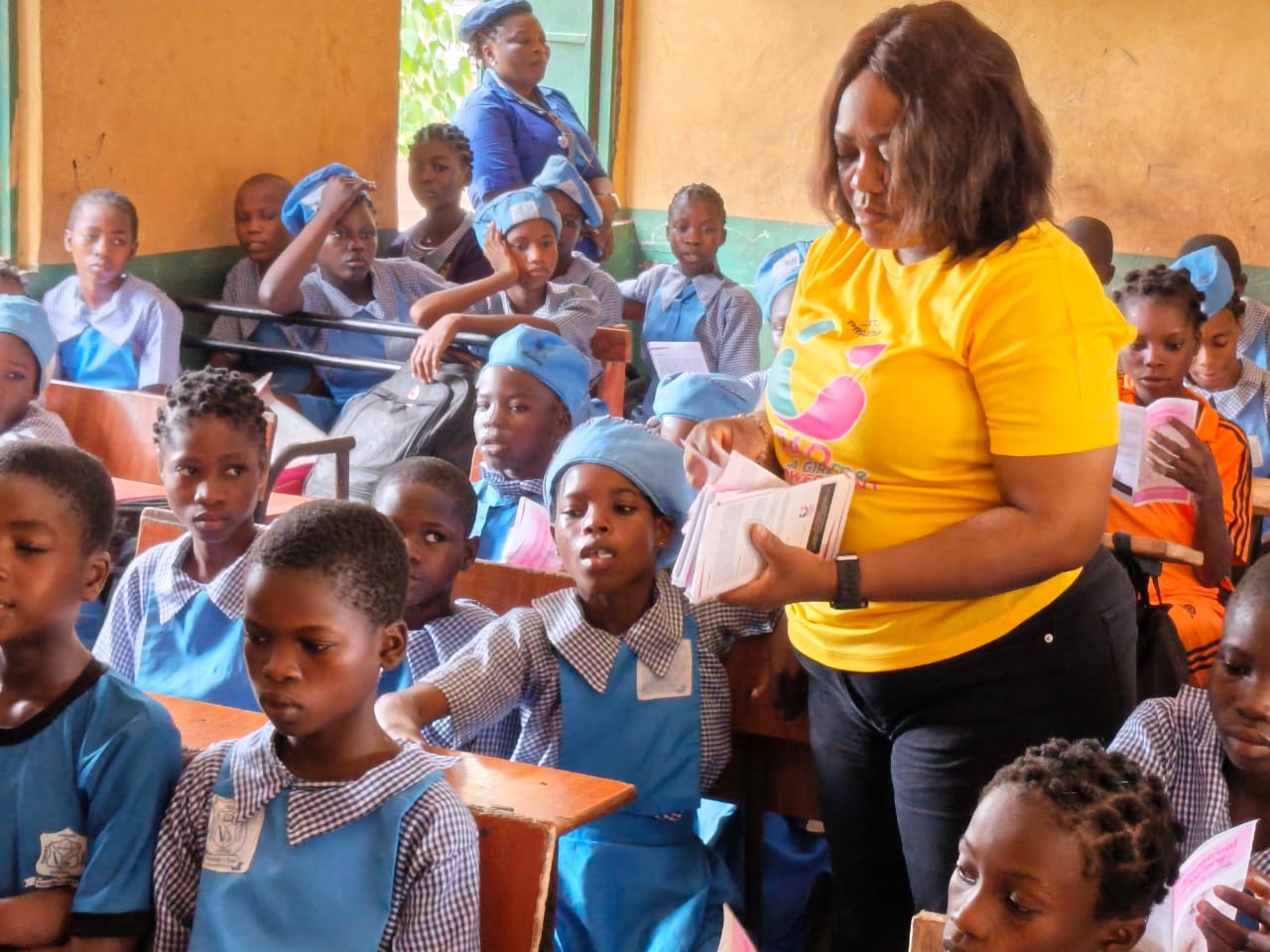
The Pad Me A Girl Empowerment Foundation has taken its menstrual health campaign to Igbesa High School (Junior), in Ado-Odo/Ota Local Government Area of Ogun State, providing free sanitary pads, menstrual hygiene pamphlets, exercise books and pens to over 100 schoolgirls to promote menstrual health, dignity and education.
The outreach, held on Wednesday, October 21, commemorated the 2026 International Day of the Girl Child, whose global theme is “End Child Marriage and Invest in Girls’ Rights!”
The programme brought together girls from Junior Secondary School (JSS) 1 to 3 who participate in the school’s reading clubs for mentorship, reading activities and menstrual health education.
It was convened by Oyelami Yetunde Anuoluwapo and Blessing Kappo, teachers and Teach For Nigeria Fellows at the school, following an appeal for sanitary products, learning materials and health education support. The Foundation’s founder, Theresa Moses, responded by providing the requested items and facilitating an interactive session on menstrual hygiene management.
Speaking at the event, Moses said she was inspired by the girls’ determination and aspirations, stressing the need for sustained investment in their health, education and future.
“Invest in girls and Nigeria will rise. Every girl deserves dignity, education and the right to dream beyond child marriage. That is why we are here; to ensure no girl misses school because of her period,” she said.
She emphasised that access to menstrual hygiene products and accurate information helps girls manage their periods confidently and participate fully in school activities.
In a letter of appreciation, Oyelami and Kappo described the outreach as impactful and inspiring, noting that it enhanced the girls’ understanding of menstrual health, hygiene and self-confidence. They also said the support would help promote the students’ hygiene, school attendance and dignity.
“You did not just give pads; you gave our girls confidence and hope,” the teachers wrote on behalf of the school community, expressing gratitude to the Foundation and hope for future collaboration.
Mrs Amarachi Eze, Assistant Divisional Commissioner of the Nigerian Girl Guides Association, Ado-Odo/Ota, Ogun State Branch, also commended the Foundation for supporting the girls’ hygiene needs and development.
“We sincerely appreciate the Management of Pad Me A Girl Foundation for joining hands with the Association in supporting our girls on hygiene management. May God Almighty continue to uplift your foundation. Thanks for joining hands in the development of girls in our schools. Bravo,” she said.
The Foundation’s Media Coordinator, Mr Oluwatosin Simon Faleye, called on corporate organisations, non-governmental organisations and well-meaning Nigerians to support initiatives that address period poverty and help girls remain in school.
“For over a year, we have been committed to ending period poverty and keeping girls in school. We call on corporate organisations and well-meaning Nigerians to support this cause for the betterment of Nigeria,” Faleye said.
The celebration also featured a student drama presentation highlighting the effects of child marriage, alongside reading and mentorship activities designed to encourage the girls to understand their rights, value their education and pursue their aspirations.
The Foundation also acknowledged the continued support of its sponsors and partners, including Access Bank, Pro Star Sports International, BL Consulting, Vita Baites Foods, Checkers, Senator Ireti Kingibe, representing the Federal Capital Territory (FCT) in the 10th Nigerian National Assembly, the Senate Committee on Women Affairs (SCOWAS), as well as individuals and media organisations whose contributions have supported its broader mission of ending period poverty, promoting menstrual health education and empowering girls and women.
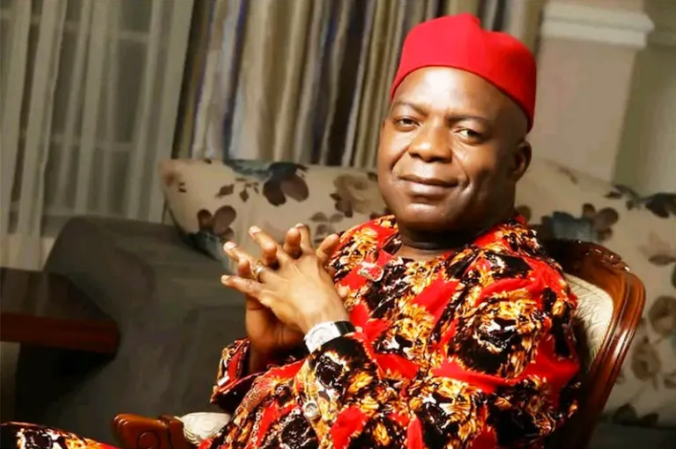
Abia State governor, Alex Otti, is set to flag off the reconstruction of Uratta Road and Old Express Road in Aba, two major routes which poor condition has disrupted transportation, commercial activities and access to residential communities for years.
The governor’s media aide, Ferdinand Ekeoma, in a statement on Wednesday, said that work on the roads has begun ahead of the scheduled official flag-off.
The two roads are considered important to Aba’s commercial and industrial activities, with Uratta Road connecting several adjoining streets to Port Harcourt Road and Old Express Road. At the same time, Old Express Road serves as a key route within the city’s industrial layout.
Ekeoma said the roads had suffered neglect for more than 24 years, leaving some sections impassable and forcing residents and businesses to contend with difficult transportation conditions.
According to the statement, Uratta Road provides access to more than 100 adjoining streets. Its poor condition has affected residents, traders and small-scale manufacturers who depend on the road to transport goods and access their businesses.
The statement said the road had become waterlogged and overgrown with weeds, discouraging commercial motorcycle and tricycle operators from using it.
Similarly, the deterioration of Old Express Road forced heavy-duty truck operators, fabric merchants, spare-parts dealers and small businesses to use longer routes, increasing transportation costs and affecting productivity.
The government said the road reconstruction is part of its broader effort to restore Aba’s infrastructure and strengthen the city’s commercial base.
Aba, one of southeastern Nigeria’s major commercial centres, hosts manufacturing clusters, markets, and small and medium-sized enterprises that depend heavily on functional roads to move raw materials and finished products.
The government said the reconstruction would improve market access, reduce transportation costs, facilitate the movement of goods, and support businesses operating along the affected corridors.
Ekeoma cited the reconstruction of Port Harcourt Road as an example of the administration’s infrastructure programme, noting that improved road access encouraged shops to reopen, attracted manufacturing activities and increased property rents along the corridor.
The government also said the new projects would complement other road interventions in Aba, including works on Ohanku and Obohia roads, as part of efforts to improve connectivity within the commercial city.
Beyond road construction, the administration said its projects include drainage systems, solar-powered streetlights, and pedestrian walkways, which it described as necessary to improve safety, accessibility, and flood resilience.
Ekeoma said Governor Otti views infrastructure development as an economic strategy rather than merely a construction programme, arguing that better roads would help businesses operate more efficiently and create employment opportunities.
He also quoted the governor as saying at an earlier church event that his administration is shifting attention from basic infrastructure improvements to healthcare, education, technology and industrialisation.
The governor, a former bank chief executive, was elected in 2023 on the Labour Party platform, defeating candidates from the major established parties in a state historically dominated by the Peoples’ Democratic Party.
Otti has remained in the Labour Party despite the defection of its 2023 presidential candidate, Peter Obi.
His administration has made rehabilitating Aba roads and public infrastructure central to its governance agenda, presenting the city’s recovery as essential to reviving economic activity across Abia State.

MILO Nigeria, in partnership with former Nigerian national team captain and MILO Brand Ambassador Ahmed Musa, has concluded the inaugural MILO × Ahmed Musa Sports Clinic and Tournament in Kano, providing 2,500 young footballers with professional coaching, mentorship and competitive football experience.
Over two weeks, participants took part in 10 coaching sessions and competed in matches under the guidance of Ahmed Musa and experienced coaches. The programme combined practical football training with lessons in teamwork, discipline, resilience and confidence, equipping participants with skills and values that extend beyond the pitch.
The initiative culminated in a tournament at the Ahmed Musa Sports Complex in Kano, where Khamis Football Academy emerged as champions of the inaugural edition. Participants also received cash prizes, certificates and football equipment.
Speaking on the initiative, Gilbert Tweneboah-Koduah, Category Lead, MILO, said: “At MILO, we believe sport is a powerful platform for young people to discover their abilities, build confidence and develop values that extend beyond the field of play. Our partnership with Ahmed Musa brings together MILO’s longstanding commitment to sports development and the experience of an athlete whose journey from grassroots football to the highest level of the game can inspire the next generation. By combining his experience with structured coaching and competition, this programme has given young footballers in Kano an opportunity to develop their skills, learn from experienced professionals and better understand the commitment required to pursue their aspirations.”
For the participants, the clinic offered an opportunity to learn from an athlete whose football journey began in northern Nigeria and progressed to the highest levels of the sport, making his experience a source of inspiration for aspiring players.
Commenting on the partnership, Ahmed Musa said: “Nigeria has incredible football talent, but talent alone is not enough. Young players need good coaching, regular competition and people who will guide them. I am proud to partner with MILO and share some of what football has taught me. My message to these players is simple: keep training, listen to your coaches and work hard every day to improve.”
Musa also called for greater investment in grassroots football, emphasizing the importance of giving young players access to quality coaching, structured development and regular competitive opportunities.
The MILO × Ahmed Musa Sports Clinic and Tournament builds on MILO’s longstanding commitment to youth development through sports in Nigeria. Through its school-based and grassroots sporting initiatives, MILO continues to create opportunities for young people to participate in sports, develop their abilities and embrace values that can support them both on and off the pitch.


