
Headlines
See Full List of Officers, Soldiers Who Deserted the Army

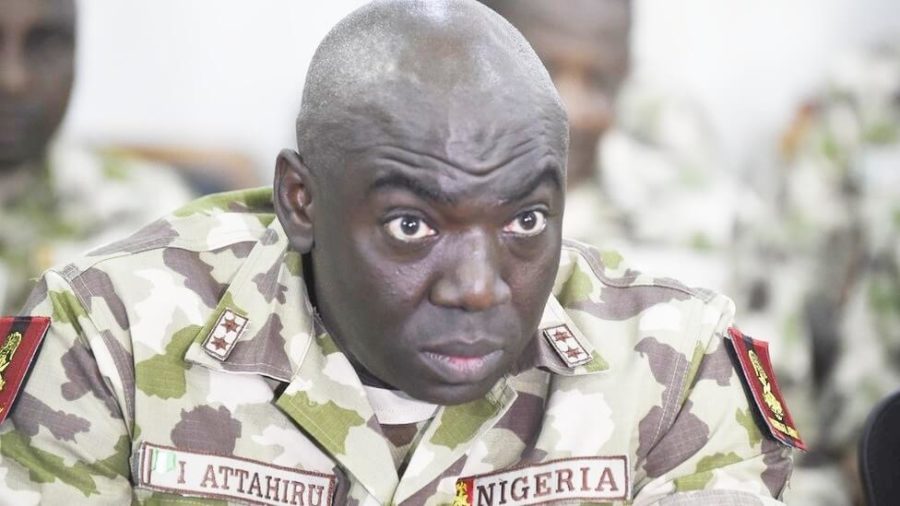
- /home/rhoncare/pointblank.ng/wp-content/plugins/mvp-social-buttons/mvp-social-buttons.php on line 27
https://pointblank.ng/wp-content/uploads/2021/03/Attahiru-1.jpg&description=See Full List of Officers, Soldiers Who Deserted the Army', 'pinterestShare', 'width=750,height=350'); return false;" title="Pin This Post">
- Share
- Tweet /home/rhoncare/pointblank.ng/wp-content/plugins/mvp-social-buttons/mvp-social-buttons.php on line 69
https://pointblank.ng/wp-content/uploads/2021/03/Attahiru-1.jpg&description=See Full List of Officers, Soldiers Who Deserted the Army', 'pinterestShare', 'width=750,height=350'); return false;" title="Pin This Post">
The Nigerian Army has declared a total of 12 officers and 89 soldiers wanted for deserting the war front in Borno State.
The army authorities have also frozen the banks accounts of the affected personnel.
Military sources told PREMIUM TIMES the soldiers absconded from duty after insurgents attacked their camps in Marte and Dikwa Local Government Areas of Borno State, leaving scores of their colleagues dead.
This newspaper had exclusively reported how at least seven soldiers of the Nigerian Army were confirmed dead after Boko Haram terrorists attacked Marte.
The soldiers, attached to the 15 Task Force Battalion, were ambushed and dislodged after hours of intense fighting, sources told PREMIUM TIMES.
According to those familiar with the matter, the troops were overwhelmed and could not withstand the superior firepower of the terrorists.
The unit then tactically retreated and relocated to Dikwa, which was attacked again.
The Nigerian Army recently announced the recovery of Marte and other communities.
Order to apprehend deserters
Military insiders said the order to arrest and freeze bank accounts of the fleeing soldiers came from authorities of Operation Lafiya Dole in Borno.
Various formations of the army have been notified to immediately apprehend and deliver any of the soldiers found in their areas of responsibilities.
An internal memo to that effect has already been circulated to various formations, our sources said.
Full list of the officers and soldiers who deserted the army:
- GY Mohammed
- EP Nwangwu
- US Muhammad
- EG Utok
- A Ibrahim
- US Ibrahim
- ME Ochei
- EN Essien
- FC Maduako
- KO Adejare
- S Mammada
- YJ Ishaya
- Muazu Yusuf
- Musa Usman
- Idris Garba
- Chigbo John
- Aminu Mohammed
- Godfrey Samuel
- Christopher Silas
- Okoro Emeka
- Meze Hillary
- Zakka Peter
- Onyebuchi Kennedy
- Okunola Oluwasegun
- Suoyefe Abiola
- Mwankat Shalmak
- Ekekien Peter
- Daniel Emmanuel
- John Monday
- Yakubu Amos
- Aminu Saidu
- Pius Okoro
- Kenebra Shedrach
- Dominic Eworo
- Ojo Oluwasegun
- Nura Lawal
- Yakubu Suleiman
- Johnson Chorus
- Isah Shaibu
- Nasiru Hamisu
- Jibrin Sa’adu
- John Ukpenkune
- Umar Sani
- Mustapha Suleiman
- Isiaq Adam
- Muhammed Ahmed
- John Richard
- Kabiru Hashimu
- Awuna Monday
- Isah John
- Zamani Fidelis
- Abubakar Adam
- Philip Chia
- Ogundipe GBenga
- Samson Unite
- Francis Audu
- Abubakar Musa
- Ibrahim Adamu
- Sadiq Abubakar
- Lawal Abdullahi
- Ajala David
- Suleiman Jamilu
- Okoro Ama
- Sunday Sule
- Aimato Abdulsalam
- Abubakar Musa
- Suleiman Kabiru
- Onu Kingsley
- Buba Usman
- James John
- Hussaini Adamu
- Shamsudeen Ismail
- Saidu Sani
- Abdullahi Musa
- Abubakar Yahaya
- Edosa Aigboje
- Ibrahim Umar
- Chukwujekwu Okenwa
- Abdullahi Usman
- Ukali Emmanuel
- Joseph Benard
- Ewubare Gold
- Abimiku Sunday
- Ibrahim Mansur
- Joseph Ayuba
- Ayanyemi Tayo
- Remember Jeremiah
- Jimoh Adesina
- Ukwokori Precious
- Ayawei Ayibatemi
- Kalu Sunday
- Abdulkadir Ahmed
- Osakwe Festus N
- Badamashi Omokafe
- Levi Pwagureno
- Paul Pilate Saddam
- Bello Musa
- Moses Ayo
- Ademu Alih
- Ogobi Fredrick
- Benedict Uduebor
Premium Times


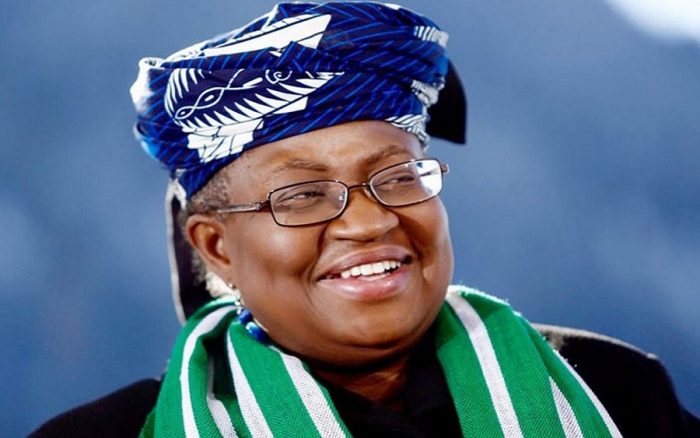
Director-General of the World Trade Organisation (WTO), Mrs. Ngozi Okonjo-Iweala, has said that her probe of an alleged $2.4bn subsidy fraud led to the abduction of her mother.
It would be recalled that the former Finance Minister’s mother, Kamene Okonjo, was kidnapped from her home in Ogwashi-Uku, Delta State, in December 2012.
In a recent interview with Bloomberg, Okonjo-Iweala said the abductors demanded that she resign as minister of finance and leave the country.
The WTO director-general served as Nigeria’s finance minister between 2011 and 2015 under former President Goodluck Jonathan.
She said the subsidy investigation began after her office noticed a sharp increase in claims submitted by petrol importers.
“So I went to the president and said, look, something is going on here. Could we audit the accounts? And he said, yes, go ahead. And we found about $2.4 billion worth of fraud. So, we refused to pay,” she recounted.
She said her mother was abducted shortly after the decision was announced, adding that her captors demanded her resignation as a condition for her release.
“I was told (by the kidnappers) that for her to be released, I should resign and leave the country,” she said.
The former minister described the incident as one of the most traumatic experiences of her life, saying her mother was held in a forest before escaping.
“She was held in the middle of a forest, and one night she escaped. She’s still alive. She’s 96 now,” Okonjo-Iweala said.
“It was a terrible, terrible five-day ordeal. I think the worst in my life.”
“I never dreamt my parents could ever be touched in this way, that people would be that evil,” she added.
Okonjo-Iweala said she considered resigning before her mother regained her freedom, but her father warned her against giving in to the abductors’ demands.
“He said, ‘We don’t give in to blackmail’. And he said, ‘You’ve got to carry on. You’ve got to go to work’,” she recalled.
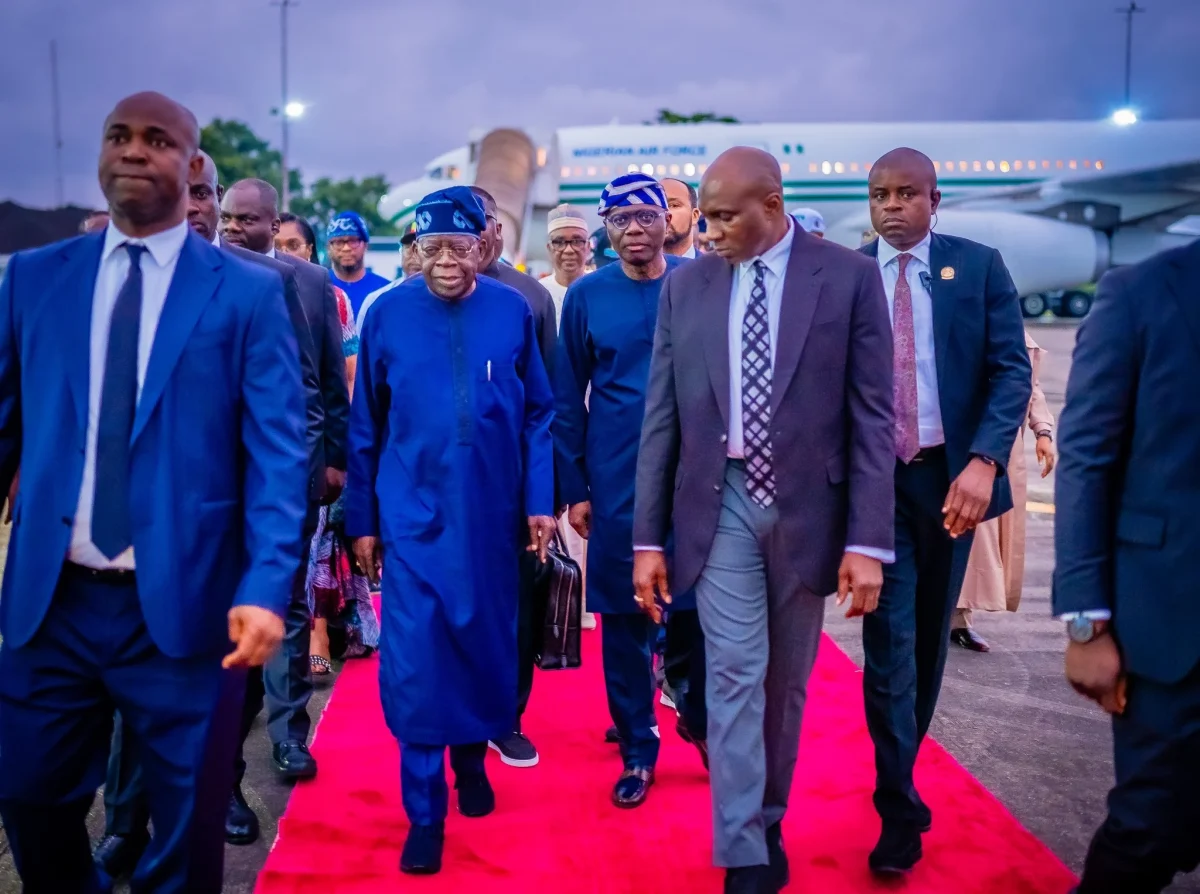
President Bola Tinubu has told members of the All Progressives Congress (APC) Presidential Campaign Council not to expect him to accompany them to every campaign event ahead of the 2027 general election, saying he must remain focused on governance and the country’s economic responsibilities.
Tinubu spoke on Wednesday during the inauguration of the APC Presidential Campaign Council in Abuja, where he urged members to take the party’s message to Nigerians across the states and local government areas while he continues to attend to matters of governance.
The president said he agreed with concerns that the demands of the campaign should not distract him from running the country, adding that Nigeria needs his attention at the moment.
“You’ve warned me not to allow the rigour of the campaign to distract me from governance, I hear you. I am in full agreement with your decision. Nigeria needs more attention now,” Tinubu said.
He told council members to excuse him from accompanying them to every campaign event, noting that his administration has bills to pay and international financial obligations to meet.
“So, you will excuse me from going everywhere with you, we have bills to pay. The American creditors cannot wait,” the President said.
Tinubu also said the government needs to attract investors who would commit to long-term investments in Nigeria and contribute to the future of the country’s children.
“We want those investors to come in, be here to stay, to invest for the future of our children,” he said.
The president, however, assured Nigerians that he would continue to engage them directly even as the campaign council took charge of mobilisation across the country.
“However, I will still make time to speak directly with Nigerians, even as you lead the campaign in the states and local government areas,” he said.
Tinubu described the inauguration of the council as more than a campaign activity, saying it represents a renewed commitment to Nigerians and the responsibilities of the ruling party.
“We have not gathered merely to inaugurate a council. We have gathered to renew a covenant. A covenant with Nigerian people and the historic responsibility they have entrusted to us as Nigeria’s governing party,” he said.
He added that the council is expected to communicate the administration’s vision, achievements and agenda to voters nationwide.
“This council will carry our vision, our records and our agenda to every Nigerian, and it will carry them to victory every ward of this country,” Tinubu said.
The president also commended APC members for completing the party’s congresses, recalling that some had predicted internal crises during the process.
He said the party has overcome the challenges and emerged united, crediting members for participating in the process from the ward level to the national leadership.
“They said there will be implosion. We passed through it. We did not fail. You didn’t let us down. We got here together,” he said.
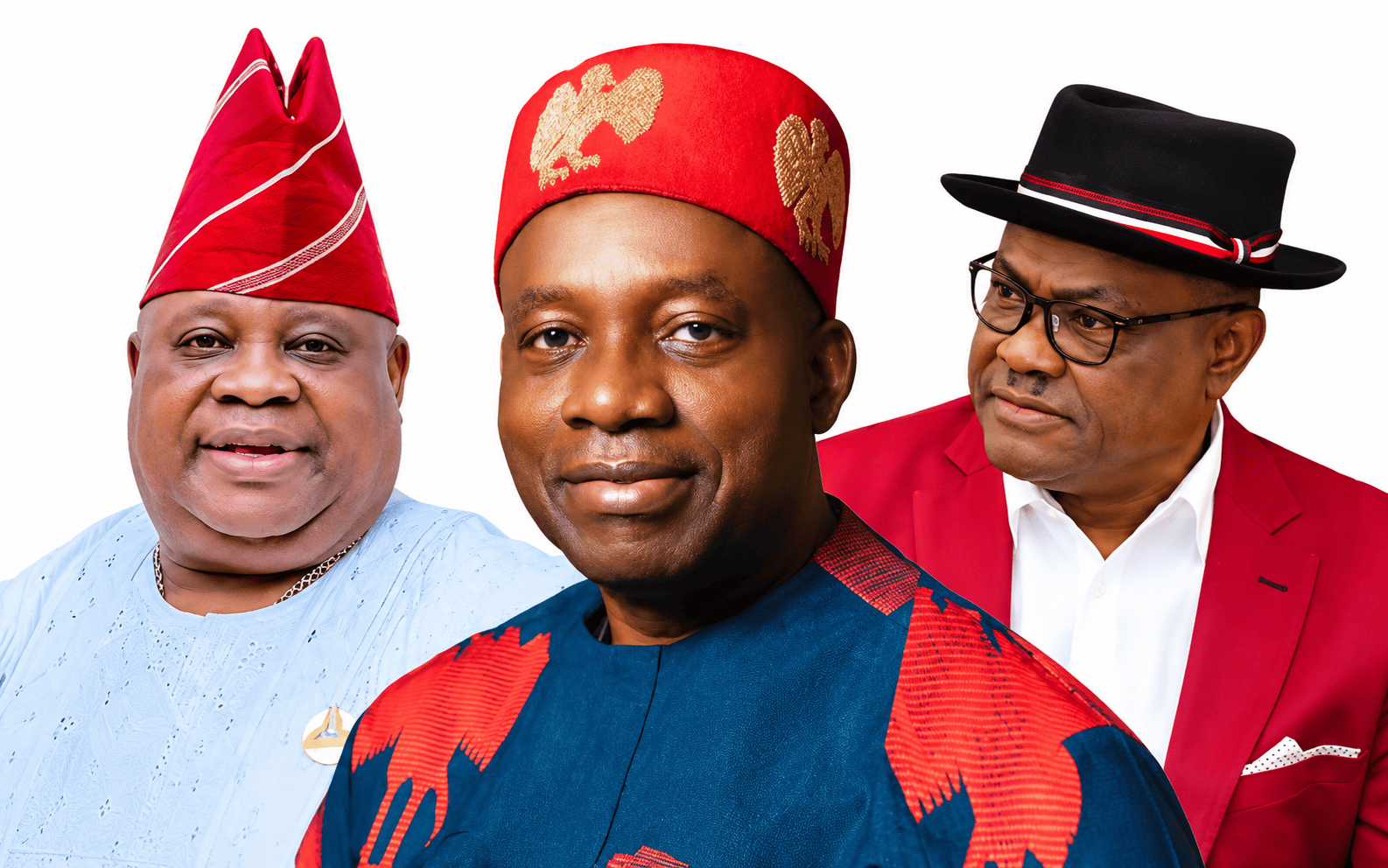
The All Progressives Congress (APC) has named Nyesom Wike, Minister of the Federal Capital Territory (FCT); Ademola Adeleke, Osun State governor; and Chukwuma Soludo, Anambra State governor, as campaign coordinators in its expanded presidential campaign council for the 2027 general election, despite their affiliations with other political parties.
Wike belongs to the Peoples’ Democratic Party (PDP), Soludo is a member of the All Progressives Grand Alliance (APGA), while Adeleke won re-election as Osun governor in 2026 under the Accord Party.
Under the new arrangement, Wike will coordinate the APC campaign in Rivers State and the FCT, Soludo will oversee Anambra, while Adeleke will coordinate the campaign in Osun.
The expanded list is scheduled for inauguration by President Bola Tinubu at the Presidential Villa in Abuja on Wednesday.
The APC initially released its campaign council list on August 22, naming Abdulaziz Yari, former Zamfara governor, as director-general. Senate President Godswill Akpabio, House of Representatives Speaker Tajudeen Abbas and Yobe Governor Mai Mala Buni were appointed deputy director-generals.
In the revised list, Akpabio, Abbas and Kwara Governor AbdulRahman AbdulRazaq are deputy vice-chairmen I, II and III, respectively, while Buni becomes deputy director-general I for the North.
The council also includes former governors and party chieftains as advisers, which include former APC national chairmen Adebisi Akande and Abdullahi Adamu; former Ogun State Governor Ibikunle Amosun; former Osun State Governor Iyiola Omisore; Senator Ibrahim Dankwambo; Senator George Akume; former Ogun State Governor Segun Osoba; and Wale Edun. Obafemi George is listed as an adviser on media.
The Directorate of Election Planning, Coordination, Monitoring and Mobilisation, established ahead of the 2027 general election, has Faleke as Deputy Director-General, with Stella Okotete and Engr. Abdullahi Garba Ramat serving as Secretary I and Secretary II, respectively. Audu Maikori is also listed as a secretary.
Other members of the directorate include Soares Omotola, Bashir Dabo, Sheriff Mohammed Usman, Jibrin Bancir, Ayoola Peter Olajolo, Abubakar Sadiq Sada and Princess Folasade Ogunbiyi.


