Headlines
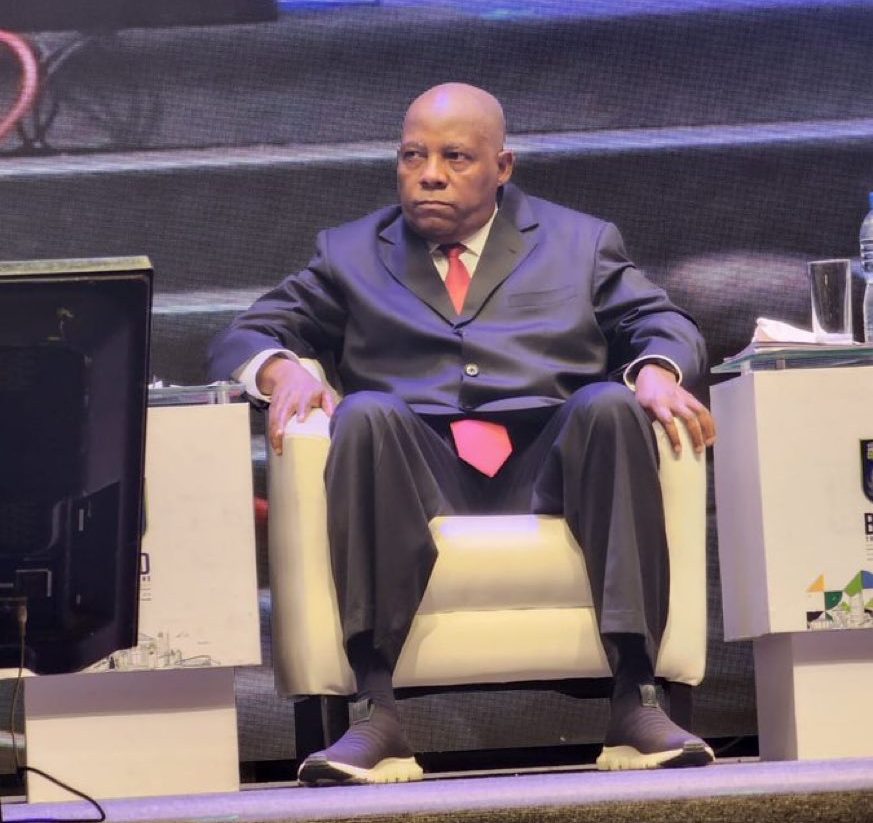
Shettima Defends Wearing Sneakers to NBA Conference
- /home/rhoncare/pointblank.ng/wp-content/plugins/mvp-social-buttons/mvp-social-buttons.php on line 27
https://pointblank.ng/wp-content/uploads/2022/08/IMG-20220822-WA0035-e1661514586356-873x600.jpg&description=Shettima Defends Wearing Sneakers to NBA Conference', 'pinterestShare', 'width=750,height=350'); return false;" title="Pin This Post">
- Share
- Tweet /home/rhoncare/pointblank.ng/wp-content/plugins/mvp-social-buttons/mvp-social-buttons.php on line 69
https://pointblank.ng/wp-content/uploads/2022/08/IMG-20220822-WA0035-e1661514586356-873x600.jpg&description=Shettima Defends Wearing Sneakers to NBA Conference', 'pinterestShare', 'width=750,height=350'); return false;" title="Pin This Post">
The All Progressives Congress vice-presidential candidate, Kashim Shettima, has explained why he wore sneakers to the Nigerian Bar Association Conference in Lagos State on Monday.
Shettima, who represented APC presidential candidate, Bola Tinubu, at the event, was dressed in a black suit and red tie, accompanied by a pair of gym shoes, which stirred reactions from social media users.
The event was attended by the presidential candidates of the Peoples Democratic Party, Atiku Abubakar and Labour Party, Peter Obi, respectively.
But justifying his style in a video clip shared on social media on Thursday, Shettima, who is a former Borno State governor, stated that he deliberated wore sneakers to the event.
“I was in Lagos for the NBA conference. It was held in Eko Hotels, it was largely funded by the Lagos State Government, the APC government of Lagos State. Subsequently, they moved to Eko Atlantic city, a product of an idea conceived by Asiwaju Bola Ahmed Tinubu.
“When I sent my recce team… One of the presidential candidates, his team held meetings for three consecutive nights to commit mischief.
“When I was told it was a hostile crowd. I’m a banker, trained by one of the best bankers in the world. I’m a Jim Ovia boy. I deliberately wore sneakers to the NBA to mock (sic) at them.”
Headlines
VP Shettima Delivers Tinubu’s Address at the 81st UNGA in New York (Full Text)
STATEMENT BY H.E. BOLA AHMED TINUBU, GCFR, PRESIDENT AND COMMANDER-IN-CHIEF OF THE FEDERAL REPUBLIC OF NIGERIA
AS DELIVERED BY
H.E. KASHIM SHETTIMA, GCON,
VICE PRESIDENT OF THE FEDERAL REPUBLIC OF NIGERIA
AT THE GENERAL DEBATE OF THE EIGHTY-FIRST SESSION OF THE UNITED NATIONS GENERAL ASSEMBLY ON THE THEME: “RESTORING TRUST, MANAGING TRANSFORMATION: A UNITED NATIONS THAT DELIVERS FOR ALL”
24TH SEPTEMBER, 2026
Mr. President,
Mr. Secretary-General,
Excellencies, Heads of State and Government,
Distinguished Delegates,
I extend my warmest congratulations to you, Mr. President, on your election as President of the Eighty-First Session of the United Nations General Assembly and assure you of Nigeria’s full cooperation and support. I commend your predecessor’s stewardship of this Assembly. I also salute the Secretary-General, His Excellency António Guterres, for steering the United Nations through storms that have sharpened our awareness of the cost of inaction.
2. None of us can pretend that conflicts within our borders or in lands far beyond them do not exact a price from us. Such is the reach of our interdependence. Such is the urgency of this session’s sacred duty to restore trust in the international institutions we established to reconcile our differences and advance our common interests.
3. The persistence of conflict across the world recalls the purpose for which the United Nations was founded: to spare succeeding generations the devastation of war. We must therefore return to the founding principles of dialogue, mutual respect and collective responsibility. Nigeria stands by the Charter and its promise of a world in which diplomacy prevails over coercion, cooperation over isolation and international law over the arbitrary exercise of power.
Mr. President,
4. The reform of this institution must begin with the reconstitution of the Security Council, for the world of 2026 cannot remain captive to the distribution of power in 1945. Africa cannot continue to fill the Council’s agenda while remaining absent from its permanent membership. Nigeria demands, in accordance with the Ezulwini Consensus and the Sirte Declaration, at least two permanent seats for Africa, with all the rights and responsibilities of permanent membership, including the veto for as long as it exists, and five non-permanent seats in total. The authority to speak for humanity carries an obligation to represent it.
5. Nigeria stands ready to assume greater responsibility on the strength of obligations honoured and sacrifices made over decades in the service of peace. From Liberia and Sierra Leone to Darfur, Mali and The Gambia, we have committed personnel and resources when international solidarity required action. Through ECOWAS, the African Union and our Gulf of Guinea partnerships, we continue to advance mediation, democratic governance, counter-terrorism and maritime security.
Mr. President,
6. Our foreign policy rests on the same conviction that guides our economic reforms. Through sound macroeconomic management, stronger institutions, private-sector development and strategic public investment, we seek to give practical meaning to our sustainable development commitments. This purpose binds our national advancement to our continent’s progress and to our responsibility to contribute to a peaceful, equitable and prosperous world.
7. We understand that governments and multilateral institutions earn trust when their decisions improve lives. Yet none of these gains will matter if we turn a deaf ear to the threats gathering around our borders and farther afield. We inhabit the only planet known to sustain human life, and as long as that scientific fact holds, we cannot pretend that we are insulated from conflicts elsewhere. Geography offers no exemption from the consequences of a fractured world.
Mr. President,
8. We reject the false choice between development and climate action. Developing countries must industrialise, eradicate poverty and expand energy access through low-carbon pathways supported by technology transfer, capacity building and climate finance. Africa contributes less than four per cent of greenhouse gas emissions, yet bears disproportionate consequences. Nigeria remains committed to the Paris Agreement and an equitable energy transition that reflects historical responsibility and capacity while protecting people’s right to development.
9. Under our Energy Transition Plan, we are working towards net-zero emissions by 2060 while expanding access to affordable, reliable and sustainable energy. This effort combines renewable energy, clean cooking and gas as a transitional fuel with climate-smart agriculture and nature-based solutions. Finance must be governed by equity and shared responsibility rather than charity, with international commitments translated into accessible, predictable and adequately funded mechanisms enabling developing countries to pursue climate action without compromising development objectives.
Excellencies,
10. We refuse to surrender our technological future to paranoia. An invention can be destructive or beneficial, depending on the purposes it serves and the judgement of those who use it. A knife can take a life in the hands of an assailant and save one in the hands of a surgeon. We can deploy artificial intelligence to wage war or use it to transform healthcare, education, agriculture, governance and economic productivity. Much of the anxiety surrounding AI reflects the distrust we have allowed to grow among us.
11. Nigeria is investing in digital public infrastructure, broadband connectivity, innovation ecosystems, research institutions and technology entrepreneurship. We invite the world to work with our inventive, resourceful and enterprising young people to direct AI towards humanity’s advancement rather than its destruction.
12. Mr. President,
13. One of the greatest obstacles to sustainable development is inadequate financing. Many developing countries devote substantial resources to debt servicing at the expense of education, healthcare and infrastructure. Nigeria therefore calls for reform of the international financial architecture, wider access to concessional financing and debt sustainability frameworks that recognise developmental needs. We also support innovative financing through private capital, blended finance, South-South cooperation and strategic partnerships for sustainable development, climate adaptation and resilient infrastructure.
14. Nigeria further recognises the African Continental Free Trade Area as one of the continent’s most transformative opportunities. It can strengthen regional value chains, expand intra-African trade, promote industrialisation and attract investment. Africa must move beyond its historical role as an exporter of raw materials towards greater value addition, manufacturing, technological innovation and knowledge-driven growth. Our abundant natural resources must become engines of shared prosperity rather than sources of perpetual dependency.
Mr. President,
15. No nation, however formidable its defences, can secure itself completely against dangers sustained beyond its borders. Terrorism, organised crime, cyberattacks and illicit finance exploit the gaps between our national responses, drawing strength from the divisions that weaken collective action. Nigeria’s prolonged struggle against Boko Haram, ISWAP and other armed groups has taught us that military victories require enduring foundations in education, economic opportunity, accountable governance and communities whose rights and dignity are protected. Development cannot take root where violence repeatedly uproots livelihoods, and peace cannot endure where injustice and exclusion replenish the ranks of those who threaten it.
16. Our common security therefore demands cooperation equal to the reach of the threats before us. We must exchange intelligence, strengthen institutional capacity, interrupt the financing of violence and prevent weapons from crossing borders that our responses too often fail to cross. The turmoil in the Sahel illustrates how insecurity in one territory can imperil its neighbours, displace populations and frustrate commerce, regional integration and democratic governance. As a founding member of ECOWAS, Nigeria upholds regional solidarity and African leadership in resolving these challenges, reinforced by principled international partnerships. No country can claim lasting safety while the forces capable of destabilising it retain sanctuary, resources and recruits elsewhere.
Excellencies,
17. Nigeria remains committed to the peaceful settlement of disputes under the United Nations Charter. The conflicts in Sudan and other war-torn countries demand urgent diplomacy to address their humanitarian, economic and geopolitical consequences. All parties must uphold international humanitarian and human rights law, protect civilians and facilitate humanitarian access. Negotiated settlements must respect sovereignty and territorial integrity. Within and beyond our continent, no claim to security can justify starving children, denying relief to civilians or erasing communities from the land they call home.
18. We should all be afraid of a world in which we can no longer tell the victim from the aggressor. When our investment in propaganda shields perpetrators from justice to the point that telling the truth becomes a crime, the promise of this institution stands betrayed.
19. We place our faith in diplomacy because military victories alone cannot secure lasting peace. Dialogue, reconciliation and inclusive political processes must give people a stake in ending violence and preserving the agreements that follow. The United Nations must therefore strengthen peacekeeping and give greater attention to peacebuilding, mediation, institution-building and sustainable development. Prevention must command greater resources and political attention.
Mr. President,
20. Africa is ready for the future. Our resilience, our ingenuity, our youthful population, our natural wealth and our expanding markets can make us a major driver of global growth in this century. The African Continental Free Trade Area offers exceptional scope to deepen regional integration, accelerate industrialisation and strengthen our place in global value chains. Developing countries must be recognised as indispensable partners whose contributions to global solutions and shared prosperity extend far beyond their need for assistance.
21. Such a partnership requires a United Nations that evolves with the aspirations of present and future generations. Institutions that adapt preserve their relevance; those that resist change imperil it. Nigeria remains optimistic because history shows that countries acting with common purpose and determination can overcome obstacles once considered insurmountable. Our generation has the privilege of shaping the future and the responsibility to answer for it. Those who follow us will judge our courage in reforming outdated institutions, building cooperation across divisions, protecting the planet and directing technology responsibly.
Mr. President, Excellencies, Distinguished Delegates,
22. Nigeria pledges to choose cooperation over confrontation, dialogue over division, hope over fear and partnership over isolation. These choices must shape institutions that respond to the legitimate aspirations of all nations. Restoring trust requires us to honour our obligations to one another and to manage the changes before us with justice, wisdom and compassion.
23. The world looks to this Assembly for leadership, and our debates must lead to action worthy of that expectation. Nigeria believes that the humanity we share is stronger than the divisions we have made and that cooperation remains wiser than conflict. A reformed, inclusive and effective United Nations is indispensable to the peaceful, just and sustainable world that future generations deserve. Whatever our differences, we must remember that humanity is our oldest citizenship, and peace is the inheritance we owe every child.
24. I thank you for your kind attention.
Headlines
Tinubu’s Absence: There’s No Vacancy in Aso Rock, Akpabio Declares
President of the Senate, Godswill Akpabio has dismissed calls for President Bola Tinubu to hand over power to Vice President Kashim Shettima, saying there is no leadership vacuum despite the President’s continued working vacation abroad.
Speaking on Tuesday, in Akwa Ibom State, while commissioning road projects executed by Governor Umo Eno, Akpabio addressed public concern over Tinubu’s three-week holiday, which was recently extended by one week. He insisted the President remains fully in office and continues to carry out his constitutional duties.
“I am the Senate President, and I am not the acting President of Nigeria, because President Tinubu is still in power. He is on a working leave, and there is no absence in Aso Rock. The world is a global village, and one can give instructions over the internet. So, why are people complaining?” he retorted.
Akpabio emphasized that only his office can declare a presidential vacancy and that no such condition currently exists. “Right now, there is no vacancy. Asiwaju Tinubu is still in power, and he is still running the affairs of Nigeria,” he added.
To underscore the President’s continued engagement, Akpabio disclosed of recent diplomatic contacts, including communications with French President Emmanuel Macron.
His remarks may have finally put to bed, unnecessary concerns raised by critics who claim the extended absence has hindered governance. Invoking modern communication, Akpabio argued a “remote” presidency can still function effectively.
The Presidency has not provided a formal return date for President Tinubu. Akpabio’s comments, however, signal a united stance within the ruling All Progressives Congress (APC) aimed at quelling speculation about a leadership crisis.
Headlines
Nigeria Can Not Be on Vacation, Who is in Charge? Atiku Queries over Vacuum in Aso Rock
Former Vice President Atiku Abubakar has asked the Presidency and the National Assembly to clarify who is constitutionally exercising the powers of President Bola Ahmed Tinubu following the expiration of the 21-day period announced for the President’s annual vacation.
Recall that Tinubu left Nigeria on August 30 for a three-week annual vacation in Europe. The President’s absence coincided with Vice President Kashim Shettima’s official engagements outside the country, including his current representation of Nigeria at the 81st United Nations General Assembly in New York.
In a personally signed statement on Monday, Atiku argued that the expiration of the 21-day period had raised questions under Section 145 of the 1999 Constitution regarding the transfer of presidential powers.
Section 145(1) provides for the President to transmit a written declaration to the President of the Senate and the Speaker of the House of Representatives when proceeding on vacation extending beyond a specified period or when otherwise unable to perform the functions of his office.
Atiku said Nigerians had not been shown any such declaration transferring presidential functions to Shettima.
“President Tinubu left Nigeria on 30 August. The Presidency publicly announced a three-week vacation. Yet, to date, Nigerians have not been shown any constitutional letter transmitting presidential authority to Vice President Kashim Shettima.
“The 21 days have now elapsed. If such a letter exists, the Presidency should publish it immediately,” Atiku said.
The 2027 African Democratic Congress (ADC) presidential candidate, said the constitutional provision also addresses a situation where the President fails to transmit the required declaration.
He referred to Section 145(2), which provides that where the President is unable or fails to transmit the declaration within 21 days, the National Assembly can, by a simple majority in each chamber, mandate the Vice President to perform the functions of President as Acting President.
Atiku therefore asked the National Assembly to explain whether the constitutional procedure had been activated.
“If it does not, then the constitutional mechanism contemplated by Section 145(2) has been triggered, and the National Assembly owes Nigerians an explanation as to why it has not acted.
“This is not a matter of political convenience. It is a matter of constitutional order,” he said.
Atiku further drew attention to Shettima’s presence in New York, where he is leading Nigeria’s delegation to the 81st United Nations General Assembly based on the President’s directive.
Atiku said the situation raised a question about who was exercising presidential authority in Nigeria and under what constitutional instrument.
“So again: who is exercising presidential authority in Nigeria today, and under what constitutional instrument?” he asked.
The former Vice President also criticised what he described as reliance on informal indications of presidential activity while the President remains abroad.
“Nigeria cannot be governed by assumptions. It cannot be governed by presidential social-media posts from Europe.
“It cannot be governed by photographs from private dinners at the Élysée Palace.
“It cannot be governed on autopilot,” he said.
Atiku also said President Tinubu should be in the country at a time like this, linking his concerns to recent domestic developments in the country, including the deaths of 37 Nigerians in the custody of the Nigeria Security and Civil Defence Corps in Minna.
He said the incident had led to investigations, suspensions and calls for independent scrutiny.
He also raised concerns about petrol prices, claiming that the product was selling for as much as ₦1,500 per litre in some parts of the country.
“These are not ordinary times. Yet the President is abroad. The Vice President is abroad.
“The Senate President is abroad. And Nigerians have not been told, in the clear constitutional language required of a serious democracy, who is exercising the powers of the President,” Atiku said.
Atiku acknowledged the diplomatic significance of Tinubu’s private dinner with French President Emmanuel Macron in Paris but argued that Nigeria’s governance responsibilities could not be suspended while the President was abroad.
“President Tinubu’s private dinner with President Emmanuel Macron in Paris may serve diplomatic purposes. But Nigeria itself cannot be placed on vacation.
“The Constitution does not recognise a ‘working vacation’ as an alternative system of presidential succession.
“It provides a procedure. That procedure must be obeyed,” he argued.
Atiku consequently called on the Presidency to disclose whether Tinubu transmitted the declaration required under Section 145(1) before leaving Nigeria.
He also asked the President of the Senate and the Speaker of the House of Representatives to state whether they received such a communication.
“If no declaration was transmitted within the constitutionally stipulated period, the National Assembly must explain why the procedure provided by Section 145(2) has not been activated,” he said.
Atiku concluded that the issue was bigger than the President’s personal movements, arguing that Nigerians were entitled to know who was constitutionally responsible for the exercise of presidential powers.
“Nigeria is bigger than any President.
“At a time of severe economic hardship, rising energy costs, security challenges and the shocking deaths of citizens in government custody, the country deserves visible, accountable and constitutionally grounded leadership.
“The question will not disappear: Who, constitutionally, is in charge of Nigeria?” Atiku questioned.