
Connect with us

Headlines

Tambuwal, Abaribe Joined Me to Oppose Tinubu’s Emergency Declaration – Dickson

Published

on

By Eric Elezuo

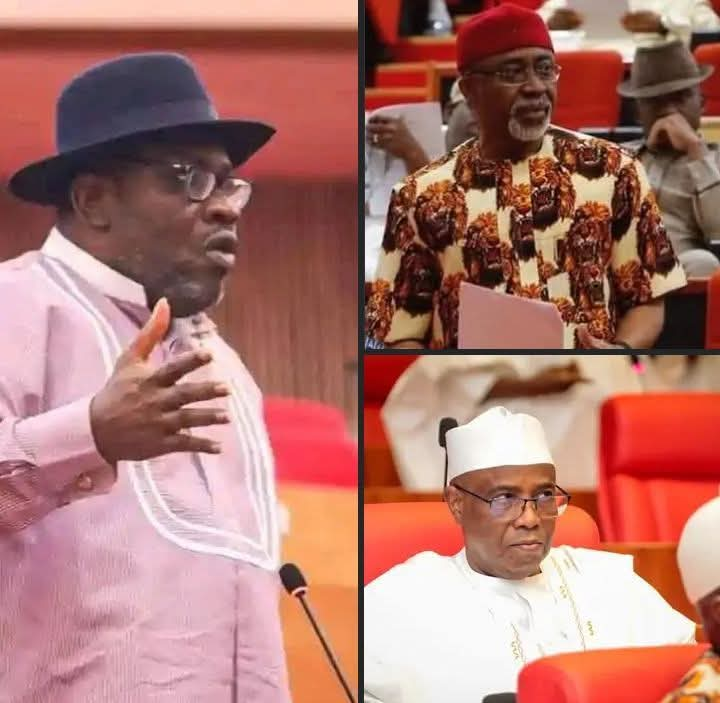
The senator representing Bayelsa West Senatorial District, Seriake Dickson, has named Senators Aminu Tambuwal and Enyinnaya Abaribe among a few others, who stood with him to oppose the unconstitutionality of the suspension of the Rivers State Governor, Siminalayi Fubara, his deputy, Ngozi Odu, and the members of the House of Assembly.

The senator, in a statement, also revealed the reasons he walked out of the red chamber on Thursday following a heated argument regarding the approval of the State of Emergency in Rivers State.

In the statement, Dickson, who already told as many that cares to listen before the sitting that he will never support the emergency rule on the floor of the senate, met a brick wall in the visibly angry senate president, Godswill Akpabio, who he claimed tried to deny him his freedom to express himself, resulting in the heated argument that ensued.

The senator noted that when it was obvious that the red chamber was bent on validating the President’s emergency rule, he staged a walkout from the senate, saying he wouldn’t want to be present when the report of what he opposed is read.

Dickson’s detailed analysis of what transpired is presented below:

SENATOR SERIAKE DICKSON GIVES DETAILED UPDATE ON WHAT TRANSPIRED TODAY

Today at the sitting of the Senate, the issue of the President’s proclamation of a state of emergency in Rivers State came up for discussion and as I have stated repeatedly, I raised my objections in the closed session on how the declaration fell short of constitutional prescription, based on my view as a Democrat, sworn to uphold the Nigerian constitution.

The Senate did not undertake the debate in an open session however, it was quite robust. I want to thank Sen. Aminu Waziri Tambuwal for his strong support of the unconstitutionality of the declaration, especially the aspect that deals with the suspension of the elected officials of the Rivers State government.

At the end of the day, majority of the senators supported the proclamation as no room was given for an open debate at plenary. I left the plenary before the Senate President was directed to report the outcome because I didn’t want to be present while what I opposed is being reported. I believe Senator Tambuwal, Senator Abaribe and others equally left too.

I want to make it clear that as I stated repeatedly, I spoke and voted against the proclamation in our closed session, supported by Senator Aminu Tambuwal and a few other senators who were not recognized to speak.

And so I want to thank all the senators who shared the view that I vigorously canvassed.

I am however aware of the efforts made to modify the declaration as a result of the concerns and views we have expressed and canvassed the past few days. Though I acknowledge the effort being made by the leadership and President to moderate the terms of the declaration and to create a mechanism for oversight, theoretically this does not counter the primary issue of constitutionality.

The beauty of democracy is such that the minority will have their say while the majority their way. I would have wished for a more robust and open debate so that all views and opinions can be openly canvassed as I requested even at the closed session specifically and thereafter, the majority can have their way but as it is, both chambers have decided and the ball is now on the court of the other arms of government, especially the judiciary, in the event of any challenge.

My attention has also been drawn to a viral video showing parts of the unfortunate exchanges between the Senate President and I before we desolved to the closed session.

As I said on the floor, the Senate President was very unfair to me by trying to censor my freedom of expression and by deliberately misrepresenting the import of what I said in the broadcast yesterday which was the same thing I said on the floor today. It is my opposition in principle to the declaration of a state of emergency, as well as the suspension of elected officials.

I thank all those who have called to commend my composure under unnecessary and unexpected attempt at intimidation. Everyone, including the Senate President, knows I have long gone beyond that stage in my life.

The Senate as I said is a meeting of equals and everyone should be respected just as we accord respect to the Chair. No senator needs the permission of the senate president to express an opinion in an interview on a topical matter of national interest that is in the public domain.

I intend to meet the Senate President to formally express my displeasure, to prevent a reoccurrence.

I thank my constituents, Nigerians and all people of goodwill who have called to express solidarity and urge them not to be dismayed at the direction our democracy appears to have taken.

For someone like me who has been in trenches over the years, all these challenges are actually a call to duty and I therefore implore all people of goodwill to come together and ensure that participatory democracy is promoted in our country.

Our thoughts and prayers are with the people of Rivers State.”

President Bola Tinubu, on Tuesday, declared a state of emergency in Rivers, sacking all elected officers, and appointing a Sole Administrator, in the person retired former Chief of Naval Staff, Vice Admiral Ibok-Ete Ibas, for an initial period of six months.

Continue Reading
Advertisement


Click to comment

Leave a Reply

Your email address will not be published. Required fields are marked *

Headlines

Supreme Court Voids INEC’s Derecognition, Restores David Mark-led Leadership of ADC

Published

on

The Supreme Court has vacated the order of the Court of Appeal which barred the recognition of David Mark as the National Chairman of the African Democratic Congress, ADC.

The apex court on Thursday held that the preservative order by the Court of Appeal was in bad faith, unnecessary, unwarranted and improper.

In a unanimous judgment of the Supreme Court, Justice Mohammed Lawal Garba held that the Court of Appeal ought not to have made such order because it was not sought by any of the parties in the matter.

The Court of Appeal had issued an order of status quo antem bellum upon which the ADC exco under David Mark was de-recognized by the Independent National Electoral Commission, INEC.

With the vacation of the order, David Mark and the other national officers are to be recognized as ADC leaders by the electoral body.

Continue Reading

Headlines

Supreme Court Rules Against Turaki-led PDP, Voids Ibadan Convention

Published

on

The convention produced the Tanimu Turaki-led factional national executives of the party.

Continue Reading

Headlines

Supreme Court to Rule on ADC, PDP Leadership Crises Today

Published

on

Attention has shifted to the Supreme Court, which has fixed April 30 (today) for judgment in the leadership tussle within the African Democratic Congress (ADC).

A five-member panel led by Justice Mohammed Garba will resolve the appeal filed by the David Mark-led faction concerning the authentic leadership of the party.

Also on Thursday, the court is expected to determine the leadership dispute rocking the Peoples Democratic Party (PDP).

Two PDP factions—one led by Kabir Turaki and the other by the Minister of the Federal Capital Territory, Nyesom Wike—are laying claim to the leadership of the party.

The Supreme Court had on April 22 reserved judgment in the ADC crisis to a date to be communicated to the parties involved in the tussle.

However, on Tuesday, the ADC formally wrote to the Chief Justice of Nigeria (CJN), Justice Kudirat Kekere-Ekun, pleading for the quick delivery of judgment in the leadership tussle at the national level.

The party claimed it would suffer irreparable harm if judgment in the protracted battle was not delivered within the period allowed by the Electoral Act for fielding candidates for the 2027 general elections.

It stated in part: “Without the delivery of judgment within the next three days from the date of this letter, the ADC stands the grave and irreversible risk of being excluded from participating in the 2027 general elections.

“This would disenfranchise millions of Nigerians who have subscribed to the ideals of the ADC and deny them their constitutional right to freely associate and contest elections through a political party of their choice.”

At the April 22 hearing, Jibrin Okutepa, SAN, who represented David Mark, urged the Supreme Court to allow the appeal, arguing that the apex court had earlier, on March 21, 2025, held that “no court has jurisdiction to entertain matters bordering on the internal affairs of political parties.”

During the hearing, Okutepa urged the apex court to hold that the Federal High Court in Abuja lacked jurisdiction to entertain the suit.

However, Robert Emukperu, SAN, who represented the first respondent, Nafiu Gombe, urged the court to dismiss the appeal and affirm the judgment of the lower court, which held that the suit was premature.

It will be recalled that a three-member panel of the Court of Appeal dismissed Mark’s appeal, ruling that it was premature and filed without leave of the trial court.

In the PDP matter, the first appeal, marked SC/CV/164/2026, stems from a decision of Justice Peter Lifu of the Federal High Court in Abuja, who restrained the party from proceeding with its planned convention pending the determination of a suit filed by former Jigawa State Governor Sule Lamido.

On November 14, the court issued a final order restraining the PDP from conducting its national convention.

Justice Lifu held that Lamido was “unjustly denied” the opportunity to obtain a nomination form to contest for national chairman, in violation of the PDP constitution and internal regulations.

The Court of Appeal later upheld the decision on March 9, prompting the PDP to appeal.

The second appeal, SC/CV/166/2026, was filed by the PDP, its National Working Committee (NWC), and National Executive Committee (NEC).

It arose from a judgment delivered by Justice James Omotosho, which stopped the party from holding its Ibadan national convention.

The Court of Appeal upheld that decision, agreeing that INEC should not validate the outcome of the convention.

After hearing all arguments, the Supreme Court reserved judgment, stating that the date would be communicated to the parties.

Continue Reading
