
Metro
The Architectonics of Influence: Leadership, Power, and Deliberate Pursuit of Possibilities


- /home/rhoncare/pointblank.ng/wp-content/plugins/mvp-social-buttons/mvp-social-buttons.php on line 27
https://pointblank.ng/wp-content/uploads/2025/08/DR.TOLULOPE-A.-ADEGOKE-AMBP-UN__-1-744x600.jpg&description=The Architectonics of Influence: Leadership, Power, and Deliberate Pursuit of Possibilities', 'pinterestShare', 'width=750,height=350'); return false;" title="Pin This Post">
- Share
- Tweet /home/rhoncare/pointblank.ng/wp-content/plugins/mvp-social-buttons/mvp-social-buttons.php on line 69
https://pointblank.ng/wp-content/uploads/2025/08/DR.TOLULOPE-A.-ADEGOKE-AMBP-UN__-1-744x600.jpg&description=The Architectonics of Influence: Leadership, Power, and Deliberate Pursuit of Possibilities', 'pinterestShare', 'width=750,height=350'); return false;" title="Pin This Post">
By Tolulope A. Adegoke, PhD
“Leadership envisions the future, Power builds it, but only Control ensures it endures. In their deliberate synergy lies the architecture of all human progress,” – Tolulope A. Adegoke, PhD
Introduction: The Tripartite Foundation of Progress
At the heart of every significant human achievement—from the ascent of a thriving corporation to the resilience of a prosperous nation and the self-actualization of an individual—lies the potent interplay of three fundamental forces: Leadership, Power, and Control.
These concepts are often conflated or misunderstood. Yet, their distinct roles and synergistic relationship form the very bedrock upon which possibilities are envisioned and delivered. Leadership provides the vision and the compass; power furnishes the engine and the tools; and control ensures the steering and the governance. Together, they create an “architectonics of influence,” a deliberate framework for building a better future across all sectors of human endeavor.
Deconstructing the Core Concepts
- Leadership: The Compass of Purpose
Leadership is not merely a position; it is a process of social influence that maximizes the efforts of others toward achieving a goal. It is the domain of vision, inspiration, and emotional intelligence.
- For Peoples: Leadership manifests as mentorship, parenting, and community organizing. It empowers individuals to transcend their limitations, fostering personal growth, resilience, and a sense of agency.
- For Corporates: Leadership sets the strategic direction, cultivates culture, and inspires innovation. It is the force that aligns diverse talents toward a common mission, navigating market volatility and competitive pressures.
- For Nations: Leadership, at its best, articulates a national destiny, unites citizens around shared values, and steers the country through crises and opportunities on the global stage.
- Power: The Currency of Action
Power is the capacity to influence the behavior of others or the course of events. It is raw potential energy that, in itself, is neutral—its morality defined by its application. French and Raven’s classic bases of power provide a useful lens:
- Coercive & Reward Power: (Sticks and Carrots) Effective in the short term but often unsustainable, as they rely on external compliance rather than internal commitment.
- Legitimate Power: Derived from a formal position or title (e.g., CEO, Prime Minister).
- Expert Power: Granted based on knowledge, skills, and competence.
- Referent Power: The most potent form, earned through charisma, respect, and admirable qualities.
- Control: The Rudder of Stewardship
Control represents the systems, processes, and ethical frameworks that guide the application of power. It is the essential counterbalance that prevents power from becoming corrupt, arbitrary, or inefficient. Control is not about restriction, but about direction and stewardship.
- Mechanisms of Control: These include transparency, accountability, checks and balances, legal and regulatory frameworks, ethical codes of conduct, and performance metrics.
The Synergistic Equation: Leadership + Power + Control = Delivered Possibilities
The true impact occurs when these three elements are harmonized. Leadership without power is impotent; power without leadership is directionless; and both without control are dangerous.
The Formula for Impact: A visionary leader (Leadership) must wield appropriate forms of power (e.g., Expert and Referent) to mobilize resources and people. This application of power must then be channeled through robust control mechanisms to ensure it is effective, ethical, and aligned with the overarching goal. This synergy unlocks possibilities.
The Perils of Imbalance:
- Leadership without Power: The inspiring visionary with no authority or resources becomes a frustrated prophet, their ideas never materializing.
- Power without Leadership: The powerful but visionless authority figure (a tyrannical manager, a despotic ruler) creates chaos, stifles innovation, and leads to oppression or organizational decay.
- Power without Control: This is the definition of tyranny and corruption. It leads to the abuse of resources, the suppression of dissent, and ultimately, systemic failure (e.g., corporate scandals, state collapse).
Delivery Across Sectors: Peoples, Corporates, and Nations
- For Peoples: The Realm of Personal and Community Agency
- Leadership: Self-leadership—taking responsibility for one’s own growth and actions. Community leaders articulate a shared vision for neighborhood improvement.
- Power: The power of knowledge (Expert), the power of a strong network (Referent), and the collective power of organized action.
- Control: Personal discipline, ethical codes, and community-agreed rules of engagement.
- Delivered Possibilities: Empowered individuals achieve self-actualization. Cohesive communities solve local problems, foster social capital, and create environments where people can thrive.
- For Corporates: The Engine of Innovation and Value Creation
- Leadership: The CEO and C-suite set a compelling vision and culture. Middle managers translate strategy into action and empower their teams.
- Power: Legitimate power of hierarchy, expert power of specialized teams, and the referent power of a strong brand and respected leadership.
- Control: Corporate governance, board oversight, compliance departments, performance management systems, and a strong ethical culture.
- Delivered Possibilities: Sustainable profitability, market innovation, employee engagement and well-being, and long-term value for all stakeholders.
- For Nations: The Framework for Collective Prosperity and Stability
- Leadership: Elected officials, civil servants, and a judiciary that provide direction, uphold the law, and steward national resources.
- Power: The sovereign power of the state, derived from the consent of the governed (Legitimate), and exercised through institutions (military, judiciary, executive).
- Control: The Constitution, separation of powers, an independent judiciary, a free press, transparent elections, and anti-corruption watchdogs.
- Delivered Possibilities: Economic development, social justice, national security, public health, and the preservation of fundamental rights and freedoms—the foundation for a flourishing society.
The Indispensable Role of Control: From Stewardship to Possibilities
Control is the often-overlooked hero in this narrative. It is the difference between a dictator and a statesman, between a reckless conglomerate and a sustainable enterprise.
- Control Fosters Trust: Transparent and accountable systems build trust among citizens, employees, and investors, which is the currency of long-term collaboration.
- Control Enables Scalability: Without control mechanisms, organizations and nations cannot grow beyond a certain size without descending into inefficiency or chaos.
- Control Mitigates Risk: It provides the early warning systems and corrective actions that prevent catastrophic failures.
- Control Ensures Legitimacy: Power is seen as legitimate and worthy of support when it is exercised within a known and fair framework.
Conclusion: The Call for Conscious Stewardship
In a world of increasing complexity and interconnectedness, the deliberate and ethical management of leadership, power, and control is not a theoretical exercise—it is a practical imperative.
The ultimate delivery of possibilities—be it a child reaching their potential, a corporation pioneering a world-changing technology, or a nation achieving lasting peace and prosperity—rests on our collective ability to:
- Cultivate Leaders who are not only visionary but also humble, ethical, and empowered by referent and expert power.
- Wield Power consciously, recognizing its sources and its profound responsibility.
- Design and Uphold Control systems that are robust yet adaptable, ensuring that power is always a force for creation, not destruction.
The future does not simply happen; it is built. It is architected by those who understand that true, lasting power is the capacity to unlock human potential, and that the highest form of leadership is the stewardship of possibilities for all.
Dr. Tolulope A. Adegoke, AMBP-UN is a Doctor of Philosophy (PhD) in History and International Studies, Fellow Certified Management Consultant & Specialist, Fellow Certified Human Resource Management Professional, a Recipient of the Nigerian RoleModels Award (2024), and a Distinguished Ambassador For World Peace (AMBP-UN). He has also gained inclusion in the prestigious compendium, “Nigeria @65: Leaders of Distinction”.



The Edo State Special Criminal Court has sentenced four men to death for their involvement in the kidnapping of a woman at the Vegetable Market along Airport Road in Benin City.
Justice Aigbona Momodu handed down the sentences after finding the defendants guilty on multiple counts connected to the kidnapping case.
The convicts are Marvellous Isaac, Wisdom Michael, Rufus Emete Michael and Gift Raphael.
Isaac and Michael were sentenced to death on counts two through nine. They also received separate prison terms on other counts, including seven years on count one, while Isaac was sentenced to 10 years on count 10 and life imprisonment on count 11.
Rufus Emete Michael was sentenced to death on counts two, three, four, six and seven, in addition to a seven-year prison term on count one.
The fourth defendant, Gift Raphael, was sentenced to death on counts two, four, six and eight and received seven years imprisonment on count one.
Delivering the sentences, Justice Momodu ordered that the death sentences be carried out by hanging or lethal injection, in accordance with the court’s judgment.
The court also ordered the forfeiture of a JoJef pump-action firearm and ammunition tendered as exhibits during the trial.
The firearm, identified as Exhibit M, along with two unused cartridges and two spent cartridges listed as Exhibits E and E1, was ordered to be handed over to the Edo State Police Armourer at the State Criminal Investigation Department for destruction.
Justice Momodu directed that the exhibits be transferred to the police through the Deputy Director of the Criminal Division and destroyed within 30 days.
The convictions bring to an end the trial arising from the abduction of the woman at the Vegetable Market along Airport Road, an incident that added to concerns over kidnapping and armed crime in Benin City.
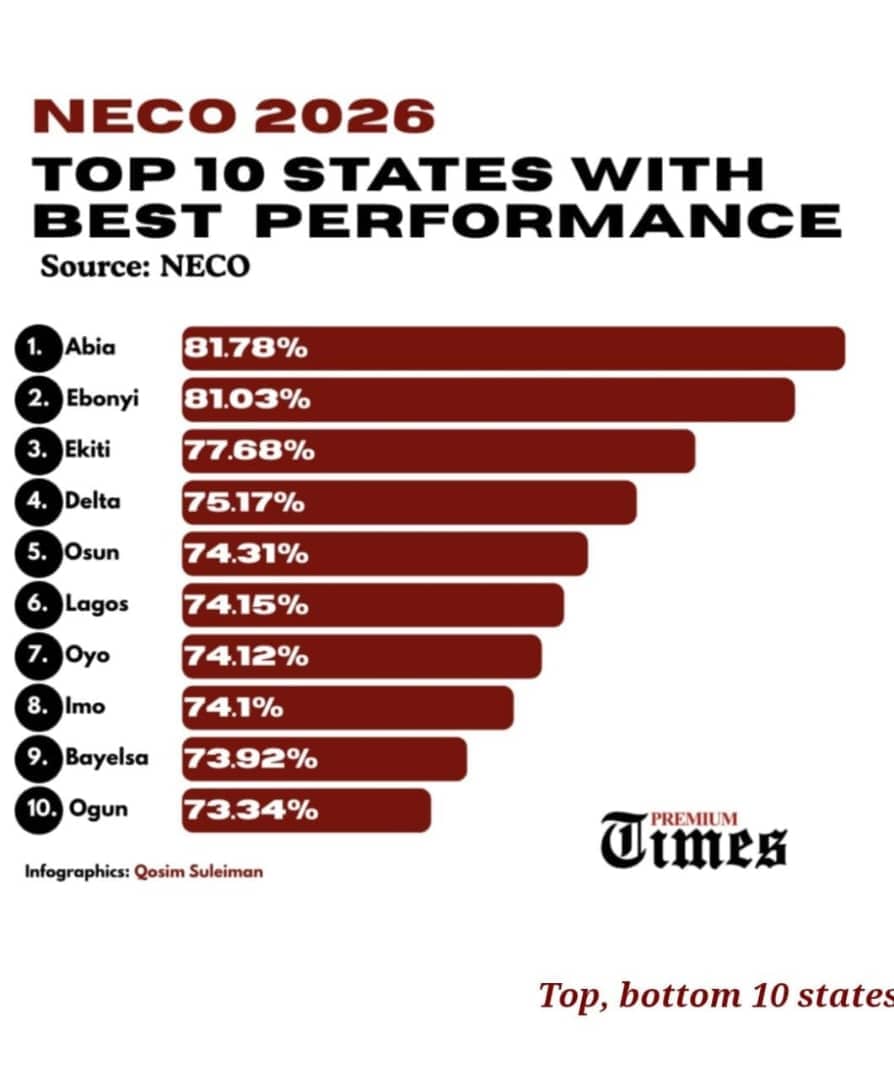
Osun State Governor, Senator Ademola Adeleke, has hailed the state’s strong performance in the 2026 National Examinations Council (NECO) Senior School Certificate Examination, describing the result as a positive reflection of ongoing efforts to reposition education in the state.
Osun placed fifth nationally in the 2026 NECO ranking, with 74.31 per cent of candidates recording at least five credits, including English Language and Mathematics.
While congratulating the students, teachers, parents, school administrators and other stakeholders, the governor noted that the state performance has been improving within a single digit rating for three consecutive years namely 2024, 2025 and 2026.
“Osun has moved from 33rd position in the 2022 NECO ranking to 5th in 2026, while improving its pass rate to 74.31 per cent. This is encouraging, and it shows that our sustained interventions in the education sector are yielding positive results,” the Governor said.
Governor Adeleke said the improved performance reflects his administration’s deliberate investment in the education sector, including the recruitment of additional teachers to strengthen the teaching workforce, while prioritising workers’ welfare and creating a more conducive environment for effective teaching and learning across public schools.
The Governor said the performance reinforces his administration’s determination to continue investing in education, noting that the objective is to build a system that gives every Osun child the knowledge, skills and opportunities needed to succeed.
“This result is encouraging, but we see it as a reason to do more. We will continue to invest in our schools, improve the learning environment, support our teachers and provide our students with the necessary tools to excel.
“We are building an education system that prepares our young people not only for examinations but for life,” the Governor said.
He assured that ongoing interventions in the education sector would be sustained and expanded, while urging students to remain committed to their studies.
His Excellency also commended teachers across the state for their dedication and sacrifices, assuring them that the administration would continue to prioritise measures that strengthen the education system and improve workers’ welfare.
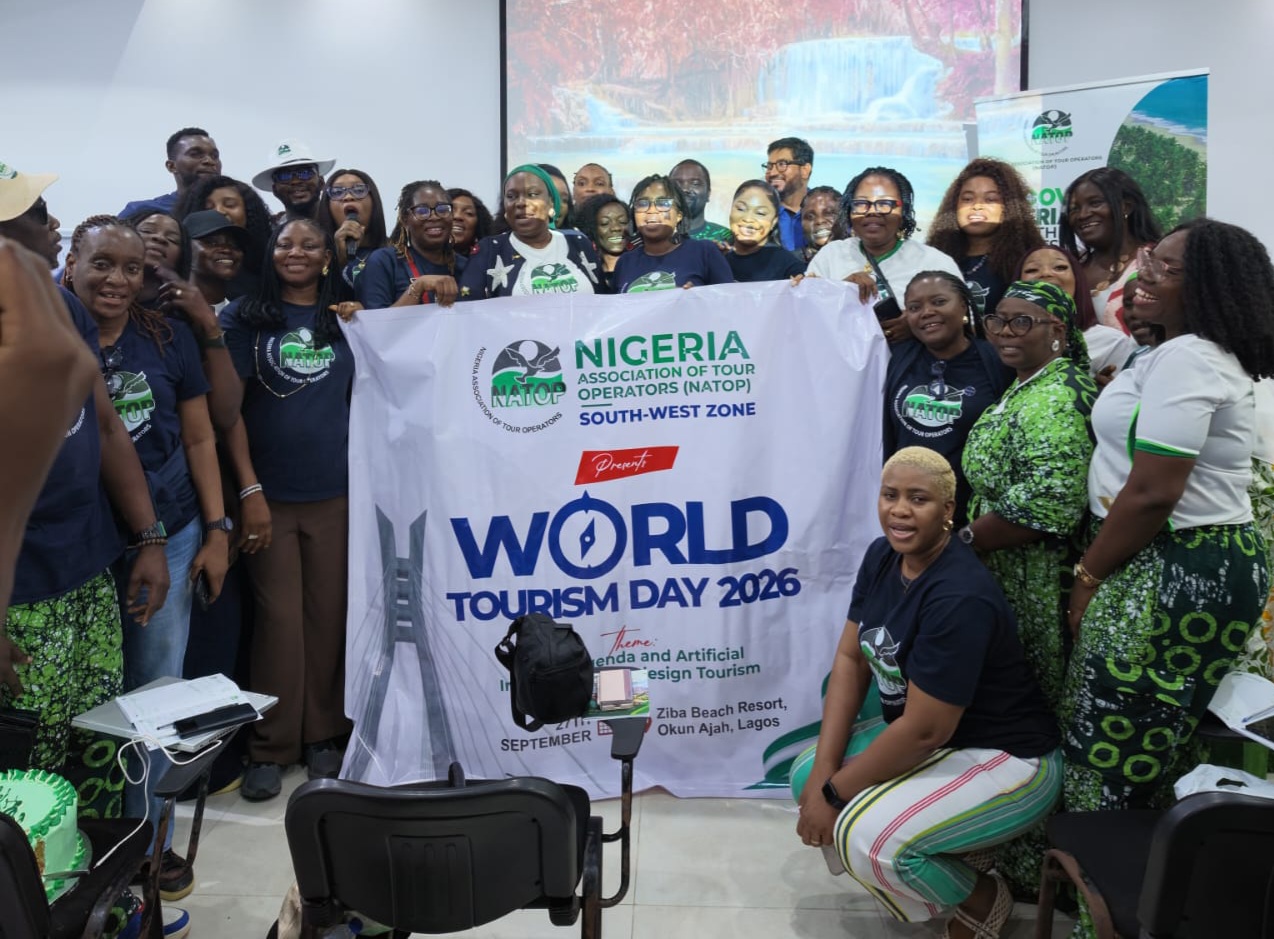
The Nigeria Association of Tour Operators (NATOP) marked the 2026 World Tourism Day with activities which capture capacity building, technology, destination promotion and domestic tourism, and celebration.
In the South West Zone, close to 200 tour operators gathered at Ziba Beach Resort, Lagos, for a special training focused on Artificial Intelligence and its application in tourism, equipping operators with digital tools to improve their businesses and destination marketing.
In Abuja, the FCT and Northern Zone, in collaboration with Naija Adventurers, staged a colourful Tourism Awareness Walk and Hike to the Centre of Nigeria.
The celebration also spread to the South-South Zone, where members marked the day with a destination tour, alongside activities to commemorate with the world tourism day celebrations.
In line with the theme for this year’s WTD celebration: ‘Digital agenda and artificial intelligence to redesign tourism’ the NATOP training on AI and application in tour operation at Ziba Beach Resort Lagos saw a large turnout of the members of the association.
The President of the association, Hajia Bolaji Mustapha explained that the idea for the location and training was to train members on how to do tour business, to know how to promote tourism digitally, using different AI tool and everything so that they will grow their businesses.
She said: “we follow the theme and, you know, blend with the old situation. Let’s do the training so that we attach it to the World Tourism Day with the theme that we have achieved something and also celebrate.”
She said the training will go a long way in helping the tour operators do greater content to digitally tell destination stories using AI, and also using the tool for expression.
Mustapha also explained why the association chose Ziba Beach Resort: “We always attach World Tourism Day to a tourism site. And definitely, if you look at this whole area and this community, that’s why we see that Ziba is a tourism site. We want to explore and of course. The resort newly launched its third phase. So, we will use this opportunity to look at their rooms, look at how we can sell this destination, to showcase it that the resort is actually in Nigeria, not Zanzibar. By using the place, we would kill two birds with one stones.
Facility tour of Ziba Beach Resort
“As tour operators who are willing to tell the good story of our Nigeria, we need to bring ourselves up to the speed, align with the digital revolution. Let everybody go digital. Because we also see the content creators are taking our business, we want to align it with what they do. We are the ones that understand the business and we’ll be able to tell the story better, so that anybody coming to Nigeria will be able to discover Nigeria with the experts.”
Also commenting on the celebration, the NATOP Vice President South West and chairman of the WTD Organizing Committee for the zone, Mrs. Wonuola Olatunde-Lamidi explained why NATOP South West’s usage of the 2026 WTD for training. She said many of the members still have a lot to learn about the tour business, and that some do not understand the foundation of the business, including how to create packages hence the need for the training.
Mrs. Olatunde-Lamidi spoke further: “Many don’t understand the foundation of what it is to create a tour package. And when you have people that are not well-trained in an industry, the industry will not grow. The kind of people that you also have will not have enough earning power to do many things. And because this is an industry that I have been in for 16 years, I run Diamonds and Pearls Travels with my husband. And I’ve seen Diamonds and Pearls Travels metamorphose into a company where people don’t just look at us as travel agents. We have become a Destination Management Company (DMC). We have become a trusted brand. We have become a company that when we talk about a destination, people want to go to that destination because of how we have portrayed the destination. And you may not realize that, as tour operators, you can actually decide where people go. You can make people go to a particular destination by marketing it, by letting them know the benefits of that destination.”
The tour operators had opportunity to tour the resort and unwind during the programme.


