
Metro
The Architecture of Enduring Impact: How Positive Posterity Walks and Works


- /home/rhoncare/pointblank.ng/wp-content/plugins/mvp-social-buttons/mvp-social-buttons.php on line 27
https://pointblank.ng/wp-content/uploads/2025/08/DR.TOLULOPE-A.-ADEGOKE-AMBP-UN__-1-744x600.jpg&description=The Architecture of Enduring Impact: How Positive Posterity Walks and Works', 'pinterestShare', 'width=750,height=350'); return false;" title="Pin This Post">
- Share
- Tweet /home/rhoncare/pointblank.ng/wp-content/plugins/mvp-social-buttons/mvp-social-buttons.php on line 69
https://pointblank.ng/wp-content/uploads/2025/08/DR.TOLULOPE-A.-ADEGOKE-AMBP-UN__-1-744x600.jpg&description=The Architecture of Enduring Impact: How Positive Posterity Walks and Works', 'pinterestShare', 'width=750,height=350'); return false;" title="Pin This Post">
By Tolulope A. Adegoke PhD
“We are not the final word, nor the first; we are the crucial comma between what was endured and what is yet to be authored. To walk in victorious posterity is to accept that the soil beneath our feet is borrowed, the air in our lungs is loaned, and the systems we build are merely scaffolding for a cathedral we will never see completed. True victory, then, is not found in the monuments we leave behind, but in the capacity we cultivate in those who will inherit the work. For the future does not begin when we are gone—it begins the moment we decide to act as if we are already guests in it.”
Introduction: The Shift from Legacy to Posterity
In the lexicon of leadership and development, the term “legacy” has long been the gold standard. It implies what one leaves behind. However, to speak of “Positive Victorious Posterity” is to engage in a far more active, dynamic, and demanding discipline. Posterity is not a passive inheritance; it is a living entity that we are actively shaping with every decision made in the boardroom, every policy enacted in the legislature, and every culture cultivated within a community.
To walk in Victorious Posterity is to move with the deliberate intention of ensuring that future generations are not merely surviving the consequences of our actions but are thriving because of the systems we install today. To work in this realm is to engineer solutions that are anti-fragile—gaining strength from the volatility of the future rather than crumbling under it.
This write-up explores the mechanics of this philosophy, dissecting how it functions at the individual, corporate, and national levels to solve the pressing challenges of inequality, environmental degradation, economic instability, and social fragmentation.
Part I: The Foundational Pillars of Victorious Posterity
Before we can apply this concept, we must understand its structural integrity. Victorious Posterity rests on three interdependent pillars:
1. Intergenerational Equity: The recognition that the rights of future generations carry equal weight to the rights of the present. This is not a moral nicety; it is a fiduciary duty. When we drain natural resources or accumulate national debt, we are borrowing from the future’s pocketbook without their consent.
2. Adaptive Resilience: Victory is not the absence of crisis, but the ability to emerge from crisis stronger. Posterity-focused systems are built with “slack”—redundancies and buffers that allow for shock absorption, whether that be economic downturns, climate events, or supply chain disruptions.
3. Semantic Integrity: The narratives we build today become the operating systems of tomorrow. A culture that celebrates short-term greed will produce a generation of transactional leaders. A culture that celebrates problem-solving and empathy will produce innovators and healers.
Part II: Impacting Peoples (The Micro Level)
At the individual and community level, the walk of Victorious Posterity is primarily concerned with Human Capital Development. The pressing challenge here is the “Skills Mismatch”—the growing chasm between what educational institutions produce and what the future economy demands.
The Solution: Victorious Posterity works by shifting educational paradigms from “knowledge retention” to “cognitive adaptability.” It is about teaching people how to think, not what to think.
· Example (Finland’s Education Reform): Finland has moved away from “subject-based” teaching to “phenomenon-based” learning. Students don’t just study history; they study the historical, geographical, and economic impacts of climate change on their specific locality. This walk toward posterity ensures that children graduating today are not memorizing facts that will be obsolete in a decade but are instead solving real-world problems. The result is a populace that is inherently ready to pivot, upskill, and contribute meaningfully to a volatile job market.
· Example (Community Banking in Bangladesh): The Grameen Bank model didn’t just lend money; it walked with communities to build credit history and entrepreneurial skills. By focusing on women and rural populations, it ensured that the posterity of those villages would not be defined by generational poverty but by generational commerce. The victory is visible in the literacy and health outcomes of the next generation, who now have mothers that are business owners.
Part III: Impacting Corporates (The Meso Level)
For corporations, the greatest pressing challenge is the tension between Quarterly Returns and Long-Term Sustainability. The modern capital market often penalizes long-term R&D in favor of immediate stock buybacks. Victorious Posterity demands a redefinition of the “Fiduciary Duty” to include stakeholders beyond the shareholder—employees, environment, and society.
The Solution: The walk of victory for a corporation involves embedding ESG (Environmental, Social, and Governance) metrics not as a PR exercise, but as core operational KPIs that dictate supply chain decisions, hiring practices, and innovation pipelines.
· Example (Patagonia’s “Earth is Now Our Only Shareholder”): Patagonia’s radical restructuring is a masterclass in Victorious Posterity. By transferring ownership to a trust dedicated to climate action, they effectively built a corporate structure that cannot be forced to prioritize profit over the planet. Their work involves using regenerative organic agriculture in their supply chain, which regenerates soil health. This is a direct intervention to solve the agricultural crisis. They are working now to ensure that cotton farmers fifty years from now have arable land, rather than desert.
· Example (Microsoft’s Carbon Negative Pledge): Unlike “Carbon Neutrality” (which allows for offsets), Microsoft’s pledge to be Carbon Negative by 2030 requires them to remove more carbon than they emit. This pushes the corporation to invest heavily in direct air capture technology and biochar. By walking this path, they are solving the challenge of “climate techno-pessimism,” proving that heavy industry can be a solution to environmental damage rather than the cause.
· The “Reverse Mentorship” Model: Corporates that work for posterity invert the traditional mentorship dynamic. They pair senior leadership with junior Gen-Z employees to understand emerging technological trends and social ethics. This ensures the corporate strategy remains relevant to the future demographic it aims to serve.
Part IV: Impacting Nations (The Macro Level)
At the national level, the challenges are systemic: Resource Scarcity, Geopolitical Fragmentation, and Aging Infrastructure. Nations often operate on a 4-year election cycle, which is antithetical to the 30-year horizon required for infrastructure and education. Victorious Posterity requires the establishment of “Future Generations Ombudsmen” or similar legislative checks that protect long-term interests from short-term political expediency.
The Solution: National policies must pivot toward “National Resilience” and “Circular Economies.”
· Example (The Netherlands’ “Deltaworks” and Room for the River): The Dutch are historically known for fighting the sea. However, in their walk toward posterity, they recognized that building ever-higher dikes was a losing battle against rising sea levels. The “Room for the River” program strategically relocated dikes inland, lowered groynes, and created water buffers to allow controlled flooding in designated areas. This is the victory of coexistence over conquest. It solved the challenge of catastrophic climate flooding by designing a landscape that accepts water rather than merely resists it, ensuring the nation’s survival for centuries.
· Example (Estonia’s Digital Governance): Estonia built its digital infrastructure on the premise that government services should be accessible to citizens regardless of geography or time. By creating a secure, blockchain-backed digital ID system, they have solved the challenge of bureaucratic corruption and inefficiency. Their posterity is “digitally native”—meaning future generations will inherit a government that is transparent, efficient, and low-cost, rather than a burdensome bureaucracy.
Part V: The Psychological Framework—The “Walk”
To “walk” in this manner requires a psychological shift from a “Survival Mindset” to a “Stewardship Mindset.”
· The Challenge: The modern world is riddled with “Doom-scrolling” and “Climate Anxiety.” This often paralyzes action. People feel that the future is bleak, so they consume more now.
· The Victorious Walk: This philosophy reframes the future as a garden to be tended, not a battlefield to be survived. It requires leaders to exercise “Radical Optimism”—the belief that human ingenuity, combined with ethical constraint, can solve technical problems.
· Practice: Leaders must engage in “Reverse Thinking”—imagining the year 2075 and looking back to 2026. From that future perspective, what decision would they wish they had made? This mental exercise forces leaders to abandon sunk costs and embrace daunting transitions (e.g., moving from fossil fuels to green hydrogen).
Part VI: The Strategic Framework—The “Work”
To “work” in Victorious Posterity involves a practical, step-by-step strategic model that I term the “Posterity Matrix.”
1. Impact Auditing: We cannot manage what we do not measure. Corporates and nations must develop “Lifecycle Assessment” tools that measure the total cost of a product or policy over a 50-year horizon, not just a 5-year horizon. This includes social cost of carbon, social disruption of automation, and biodiversity loss.
2. Generational Councils: Establish advisory boards comprised of individuals aged 15-25 to review major policy proposals. Their lack of experience is actually their asset; they are the voice of the future’s user experience.
3. Diversified Sovereignty: At the national level, this means investing in domestic food and energy production to insulate the nation from global shocks (e.g., Israel’s desalination and drip-irrigation technologies that made a desert nation into an agricultural powerhouse).
4. Ethical AI Deployment: Posterity works when AI is used to augment human potential, not just replace it. Nations must invest in AI that predicts infrastructure decay (bridges, roads) to fix them before they collapse, solving the crisis of aging public assets.
Conclusion: The Intergenerational Contract
Positive Victorious Posterity is not a destination; it is a continuous, iterative process of negotiation between the living, the unborn, and the planet. It demands that we view time not as a linear arrow, but as a cycle of renewal.
For the Individual, it means becoming a lifelong learner who contributes more knowledge than they consume. For the Corporate, it means becoming a regenerative entity that creates more value (environmental and social) than it extracts. For the Nation, it means becoming a guardian of resources, a cultivator of peace, and an enabler of human dignity.
The pressing challenges of our time—political polarization, ecological collapse, and economic inequality—are not insurmountable. They are merely the friction that forces us to innovate. Victorious Posterity walks with the humility of knowing we are not the final chapter and works with the audacity of knowing we are the most important chapter so far. It is in this tension between humility and audacity that victory is forged.
Let us stop asking, “What will we leave behind?” and start asking, “What are we building alongside?” Because ultimately, posterity is not waiting in the future; it is being assembled in the present, piece by piece, by those who dare to walk forward with their eyes fixed on the horizon, and their feet firmly rooted in the soil of today.
Dr. Tolulope A. Adegoke, AMBP-UN is a globally recognized scholar-practitioner and thought leader at the nexus of security, governance, and strategic leadership. His mission is dedicated to advancing ethical governance, strategic human capital development, resilient nation building, and global peace. He can be reached via: tolulopeadegoke01@gmail.com, globalstageimpacts@gmail.com


Metro
International Day of the Girl-Child: Pad Me A Girl Foundation Holds Menstrual Health Outreach in Ogun
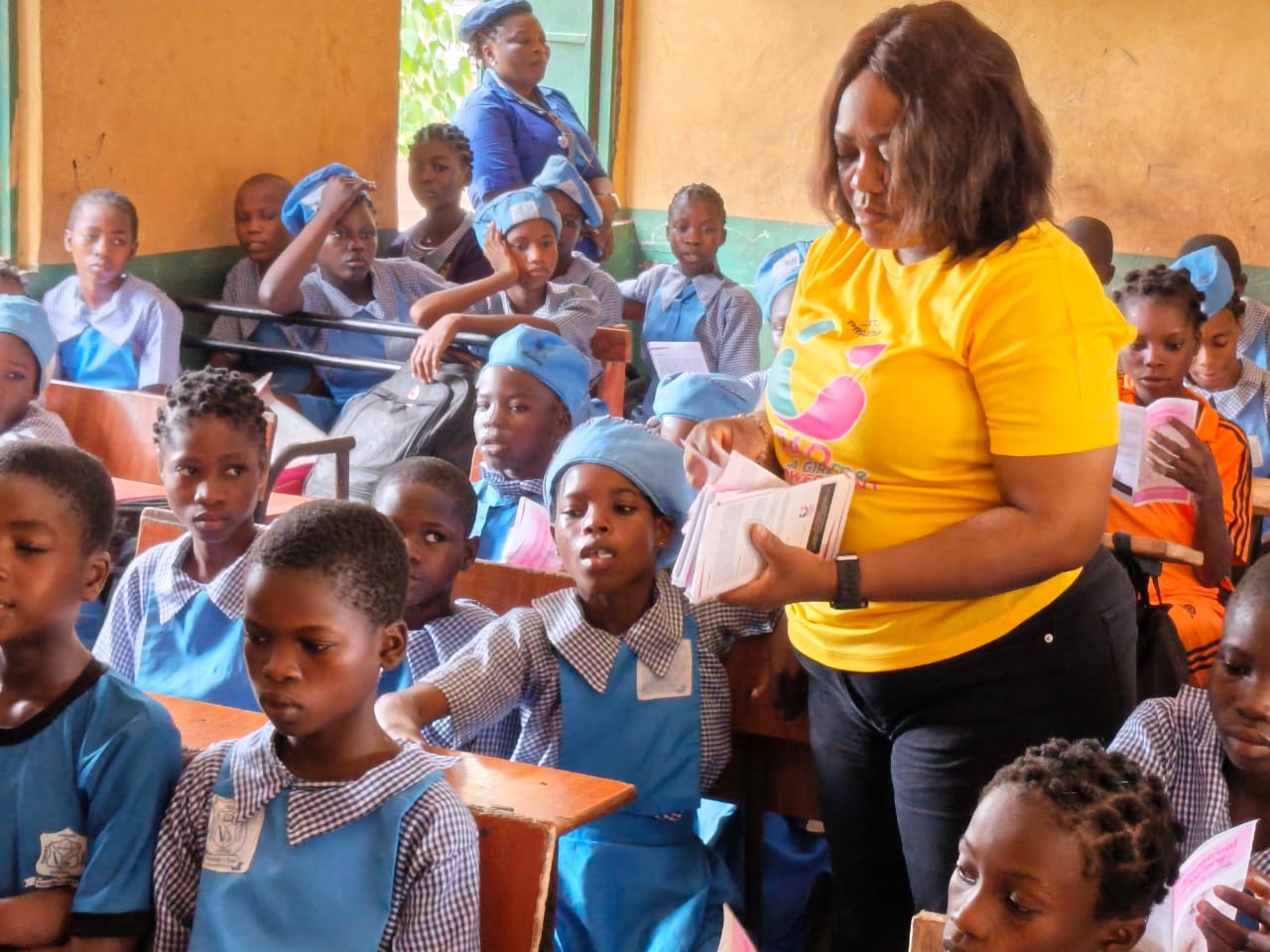
The Pad Me A Girl Empowerment Foundation has taken its menstrual health campaign to Igbesa High School (Junior), in Ado-Odo/Ota Local Government Area of Ogun State, providing free sanitary pads, menstrual hygiene pamphlets, exercise books and pens to over 100 schoolgirls to promote menstrual health, dignity and education.
The outreach, held on Wednesday, October 21, commemorated the 2026 International Day of the Girl Child, whose global theme is “End Child Marriage and Invest in Girls’ Rights!”
The programme brought together girls from Junior Secondary School (JSS) 1 to 3 who participate in the school’s reading clubs for mentorship, reading activities and menstrual health education.
It was convened by Oyelami Yetunde Anuoluwapo and Blessing Kappo, teachers and Teach For Nigeria Fellows at the school, following an appeal for sanitary products, learning materials and health education support. The Foundation’s founder, Theresa Moses, responded by providing the requested items and facilitating an interactive session on menstrual hygiene management.
Speaking at the event, Moses said she was inspired by the girls’ determination and aspirations, stressing the need for sustained investment in their health, education and future.
“Invest in girls and Nigeria will rise. Every girl deserves dignity, education and the right to dream beyond child marriage. That is why we are here; to ensure no girl misses school because of her period,” she said.
She emphasised that access to menstrual hygiene products and accurate information helps girls manage their periods confidently and participate fully in school activities.
In a letter of appreciation, Oyelami and Kappo described the outreach as impactful and inspiring, noting that it enhanced the girls’ understanding of menstrual health, hygiene and self-confidence. They also said the support would help promote the students’ hygiene, school attendance and dignity.
“You did not just give pads; you gave our girls confidence and hope,” the teachers wrote on behalf of the school community, expressing gratitude to the Foundation and hope for future collaboration.
Mrs Amarachi Eze, Assistant Divisional Commissioner of the Nigerian Girl Guides Association, Ado-Odo/Ota, Ogun State Branch, also commended the Foundation for supporting the girls’ hygiene needs and development.
“We sincerely appreciate the Management of Pad Me A Girl Foundation for joining hands with the Association in supporting our girls on hygiene management. May God Almighty continue to uplift your foundation. Thanks for joining hands in the development of girls in our schools. Bravo,” she said.
The Foundation’s Media Coordinator, Mr Oluwatosin Simon Faleye, called on corporate organisations, non-governmental organisations and well-meaning Nigerians to support initiatives that address period poverty and help girls remain in school.
“For over a year, we have been committed to ending period poverty and keeping girls in school. We call on corporate organisations and well-meaning Nigerians to support this cause for the betterment of Nigeria,” Faleye said.
The celebration also featured a student drama presentation highlighting the effects of child marriage, alongside reading and mentorship activities designed to encourage the girls to understand their rights, value their education and pursue their aspirations.
The Foundation also acknowledged the continued support of its sponsors and partners, including Access Bank, Pro Star Sports International, BL Consulting, Vita Baites Foods, Checkers, Senator Ireti Kingibe, representing the Federal Capital Territory (FCT) in the 10th Nigerian National Assembly, the Senate Committee on Women Affairs (SCOWAS), as well as individuals and media organisations whose contributions have supported its broader mission of ending period poverty, promoting menstrual health education and empowering girls and women.
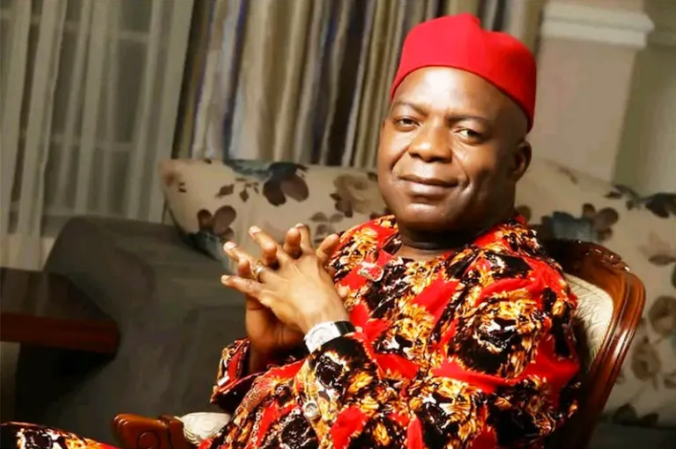
Abia State governor, Alex Otti, is set to flag off the reconstruction of Uratta Road and Old Express Road in Aba, two major routes which poor condition has disrupted transportation, commercial activities and access to residential communities for years.
The governor’s media aide, Ferdinand Ekeoma, in a statement on Wednesday, said that work on the roads has begun ahead of the scheduled official flag-off.
The two roads are considered important to Aba’s commercial and industrial activities, with Uratta Road connecting several adjoining streets to Port Harcourt Road and Old Express Road. At the same time, Old Express Road serves as a key route within the city’s industrial layout.
Ekeoma said the roads had suffered neglect for more than 24 years, leaving some sections impassable and forcing residents and businesses to contend with difficult transportation conditions.
According to the statement, Uratta Road provides access to more than 100 adjoining streets. Its poor condition has affected residents, traders and small-scale manufacturers who depend on the road to transport goods and access their businesses.
The statement said the road had become waterlogged and overgrown with weeds, discouraging commercial motorcycle and tricycle operators from using it.
Similarly, the deterioration of Old Express Road forced heavy-duty truck operators, fabric merchants, spare-parts dealers and small businesses to use longer routes, increasing transportation costs and affecting productivity.
The government said the road reconstruction is part of its broader effort to restore Aba’s infrastructure and strengthen the city’s commercial base.
Aba, one of southeastern Nigeria’s major commercial centres, hosts manufacturing clusters, markets, and small and medium-sized enterprises that depend heavily on functional roads to move raw materials and finished products.
The government said the reconstruction would improve market access, reduce transportation costs, facilitate the movement of goods, and support businesses operating along the affected corridors.
Ekeoma cited the reconstruction of Port Harcourt Road as an example of the administration’s infrastructure programme, noting that improved road access encouraged shops to reopen, attracted manufacturing activities and increased property rents along the corridor.
The government also said the new projects would complement other road interventions in Aba, including works on Ohanku and Obohia roads, as part of efforts to improve connectivity within the commercial city.
Beyond road construction, the administration said its projects include drainage systems, solar-powered streetlights, and pedestrian walkways, which it described as necessary to improve safety, accessibility, and flood resilience.
Ekeoma said Governor Otti views infrastructure development as an economic strategy rather than merely a construction programme, arguing that better roads would help businesses operate more efficiently and create employment opportunities.
He also quoted the governor as saying at an earlier church event that his administration is shifting attention from basic infrastructure improvements to healthcare, education, technology and industrialisation.
The governor, a former bank chief executive, was elected in 2023 on the Labour Party platform, defeating candidates from the major established parties in a state historically dominated by the Peoples’ Democratic Party.
Otti has remained in the Labour Party despite the defection of its 2023 presidential candidate, Peter Obi.
His administration has made rehabilitating Aba roads and public infrastructure central to its governance agenda, presenting the city’s recovery as essential to reviving economic activity across Abia State.

MILO Nigeria, in partnership with former Nigerian national team captain and MILO Brand Ambassador Ahmed Musa, has concluded the inaugural MILO × Ahmed Musa Sports Clinic and Tournament in Kano, providing 2,500 young footballers with professional coaching, mentorship and competitive football experience.
Over two weeks, participants took part in 10 coaching sessions and competed in matches under the guidance of Ahmed Musa and experienced coaches. The programme combined practical football training with lessons in teamwork, discipline, resilience and confidence, equipping participants with skills and values that extend beyond the pitch.
The initiative culminated in a tournament at the Ahmed Musa Sports Complex in Kano, where Khamis Football Academy emerged as champions of the inaugural edition. Participants also received cash prizes, certificates and football equipment.
Speaking on the initiative, Gilbert Tweneboah-Koduah, Category Lead, MILO, said: “At MILO, we believe sport is a powerful platform for young people to discover their abilities, build confidence and develop values that extend beyond the field of play. Our partnership with Ahmed Musa brings together MILO’s longstanding commitment to sports development and the experience of an athlete whose journey from grassroots football to the highest level of the game can inspire the next generation. By combining his experience with structured coaching and competition, this programme has given young footballers in Kano an opportunity to develop their skills, learn from experienced professionals and better understand the commitment required to pursue their aspirations.”
For the participants, the clinic offered an opportunity to learn from an athlete whose football journey began in northern Nigeria and progressed to the highest levels of the sport, making his experience a source of inspiration for aspiring players.
Commenting on the partnership, Ahmed Musa said: “Nigeria has incredible football talent, but talent alone is not enough. Young players need good coaching, regular competition and people who will guide them. I am proud to partner with MILO and share some of what football has taught me. My message to these players is simple: keep training, listen to your coaches and work hard every day to improve.”
Musa also called for greater investment in grassroots football, emphasizing the importance of giving young players access to quality coaching, structured development and regular competitive opportunities.
The MILO × Ahmed Musa Sports Clinic and Tournament builds on MILO’s longstanding commitment to youth development through sports in Nigeria. Through its school-based and grassroots sporting initiatives, MILO continues to create opportunities for young people to participate in sports, develop their abilities and embrace values that can support them both on and off the pitch.


