
Metro
The Diplomacy of Dignity: Unlocking Manna, Navigating Doors, and Reclaiming Character


- /home/rhoncare/pointblank.ng/wp-content/plugins/mvp-social-buttons/mvp-social-buttons.php on line 27
https://pointblank.ng/wp-content/uploads/2025/08/DR.TOLULOPE-A.-ADEGOKE-AMBP-UN__-1-744x600.jpg&description=The Diplomacy of Dignity: Unlocking Manna, Navigating Doors, and Reclaiming Character', 'pinterestShare', 'width=750,height=350'); return false;" title="Pin This Post">
- Share
- Tweet /home/rhoncare/pointblank.ng/wp-content/plugins/mvp-social-buttons/mvp-social-buttons.php on line 69
https://pointblank.ng/wp-content/uploads/2025/08/DR.TOLULOPE-A.-ADEGOKE-AMBP-UN__-1-744x600.jpg&description=The Diplomacy of Dignity: Unlocking Manna, Navigating Doors, and Reclaiming Character', 'pinterestShare', 'width=750,height=350'); return false;" title="Pin This Post">
By Tolulope A. Adegoke
Access is the door; character is the key. But manners—manners are the hand that turns it. Turn gently, for every lock has a master, and every master remembers the weight of your touch.
Introduction: The Alchemy of Conduct
In the lexicon of leadership, strategy, vision, and resilience are often heralded as the pillars of success. Yet, beneath these monumental structures lies a more subtle, pervasive, and ultimately decisive foundation: Manners. Far from being mere decorative pleasantries or antiquated social rituals, manners are the operational currency of human interaction. To profess that “Manners give the Manna” is to recognize a profound metaphysical and practical truth—that the quality of one’s conduct directly correlates to the abundance of opportunities, trust, and resources (the “manna”) one receives in a professional and societal context.
This write-up posits that mannerism is not merely etiquette; it is the highest form of Cultural Intelligence (CI). It is the dynamic ability to navigate diverse human ecosystems with empathy, respect, and situational awareness. True leadership, therefore, is not a position of power but a performance of character. When access is treated as a privilege rather than a right, when honor is woven into communication, and when appreciation is rendered with sincerity, the leader transforms from a manager of tasks into an architect of possibilities.
Part I: The Economics of Etiquette—Why “Manners” Yield “Manna”
The adage “Manners give the Manna” is rooted in the economics of social capital. In every organization, the “manna” represents the intangible assets that fuel success: loyalty, discretionary effort, insider information, and collaborative synergy. These are not entitlements; they are gifts granted by subordinates, peers, and superiors based on the perceived worthiness of the receiver.
· Example 1: The Executive and the Elevator. Consider a CEO who steps into a crowded elevator. Instead of ignoring the junior staff member holding the door, the CEO offers a warm acknowledgment, asks about their ongoing project by name, and thanks them for their diligence upon exiting. This 30-second interaction yields “manna” in the form of heightened morale, a sense of visibility, and a narrative of approachability that spreads through the workforce. Conversely, the CEO who stares at their phone in silence harvests resentment. The “manna” of trust is withheld.
· Example 2: The Cross-Cultural Negotiation. A Western executive negotiating with a Japanese corporation arrives early, presents a business card with both hands, and bows slightly upon receipt. This act of cultural mannerism signals profound respect for the host’s hierarchy. It bypasses transactional friction and opens the “door” to relational negotiation. The “manna” here is a contract signed with goodwill, rather than legal rigidity. The executive who ignores these rituals may win the argument but lose the relationship—and thus, the long-term “manna.”
Manners, therefore, are the lubrication that reduces the entropy of human systems. They signal predictability, safety, and mutual regard—conditions under which human beings perform optimally.
Part II: Mannerism as Cultural Intelligence (CI)
Cultural Intelligence (CI) is the capability to relate and work effectively across cultures. However, a significant oversight in contemporary CI training is the reduction of culture to nationality. Culture exists in corporate boardrooms, engineering bays, and creative studios. Mannerism is the practical application of CI.
· Understanding Context (Cognitive CI): Mannerism requires the leader to read the room. In a high-trust Scandinavian startup, mannerism might mean flat hierarchies and first-name basis communication. In a traditional Indian family-run conglomerate, mannerism demands deference to age and tenure. The leader with high CI does not impose a monolithic standard of “politeness” but adapts their behavioral code to honor the prevailing cultural architecture. This is not duplicity; it is the intelligence of adaptation.
· Managing Micro-expressions (Motivational CI): True mannerism is motivational; it stems from the genuine desire to connect. When a leader thanks a team for working late, the mannerism is not in the words “thank you,” but in the tone, the eye contact, and the subsequent action of providing a compensatory day off. This behavioral integrity speaks the universal language of respect, transcending linguistic barriers.
· The Behavioral Index (Behavioral CI): Mannerism is the observable index of one’s cultural intelligence. It is the act of listening without interrupting, the discipline of acknowledging an email within 24 hours, and the grace of giving credit in a public forum. These behaviors indicate that the leader has internalized the cultural values of fairness and dignity.
Part III: “Manners Make the Man”—The Nexus of Character and Identity
“Manners make the Man” is a declarative statement on identity. It suggests that our external conduct is not a mask but a mold—it shapes who we are. A leader who habitually practices courtesy rewires their neural pathways to default to empathy.
· The Construct of Dignity: Manners are the scaffolding of dignity. They prevent the dehumanization of the other. In high-stakes environments, where stress is prevalent, the “Man” (or person) who retains their manners retains their humanity. For instance, during a corporate restructuring, a leader with manners will lay off employees with transparent communication, severance support, and personal acknowledgment of their contributions. This leader maintains their moral standing. The leader who lacks manners treats the layoff as a statistical necessity, reducing humans to numbers. The former preserves their reputation; the latter destroys theirs.
· Character as the Key: The write-up asserts that “men are the doors, but character is the key.” In the professional realm, human beings are the gatekeepers of opportunity. The hiring manager, the client, the mentor—they are the “doors.” No amount of technical skill (the “crowbar”) will open these doors if the character (the “key”) is malformed. Character is the aggregate of one’s manners. It is the consistency of respect, the reliability of word, and the courage to be humble. A leader with impeccable character finds doors swinging open because the gatekeepers trust the hand that turns the key.
Part IV: The Sacred Trust of Access—A Privilege, Not a Right
One of the most dangerous fallacies in leadership is the conflation of access with equality. Access to the CEO, access to confidential data, or access to decision-making corridors is a privilege conferred by the organization or society. It is never an inherent right.
· The Abuse of Familiarity: When a leader assumes that because they have access to a subordinate’s time, they have the right to disregard that subordinate’s personal boundaries, they abuse the privilege. Interrupting a team member’s lunch for a non-urgent query, sending emails at midnight with the expectation of immediate replies, or using positional power to bypass protocols are all abuses of access. This behavior erodes the “manna” of goodwill and replaces it with the “mire” of burnout and attrition.
· The Illusion of Equality: Access does not equal equality. A leader may have the privilege of a private office, but they must treat the cleaner who enters that office with the same dignity as the visiting dignitary. Treating all interactions with dignified honor does not mean treating everyone identically; it means treating everyone with an equivalent standard of respect, tailored to the context. The intern deserves the leader’s full attention during a one-on-one meeting, just as the board member does. The difference is the topic, not the tone.
Part V: The Doorway to All Doors—The Practical Prescription
If “men are the doors,” and “character is the key,” then the leadership prescription is clear: invest relentlessly in the refinement of character through the daily practice of manners.
1. The Prescription of Active Listening: Leadership is often reduced to speaking, but the ultimate manner is silence—the silence that allows others to speak. In board meetings, practice the 70/30 rule: listen 70% of the time, speak 30%. When you listen, you honor the speaker’s presence. This opens the “door” to innovative ideas that the loud leader would never hear.
2. The Prescription of the Handwritten Note: In a digital age, the analog gesture carries disproportionate weight. A leader who sends a handwritten thank-you note to a retiring employee or a successful project lead demonstrates a timeless mannerism. This act of appreciation is a “key” that unlocks immense loyalty. It costs little but yields substantial “manna” in emotional currency.
3. The Prescription of Punctuality and Preparation: Manners are a form of preparation. Arriving on time for a meeting is a statement that you value the other person’s time. Preparing for a discussion shows respect for the intellectual capacity of those attending. This builds a culture of competence and mutual esteem.
4. The Prescription of Public Praise and Private Critique: Criticism must be a gift wrapped in privacy; praise must be a celebration broadcasted publicly. This is a core mannerism of leadership. It protects the dignity of the individual while elevating the standard for the team. When critique is handled with discretion, the “door” of vulnerability remains open for growth.
Part VI: The Abuses and Their Antidotes
Leadership culture across boards often suffers from the “elite syndrome”—the belief that positional power absolves one of basic courtesy.
· The Abuse of Interruption: Leaders frequently interrupt to display intellectual dominance. Antidote: Institute a “no interruption” rule in strategic meetings. Allow the speaker to complete their thought. This forces active listening and often reveals that the “interrupter” had nothing new to add.
· The Abuse of Credit: Leaders often take credit for team successes to bolster their image. Antidote: Practice the art of “Giving the Gold.” Explicitly name the contributors in external communications. When the leader gives away the credit, they gain the far greater reward of trust.
· The Abuse of Emotional Dumping: Leaders sometimes use subordinates as emotional punching bags during stressful periods. Antidote: Cultivate emotional regulation. Establish a “cooling-off” period before responding to aggravating emails or situations. The leader who controls their emotions controls the room.
Part VII: Conclusion—The Synthesis of Civility and Sovereignty
In the final analysis, manners are not soft skills; they are sovereign skills. They are the demarcation between the ruler and the tyrant, the mentor and the demagogue. The ultimate essence of leadership is found not in the magnitude of the decisions one makes, but in the dignity with which one makes them.
We must elevate the narrative: “Manners give the Manna” is not a cliché but a cognitive framework for operational excellence. “Mannerism is Cultural Intelligence” is not a theory but a necessity for the globalized leader. “Manners make the Man” is not a moral judgment but a practical reality—we are what we repeatedly do.
To the leaders of tomorrow: Access is your platform, not your pedestal. Dignity is your armor. Appreciation is your fuel. The character you forge through your daily interactions is the master key that unlocks every door. Lead with the grace that acknowledges the humanity in every handshake, every email, and every glance. In doing so, you will not only harvest the “manna” of success but will cultivate a legacy of honor that outlives your tenure.
This is the concrete solution prescription: To lead is to serve with honor; to serve with honor is to practice impeccable manners; to practice impeccable manners is to secure the key to every door.
We all should further note that: The world does not need more leaders with sharper strategies; it needs leaders with softer hearts and stiffer backbones—leaders who understand that every interaction is an inheritance, and every word is a testament. This write-up, is a written manual, which I have placed in our hands to further turn it into remarkable actions across board, even in generations to come.
Dr. Tolulope A. Adegoke, AMBP-UN is a globally recognized scholar-practitioner and thought leader at the nexus of security, governance, and strategic leadership. His mission is dedicated to advancing ethical governance, strategic human capital development, resilient nation building, and global peace. He can be reached via: tolulopeadegoke01@gmail.com, globalstageimpacts@gmail.com



By Tolulope A. Adegoke
“Sixty-six lanterns lit, and not one flame asked permission of the wind. That is the arithmetic of this land—where the storm arrives first and the light arrives anyway. We were not handed a smooth road; we were handed feet, and feet have always been enough. What others call odds, we call the weight that gives our stride its meaning. So let the doubter keep his ledger of our failures; we keep a different record—one written in the stubborn grammar of a people who wake up, try again, and refuse to hand their tomorrow to anyone else. This soil does not owe a blessing to the mouth that curses it. Speak well of her, then, not because she is finished, but because she is still becoming—and becoming is the holiest thing a nation can do. We rise. We shine. Not after the storm—inside it.” – Tolulope A. Adegoke, PhD
Introduction: The Audacity of a Nation’s Hope
There is a peculiar kind of strength that is born not in the absence of hardship, but in the furnace of it. It is the strength that refuses to be extinguished by the storms of adversity, the strength that looks at towering mountains and dares to imagine a path over them. This is the strength that defines Nigeria. As we mark sixty-six years of nationhood, we do not gather merely to recount the ease of our journey, for the road has been anything but smooth. Rather, we gather to celebrate a profound and unyielding resolve: the decision to rise, and in rising, to shine.
The story of Nigeria is not a fairy tale of uninterrupted triumph. It is a complex, textured narrative of a people learning to govern themselves, of a federation of over two hundred and fifty ethnic nationalities striving to forge a common destiny. It is a story punctuated by growing pains, by moments of national introspection, and by challenges that have tested the very fabric of our unity. Yet, it is precisely within this crucible that the Nigerian spirit has been refined. We rise, not because we are oblivious to our challenges, but because we have made a conscious, collective decision to be resilient—to confront our difficulties head-on and to overcome them.
The Anatomy of Nigerian Resilience
Resilience is a word often used lightly, but in the Nigerian context, it is a lived reality. It is the trader in Onitsha who, despite economic fluctuations, opens her stall at dawn with a smile and a prayer. It is the tech entrepreneur in Yaba who, against the backdrop of infrastructural deficits, codes the next solution for a global market. It is the teacher in a rural community who, with limited resources, inspires a generation to dream beyond their immediate horizons. It is the farmer in the Middle Belt who, season after season, plants seeds of hope in a land that has known both bounty and bloodshed.
This resilience is not a passive endurance; it is an active, creative force. It is the ingenuity that birthed the mobile money revolution, the Afrobeats genre that has taken the world by storm, and the Nollywood industry that tells our stories to a global audience. It is the intellectual prowess of our scholars, the indomitable spirit of our athletes, and the creative genius of our artists. When we say “We Rise,” we are acknowledging this irrepressible energy. We are affirming that no challenge—be it economic recession, security concerns, or social unrest—can permanently dim the light of a people determined to succeed.
The Certainty of Our Arrival
We are a nation in a hurry, yet we must also be a nation with the patience of a farmer. The journey to national greatness is not a sprint; it is a marathon. We may stumble. We may take a wrong turn. We may even, at times, feel like we are moving in circles. But the crucial thing is that we are moving. We are learning. We are evolving. The mistakes of yesterday become the lessons that inform the policies of today and the vision of tomorrow.
It may take a while, but it is certain that we will get it right. This certainty is not borne of arrogance, but of an unshakeable faith in the Nigerian project. It is rooted in the knowledge that a nation of such immense human and natural potential cannot be permanently held back. Our youth, our greatest asset, are increasingly innovative, globally connected, and fiercely patriotic. They are not waiting for a perfect Nigeria; they are actively building it, one startup, one social movement, one creative work at a time. The trajectory may be zigzag, but the destination—a prosperous, united, and equitable Nigeria—is non-negotiable.
Nigeria Shines Against All Odds
To shine against all odds is the quintessential Nigerian story. It is to excel on the global stage when the home front is fraught with difficulties. It is the Nigerian doctor performing groundbreaking surgeries abroad, the Nigerian professor leading research at top universities, the Nigerian artist headlining international festivals. These individual and collective successes are not anomalies; they are reflections of a national character that is intrinsically brilliant.
The Nigerian diaspora is a testament to this. From Houston to London, from Toronto to Dubai, Nigerians are making their mark, contributing to economies, cultures, and knowledge systems. They are not just surviving; they are thriving. And in their success, they carry a piece of home with them—a resilience, a vibrancy, a hustler’s spirit that is uniquely Nigerian. This is the light that shines, a beacon of what is possible when the Nigerian spirit is given room to flourish.
A Word on Cursing the Land
There is an ancient wisdom that is deeply relevant to our national conversation: the land that you curse may not be empowered or capable enough to bless you in return. To constantly disparage one’s country, to speak of it only in terms of its failures and to ignore its immense potential, is to poison the well from which one must drink. Patriotism is not blind allegiance; it is loyal, constructive criticism married to a deep and abiding love. It is the difference between a prophet of doom and a partner in progress.
We must be careful with our words. Our words shape our reality. If we speak of Nigeria only as a cursed land, we sow the seeds of despair in our own hearts and in the hearts of the next generation. Instead, we must speak of a land of promise, a land of resilient people, a land that is worthy of our best efforts and our most profound hopes. The same land that some dismiss is the land that has produced some of the world’s most remarkable minds and most vibrant cultures. To bless Nigeria is to bless ourselves, for our fate is inextricably linked to that of the nation.
Sixty-Six Years: A Commemoration of Hope
Sixty-six years is a significant milestone. It is a period that allows for reflection on how far we have come from the hopeful dawn of independence in 1960. We have weathered civil war, military dictatorships, and the turbulent transition to democracy. We have seen our economy rise and fall with the vagaries of oil prices. We have faced the scourge of terrorism and the challenges of internal security. Through it all, the Nigerian state has remained, and the Nigerian spirit has endured.
As we celebrate, we are not celebrating a finished product. We are celebrating a work in progress. We are celebrating the audacity of a people who, despite their differences, have chosen to remain together. We are celebrating the promise of a future that we can build together. We are celebrating the fact that, in the words of our national anthem, “the labours of our heroes past shall never be in vain.”
Conclusion: A Blessing for the Journey Ahead
God bless Nigeria. This is not just a phrase; it is a prayer. It is a petition for divine guidance, wisdom, and protection over our land and our leaders. It is a prayer for the healing of our divisions and the strengthening of our unity. It is a prayer that we may be wise stewards of the resources and talents with which we have been so abundantly endowed.
As we step into the next chapter of our national story, let us recommit ourselves to the principles of resilience, hope, and hard work. Let us be a generation that builds bridges rather than walls, that plants trees under whose shade we may never sit, and that speaks life into our nation rather than death.
We rise because we must. We shine because our light is too bright to be hidden. We overcome because our collective will is stronger than any challenge. It may take a while, but the destination is sure.
God bless the Federal Republic of Nigeria.
Happy 66th Independence Anniversary!
Dr. Tolulope A. Adegoke, AMBP-UN, is a globally recognized scholar-practitioner and thought leader at the nexus of security, governance, and strategic leadership. His mission is dedicated to advancing ethical governance, strategic human capital development, resilient nation-building, and global peace. He bridges the worlds of academic rigor and practical application, contributing to leadership discourse at the highest levels of policy and practice. He can be reached via: tolulopeadegoke01@gmail.com, globalstageimpacts@gmail.com

The Edo State Special Criminal Court has sentenced four men to death for their involvement in the kidnapping of a woman at the Vegetable Market along Airport Road in Benin City.
Justice Aigbona Momodu handed down the sentences after finding the defendants guilty on multiple counts connected to the kidnapping case.
The convicts are Marvellous Isaac, Wisdom Michael, Rufus Emete Michael and Gift Raphael.
Isaac and Michael were sentenced to death on counts two through nine. They also received separate prison terms on other counts, including seven years on count one, while Isaac was sentenced to 10 years on count 10 and life imprisonment on count 11.
Rufus Emete Michael was sentenced to death on counts two, three, four, six and seven, in addition to a seven-year prison term on count one.
The fourth defendant, Gift Raphael, was sentenced to death on counts two, four, six and eight and received seven years imprisonment on count one.
Delivering the sentences, Justice Momodu ordered that the death sentences be carried out by hanging or lethal injection, in accordance with the court’s judgment.
The court also ordered the forfeiture of a JoJef pump-action firearm and ammunition tendered as exhibits during the trial.
The firearm, identified as Exhibit M, along with two unused cartridges and two spent cartridges listed as Exhibits E and E1, was ordered to be handed over to the Edo State Police Armourer at the State Criminal Investigation Department for destruction.
Justice Momodu directed that the exhibits be transferred to the police through the Deputy Director of the Criminal Division and destroyed within 30 days.
The convictions bring to an end the trial arising from the abduction of the woman at the Vegetable Market along Airport Road, an incident that added to concerns over kidnapping and armed crime in Benin City.
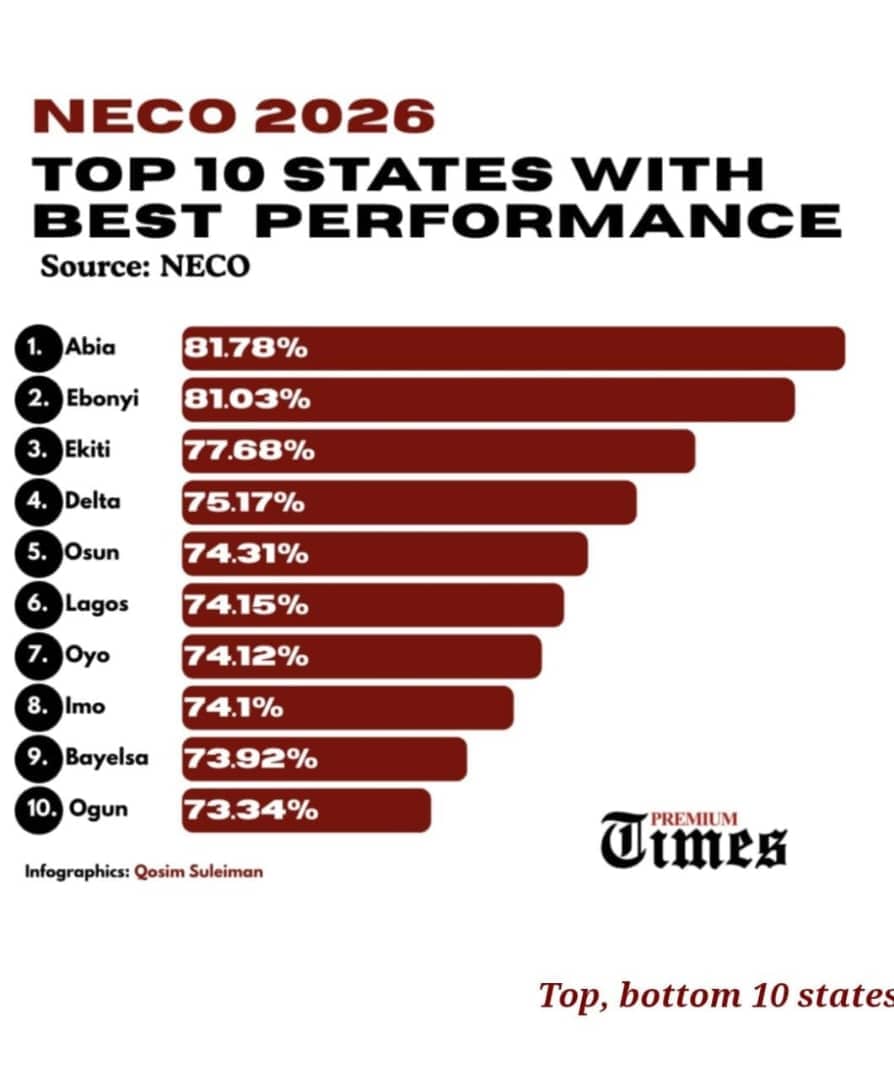
Osun State Governor, Senator Ademola Adeleke, has hailed the state’s strong performance in the 2026 National Examinations Council (NECO) Senior School Certificate Examination, describing the result as a positive reflection of ongoing efforts to reposition education in the state.
Osun placed fifth nationally in the 2026 NECO ranking, with 74.31 per cent of candidates recording at least five credits, including English Language and Mathematics.
While congratulating the students, teachers, parents, school administrators and other stakeholders, the governor noted that the state performance has been improving within a single digit rating for three consecutive years namely 2024, 2025 and 2026.
“Osun has moved from 33rd position in the 2022 NECO ranking to 5th in 2026, while improving its pass rate to 74.31 per cent. This is encouraging, and it shows that our sustained interventions in the education sector are yielding positive results,” the Governor said.
Governor Adeleke said the improved performance reflects his administration’s deliberate investment in the education sector, including the recruitment of additional teachers to strengthen the teaching workforce, while prioritising workers’ welfare and creating a more conducive environment for effective teaching and learning across public schools.
The Governor said the performance reinforces his administration’s determination to continue investing in education, noting that the objective is to build a system that gives every Osun child the knowledge, skills and opportunities needed to succeed.
“This result is encouraging, but we see it as a reason to do more. We will continue to invest in our schools, improve the learning environment, support our teachers and provide our students with the necessary tools to excel.
“We are building an education system that prepares our young people not only for examinations but for life,” the Governor said.
He assured that ongoing interventions in the education sector would be sustained and expanded, while urging students to remain committed to their studies.
His Excellency also commended teachers across the state for their dedication and sacrifices, assuring them that the administration would continue to prioritise measures that strengthen the education system and improve workers’ welfare.


