
News
The DSS Operates Within Its Mandate by Dr. Peter Afunanya


- /home/rhoncare/pointblank.ng/wp-content/plugins/mvp-social-buttons/mvp-social-buttons.php on line 27
https://pointblank.ng/wp-content/uploads/2019/08/DSS.jpg&description=The DSS Operates Within Its Mandate by Dr. Peter Afunanya', 'pinterestShare', 'width=750,height=350'); return false;" title="Pin This Post">
- Share
- Tweet /home/rhoncare/pointblank.ng/wp-content/plugins/mvp-social-buttons/mvp-social-buttons.php on line 69
https://pointblank.ng/wp-content/uploads/2019/08/DSS.jpg&description=The DSS Operates Within Its Mandate by Dr. Peter Afunanya', 'pinterestShare', 'width=750,height=350'); return false;" title="Pin This Post">
Recently, about five major newspapers called out the DSS for bashing of sorts. The papers, which used their platforms to express varied views about the modus operandi of the Service include Vanguard, Daily Trust, The Sun, Tribune and Punch. While Vanguard’s piece on 2nd June 2023 was Dousing the DSS/EFCC Feud, Daily Trust, on 6th June 2023, published an editorial titled The DSS Must Conduct Its Duties as a Secret Service. The Sun, on 7th June, published The Needless DSS/EFCC Fracas while Tribune on 8th June 2023 wrote on The EFCC/DSS Confrontation. Similarly, on 14th June 2023, Punch featured DSS, Others Need Radical Reforms. It did not seem that the editorials which sought the reforms of the DSS or to criticise it for its public statements or actions on various subject matters of national security concern were, by any means, an accident or a coincidence. It looked every inch planted or organised. It is a hatchet job or so it seemed. The judgement that the Service is excessively public or ubiquitous missed the point. The papers manifested predictable bias and patterns.
Relatedly, some respected legal personalities namely, Olisa Agbakoba SAN, Mike Ozekhome SAN and Femi Falana SAN opined that the Service operates outside its mandate especially with regards to the investigation of Godwin Emefiele. The fact that this matter has become sub-judice constrains the Service from making further statements about it. The celebration of the news of a court order to allow his Lawyers and family access to him is quite unnecessary. He was never denied access. Ever since he was taken into custody, his family has continually accessed him. Same with medical officials. The impression that the Service is going to act on the prompting of the Court is not correct. This is by the way.
Back to the subject under discourse. While it may be fair to admit that the news media and aforementioned personalities are entitled to their opinions, measured ignorance predominantly played out in their arguments. First, they failed to recognise that security threats are evolving and so do the approaches to managing them. Instructively, the security landscape in Nigeria, like many other countries, has become increasingly complex and dynamic. The periodic issuance of press statements to educate or carry citizens and residents along has undoubtedly become part of strategies to manage national security challenges. Extensive research would have revealed to the critics that the Central Intelligence Agency (CIA), Federal Bureau of Investigation (FBI) and other world intelligence Services deploy similar tactics including occasional statements and advisories. The CIA includes demographic information on its website to provide the public with valuable insights and data about various populations so to enhance understanding of different regions and communities. Does it mean CIA is operating outside its mandate? Or will that be accepted because it’s CIA, a foreign body?
The need for the agencies to be responsive, transparent and apprise taxpayers has become the global norm in national security and intelligence management. It is called security/intelligence accountability. The tenets of security and intelligence governance expect that agencies remain transparent, accountable and compliant to democracy. World over, Intelligence Services operate in ways and means not too discernable to the uninitiate. But the institutionalisation of democracy as preferred political culture has nonetheless forced such agencies to communicate often with the Public. You can see why the public statements can never be out of place. Without public consciousness and support, countering threats may remain a herculean task for security agencies. Democratic subordination and legislative oversight are basic principles which make it an obligation for these agencies to operate openly even when some of their activities are secret. Ask the USA, UK, France, Canada and other advanced democracies. This level of openness does not vitiate the expected secrecy or in any way compromise their operations.
Regarding the matter concerning the DSS and EFCC, both agencies have refuted claims of a rivalry. It is important to note that comparing the 30th May, 2023 incident at 15 Awolowo Road, Lagos to the barricade of National Assembly in 2018 is inaccurate and unjust due to the substantial differences in the nature and context of the two events. While it is essential to emphasize inter-agency relations and cooperation, it would be unfair to generalise and imply that the Service is in rivalry and power struggle with the Commission. Each agency operates within its distinct mandate and context.
Meanwhile, the editorials accurately alluded to the constitutionality of the DSS as an intelligence organisation in detecting, preventing and neutralising threats against Nigeria. They commended the Service for its commitment to the security of the country as well as the many feats it had accomplished in the course of discharging its duties. Thank you indeed. It has to be understood that the Service is not only an intelligence organisation. It is also a law enforcement agency. It is a security and policy advisory organ. Its establishment law expects it to prevent. To prevent unarguably means to enforce. Should the Service seek media endorsement or permission before deploying operatives and equipment to conduct its job? Should it rather play to the gallery? Characteristic of intelligence operating systems, DSS’ activities may never be completely explained or understood particularly to those who do not need to know.
Even though some of its high officials and operations are known and their veils of secrecy uncovered, there are thousand undercover personnel and actions that have no business going public. It is expected to remain so. With its broad mandate and legal authority to investigate crimes of national security significance, the DSS is well within its rights to initiate an inquiry into any relevant matter. The DSS is primarily charged to detect and prevent crimes and threats against the internal security of Nigeria. More profoundly, it is to undertake such other responsibility as maybe assigned to it by the President and Commander-in-Chief. Appreciating this role of the DSS is instructive for some sections of the media, lawyers and other interested parties. The Service operates on the basis of rule of law. Its operations are rule governed. As required, it obtains arrest and detention warrants when and if needed. For the fact that such instruments are not advertised does not suggest otherwise. Critics should get conversant with the law and rules of engagement and desist from misinforming, misleading or inciting the public. Those seeking to weaken the Service through premeditated reforms may be on a wild goose chase. Consistent attack on it based on ignorance, unrealised interests and emotional assessments and judgements does the country no good. The DSS has stood so firmly for Nigeria. It will continue to.
Considering the warped mentality that has triggered these writeups, it will, no doubt, be unsurprising to witness an upsurge in malicious articles, criticisms and baseless attacks in the public space following the investigations of Messrs Godwin Emefiele and Abdulrasheed Bawa among other flimsy matters. Certain groups and people are bound to come up with frivolous allegations against the Service and its leadership. These entities may also exploit unpatriotic members of the Service to spread falsehoods, propaganda and hate in order to project the Organisation in a bad light. Given their reach and war chest to mobilise forces against Government and its key officials, the adversaries may intend to cause distractions to the on-going investigations as directed by the C-in-C. However, the Service will not depose its professionalism for cheap backlash nor discharge its duty with prejudice or fear.
For those who canvass the opinion that the DSS has no business in investigating the matters referred to it are obviously not taking seriously the omnibus powers of the President, as enshrined in the enabling Acts of the SSS and the NSA. As argued by a onetime Director of the DSS, Fubara Duke, “When a law confers on the President power to delegate ANY assignments he deems fit for a particular Agency to perform, I wonder how it falls outside the purview of (ANY) the stipulations of the President’s powers and by extension why the DSS is being faulted for carrying out the President’s directive”. Continuing, he added: “I have heard arguments of cases being thrown out by the courts over questionable prosecutorial powers of the DSS regarding some categories of cases including criminal cases. Without prejudice to the wisdom of the court on such judgements, they should not override the lawful investigative authority of the DSS. Should there be need for prosecution in due course, these determinations would be appropriately evaluated and where/if necessary, appropriate prosecutorial agencies which may include the Attorney General’s Office or other sister agencies may be deployed to prosecute. It is not the first time this has happened”.
Let it be clear, however, that the DSS will remain unshaken and professional in carrying out its duties. It recommits to diligently operate, as always, within the confines of the law and to uphold the fundamental rights of all Nigerians. The media must, as the fifth estate of the realm, remain balanced, accurate, impartial and accountable. To sustain a deliberate misguidance of the public with any form of misconceptions is detrimental to nationhood. Therefore, to deepen the expected contributions, seeking veracity is not only ethical but obligatory. That should not be asking for too much.
Dr. Peter Afunanya, fsi is the Public Relations Officer, Department of State Services



President Bola Tinubu has extended his “working vacation” in Europe by a few days and is expected to return to Nigeria at the weekend, the Presidency said on Monday.
The announcement came as Vice President Kashim Shettima represents the President at the 81st United Nations General Assembly in New York, where he is scheduled to deliver Nigeria’s national statement.
Tinubu departed Nigeria on August 30 to begin his working vacation in London. After spending one week in the United Kingdom, he proceeded to Paris, France, where he held meetings with French President Emmanuel Macron and businessman Vincent Bolloré.
Bolloré’s media interests include Canal+, MultiChoice and Universal Music Group.
A statement signed on Monday by Bayo Onanuga, Special Adviser to the President on Information and Strategy, said Tinubu has remains in touch with developments at home and continued to direct the affairs of government despite being away from Nigeria.
One of the major decisions taken by the President during the period was his directive for an independent investigation into the deaths of 37 suspected illegal miners in Minna following their detention by the Nigeria Security and Civil Defence Corps.
The deaths had raised concerns over the circumstances surrounding the detention and treatment of the miners, prompting the President to order an independent probe.
Tinubu’s decision to extend his stay abroad means he will not personally attend the opening of the high-level segment of the UN General Assembly in New York. Shettima, who departed Abuja on September 20, is representing the President at the global gathering and will present Nigeria’s national statement.
The Presidency said the Vice President’s representation was part of the arrangements for Tinubu’s absence from the country.
With Shettima now in New York, the Secretary to the Government of the Federation, Senator George Akume, will continue to represent the President at some official functions.
The Presidency said Tinubu had also delegated the Vice President to represent him at official functions while he was away, while Akume had similarly stepped in at other engagements.
The President’s extended stay in Europe also comes amid increased political activities at home ahead of the 2027 general elections.
According to the Presidency, the Director-General of the Presidential Campaign Council, Senator Abubakar Yari, has been leading notable leaders of the ruling party in consultations with prominent traditional rulers across the country.
The consultations form part of ongoing political engagements as the administration moves towards the next electoral cycle.
The Presidency also reacted strongly to criticism over Tinubu’s decision not to attend the UN General Assembly personally.
It described as irresponsible what it called a “baseless insinuation” by former Vice President Atiku Abubakar and a United States-based lobbying firm headed by an ex-convict regarding the President’s non-attendance at the global gathering.
The Presidency maintained that Nigeria would be adequately represented by Shettima, who will deliver the country’s national statement.
Tinubu’s latest trip began as an official working vacation, during which the President combined his leave with selected diplomatic, business and governmental engagements.
His meeting with Macron in Paris provided an opportunity for discussions on bilateral relations, while his engagement with Bolloré focused on business and investment interests involving Nigeria.
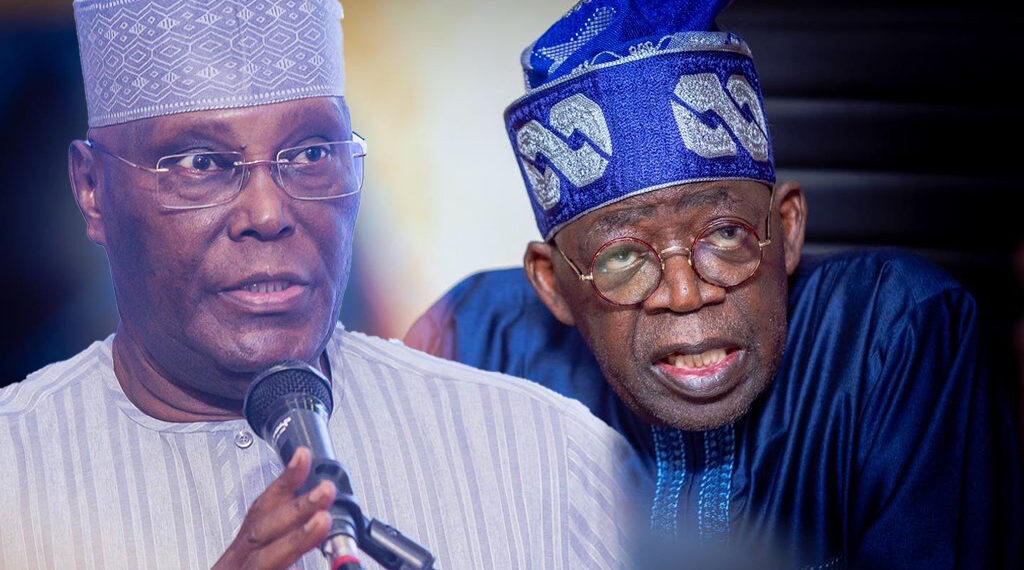
Former Vice President Atiku Abubakar has urged President Bola Tinubu to take immediate steps to reduce the cost of petrol, saying Nigerians are struggling with the combined impact of high energy, transportation and food prices.
Atiku made the call on Friday in Abuja during a press briefing on fuel prices, palliatives and the rising cost of living. His comments came amid renewed concerns over the effect of higher petrol prices on households and businesses.
The African Democratic Congress (ADC) presidential candidate said the removal of petrol subsidy in May 2023 placed additional pressure on families, workers, farmers and businesses.
He said the effect of higher petrol prices was not limited to motorists, as increased transportation and logistics costs had also pushed up the prices of food and other essential goods.
“When government makes energy expensive, it makes life expensive,” Atiku said.
The former vice president recalled that he had previously called for government intervention to reduce petrol prices, but said Tinubu had dismissed the proposal as showing “serious ignorance” of governance and the economy.
Atiku questioned whether the Nigeria Labour Congress (NLC), petroleum marketers, manufacturers and ordinary Nigerians who had raised concerns about rising costs could all be described as ignorant.
“When workers, producers, marketers and ordinary families are all raising the alarm, government must listen,” he said.
He said the government should be prepared to review its policies when their consequences become difficult for citizens to bear, adding that rising production costs were putting further pressure on manufacturers while families were finding it harder to afford basic goods.
Atiku also argued that government revenue and GDP figures did not necessarily reflect the economic reality facing ordinary Nigerians.
“If government receives more Naira while the citizen’s naira buys less food, less fuel, less electricity and less transportation, then bigger government revenues mean little to the family struggling to survive,” he said.
The ADC candidate urged Tinubu to use the remaining eight months of his first term to reduce the burden on Nigerians and consider any measure capable of lowering petrol prices, even if the proposal came from a political opponent.
“What matters to me is that Nigerians pay less,” Atiku said. “A sensible idea does not become a bad idea because it came from your opponent.”
He also offered to make his policy framework available to the Tinubu administration, saying Nigerians should not have to wait for a new government before benefiting from policies that could provide relief.
“If you need the framework, I will provide it. Implement it under your government. Give it whatever name you choose. Take the credit,” he said.
“I ask for only one thing: Let Nigerians breathe.”
By Henry Ukazu
Dear Destiny Friends,
Passion and purpose are among the most debated topics in the human development space. It’s a grey area that has attracted a lot of attention. While some schools of thought believe it’s better to focus on passion, other schools of thought believe that it’s profitable for one to focus on a job that pays the bills.
According to the latter school of thought, passion doesn’t pay the bills. Well, depending on the schools of thought one subscribes to, I personally believe it pays more for one to pursue passion than profit, and I will explain in a minute.
I strongly believe passion is stronger than power because when one loves what one is doing, there’s an inherent strength that comes with it, but if one doesn’t like what they are doing, they’ll lack the moral strength to forge on.
Let me share a practical example with you. My late dad encouraged me to study Taxation Law at New York Law School, a major I didn’t like. He had the mindset that money rules the world, which I tend to believe because when money talks, the world “generally” seems to move around. That mindset and principle is relatable; however, it’s not applicable in other cases because there are some people or situations where money doesn’t move around.
My late dad believed it makes no sense for me to read a major and remain unemployable or poor. So, when I arrived in the United States, the economy was experiencing a recession, and there were no jobs at the time. So, while I was passionate about studying International Relations, Energy Law, or Communications Law, my late dad sat me down and said, based on the information he was receiving from his friends, these are great courses, but when I graduate, it will be hard to find a job because most people in those firms are laying off employees.
According to my late dad, his friends suggested that since I have a legal background, tax law is the only major I can study and be guaranteed a job because people and corporations will always file their tax returns. I initially objected to this advice because my brain is not wired for numbers. I really struggled to accept this advice because I hated numbers with passion.
My late dad would later tell me, you know we are from a humble background, and so we need money. My late dad would always say, “You wouldn’t want to study international law or communication, and the only thing you can do very well is speak English while remaining poor. One fact about my late dad was that he liked money to a stupor. According to him, after God, the most important thing in the world is money.
After much hesitation, I decided to study the major to make my late dad happy because I saw how happy he would be when I studied tax law. If truth be told, I wasn’t happy studying the major. I really struggled with the major. I managed to get a scholarship and graduated with a decent grade, but getting a job was challenging because employers could see that I didn’t like the major each time I went for an interview.
At the end of the day, I managed to get a job as a Case Manager for a private organization and later as the Legal Coordinator for the New York City Department of Correction. An important point to note here is that, after I left the tax firm, I was intentional about applying for jobs I was passionate about. Money to me was a secondary concern because I strongly believe that when you love what you do and you are good at it, money will surely find you.
I had to share this practical experience to give an insight into the importance of focusing on passion. Don’t get me wrong, money is good, but I personally feel there are more valuable things than money, and a perfect example is marrying a kind man as opposed to marrying a man with money, or marrying a lady with good character as opposed to marrying a lady with a good physique.
It’s instructive to note that when I began to focus on what I love to do, I had to spend time on honing my skills, developing myself by attending relevant training sessions and taking courses that would distinguish me from my contemporaries. It didn’t take long for me to receive recognition for my work. I was celebrated for being a trailblazing author of three books on television; I was interviewed by The New York Times in addition to meeting resourceful global leaders. In all sincerity, I doubt if I would have received accolades assuming I focused on taxation or doing what would give me money.
The moral of this analysis is that while profit is good, passion is much better because it will give one the necessary satisfaction and fulfilment they deserve. To understand how this works, one might make good money in a job but won’t be happy, but someone else might make little money and be happy in what they are doing. If research is done on what makes one happy, most people will likely say it is their passion or what they love to do that makes them happy as opposed to the job they do. It’s only a fragment of people who will attribute their happiness to the job they do, and that’s simply because they have truly figured out who they are or are probably happy and passionate about the work they do.
Let me explain a little: your profession is what you are trained to do as a doctor, lawyer, accountant, or engineer. Your vocation is what you are trained to do as a skilled worker or one with a 9-to-5 job, but your ministry is your calling, and that’s why you find your talent or gift and passion. So, one’s passion can be found in what they love to do.
When one’s profession is aligned with one’s vocation and ministry, then success is bound to be present because passion is at play.
It’s instructive to note that most of the great people I know in the world have become famous because they were doing what they love to do. I recently attended an award ceremony where my alma mater, Baruch College, celebrated alumni who have distinguished themselves. One of the award recipients, Ms. Doris Gonzalez, stated in her speech, “Of all the jobs I have had in my life, this is my best job. I really love my job”. I strongly believe there is a form of spiritual blessing and success that comes when one is happy doing what one is passionate about.
In conclusion, if one is desirous of succeeding in life, please endeavor to focus on your passion; if you can’t find it, explore what makes you happy. When you find what makes you happy, develop and monetize it, and in no distant time, opportunities and recognition will begin to triple in.
Henry Ukazu writes from New York. He works with the New York City Department of Correction as the Legal Coordinator. He’s the founder of Gloemi. He’s a Transformative Human Capacity and Mindset coach. He is also a public speaker, youth advocate, creative writer, and author of Design Your Destiny- Actualizing Your Birthright to Success, Unleash Your Destiny and The Six Pillars of Success. He can be reached via info@gloemi.com


