
Metro
The Inherited Fracture: Escaping the Divide-and-Rule Instinct Across Board


- /home/rhoncare/pointblank.ng/wp-content/plugins/mvp-social-buttons/mvp-social-buttons.php on line 27
https://pointblank.ng/wp-content/uploads/2025/08/DR.TOLULOPE-A.-ADEGOKE-AMBP-UN__-1-744x600.jpg&description=The Inherited Fracture: Escaping the Divide-and-Rule Instinct Across Board', 'pinterestShare', 'width=750,height=350'); return false;" title="Pin This Post">
- Share
- Tweet /home/rhoncare/pointblank.ng/wp-content/plugins/mvp-social-buttons/mvp-social-buttons.php on line 69
https://pointblank.ng/wp-content/uploads/2025/08/DR.TOLULOPE-A.-ADEGOKE-AMBP-UN__-1-744x600.jpg&description=The Inherited Fracture: Escaping the Divide-and-Rule Instinct Across Board', 'pinterestShare', 'width=750,height=350'); return false;" title="Pin This Post">
By Tolulope A. Adegoke
“The old empire did not bequeath us a map; it bequeathed us a reflex. We are the first generation with the tools to see the fracture, and therefore the first with the moral chore of mending it—not through the erasure of difference, but through the deliberate weaving of it into a load-bearing fabric. The shackle was never iron; it was a story we mistook for our skin. The task, therefore, is not to break free, but to finally tell a truer one, and in the telling, become whole enough to bequeath wholeness.”
Introduction: The Quiet Inheritance
No child is born with a map of enemies. No infant instinctively divides the world into “us” and “them.” Yet by adolescence, most of us have unconsciously inherited a vivid cartography of division—lines drawn long before our first breath, tracing the borders of tribe, class, ideology, and nation. This inheritance is not accidental. It is the meticulously preserved residue of a strategy so ancient and so effective that it has become woven into the invisible fabric of how we organize our families, our work, and our geopolitics.
The strategy is “divide and rule,” and its enduring victory is not that it conquered past civilizations, but that it continues to conquer future ones before they are even born. The shackle from the past is not a rusty iron chain we can see and cut; it is a psychological operating system, a default setting of fragmentation that tells us difference is dangerous, that another’s gain is our loss, and that solidarity is a naïve dream. This write-up is an inquiry into how that inherited mantle still drapes itself over the three great arenas of human life—Peoples, Corporates, and Nations—and, more crucially, how we can finally, generationally, set it down.
Part I: Tracing the Original Wound
To understand why division feels so instinctive, we must first recognize that it was carefully taught. The imperial architects of history—from the Roman Senate setting Gallic tribes against each other to the colonial census offices that rigidly codified fluid identities into immutable castes—were not mere conquerors of land. They were engineers of human psychology. Their profound insight was chilling in its simplicity: a people busy fighting each other over manufactured scarcities of dignity, resources, and recognition will never marshal the collective strength to question the structure of the room they are all trapped in.
This method did not fade with the lowering of colonial flags. It shape-shifted. It flowed seamlessly into the architecture of modern politics, where wedge issues and culture wars create passionate, performative tribes that exhaust public energy on symbolic combat while systemic questions go unasked. It entered the economic realm, where labor is pitted against labor across borders, and the workplace is structured into competing fiefdoms. It found its ultimate amplifier in the digital age, where algorithms, optimized not for truth but for engagement, feed us a personalized diet of indignation, continuously redrawing the lines between “our” fact and “their” fiction.
The deepest shackle, therefore, is not an external policy but an internalized reflex. The generational problem we face is that we parent, manage, and govern with the inherited assumption that a cohesive whole is a dangerous fiction, and that a controlled, managed division is the safest form of stability. We have mistaken a centuries-old psychological warfare tactic for human nature itself.
Part II: Peoples – From Inherited Suspicion to Chosen Solidarity
The most intimate theater of the divide-and-rule legacy is the community, where the human need for belonging is manipulated into a weapon against other belonging. We inherit not just our grandmother’s recipes but also her historical wounds, her curated list of historical betrayals by “the others.” When identity becomes a fortress, and every interaction across difference is framed as a potential siege, society unravels into a zero-sum competition of grievances. One group’s acknowledgment becomes another’s perceived erasure, and the common ground—the very earth we all need to survive on—becomes a forgotten abstraction.
The Generative Pivot: The Loom, Not the Mosaic
The conventional metaphor for unity is the mosaic—distinct tiles fixed in place. But a more dynamic, human solution is the loom. In weaving, distinct, colorful threads do not merely sit beside each other; they actively interlace under creative tension to produce a fabric far stronger and more beautiful than the loose pile of individual strands. This is the generational work: to weave a social fabric where difference is not merely tolerated but is the essential, structural component of collective strength.
1. The Alchemy of Shared Enterprise: Nothing dissolves manufactured mistrust like sweating together for a common purpose invisible to ideology. When a neighborhood of diverse faiths and backgrounds collaboratively designs a green space, starts a community-owned energy cooperative, or builds a multi-generational playground, something alchemical occurs. The direct, felt experience of shared competence and mutual reliance creates a counter-narrative to the inherited one. A child watching a Sikh father and a Muslim mother co-chair a local river cleanup does not just learn tolerance; they learn the tangible truth of interdependence. This solves the generational problem of social fragmentation not through lectures on unity, but by providing the real, material evidence that we live better, safer, and richer lives when we are bound together in practical projects. It transforms the public from an audience of divided spectators into a collaborative cast of problem-solvers.
2. Re-narrating the Past Together: The past is often a weapon, parceled out in separate, conflicting memories. A generational solution is the community-wide re-narration project—a collective, facilitated process where a town’s entire history, including its moments of deep division and injustice, is documented and acknowledged not by one side for its own vindication, but by all sides for the purpose of a shared, complex inheritance. When a painful historical event ceases to be “their crime against us” and becomes “a tragedy in our shared story from which we must all learn,” the emotional charge is diffused. The next generation inherits not a selective, incendiary pamphlet, but a full, somber, and ultimately uniting library of shared experience.
Part III: Corporates – From Fiefdoms of Turf to Ecosystems of Flow
The modern corporation, for all its talk of disruption, is often a deeply conservative feudal structure. The inherited mantle here is the cult of the silo. Departments become sovereign nations with their own languages, rituals, and guarded borders. Marketing and Sales engage in a cold war of blame; Product and Engineering view each other as obstacles. This is internal divide-and-rule in its most mundane, daily form: a management inheritance that subconsciously fears a truly unified, cross-functional workforce because a fluidly collaborating team is harder to control than a set of competing baronies.
The generational cost is the “perfect department, failing company” paradox, where each unit optimizes for its own narrow metrics—sales volume, lines of code, ad impressions—while the living, breathing organism of the enterprise, the thing that actually delivers value to a human customer, atrophies.
The Generative Pivot: The Symphony, Not the Org Chart
The solution is a fundamental shift in structural metaphor from a static hierarchy to a living symphony. An orchestra does not succeed because the brass section beats the strings. Every musician has a completely different, highly specialized instrument and a distinct musical line to play, yet all are integrated by a single unifying element: the full score.
1. The Shared Score of Radical Transparency: The corporate “score” is a single, universally accessible, real-time operating system that visualizes all work, all customer feedback, all financial flow. When a junior developer can see exactly how her code latency impacts customer churn in a chart viewable by the CEO, the informational hoarding that powers silo politics evaporates. Power no longer comes from guarding a border of knowledge but from contributing to the visible whole. This solves the generational problem of corporate sclerosis by ensuring that the enterprise inherits a nervous system, not a suit of armor. An organization that sees itself whole can act whole.
2. Mission-Driven, Ephemeral Teams: Instead of permanent departments, work flows to ephemeral, mission-specific teams that form, solve a problem, and dissolve back into the organizational fluid. A sustainability initiative, for example, is staffed not by a permanent “Green Department” that everyone else ignores, but by a temporary swarm pulling in a supply chain veteran, a materials chemist, a brand storyteller, and a frontline retailer. Their shared KPI is a unified, real-world outcome. When a professional identity is no longer “I am a Marketing person defending my turf” but “I am a problem-solver who brings marketing insight to the mission,” the inherited mantle of internal division is finally unwoven. The company’s grandchildren—its long-term future products and culture—are protected by this fluid, adaptive resilience.
Part IV: Nations – Beyond the Westphalian Straitjacket
The nation-state system is the most monumental and seemingly immovable of the inherited mantles. Born from the idea of absolute, internally homogenous sovereignty, it creates a world of hard containers where the most critical threats we face—a warming atmosphere, a migrating virus, the existential risk of ungoverned artificial intelligence—flow like water across borders we treat as concrete. We are trying to solve planetary-scale, networked problems with a batch of standalone, disconnected operating systems. An election-cycle-driven leader performing national interest for a domestic audience is structurally incentivized to prioritize a 2% short-term domestic gain over averting a 20% long-term global disaster.
This is the ultimate gerontocracy of concepts: an inherited 17th-century political structure mismanaging 21st-century existential threats. The shackle is a logic that says global cooperation is a zero-sum sacrifice of sovereignty, rather than a strategic extension of it.
The Generative Pivot: The Bioregion and the Commons Trust
The generational escape is not a single world government—that is just the old divide-and-rule hierarchy scaled to a terrifying, monocultural extreme. The human-scale solution is a layered, functional network where sovereignty is not abolished but intelligently pooled for specific planetary survival missions.
1. The Bioregional, Not Just National, Identity: The most profound counter to artificial national division is the cultivation of a bioregional consciousness. A person living in the Nile Delta has a more fundamental, generational relationship with someone upstream in the Ethiopian highlands than with a fellow citizen in a distant desert city of the same nation. The flow of water, the health of soil, the migration of pollinators—these create a natural, non-negotiable community of fate. The generational solution is to elevate these bioregional governance bodies—river basin authorities, regional seas commissions—to full political stature, granting them real, binding legal power co-equal to national parliaments on issues within their ecological domain. An upstream dam project would no longer be just a national prerogative; it would be subject to the legal authority of a bioregional commons trust in which the downstream nation is an equal partner. This solves the problem of resource conflict by changing the unit of political identity itself.
2. The Global Mandate for the Global Commons: For the atmosphere, the high seas, and the polar-regions, nations must charter autonomous, science-driven Global Commons Trusts with a sliver of strongly delegated sovereignty. Imagine an Atmospheric Integrity Agency, governed not by political negotiation but by a fiduciary duty to a set planetary threshold. It monitors, sets a global price on carbon extraction, and distributes the proceeds back to every human on Earth as a universal basic dividend. The division of a global “us vs. them” on climate collapses when a family in Indonesia and a family in Canada receive the same quarterly check from their shared atmospheric trust. It transforms a zone of geopolitical conflict into a zone of shared, inheritable wealth. A child born into such a world inherits a planet managed by a logic of collective trusteeship, not competitive looting.
Conclusion: The Task of the Living
The mantle of divide and rule is weighty because it is lined with the lead of fear: fear of the stranger, fear of irrelevance, fear of a future that demands we think in wholes while our institutions are built in pieces. Yet it is a mantle we have woven and placed upon our own shoulders, generation after generation, mistaking it for the very fabric of reality.
The profound, hopeful truth is that it is a garment, not our skin. We can shed it. The human capacity for direct, unmediated connection, for the fierce protection of our children’s future, and for the intuitive understanding that a forest is not a war of trees but a symphony of mutual nourishment—these are not new inventions. They are our original inheritance, buried under the heavy, historical robes of empire and distrust.
The generational task is not to fight the darkness with weapons it has forged. It is to quietly, persistently, and structurally build the new loom, learn the new score, and chart the new watershed. By weaving a social fabric of chosen interdependence, by organizing work into symphonies of shared value, and by governing the planet as the single, breathing commons it actually is, we finally fulfill the obligation we hold to the future. We bequeath not the cold chains of an imperial past, but a living, breathing inheritance of wholeness—one that equips our grandchildren not for a life of perennial conflict, but for the magnificent and ongoing project of building a single, richly varied human world.
Dr. Tolulope A. Adegoke, AMBP-UN is a globally recognized scholar-practitioner and thought leader at the nexus of security, governance, and strategic leadership. His mission is dedicated to advancing ethical governance, strategic human capital development, resilient nation building, and global peace. He can be reached via: tolulopeadegoke01@gmail.com, globalstageimpacts@gmail.com


Metro
International Day of the Girl-Child: Pad Me A Girl Foundation Holds Menstrual Health Outreach in Ogun
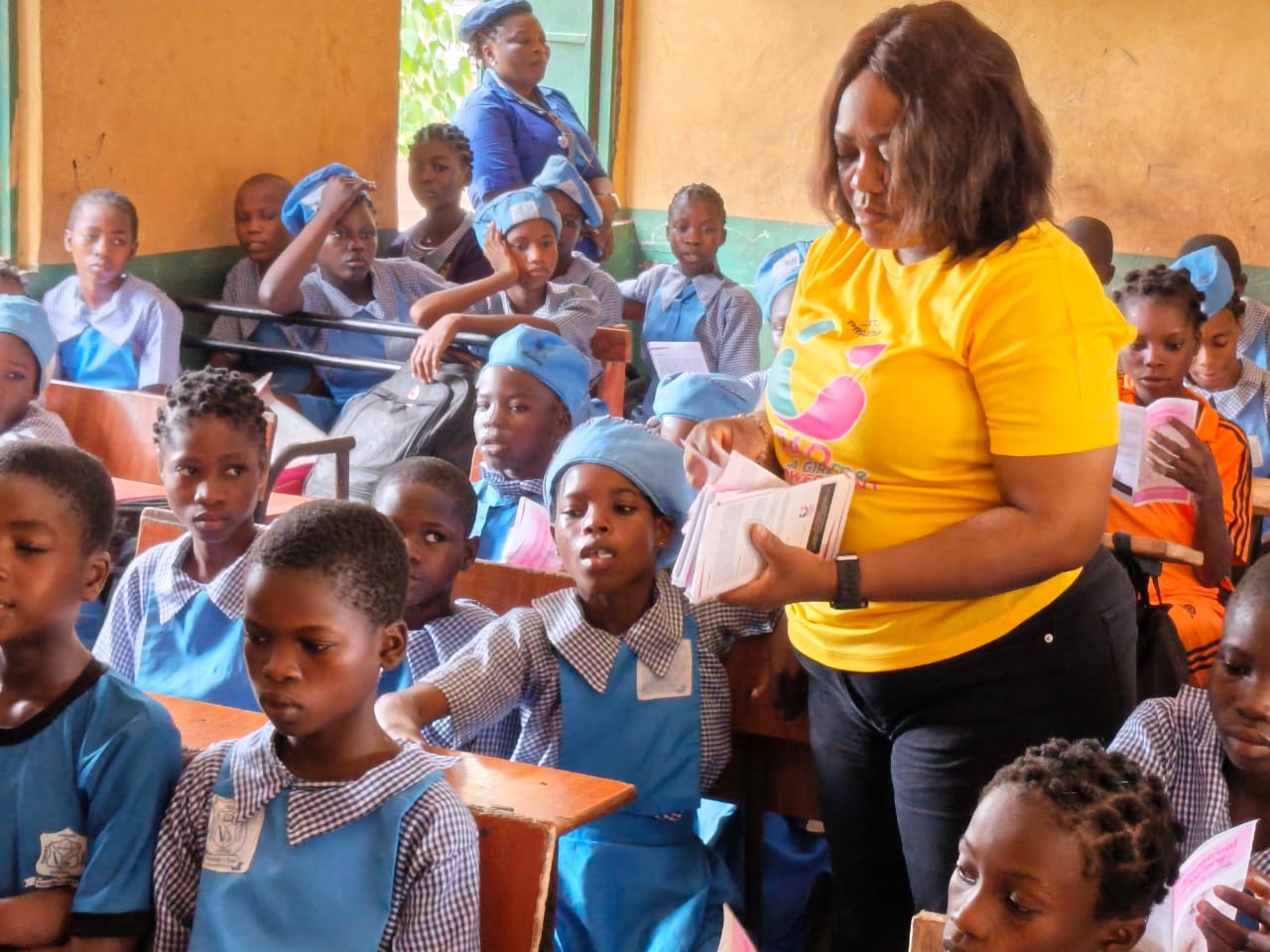
The Pad Me A Girl Empowerment Foundation has taken its menstrual health campaign to Igbesa High School (Junior), in Ado-Odo/Ota Local Government Area of Ogun State, providing free sanitary pads, menstrual hygiene pamphlets, exercise books and pens to over 100 schoolgirls to promote menstrual health, dignity and education.
The outreach, held on Wednesday, October 21, commemorated the 2026 International Day of the Girl Child, whose global theme is “End Child Marriage and Invest in Girls’ Rights!”
The programme brought together girls from Junior Secondary School (JSS) 1 to 3 who participate in the school’s reading clubs for mentorship, reading activities and menstrual health education.
It was convened by Oyelami Yetunde Anuoluwapo and Blessing Kappo, teachers and Teach For Nigeria Fellows at the school, following an appeal for sanitary products, learning materials and health education support. The Foundation’s founder, Theresa Moses, responded by providing the requested items and facilitating an interactive session on menstrual hygiene management.
Speaking at the event, Moses said she was inspired by the girls’ determination and aspirations, stressing the need for sustained investment in their health, education and future.
“Invest in girls and Nigeria will rise. Every girl deserves dignity, education and the right to dream beyond child marriage. That is why we are here; to ensure no girl misses school because of her period,” she said.
She emphasised that access to menstrual hygiene products and accurate information helps girls manage their periods confidently and participate fully in school activities.
In a letter of appreciation, Oyelami and Kappo described the outreach as impactful and inspiring, noting that it enhanced the girls’ understanding of menstrual health, hygiene and self-confidence. They also said the support would help promote the students’ hygiene, school attendance and dignity.
“You did not just give pads; you gave our girls confidence and hope,” the teachers wrote on behalf of the school community, expressing gratitude to the Foundation and hope for future collaboration.
Mrs Amarachi Eze, Assistant Divisional Commissioner of the Nigerian Girl Guides Association, Ado-Odo/Ota, Ogun State Branch, also commended the Foundation for supporting the girls’ hygiene needs and development.
“We sincerely appreciate the Management of Pad Me A Girl Foundation for joining hands with the Association in supporting our girls on hygiene management. May God Almighty continue to uplift your foundation. Thanks for joining hands in the development of girls in our schools. Bravo,” she said.
The Foundation’s Media Coordinator, Mr Oluwatosin Simon Faleye, called on corporate organisations, non-governmental organisations and well-meaning Nigerians to support initiatives that address period poverty and help girls remain in school.
“For over a year, we have been committed to ending period poverty and keeping girls in school. We call on corporate organisations and well-meaning Nigerians to support this cause for the betterment of Nigeria,” Faleye said.
The celebration also featured a student drama presentation highlighting the effects of child marriage, alongside reading and mentorship activities designed to encourage the girls to understand their rights, value their education and pursue their aspirations.
The Foundation also acknowledged the continued support of its sponsors and partners, including Access Bank, Pro Star Sports International, BL Consulting, Vita Baites Foods, Checkers, Senator Ireti Kingibe, representing the Federal Capital Territory (FCT) in the 10th Nigerian National Assembly, the Senate Committee on Women Affairs (SCOWAS), as well as individuals and media organisations whose contributions have supported its broader mission of ending period poverty, promoting menstrual health education and empowering girls and women.
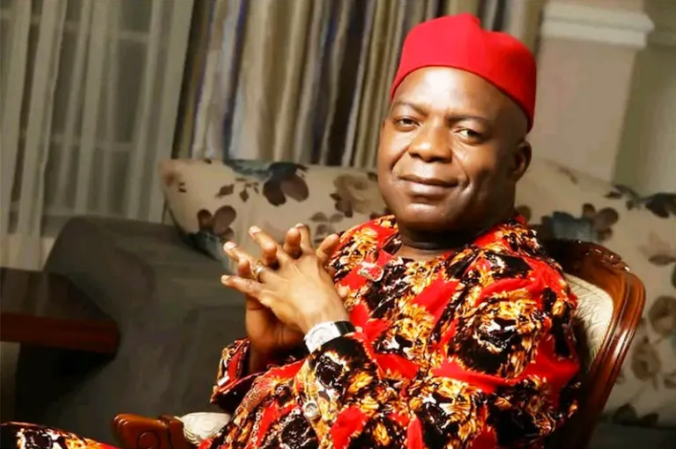
Abia State governor, Alex Otti, is set to flag off the reconstruction of Uratta Road and Old Express Road in Aba, two major routes which poor condition has disrupted transportation, commercial activities and access to residential communities for years.
The governor’s media aide, Ferdinand Ekeoma, in a statement on Wednesday, said that work on the roads has begun ahead of the scheduled official flag-off.
The two roads are considered important to Aba’s commercial and industrial activities, with Uratta Road connecting several adjoining streets to Port Harcourt Road and Old Express Road. At the same time, Old Express Road serves as a key route within the city’s industrial layout.
Ekeoma said the roads had suffered neglect for more than 24 years, leaving some sections impassable and forcing residents and businesses to contend with difficult transportation conditions.
According to the statement, Uratta Road provides access to more than 100 adjoining streets. Its poor condition has affected residents, traders and small-scale manufacturers who depend on the road to transport goods and access their businesses.
The statement said the road had become waterlogged and overgrown with weeds, discouraging commercial motorcycle and tricycle operators from using it.
Similarly, the deterioration of Old Express Road forced heavy-duty truck operators, fabric merchants, spare-parts dealers and small businesses to use longer routes, increasing transportation costs and affecting productivity.
The government said the road reconstruction is part of its broader effort to restore Aba’s infrastructure and strengthen the city’s commercial base.
Aba, one of southeastern Nigeria’s major commercial centres, hosts manufacturing clusters, markets, and small and medium-sized enterprises that depend heavily on functional roads to move raw materials and finished products.
The government said the reconstruction would improve market access, reduce transportation costs, facilitate the movement of goods, and support businesses operating along the affected corridors.
Ekeoma cited the reconstruction of Port Harcourt Road as an example of the administration’s infrastructure programme, noting that improved road access encouraged shops to reopen, attracted manufacturing activities and increased property rents along the corridor.
The government also said the new projects would complement other road interventions in Aba, including works on Ohanku and Obohia roads, as part of efforts to improve connectivity within the commercial city.
Beyond road construction, the administration said its projects include drainage systems, solar-powered streetlights, and pedestrian walkways, which it described as necessary to improve safety, accessibility, and flood resilience.
Ekeoma said Governor Otti views infrastructure development as an economic strategy rather than merely a construction programme, arguing that better roads would help businesses operate more efficiently and create employment opportunities.
He also quoted the governor as saying at an earlier church event that his administration is shifting attention from basic infrastructure improvements to healthcare, education, technology and industrialisation.
The governor, a former bank chief executive, was elected in 2023 on the Labour Party platform, defeating candidates from the major established parties in a state historically dominated by the Peoples’ Democratic Party.
Otti has remained in the Labour Party despite the defection of its 2023 presidential candidate, Peter Obi.
His administration has made rehabilitating Aba roads and public infrastructure central to its governance agenda, presenting the city’s recovery as essential to reviving economic activity across Abia State.
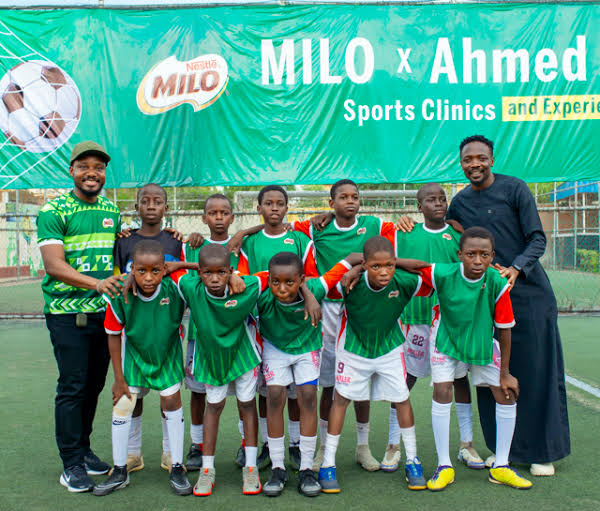
MILO Nigeria, in partnership with former Nigerian national team captain and MILO Brand Ambassador Ahmed Musa, has concluded the inaugural MILO × Ahmed Musa Sports Clinic and Tournament in Kano, providing 2,500 young footballers with professional coaching, mentorship and competitive football experience.
Over two weeks, participants took part in 10 coaching sessions and competed in matches under the guidance of Ahmed Musa and experienced coaches. The programme combined practical football training with lessons in teamwork, discipline, resilience and confidence, equipping participants with skills and values that extend beyond the pitch.
The initiative culminated in a tournament at the Ahmed Musa Sports Complex in Kano, where Khamis Football Academy emerged as champions of the inaugural edition. Participants also received cash prizes, certificates and football equipment.
Speaking on the initiative, Gilbert Tweneboah-Koduah, Category Lead, MILO, said: “At MILO, we believe sport is a powerful platform for young people to discover their abilities, build confidence and develop values that extend beyond the field of play. Our partnership with Ahmed Musa brings together MILO’s longstanding commitment to sports development and the experience of an athlete whose journey from grassroots football to the highest level of the game can inspire the next generation. By combining his experience with structured coaching and competition, this programme has given young footballers in Kano an opportunity to develop their skills, learn from experienced professionals and better understand the commitment required to pursue their aspirations.”
For the participants, the clinic offered an opportunity to learn from an athlete whose football journey began in northern Nigeria and progressed to the highest levels of the sport, making his experience a source of inspiration for aspiring players.
Commenting on the partnership, Ahmed Musa said: “Nigeria has incredible football talent, but talent alone is not enough. Young players need good coaching, regular competition and people who will guide them. I am proud to partner with MILO and share some of what football has taught me. My message to these players is simple: keep training, listen to your coaches and work hard every day to improve.”
Musa also called for greater investment in grassroots football, emphasizing the importance of giving young players access to quality coaching, structured development and regular competitive opportunities.
The MILO × Ahmed Musa Sports Clinic and Tournament builds on MILO’s longstanding commitment to youth development through sports in Nigeria. Through its school-based and grassroots sporting initiatives, MILO continues to create opportunities for young people to participate in sports, develop their abilities and embrace values that can support them both on and off the pitch.


