
Metro
The Nigerian Leadership Imperative: A Strategic Framework for National Transformation


- /home/rhoncare/pointblank.ng/wp-content/plugins/mvp-social-buttons/mvp-social-buttons.php on line 27
https://pointblank.ng/wp-content/uploads/2025/08/DR.TOLULOPE-A.-ADEGOKE-AMBP-UN__-1-744x600.jpg&description=The Nigerian Leadership Imperative: A Strategic Framework for National Transformation', 'pinterestShare', 'width=750,height=350'); return false;" title="Pin This Post">
- Share
- Tweet /home/rhoncare/pointblank.ng/wp-content/plugins/mvp-social-buttons/mvp-social-buttons.php on line 69
https://pointblank.ng/wp-content/uploads/2025/08/DR.TOLULOPE-A.-ADEGOKE-AMBP-UN__-1-744x600.jpg&description=The Nigerian Leadership Imperative: A Strategic Framework for National Transformation', 'pinterestShare', 'width=750,height=350'); return false;" title="Pin This Post">
By Tolulope A. Adegoke, PhD
“The transformation of Nigeria hinges not on a single leader, but on a reformed system that cultivates servant leadership, institutional integrity, and strategic foresight across all sectors” – Tolulope A. Adegoke, PhD
Preamble
Nigeria’s potential is constrained not by a lack of resources, but by a deficit of transformative leadership. To unlock the possibilities for its people, corporations, and the nation, a systemic overhaul is required. Dr. Adegoke presents an original, comprehensive framework designed to cultivate a new leadership paradigm across all sectors. The proposed model is built on the pillars of ethical governance, institutional integrity, strategic competency, and a culture of servant leadership, aligning Nigerian outcomes with global benchmarks for sustainable development.
1. The Core Philosophy: Redefining Leadership for Nigeria
The prevailing leadership model, often characterized by transactional and authoritarian tendencies, must be deliberately supplanted. The new ethos must be rooted in two complementary paradigms:
· Servant Leadership: Positioning leaders as enablers and stewards whose primary mandate is to empower citizens and employees, remove systemic obstacles, and foster an environment for collective flourishing.
· Transformational Leadership: Demanding leaders who can articulate and inspire commitment to a unifying national vision—one that transcends parochial interests and mobilizes human capital towards shared prosperity.
· Stakeholder Value Orientation: For the corporate sector, this necessitates a shift from narrow shareholder primacy to a broader commitment to creating value for all stakeholders—employees, customers, communities, and the environment—in alignment with international Environmental, Social, and Governance (ESG) principles.
2. A Multi-Sectoral Framework for Action
Sustainable progress requires synchronized leadership excellence across public, private, and civic spheres.
Tier 1: Public Sector & Governance Reformation
The public sector sets the foundational tone and must be the primary focus of reform.
A. Institutional Fortification:
· Meritocratic Appointments: Establish transparent, competitive recruitment processes for all significant public offices (Ministers, Agency Heads, Ambassadors), with publicly disclosed competency criteria to eliminate patronage.
· Guaranteed Autonomy: Legislate and enforce the operational and financial independence of critical institutions—the Judiciary, anti-corruption bodies (EFCC, ICPC), the electoral commission (INEC), and the Central Bank (CBN). Leadership appointments must be based on non-partisan expertise.
· Digital-First Governance: Accelerate the implementation of a robust national digital identity system and integrate all citizen-facing services onto centralized, interoperable platforms to enhance efficiency, transparency, and accountability.
B. Performance and Accountability Infrastructure:
· Mandatory KPIs for Public Officials: Link the tenure and remuneration of cabinet members, governors, and agency heads to the achievement of Specific, Measurable, Achievable, Relevant, and Time-bound (SMART) objectives, directly tied to national development goals like the Sustainable Development Goals (SDGs).
· Radical Transparency: Mandate real-time public disclosure of government budgets, contracts, and project trackers through open-data portals to empower citizen oversight and deter malfeasance.
C. Justice and Security Sector Modernization:
· Leadership Accountability: Invest in continuous, world-class training for judicial and security leadership in modern jurisprudence, human rights, and strategic management. Hold leaders directly accountable for the ethical conduct of their institutions.
Tier 2: Corporate Sector & Economic Leadership
The private sector must evolve from navigating a challenging environment to actively shaping a competitive one.
A. Mainstreaming Global Best Practices:
· Mandatory ESG Integration: Enforce comprehensive ESG reporting as a listing requirement on the Nigerian Exchange (NGX) to align with global capital markets, attract sustainable investment, and demonstrate corporate responsibility.
· Robust Corporate Governance: Strengthen the enforcement of the Nigerian Code of Corporate Governance, ensuring board compositions reflect diversity, independence, and strategic expertise for effective oversight.
B. Cultivating Ethical Innovation:
· The Ethical Tone from the Top: CEOs and board chairs must be the chief advocates for organizational integrity, implementing zero-tolerance policies for corruption and fostering a culture of compliance.
· Strategic Investment in Human Capital: Corporate strategy must prioritize significant investment in research & development (R&D) and continuous talent development to build a globally competitive Nigerian workforce.
C. Constructive Collaboration:
· Strategic Public-Private Partnerships (PPPs): Corporate leaders should engage government as proactive partners in co-designing critical infrastructure and policy frameworks.
· Industry-Wide Standards: Form influential industry consortia to drive self-regulation, establish high operational standards, and advocate for sector-wide policies that enhance national competitiveness.
Tier 3: Civic & Grassroots Leadership Activation
Unleashing the potential of the Nigerian people is the ultimate objective.
A. Educational System Transformation:
· Curriculum Modernization: Overhaul the national educational curriculum to embed critical thinking, digital literacy, ethical reasoning, and entrepreneurial skills from foundational to tertiary levels.
· Reforming the NYSC: Re-engineer the National Youth Service Corps into a premier leadership academy, focusing on practical community development, entrepreneurship, and fostering genuine national cohesion.
B. Empowering Civil Society:
· Amplifying Grassroots Voices: Create protected platforms and provide resources for community organizers, social entrepreneurs, and civic activists who are catalysts for local development.
· A Free and Responsible Media: Support a robust, independent media sector that acts as a societal watchdog, upholding the highest standards of investigative journalism and ethical reporting.
3. Foundational Enablers for Systemic Change
These competencies are essential for the framework’s success across all sectors:
· Evidence-Based Decision-Making: Transition all strategic planning from intuition to rigorous data analytics.
· Strategic Foresight: Institutionalize long-term horizon scanning and scenario planning within government and corporate strategy units.
· Emotional Intelligence & Inclusive Dialogue: Cultivate leadership capable of managing complex social dynamics, fostering inclusivity, and healing national fault lines.
4. Implementation Pathway & Metrics for Success
Phase 1: Catalyzation (Years 0-2)
· Launch a high-impact national leadership and ethics initiative.
· Enact and implement robust electoral reforms to guarantee credible elections.
· Legislate mandatory ESG reporting for all NGX-listed firms.
Phase 2: Institutionalization (Years 3-5)
· Achieve full digitization of core government services and financial management systems.
· Establish a world-class, independent National Institute of Strategic Leadership.
· Fully operationalize the performance-based KPI system for all federal leadership positions.
Phase 3: Global Integration (Years 6-10+)
· Nigeria emerges as a regional leader in governance and corporate integrity.
· Demonstrate measurable, sharp improvements in global indices: Transparency International’s Corruption Perception Index, the World Bank’s Ease of Doing Business, and the UN Human Development Index.
Conclusion: The Call to Build a Legacy
The gap between Nigeria’s potential and its reality can only be bridged by a deliberate and courageous commitment to leadership transformation. This framework provides a structured, actionable pathway. It demands a collective break from the past and an unwavering dedication to a future where Nigerian leadership is synonymous with service, integrity, and excellence. The responsibility to choose this path rests with the current generation of leaders across every sphere of national life.
Dr. Tolulope A. Adegoke, AMBP-UN is a Doctor of Philosophy (PhD) in History and International Studies, Fellow Certified Management Consultant & Specialist, Fellow Certified Human Resource Management Professional, a Recipient of the Nigerian Role Models Award (2024), and a Distinguished Ambassador For World Peace (AMBP-UN). He has also gained inclusion in the prestigious compendium, “Nigeria @65: Leaders of Distinction.”



The Edo State Special Criminal Court has sentenced four men to death for their involvement in the kidnapping of a woman at the Vegetable Market along Airport Road in Benin City.
Justice Aigbona Momodu handed down the sentences after finding the defendants guilty on multiple counts connected to the kidnapping case.
The convicts are Marvellous Isaac, Wisdom Michael, Rufus Emete Michael and Gift Raphael.
Isaac and Michael were sentenced to death on counts two through nine. They also received separate prison terms on other counts, including seven years on count one, while Isaac was sentenced to 10 years on count 10 and life imprisonment on count 11.
Rufus Emete Michael was sentenced to death on counts two, three, four, six and seven, in addition to a seven-year prison term on count one.
The fourth defendant, Gift Raphael, was sentenced to death on counts two, four, six and eight and received seven years imprisonment on count one.
Delivering the sentences, Justice Momodu ordered that the death sentences be carried out by hanging or lethal injection, in accordance with the court’s judgment.
The court also ordered the forfeiture of a JoJef pump-action firearm and ammunition tendered as exhibits during the trial.
The firearm, identified as Exhibit M, along with two unused cartridges and two spent cartridges listed as Exhibits E and E1, was ordered to be handed over to the Edo State Police Armourer at the State Criminal Investigation Department for destruction.
Justice Momodu directed that the exhibits be transferred to the police through the Deputy Director of the Criminal Division and destroyed within 30 days.
The convictions bring to an end the trial arising from the abduction of the woman at the Vegetable Market along Airport Road, an incident that added to concerns over kidnapping and armed crime in Benin City.
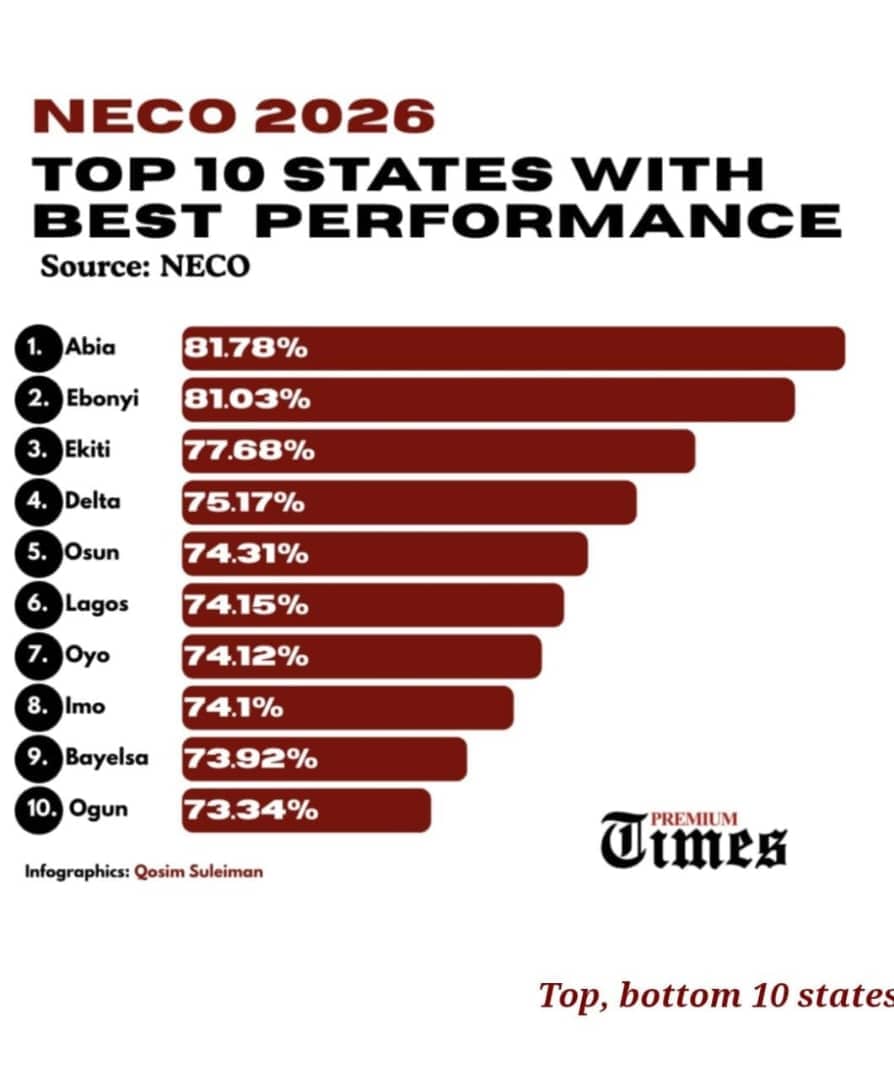
Osun State Governor, Senator Ademola Adeleke, has hailed the state’s strong performance in the 2026 National Examinations Council (NECO) Senior School Certificate Examination, describing the result as a positive reflection of ongoing efforts to reposition education in the state.
Osun placed fifth nationally in the 2026 NECO ranking, with 74.31 per cent of candidates recording at least five credits, including English Language and Mathematics.
While congratulating the students, teachers, parents, school administrators and other stakeholders, the governor noted that the state performance has been improving within a single digit rating for three consecutive years namely 2024, 2025 and 2026.
“Osun has moved from 33rd position in the 2022 NECO ranking to 5th in 2026, while improving its pass rate to 74.31 per cent. This is encouraging, and it shows that our sustained interventions in the education sector are yielding positive results,” the Governor said.
Governor Adeleke said the improved performance reflects his administration’s deliberate investment in the education sector, including the recruitment of additional teachers to strengthen the teaching workforce, while prioritising workers’ welfare and creating a more conducive environment for effective teaching and learning across public schools.
The Governor said the performance reinforces his administration’s determination to continue investing in education, noting that the objective is to build a system that gives every Osun child the knowledge, skills and opportunities needed to succeed.
“This result is encouraging, but we see it as a reason to do more. We will continue to invest in our schools, improve the learning environment, support our teachers and provide our students with the necessary tools to excel.
“We are building an education system that prepares our young people not only for examinations but for life,” the Governor said.
He assured that ongoing interventions in the education sector would be sustained and expanded, while urging students to remain committed to their studies.
His Excellency also commended teachers across the state for their dedication and sacrifices, assuring them that the administration would continue to prioritise measures that strengthen the education system and improve workers’ welfare.
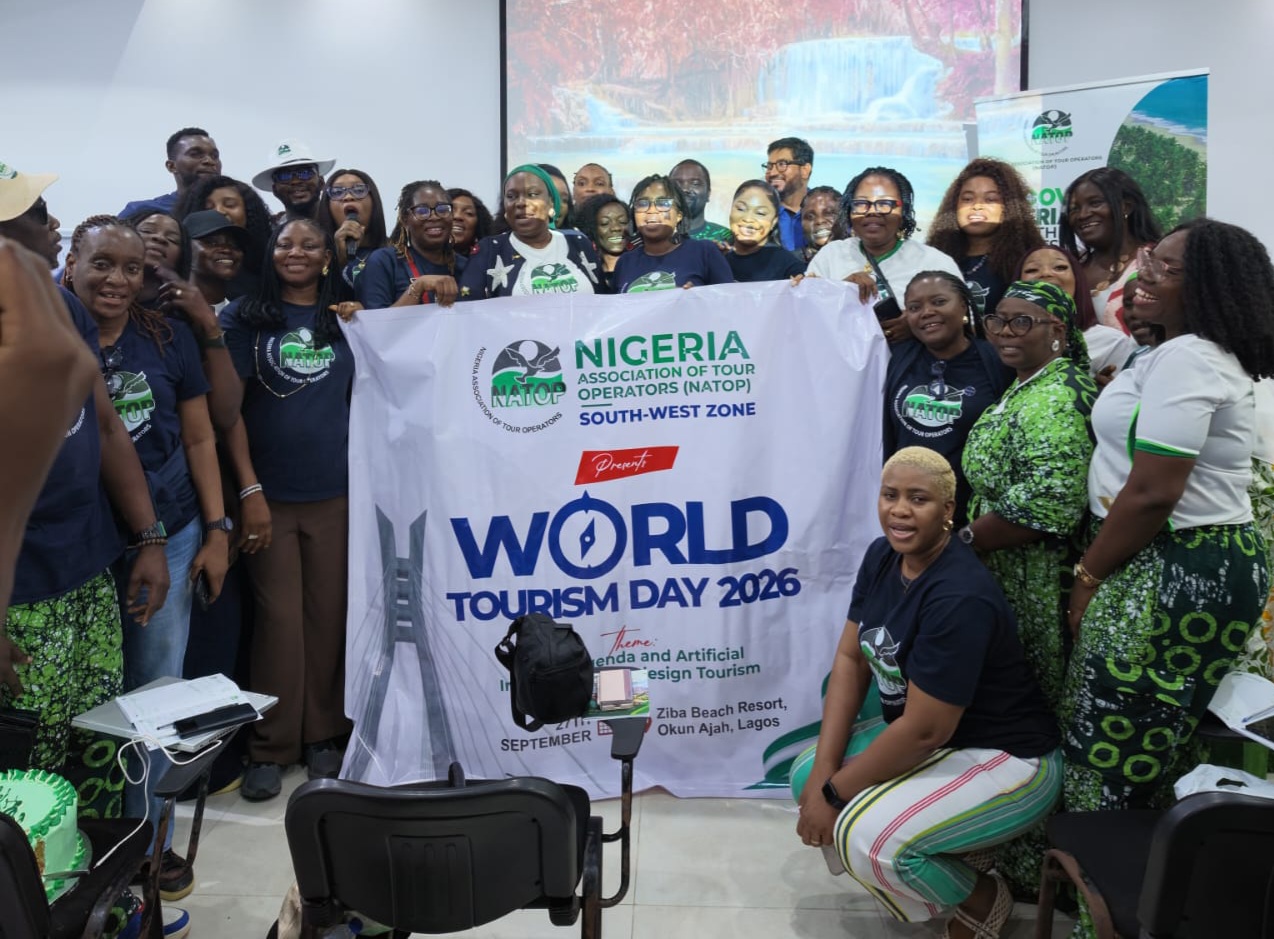
The Nigeria Association of Tour Operators (NATOP) marked the 2026 World Tourism Day with activities which capture capacity building, technology, destination promotion and domestic tourism, and celebration.
In the South West Zone, close to 200 tour operators gathered at Ziba Beach Resort, Lagos, for a special training focused on Artificial Intelligence and its application in tourism, equipping operators with digital tools to improve their businesses and destination marketing.
In Abuja, the FCT and Northern Zone, in collaboration with Naija Adventurers, staged a colourful Tourism Awareness Walk and Hike to the Centre of Nigeria.
The celebration also spread to the South-South Zone, where members marked the day with a destination tour, alongside activities to commemorate with the world tourism day celebrations.
In line with the theme for this year’s WTD celebration: ‘Digital agenda and artificial intelligence to redesign tourism’ the NATOP training on AI and application in tour operation at Ziba Beach Resort Lagos saw a large turnout of the members of the association.
The President of the association, Hajia Bolaji Mustapha explained that the idea for the location and training was to train members on how to do tour business, to know how to promote tourism digitally, using different AI tool and everything so that they will grow their businesses.
She said: “we follow the theme and, you know, blend with the old situation. Let’s do the training so that we attach it to the World Tourism Day with the theme that we have achieved something and also celebrate.”
She said the training will go a long way in helping the tour operators do greater content to digitally tell destination stories using AI, and also using the tool for expression.
Mustapha also explained why the association chose Ziba Beach Resort: “We always attach World Tourism Day to a tourism site. And definitely, if you look at this whole area and this community, that’s why we see that Ziba is a tourism site. We want to explore and of course. The resort newly launched its third phase. So, we will use this opportunity to look at their rooms, look at how we can sell this destination, to showcase it that the resort is actually in Nigeria, not Zanzibar. By using the place, we would kill two birds with one stones.
Facility tour of Ziba Beach Resort
“As tour operators who are willing to tell the good story of our Nigeria, we need to bring ourselves up to the speed, align with the digital revolution. Let everybody go digital. Because we also see the content creators are taking our business, we want to align it with what they do. We are the ones that understand the business and we’ll be able to tell the story better, so that anybody coming to Nigeria will be able to discover Nigeria with the experts.”
Also commenting on the celebration, the NATOP Vice President South West and chairman of the WTD Organizing Committee for the zone, Mrs. Wonuola Olatunde-Lamidi explained why NATOP South West’s usage of the 2026 WTD for training. She said many of the members still have a lot to learn about the tour business, and that some do not understand the foundation of the business, including how to create packages hence the need for the training.
Mrs. Olatunde-Lamidi spoke further: “Many don’t understand the foundation of what it is to create a tour package. And when you have people that are not well-trained in an industry, the industry will not grow. The kind of people that you also have will not have enough earning power to do many things. And because this is an industry that I have been in for 16 years, I run Diamonds and Pearls Travels with my husband. And I’ve seen Diamonds and Pearls Travels metamorphose into a company where people don’t just look at us as travel agents. We have become a Destination Management Company (DMC). We have become a trusted brand. We have become a company that when we talk about a destination, people want to go to that destination because of how we have portrayed the destination. And you may not realize that, as tour operators, you can actually decide where people go. You can make people go to a particular destination by marketing it, by letting them know the benefits of that destination.”
The tour operators had opportunity to tour the resort and unwind during the programme.


