
Metro
The Power of Strategy in the 21st Century: Unlocking Extraordinary Possibilities (Pt. 2)


- /home/rhoncare/pointblank.ng/wp-content/plugins/mvp-social-buttons/mvp-social-buttons.php on line 27
https://pointblank.ng/wp-content/uploads/2025/08/DR.TOLULOPE-A.-ADEGOKE-AMBP-UN__-1-744x600.jpg&description=The Power of Strategy in the 21st Century: Unlocking Extraordinary Possibilities (Pt. 2)', 'pinterestShare', 'width=750,height=350'); return false;" title="Pin This Post">
- Share
- Tweet /home/rhoncare/pointblank.ng/wp-content/plugins/mvp-social-buttons/mvp-social-buttons.php on line 69
https://pointblank.ng/wp-content/uploads/2025/08/DR.TOLULOPE-A.-ADEGOKE-AMBP-UN__-1-744x600.jpg&description=The Power of Strategy in the 21st Century: Unlocking Extraordinary Possibilities (Pt. 2)', 'pinterestShare', 'width=750,height=350'); return false;" title="Pin This Post">
By Tolulope A. Adegoke PhD
“In Nigeria, strategy is not an abstraction imported from elsewhere—it is forged daily in the crucible of reality. Here, global principles meet local truths, and the strategies that work are those humble enough to learn from both. The future of this nation will be written not by those who wait for solutions, but by those who create them from the raw materials of our own experience” – Tolulope A. Adegoke, PhD
Introduction: Why Strategy Matters More Than Ever
There was a time when strategy meant creating a detailed plan and sticking to it for years. You would map everything out, follow the steps, and expect success to follow. That world no longer exists.
Today, change happens too fast for rigid plans. Industries transform overnight. Skills that were valuable last year become obsolete. Global events ripple through local economies in ways we could never predict. In this environment, strategy has evolved into something more dynamic—less about predicting the future and more about building the capacity to navigate it successfully.
This is the power of 21st-century strategy. It helps individuals chart meaningful careers in uncertain times. It enables businesses to thrive despite constant disruption. It allows nations to build prosperity that outlasts any single administration.
Nowhere is this more evident than in Nigeria. Here, strategy is not an abstract exercise. It is a daily necessity. Nigerians navigate unreliable infrastructure, policy shifts, and economic volatility while pursuing their ambitions. The strategies that work here are not imported from textbooks. They are forged in the reality of local experience—blending global knowledge with gritty, on-the-ground wisdom.
This exploration looks at how strategy works at three levels in Nigeria: for the person trying to build a meaningful life, for the business striving to grow, and for the nation working to secure its future.
Part One: For the Nigerian People—Redefining Success in a Changing World
The Old Promise That No Longer Holds
Not long ago, the path to a good life seemed clear. You went to school, earned your degree, found a job, and worked your way up. That degree was your ticket. It signaled to employers that you had what it takes.
That promise has broken.
Today, Nigeria produces hundreds of thousands of graduates each year. Many of them are brilliant. Many of them struggle to find work. The degree that once opened doors now barely gets a foot in. Employers have changed what they look for. They want to know not what you studied, but what you can actually do.
This is not unique to Nigeria. It is happening everywhere. But in Nigeria, where formal jobs are scarce and the youth population is massive, the shift hits harder. For the average Nigerian young person, the message is clear: waiting for someone to give you a job is not a strategy.
A New Way of Thinking About Yourself
The most important strategic shift for any individual is this: stop thinking of yourself as someone looking for work and start thinking of yourself as someone who creates value.
This is not just positive thinking. It is a fundamental change in perspective. When you see yourself as a value creator, you ask different questions. Not “who will hire me?” but “what problems can I solve?” Not “what jobs are available?” but “where can I apply my skills?” Not “what degree do I need?” but “what can I learn to become more useful?”
This mindset matters because it puts you in control. You are no longer waiting for opportunities to be given to you. You are actively looking for ways to contribute. And in an economy where problems are everywhere, people who can solve them will always find a way to earn a living.
What Skills Actually Matter Today
If degrees no longer guarantee success, what does? The answer lies in skills that are both practical and adaptable.
Problem-solving sits at the top of the list. Every organization, every community, every family faces challenges. People who can look at a difficult situation and figure out a way forward are always needed. This skill does not come from a textbook. It comes from practice—from learning to think clearly when things go wrong.
Communication matters more than most people realize. The ability to express ideas clearly, to listen carefully, to persuade others, to write simply—these are not soft skills. They are the tools we use to turn thoughts into action. In any field, people who communicate well stand out.
Digital literacy is no longer optional. It is the baseline. Using spreadsheets, collaborating on online platforms, understanding how data works, knowing your way around common software—these are not technical skills for specialists. They are basic tools for modern work. Without them, you are locked out of most opportunities.
Adaptability might be the most important of all. The willingness to learn new things, to admit what you do not know, to try something different when the old way stops working—this is what keeps people relevant over a lifetime. The person who can learn will always find a place. The person who stops learning will eventually be left behind.
Learning That Fits Real Life
The traditional model of education assumes you learn first and work later. You spend years in school, then you start your career. But in a fast-changing world, that model breaks down. By the time you finish learning, what you learned may already be outdated.
This is why many Nigerians are turning to micro-credentials—short, focused courses that teach specific, job-ready skills. These programs take weeks or months, not years. They cost a fraction of what university costs. And they signal clearly to employers what you can do.
A certificate in data analysis, digital marketing, project management, or solar installation tells a clear story. It says: I have this specific skill, and I can apply it right now. For employers, that is often more valuable than a general degree.
The beauty of this approach is flexibility. You can learn while working. You can stack credentials over time, building a portfolio of skills. You can pivot when opportunities shift. This is lifelong learning made practical—not an ideal, but a working strategy for staying relevant.
Taking Control of Your Financial Life
Strategy also applies to money. For years, most Nigerians had limited options. You saved what you could, kept it at home or in a bank, and hoped it would be enough. Inflation often ate away at whatever you managed to put aside.
Technology has changed this. Today, anyone with a smartphone can access tools that were once available only to the wealthy. Apps allow you to save automatically, invest small amounts, and get advice tailored to your situation. You can build a diversified portfolio with whatever you have. You can protect your money against inflation. You can plan for goals that matter to you.
The key is to start early and stay consistent. Small amounts saved regularly, invested wisely, grow over time. This is not about getting rich quick. It is about building a foundation that gives you choices. The person with savings can take risks. The person with investments can weather storms. Financial strategy is not just about money—it is about freedom.
Part Two: For Nigerian Businesses—Thriving in a Complex Environment
The End of the Five-Year Plan
There was a time when companies created detailed five-year plans and followed them religiously. Those days are gone. Markets move too fast. Technology changes too quickly. Consumer behaviour shifts in ways no one predicts.
Today, successful companies think differently. They set direction but stay flexible. They plan but remain ready to pivot. They treat strategy not as a document but as a continuous conversation—a way of making decisions in real time as new information emerges.
This is especially true in Nigeria, where the business environment presents unique challenges. Electricity is unreliable. Roads are poor. Policy can change overnight. Currency fluctuations affect everything. Companies that succeed here learn to adapt constantly. Rigidity is a recipe for failure.
What Digital Transformation Really Means
Every business today hears about digital transformation. But in Nigeria, going digital looks different than it does elsewhere.
You cannot simply move everything online and expect it to work. Internet access is not universal. Many customers prefer cash. Trust is built through personal relationships, not just websites. The purely digital model that works in London or Singapore will hit walls here.
Successful Nigerian companies understand this. They build hybrid models—digital at the core, but with physical touchpoints where needed. They offer online ordering and offline delivery. They accept digital payments but also cash. They use technology to enhance relationships, not replace them.
This is not a compromise. It is a sophisticated adaptation to local reality. The companies that get it right are not less digital. They are more intelligent about how digital actually works in their context.
Digital maturity matters more than digital adoption. This means building systems that function even when infrastructure fails. It means training people to use tools effectively. It means integrating technology into every part of the business, not just tacking it on at the edges. Companies that achieve this maturity outperform their competitors consistently.
Building Trust in a Low-Trust Environment
Nigeria faces a trust deficit. Years of broken promises, failed institutions, and economic volatility have left people cautious. Consumers do not easily trust businesses. Employees do not easily trust employers. Partners do not easily trust each other.
For companies, this is both a challenge and an opportunity. The businesses that earn trust stand out. They build loyal customer bases. They attract committed employees. They form partnerships that last.
Building trust takes time and consistency. It means delivering what you promise, every time. It means being transparent when things go wrong. It means treating customers and employees with respect, not as transactions. It means showing up consistently, even when it is difficult.
Some of Nigeria’s most successful companies have built their reputations on this foundation. They are not necessarily the flashiest or the most innovative. They are the ones people know they can count on. In an environment where trust is scarce, reliability becomes a competitive advantage.
The Power of Collaboration
The old model of business assumed competition was everything. You fought for market share. You protected your secrets. You went it alone.
That model is breaking down. The challenges businesses face today are too complex for any single organisation to solve alone. Climate change affects everyone. Skills gaps require industry-wide responses. Infrastructure deficits need collective action.
Forward-thinking Nigerian companies are embracing collaboration. They share data with competitors to build industry standards. They partner with government on infrastructure projects. They work with educational institutions to shape curricula. They understand that when the whole ecosystem grows, everyone benefits.
This is not charity. It is enlightened self-interest. A rising tide lifts all boats. Companies that invest in the broader environment create conditions for their own success.
Artificial Intelligence: Proceed with Purpose
Artificial intelligence is everywhere in business conversations. The hype is enormous. The fear of being left behind is real.
But for Nigerian companies, the strategic question is not whether to use AI. It is how to use AI wisely. Jumping on every trend without purpose leads nowhere. Building AI capabilities without governance creates risk.
The smart approach starts with problems, not technology. What specific challenges does your business face? Where could better data or smarter algorithms help? What decisions could be improved with more insight? These questions point to where AI might actually add value.
Equally important is data governance. AI learns from data. If your data is poor, your AI will be poor. If your data is biased, your AI will be biased. If your data is insecure, your AI creates vulnerability. Building strong data practices is not a technical detail. It is a strategic foundation.
Some Nigerian companies are already showing the way. They are using AI to assess credit risk for customers without formal banking history. They are using it to predict crop yields for farmers. They are using it to personalize learning for students. These applications solve real problems. They are not imported from elsewhere. They are built for Nigeria, by Nigerians.
People First: The Talent Challenge
Every business leader in Nigeria will tell you the same thing: finding and keeping good people is the hardest part of the job. The best talent is scarce. Competition is fierce. Many of the brightest leave for opportunities abroad.
This makes talent strategy central to business success. Companies that win the talent game win everything else.
What does good talent strategy look like? It starts with recognizing that people want more than money. They want to grow. They want to be valued. They want to do work that matters. Companies that provide these things attract and retain better people even when they cannot pay the highest salaries.
This means investing in training and development. It means creating clear career paths. It means building cultures where people feel respected and supported. It means giving people autonomy and trusting them to do good work.
Some Nigerian companies have built their own universities—internal training programs that develop talent systematically. Others partner with online learning platforms to give employees access to courses. Others create mentorship programs that connect experienced leaders with younger staff. These investments pay back many times over in loyalty, productivity, and innovation.
Part Three: For the Nigerian Nation—Building a Future That Works for Everyone
From Short-Term Thinking to Long-Term Vision
For decades, Nigerian governance has been shaped by election cycles. Each new administration brings its own plans, its own priorities, its own language. Programmes start and stop. Momentum is lost. Progress is fragmented.
This is changing. Slowly but significantly, Nigeria is building long-term strategic frameworks that outlast any single government. The Nigeria Agenda 2050 looks three decades ahead. The Renewed Hope Development Plan (2026-2030) translates that vision into concrete action for the next five years. These documents are not just paperwork. They represent a commitment to continuity—a recognition that real development takes time and persistence.
The shift matters because it changes how decisions get made. When long-term goals are clear, short-term choices can be evaluated against them. Does this policy move us toward the future we want? Does this budget advance our long-term priorities? These questions create discipline. They reduce the risk that immediate pressures will derail important work.
The Nigeria First Approach
There is a quiet revolution happening in Nigerian economic thinking. It is captured in the phrase “Nigeria First.”
For too long, Nigeria has been a consumer of other people’s products. We import what we could make. We buy what we could build. We send our resources abroad and buy back finished goods at higher prices. This pattern has kept us dependent. It has limited our industrial development. It has cost us jobs.
The Nigeria First approach aims to change this. It says: where possible, we should buy Nigerian. We should build Nigerian. We should invest in Nigerian capabilities.
This is not protectionism. It is strategic procurement. Government spending accounts for a significant portion of the economy—as much as 30 percent of GDP. When that money flows abroad, it creates jobs elsewhere. When it stays home, it builds local industry. Directing even a portion of procurement toward Nigerian producers could unlock millions of jobs and stimulate manufacturing capacity.
Agencies like NASENI (National Agency for Science and Engineering Infrastructure) are driving this agenda. They are not just talking about local manufacturing. They are building it—developing products, training innovators, creating infrastructure for strategic industries like battery manufacturing. They are proving that Nigerians can make world-class products.
The challenge now is scaling this approach. Moving from pilot projects to systemic change. Embedding Nigeria First in procurement rules, in investment decisions, in the daily choices of businesses and consumers. Making patriotism practical—not just a sentiment but a force that shapes economic behaviour.
Digital Sovereignty: Owning Our Future Online
The digital economy runs on infrastructure. Data centers, fiber networks, cloud platforms—these are the roads and bridges of the 21st century. Countries that own their digital infrastructure have sovereignty. Countries that depend on others are vulnerable.
Nigeria is building toward digital sovereignty. Agencies like Galaxy Backbone are laying fiber across the country, connecting states, building data centers that meet international standards. This infrastructure ensures that government data stays in Nigeria. It provides continuity even when commercial providers face challenges. It builds capability that can serve the whole economy.
The vision goes further. With robust digital infrastructure, Nigeria can become a regional hub—serving West and Central Africa, attracting investment, creating jobs in technology and services. This is not just about catching up. It is about leapfrogging—using digital technology to accelerate development in ways previous generations could not.
But infrastructure alone is not enough. Digital sovereignty also means data sovereignty—control over the information that flows through these networks. It means policies that protect privacy while enabling innovation. It means building the human capacity to manage and secure digital systems. It means creating an environment where Nigerian technology companies can thrive.
The Demographic Dividend or Disaster?
Nigeria’s young population is often described as an opportunity. With a median age of eighteen, we are one of the youngest countries in the world. These young people could drive decades of economic growth.
But demography is not destiny. Young people are only an asset if they are productively engaged. If they are educated, healthy, and employed, they create wealth. If they are not, they become a source of instability.
This makes human capital development the most important investment Nigeria can make. Every child who receives quality education adds to our future capacity. Every young person who learns a skill becomes a potential contributor. Every life saved through better healthcare strengthens the whole society.
The challenge is scale. Nigeria’s education system is underfunded and overstretched. Millions of children are out of school. Quality varies enormously. The same is true for healthcare, for skills training, for social support. Building systems that reach everyone is a massive undertaking.
Yet progress is possible. Technology offers new ways to deliver education at scale. Community health workers can extend care to remote areas. Apprenticeship models can train young people in practical skills. The building blocks of human capital exist. The task is to assemble them into functioning systems.
The Governance Challenge
None of this works without effective governance. Good plans fail without good execution. Vision without implementation is just dreaming.
Nigeria’s governance challenges are well documented. Implementation gaps separate policy from reality. Coordination failures mean different agencies work at cross purposes. Capacity constraints limit what even dedicated officials can achieve. Trust deficits make collaboration difficult.
Addressing these challenges requires its own strategy. It means investing in the civil service—training, motivating, and supporting the people who run government day to day. It means using technology to improve transparency and accountability—making it harder for things to fall through cracks. It means creating platforms for dialogue between government, business, and civil society—so policies reflect real needs and real constraints.
It also means accepting that governance reform is slow work. Institutions are not built overnight. Trust is earned over years. Capacity grows through practice. The goal is not perfection but progress—steady, cumulative improvement in how things get done.
Conclusion: The Power of Small Wins Adding Up
There is a temptation to think of strategy as something grand—bold visions, dramatic transformations, sweeping changes. And certainly, those have their place.
But in Nigeria, the most powerful strategy may be something more modest. It is the individual who learns a new skill and applies it. The business that delivers on its promises, day after day. The policy that works as intended and makes life slightly better. These small wins, repeated millions of times, accumulate into something extraordinary.
This is the power of compounding progress. Each skilled graduate adds to the talent pool. Each reliable business builds trust in the market. Each functioning program demonstrates that government can work. These gains build on each other. Over time, they transform what is possible.
Nigeria has immense resources—human, natural, cultural. It has a young population full of energy and ambition. It has entrepreneurs solving problems every day. It has officials working to build systems that serve everyone. The foundation is there.
Strategy provides the framework—the way of thinking that helps individuals, businesses, and the nation make good choices amid uncertainty. It does not guarantee success. Nothing does. But it improves the odds. It helps us see more clearly. It keeps us moving in the right direction, even when the path is unclear.
That is the power of 21st-century strategy. Not predicting the future, but preparing for it. Not controlling events, but navigating them. Not waiting for possibilities to arrive, but working to make them real.
For Nigeria and Nigerians, those possibilities are extraordinary. The work of strategy is to bring them within reach.
Dr. Tolulope A. Adegoke, AMBP-UN is a globally recognized scholar-practitioner and thought leader at the nexus of security, governance, and strategic leadership. His mission is dedicated to advancing ethical governance, strategic human capital development, and resilient nation-building, and global peace. He can be reached via: tolulopeadegoke01@gmail.com, globalstageimpacts@gmail.com


Metro
International Day of the Girl-Child: Pad Me A Girl Foundation Holds Menstrual Health Outreach in Ogun
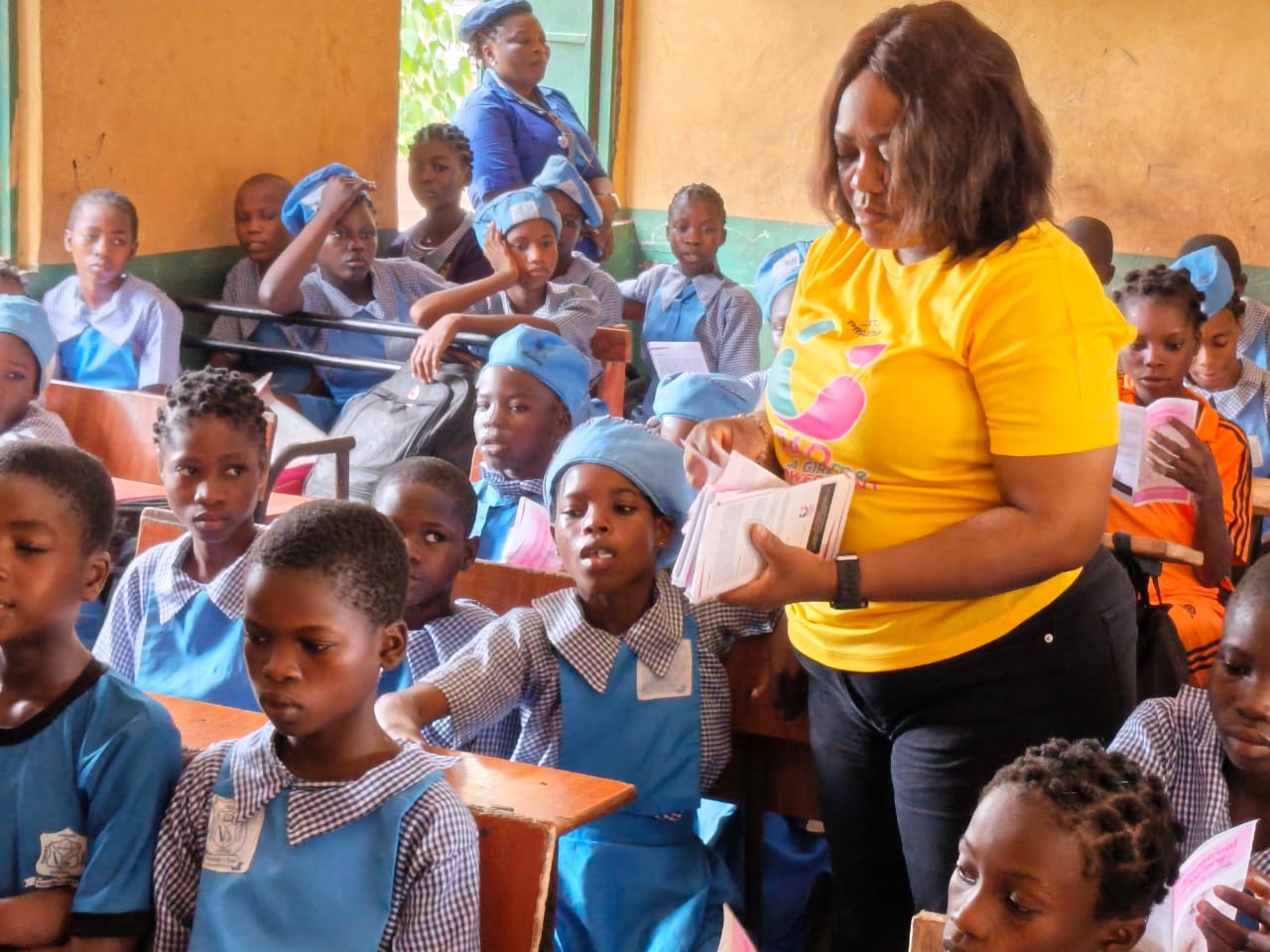
The Pad Me A Girl Empowerment Foundation has taken its menstrual health campaign to Igbesa High School (Junior), in Ado-Odo/Ota Local Government Area of Ogun State, providing free sanitary pads, menstrual hygiene pamphlets, exercise books and pens to over 100 schoolgirls to promote menstrual health, dignity and education.
The outreach, held on Wednesday, October 21, commemorated the 2026 International Day of the Girl Child, whose global theme is “End Child Marriage and Invest in Girls’ Rights!”
The programme brought together girls from Junior Secondary School (JSS) 1 to 3 who participate in the school’s reading clubs for mentorship, reading activities and menstrual health education.
It was convened by Oyelami Yetunde Anuoluwapo and Blessing Kappo, teachers and Teach For Nigeria Fellows at the school, following an appeal for sanitary products, learning materials and health education support. The Foundation’s founder, Theresa Moses, responded by providing the requested items and facilitating an interactive session on menstrual hygiene management.
Speaking at the event, Moses said she was inspired by the girls’ determination and aspirations, stressing the need for sustained investment in their health, education and future.
“Invest in girls and Nigeria will rise. Every girl deserves dignity, education and the right to dream beyond child marriage. That is why we are here; to ensure no girl misses school because of her period,” she said.
She emphasised that access to menstrual hygiene products and accurate information helps girls manage their periods confidently and participate fully in school activities.
In a letter of appreciation, Oyelami and Kappo described the outreach as impactful and inspiring, noting that it enhanced the girls’ understanding of menstrual health, hygiene and self-confidence. They also said the support would help promote the students’ hygiene, school attendance and dignity.
“You did not just give pads; you gave our girls confidence and hope,” the teachers wrote on behalf of the school community, expressing gratitude to the Foundation and hope for future collaboration.
Mrs Amarachi Eze, Assistant Divisional Commissioner of the Nigerian Girl Guides Association, Ado-Odo/Ota, Ogun State Branch, also commended the Foundation for supporting the girls’ hygiene needs and development.
“We sincerely appreciate the Management of Pad Me A Girl Foundation for joining hands with the Association in supporting our girls on hygiene management. May God Almighty continue to uplift your foundation. Thanks for joining hands in the development of girls in our schools. Bravo,” she said.
The Foundation’s Media Coordinator, Mr Oluwatosin Simon Faleye, called on corporate organisations, non-governmental organisations and well-meaning Nigerians to support initiatives that address period poverty and help girls remain in school.
“For over a year, we have been committed to ending period poverty and keeping girls in school. We call on corporate organisations and well-meaning Nigerians to support this cause for the betterment of Nigeria,” Faleye said.
The celebration also featured a student drama presentation highlighting the effects of child marriage, alongside reading and mentorship activities designed to encourage the girls to understand their rights, value their education and pursue their aspirations.
The Foundation also acknowledged the continued support of its sponsors and partners, including Access Bank, Pro Star Sports International, BL Consulting, Vita Baites Foods, Checkers, Senator Ireti Kingibe, representing the Federal Capital Territory (FCT) in the 10th Nigerian National Assembly, the Senate Committee on Women Affairs (SCOWAS), as well as individuals and media organisations whose contributions have supported its broader mission of ending period poverty, promoting menstrual health education and empowering girls and women.
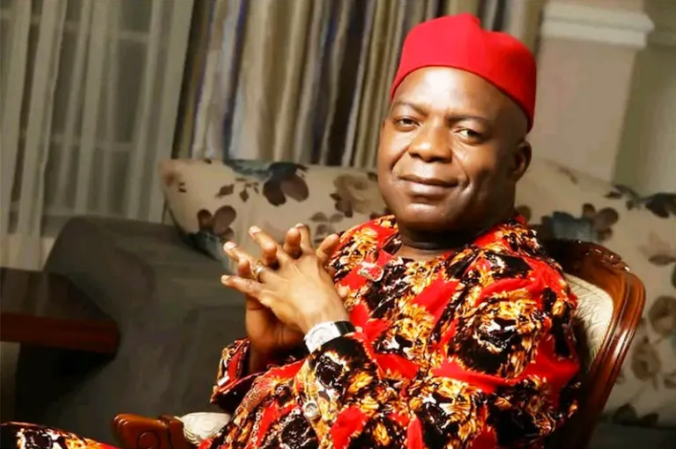
Abia State governor, Alex Otti, is set to flag off the reconstruction of Uratta Road and Old Express Road in Aba, two major routes which poor condition has disrupted transportation, commercial activities and access to residential communities for years.
The governor’s media aide, Ferdinand Ekeoma, in a statement on Wednesday, said that work on the roads has begun ahead of the scheduled official flag-off.
The two roads are considered important to Aba’s commercial and industrial activities, with Uratta Road connecting several adjoining streets to Port Harcourt Road and Old Express Road. At the same time, Old Express Road serves as a key route within the city’s industrial layout.
Ekeoma said the roads had suffered neglect for more than 24 years, leaving some sections impassable and forcing residents and businesses to contend with difficult transportation conditions.
According to the statement, Uratta Road provides access to more than 100 adjoining streets. Its poor condition has affected residents, traders and small-scale manufacturers who depend on the road to transport goods and access their businesses.
The statement said the road had become waterlogged and overgrown with weeds, discouraging commercial motorcycle and tricycle operators from using it.
Similarly, the deterioration of Old Express Road forced heavy-duty truck operators, fabric merchants, spare-parts dealers and small businesses to use longer routes, increasing transportation costs and affecting productivity.
The government said the road reconstruction is part of its broader effort to restore Aba’s infrastructure and strengthen the city’s commercial base.
Aba, one of southeastern Nigeria’s major commercial centres, hosts manufacturing clusters, markets, and small and medium-sized enterprises that depend heavily on functional roads to move raw materials and finished products.
The government said the reconstruction would improve market access, reduce transportation costs, facilitate the movement of goods, and support businesses operating along the affected corridors.
Ekeoma cited the reconstruction of Port Harcourt Road as an example of the administration’s infrastructure programme, noting that improved road access encouraged shops to reopen, attracted manufacturing activities and increased property rents along the corridor.
The government also said the new projects would complement other road interventions in Aba, including works on Ohanku and Obohia roads, as part of efforts to improve connectivity within the commercial city.
Beyond road construction, the administration said its projects include drainage systems, solar-powered streetlights, and pedestrian walkways, which it described as necessary to improve safety, accessibility, and flood resilience.
Ekeoma said Governor Otti views infrastructure development as an economic strategy rather than merely a construction programme, arguing that better roads would help businesses operate more efficiently and create employment opportunities.
He also quoted the governor as saying at an earlier church event that his administration is shifting attention from basic infrastructure improvements to healthcare, education, technology and industrialisation.
The governor, a former bank chief executive, was elected in 2023 on the Labour Party platform, defeating candidates from the major established parties in a state historically dominated by the Peoples’ Democratic Party.
Otti has remained in the Labour Party despite the defection of its 2023 presidential candidate, Peter Obi.
His administration has made rehabilitating Aba roads and public infrastructure central to its governance agenda, presenting the city’s recovery as essential to reviving economic activity across Abia State.

MILO Nigeria, in partnership with former Nigerian national team captain and MILO Brand Ambassador Ahmed Musa, has concluded the inaugural MILO × Ahmed Musa Sports Clinic and Tournament in Kano, providing 2,500 young footballers with professional coaching, mentorship and competitive football experience.
Over two weeks, participants took part in 10 coaching sessions and competed in matches under the guidance of Ahmed Musa and experienced coaches. The programme combined practical football training with lessons in teamwork, discipline, resilience and confidence, equipping participants with skills and values that extend beyond the pitch.
The initiative culminated in a tournament at the Ahmed Musa Sports Complex in Kano, where Khamis Football Academy emerged as champions of the inaugural edition. Participants also received cash prizes, certificates and football equipment.
Speaking on the initiative, Gilbert Tweneboah-Koduah, Category Lead, MILO, said: “At MILO, we believe sport is a powerful platform for young people to discover their abilities, build confidence and develop values that extend beyond the field of play. Our partnership with Ahmed Musa brings together MILO’s longstanding commitment to sports development and the experience of an athlete whose journey from grassroots football to the highest level of the game can inspire the next generation. By combining his experience with structured coaching and competition, this programme has given young footballers in Kano an opportunity to develop their skills, learn from experienced professionals and better understand the commitment required to pursue their aspirations.”
For the participants, the clinic offered an opportunity to learn from an athlete whose football journey began in northern Nigeria and progressed to the highest levels of the sport, making his experience a source of inspiration for aspiring players.
Commenting on the partnership, Ahmed Musa said: “Nigeria has incredible football talent, but talent alone is not enough. Young players need good coaching, regular competition and people who will guide them. I am proud to partner with MILO and share some of what football has taught me. My message to these players is simple: keep training, listen to your coaches and work hard every day to improve.”
Musa also called for greater investment in grassroots football, emphasizing the importance of giving young players access to quality coaching, structured development and regular competitive opportunities.
The MILO × Ahmed Musa Sports Clinic and Tournament builds on MILO’s longstanding commitment to youth development through sports in Nigeria. Through its school-based and grassroots sporting initiatives, MILO continues to create opportunities for young people to participate in sports, develop their abilities and embrace values that can support them both on and off the pitch.


