
Metro
The Scar That Leads: How Leadership’s Bruised Ego Becomes the Blueprint for Collective Glory!


- /home/rhoncare/pointblank.ng/wp-content/plugins/mvp-social-buttons/mvp-social-buttons.php on line 27
https://pointblank.ng/wp-content/uploads/2025/08/DR.TOLULOPE-A.-ADEGOKE-AMBP-UN__-1-744x600.jpg&description=The Scar That Leads: How Leadership’s Bruised Ego Becomes the Blueprint for Collective Glory!', 'pinterestShare', 'width=750,height=350'); return false;" title="Pin This Post">
- Share
- Tweet /home/rhoncare/pointblank.ng/wp-content/plugins/mvp-social-buttons/mvp-social-buttons.php on line 69
https://pointblank.ng/wp-content/uploads/2025/08/DR.TOLULOPE-A.-ADEGOKE-AMBP-UN__-1-744x600.jpg&description=The Scar That Leads: How Leadership’s Bruised Ego Becomes the Blueprint for Collective Glory!', 'pinterestShare', 'width=750,height=350'); return false;" title="Pin This Post">
By Tolulope A. Adegoke PhD
When the ego is bruised, the soul has room to grow. When the leader falls, the team learns to rise. When the visionary is humbled, the vision becomes truly shared. This is the paradox of power: only in surrender does one truly lead.
Idea in Brief
The Problem: Conventional wisdom treats a bruised ego as a liability—something to be suppressed or overcome. But leaders who try to avoid ego bruises often make their organizations fragile and defensive.
The Opportunity: The bruised ego is not merely an obstacle; it is a powerful catalyst for transformation. When leaders learn to embrace the discomfort of being wrong, challenged, or upstaged, they unlock collective genius.
The Solution: A four-part framework for transforming ego wounds into organizational wisdom: embrace vulnerability, turn setbacks into superpowers, practice radical self-awareness, and build a failure-friendly culture.
Introduction: The Crucible of Command
In the lexicon of modern leadership, few concepts are regarded with as much trepidation and misunderstanding as the “bruised ego.” Conventional wisdom often frames it as a liability—a source of poor judgment, defensive posturing, and career derailment. Leaders are advised to suppress it, transcend it, or, in some modern prescriptions, even “kill” it entirely. Yet, this perspective overlooks a profound truth: the bruised ego, when mastered, is not merely an obstacle to be overcome but a forge in which authentic leadership is tempered. It is the indispensable catalyst that births glory not for the leader, but for the collectives they serve.
This discourse posits a paradigm shift: the bruised ego is often a blessing in disguise, a necessary dismantling of the “false self” that prevents leaders from perceiving reality accurately and acting with the necessary humility and resilience to solve intractable challenges. From the corridors of global corporations to the complex ecosystems of nations, the ability to endure a bruised ego—to have one’s assumptions challenged, one’s authority questioned, and one’s plans thwarted—is the bedrock upon which enduring success is built. The path to glory is rarely a triumphant march; it is, more often, a series of humbling recoveries from falls, where the leader learns to transform a wound into wisdom and a setback into a strategic advantage.
Section I: Deconstructing the “Bruised Ego” in the Context of Leadership
Before exploring its transformative potential, it is essential to understand the nature of the ego in leadership. The ego, in psychological terms, is not inherently malevolent. It is the concept of the “self,” our identity and our idea of who we are in relation to the world. A well-developed ego is the engine of self-esteem, confidence, and ambition—qualities essential for taking risks and inspiring others. The problem arises when this healthy ego becomes distorted by pride, transforming into a “puffed-up” sense of self that is impervious to feedback and disconnected from reality. This is the ego that demands recognition, hoards credit, and perceives any challenge as a personal threat.
A “bruised ego” is the psychic wound inflicted when this self-concept is threatened. This can occur through a public failure, a perceived slight, the success of a rival, or having one’s authority or judgment questioned. As scholar Annabel Beerel articulates in Courage: The Heart of Leadership, leaders require the courage to set aside their egos, to feel vulnerable, and to face challenge while remaining principled. Without the bruise, there is often no impetus for this difficult work.
Section II: The Counter-Intuitive Gift: Why Bruising is a Blessing
The critical insight is that this “bruising” is often a necessary and painful correction to a leader’s trajectory. The very act of having one’s ego bruised forces a confrontation with reality that would otherwise be avoided. It is the definitive signal that the leader’s assumptions, strategies, or perhaps even their character, are misaligned with the demands of their environment.
The “blessing” manifests in several crucial ways:
1. The Death of Omniscience
A bruised ego shatters the illusion of infallibility. It forces the leader to acknowledge they do not have all the answers, creating space for learning, collaboration, and seeking diverse perspectives. This is the beginning of wisdom, as the leader is finally able to listen without the filter of defensiveness.
2. A Catalyst for Innovation
As Nvidia CEO Jensen Huang starkly puts it, he experienced failures—”great big ones. All humiliating and embarrassing. Many nearly doomed us”. Huang insists that product flops and near-misses that nearly sank Nvidia were not detours but the very engine of their success. “Confronting our mistake and, with humility, asking for help saved NVIDIA,” he reflected. Reflecting on the journey, Huang acknowledged that the path was marked by years of pressure, humiliation, and near-bankruptcy scares. He openly admitted that if he had known “how hard it is and all of the pain and suffering and all the embarrassment and humiliation and all the setbacks,” he would not start the company again. Yet it was precisely this endurance through humiliation that forged Nvidia’s character during its three-decade journey from a three-person gaming-graphics startup to a global AI leader. Each crisis forced his team to rethink, redesign, and innovate at a pace that steady success never would have demanded.
3. The Birth of Empathy
Leaders who have suffered setbacks, failed publicly, and had their own vulnerabilities exposed are often far more empathetic and compassionate leaders. They can connect with the struggles of their team, creating a psychological safety that fosters risk-taking and innovation. As Brené Brown’s research on vulnerability emphasizes, displaying vulnerability is not a weakness but a crucial leadership trait essential for fostering brave leaders and courageous cultures. Vulnerability, Brown asserts, is the “emotion we experience during times of uncertainty, risk, and emotional exposure,” and embracing it “lead[s] to every positive emotion that we need in our lives”.
4. A “Failure-Friendly” Culture
Leaders who have learned to embrace their own bruised egos are more likely to create a culture where failure is not a career-ending catastrophe, but a learning opportunity. When a leader embraces failure and shares vulnerability with humility, followers are able to connect with the leader at an emotional level and are more likely to share feelings of vulnerability themselves .
Section III: The Costs of an Unchecked Ego
To fully appreciate the value of the bruised ego, one must first witness the devastation wrought by an unchecked one. History is replete with examples of leaders whose refusal to have their egos challenged led to a failure of personal, corporate, and even national proportions.
1. The Iacocca-Ford Schism
On July 13, 1978, Ford Motor Company chairman Henry Ford II fired Lee Iacocca as Ford’s president, ending years of tension between the two men. The conflict had reached its zenith when Iacocca, then president of Ford, attempted to convince company directors that Henry Ford was senile and should be replaced, effectively mounting a “palace revolution” while Ford was away in China. According to Walter Hayes’s book and the recollection of board member Franklin D. Murphy, Iacocca’s attempt to oust Ford backfired spectacularly; upon returning from China and learning of the coup attempt, Ford demanded a vote of confidence from the board, declaring, “It’s me or Iacocca”. The board sided with Ford, and Iacocca was dismissed.
This was not just a personal failure; it was a strategic blunder of immense proportions. The move demoralized staff, many of whom followed Iacocca to rival Chrysler, where he led a legendary turnaround, actively strengthening a competitor while weakening Ford. This illustrates how unchecked ego battles can directly harm an organization’s competitive advantage.
2. The Apple Civil War
In the mid-1980s, Apple was torn between two powerful leaders: Steve Jobs, the visionary founder, and John Sculley, the professional CEO whom Jobs had famously recruited from Pepsi with the challenge, “Do you want to spend the rest of your life selling sugared water, or do you want a chance to change the world?”. When their visions diverged, Jobs plotted Sculley’s exit by sending him to China on a business tour and attempting to wrest control of Apple in his absence. Sculley, getting wind of the scheme, returned and made his case before the board, which voted against Jobs.
As Jobs later reflected in his famous 2005 Stanford commencement address, “It turned out that getting fired from Apple was the best thing that could have ever happened to me. The heaviness of being successful was replaced by the lightness of being a beginner again, less sure about everything. It freed me to enter into one of the most creative periods of my life”. Yet this silver lining for Jobs came at a tremendous cost to Apple, which plunged into a decade of stagnation following his departure. Even Sculley later expressed regret, suggesting, “Maybe he should have been the CEO and I should have been the president”. The conflict proved that when the ego of leadership is prioritized over collaborative vision, the entire organization suffers.
3. The Tata-Mistry Legal Feud
The saga between Ratan Tata and his successor Cyrus Mistry at Tata Sons serves as a cautionary tale of how the inability to separate one’s legacy from the evolving needs of an organization can lead to protracted conflict and instability. Mistry, who was personally endorsed by Tata for the position, was unexpectedly removed from his chairmanship in October 2016 after a board vote. He contested his dismissal, alleging mismanagement and oppression of minority shareholders by the board, while Tata Sons accused Mistry of mismanagement and underperformance.
The conflict escalated from the boardroom to legal tribunals and ultimately to the Supreme Court of India, with Mistry filing a case in the National Company Law Tribunal accusing Tata Sons of mismanagement and oppressive practices . While the Supreme Court ultimately ruled in favor of Tata Sons in March 2021, dismissing Mistry’s claims, the public battle exposed aspects of the Tata Group’s functioning that few had previously known. An executive close to the legal wrangle described it as “probably the toughest” of all controversies Tata faced—”a man handpicked by Tata himself to lead the Tata group who had now turned against him”. The feud threatened to upend the management of a $111 billion conglomerate and serves as a stark reminder of how ego-driven conflicts can destabilize even the most venerable institutions.
Section IV: The Journey from Wound to Wisdom—A Framework for Transformation
The transformation of a bruised ego from a source of pain to a source of power is not a passive process; it requires deliberate action and a fundamental shift in mindset. The exemplars of this transformation offer a practical framework.
1. Embrace Vulnerability as a Strength
The modern CEO is often expected to project an image of unwavering confidence. However, the research of Brené Brown has fundamentally challenged this assumption. Brown argues that vulnerability is “our most accurate measure of courage” and that embracing vulnerability—letting oneself be seen—is “incredibly difficult” yet essential. She notes a critical paradox: vulnerability is “the first thing I look for in you but it’s the last thing I want you to see in me. In you, it’s courage, in me, it’s inadequacy”.
The ultimate test of a healed ego is no longer seeing vulnerability as a threat. As the research emphasizes, “When a leader embraces failure and shares vulnerability with humility, followers are able to connect with the leader at an emotional level and are more likely to share feelings of vulnerability themselves” . This creates a virtuous cycle where psychological safety fosters innovation and growth.
2. Turn Setbacks into Superpowers
The most impactful leaders don’t just recover from setbacks; they reframe them. Charles Schwab’s battle with dyslexia was not a disability to be hidden but a formative experience that shaped his leadership approach. Schwab has openly acknowledged that his struggles with dyslexia prompted him to be humble and to turn to people who were smarter than him, noting that “it can actually lead to some leadership qualities”. His memoir Invested details how working around and ultimately embracing his dyslexia became central to his success as a discount brokerage pioneer.
Similarly, Jensen Huang’s journey with Nvidia demonstrates that survival through multiple existential crises—failed chips, layoffs, moments when the company was only weeks away from running out of money—requires “forgetting yesterday” and focusing relentlessly forward. The only way he endured, Huang explains, was by training himself not to dwell on setbacks: “What do they teach athletes? Forget the last point”.
3. Practice Self-Awareness and Mindfulness
As Brown’s research underscores, “How much we know ourselves is extremely important, but how we treat ourselves is the most important”. Leaders who lack self-awareness “limit the perspective and insights that (they) can share with the people [they] lead”. Authentic leaders are described as “self-aware and self-regulating individuals, whose beliefs and behaviors are anchored by a commitment to their ‘true self'”. This requires reflective practices through which leaders’ “own goals and performance are likely to thrive”.
Section V: The Collective Glory—From Individual Healing to Organizational Triumph
The ultimate purpose of mastering the bruised ego is to unlock the collective potential of the organization or nation. When a leader is no longer driven by personal glory, credit, and validation, a profound shift occurs. They become a servant to the mission, rather than a master of the narrative. This fosters a culture of psychological safety and shared purpose.
A leader who can absorb the “bruise” of not being the center of attention, of sharing credit, and of admitting a mistake builds loyalty, trust, and a workforce motivated to go above and beyond. The research on vulnerability in leadership consistently finds that “collaboration … requires a deep understanding of vulnerability: the generosity, humility, and patience needed to work through conflicts, misunderstandings, and miscommunications”. Trust and vulnerability are inextricably linked; Brown specifically identifies that “trust comes before vulnerability” is a myth, emphasizing that they are mutually reinforcing.
At the national level, this principle is equally potent. Leaders who can admit strategic failures, adapt to changing global realities, and prioritize the well-being of their people over their political legacy are those who lead their nations through crises. Conversely, leaders whose bruised egos lead to isolation, scapegoating, and the pursuit of personal narratives at the expense of national interest inevitably lead their countries into decline. The ability to lead with a healthy ego—one that is resilient yet humble—is perhaps the single most important determinant of success in the complex, interconnected challenges of the 21st century.
Conclusion: The Scar as a Blueprint
In conclusion, the bruised ego is not a sign of weakness but a sign of courage. It is the unavoidable cost of leading in a complex world where failure is not an anomaly but an inevitability. The leaders who will shape the future—from the boardrooms of our largest corporations to the halls of government—are not those who have never been bruised, but those who have learned to interpret their scars as a blueprint for a better path forward.
The “blessing” of the bruised ego lies in its power to dismantle the arrogance of certainty and replace it with the humility of curiosity. It transforms the leader from a sole decision-maker into a catalyst for collective genius. It is the painful but necessary process of forging a leader who is not defined by their power, but by their purpose. Ultimately, the bruised ego births glory not for the individual, but for the people, corporates, and nations they lead, proving that the most profound victories are born from the ashes of personal defeat. The challenge, therefore, is not to avoid the bruise, but to have the wisdom to see it for what it truly is: an opportunity for transformation.
Dr. Tolulope A. Adegoke, AMBP-UN is a globally recognized scholar-practitioner and thought leader at the nexus of security, governance, and strategic leadership. His mission is dedicated to advancing ethical governance, strategic human capital development, resilient nation building, and global peace. He can be reached via: tolulopeadegoke01@gmail.com, globalstageimpacts@gmail.com


Metro
International Day of the Girl-Child: Pad Me A Girl Foundation Holds Menstrual Health Outreach in Ogun

The Pad Me A Girl Empowerment Foundation has taken its menstrual health campaign to Igbesa High School (Junior), in Ado-Odo/Ota Local Government Area of Ogun State, providing free sanitary pads, menstrual hygiene pamphlets, exercise books and pens to over 100 schoolgirls to promote menstrual health, dignity and education.
The outreach, held on Wednesday, October 21, commemorated the 2026 International Day of the Girl Child, whose global theme is “End Child Marriage and Invest in Girls’ Rights!”
The programme brought together girls from Junior Secondary School (JSS) 1 to 3 who participate in the school’s reading clubs for mentorship, reading activities and menstrual health education.
It was convened by Oyelami Yetunde Anuoluwapo and Blessing Kappo, teachers and Teach For Nigeria Fellows at the school, following an appeal for sanitary products, learning materials and health education support. The Foundation’s founder, Theresa Moses, responded by providing the requested items and facilitating an interactive session on menstrual hygiene management.
Speaking at the event, Moses said she was inspired by the girls’ determination and aspirations, stressing the need for sustained investment in their health, education and future.
“Invest in girls and Nigeria will rise. Every girl deserves dignity, education and the right to dream beyond child marriage. That is why we are here; to ensure no girl misses school because of her period,” she said.
She emphasised that access to menstrual hygiene products and accurate information helps girls manage their periods confidently and participate fully in school activities.
In a letter of appreciation, Oyelami and Kappo described the outreach as impactful and inspiring, noting that it enhanced the girls’ understanding of menstrual health, hygiene and self-confidence. They also said the support would help promote the students’ hygiene, school attendance and dignity.
“You did not just give pads; you gave our girls confidence and hope,” the teachers wrote on behalf of the school community, expressing gratitude to the Foundation and hope for future collaboration.
Mrs Amarachi Eze, Assistant Divisional Commissioner of the Nigerian Girl Guides Association, Ado-Odo/Ota, Ogun State Branch, also commended the Foundation for supporting the girls’ hygiene needs and development.
“We sincerely appreciate the Management of Pad Me A Girl Foundation for joining hands with the Association in supporting our girls on hygiene management. May God Almighty continue to uplift your foundation. Thanks for joining hands in the development of girls in our schools. Bravo,” she said.
The Foundation’s Media Coordinator, Mr Oluwatosin Simon Faleye, called on corporate organisations, non-governmental organisations and well-meaning Nigerians to support initiatives that address period poverty and help girls remain in school.
“For over a year, we have been committed to ending period poverty and keeping girls in school. We call on corporate organisations and well-meaning Nigerians to support this cause for the betterment of Nigeria,” Faleye said.
The celebration also featured a student drama presentation highlighting the effects of child marriage, alongside reading and mentorship activities designed to encourage the girls to understand their rights, value their education and pursue their aspirations.
The Foundation also acknowledged the continued support of its sponsors and partners, including Access Bank, Pro Star Sports International, BL Consulting, Vita Baites Foods, Checkers, Senator Ireti Kingibe, representing the Federal Capital Territory (FCT) in the 10th Nigerian National Assembly, the Senate Committee on Women Affairs (SCOWAS), as well as individuals and media organisations whose contributions have supported its broader mission of ending period poverty, promoting menstrual health education and empowering girls and women.
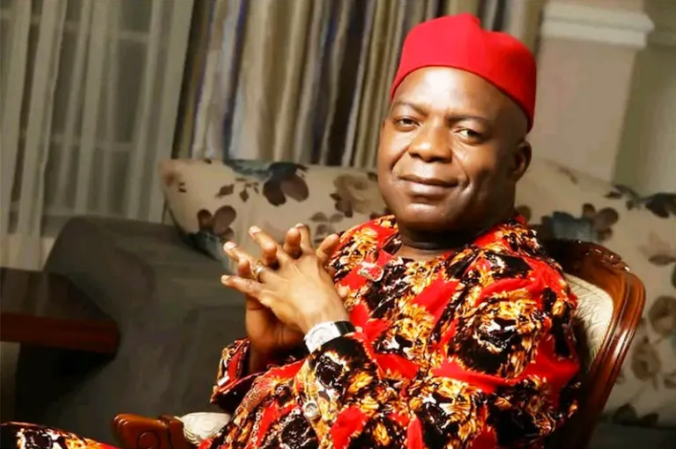
Abia State governor, Alex Otti, is set to flag off the reconstruction of Uratta Road and Old Express Road in Aba, two major routes which poor condition has disrupted transportation, commercial activities and access to residential communities for years.
The governor’s media aide, Ferdinand Ekeoma, in a statement on Wednesday, said that work on the roads has begun ahead of the scheduled official flag-off.
The two roads are considered important to Aba’s commercial and industrial activities, with Uratta Road connecting several adjoining streets to Port Harcourt Road and Old Express Road. At the same time, Old Express Road serves as a key route within the city’s industrial layout.
Ekeoma said the roads had suffered neglect for more than 24 years, leaving some sections impassable and forcing residents and businesses to contend with difficult transportation conditions.
According to the statement, Uratta Road provides access to more than 100 adjoining streets. Its poor condition has affected residents, traders and small-scale manufacturers who depend on the road to transport goods and access their businesses.
The statement said the road had become waterlogged and overgrown with weeds, discouraging commercial motorcycle and tricycle operators from using it.
Similarly, the deterioration of Old Express Road forced heavy-duty truck operators, fabric merchants, spare-parts dealers and small businesses to use longer routes, increasing transportation costs and affecting productivity.
The government said the road reconstruction is part of its broader effort to restore Aba’s infrastructure and strengthen the city’s commercial base.
Aba, one of southeastern Nigeria’s major commercial centres, hosts manufacturing clusters, markets, and small and medium-sized enterprises that depend heavily on functional roads to move raw materials and finished products.
The government said the reconstruction would improve market access, reduce transportation costs, facilitate the movement of goods, and support businesses operating along the affected corridors.
Ekeoma cited the reconstruction of Port Harcourt Road as an example of the administration’s infrastructure programme, noting that improved road access encouraged shops to reopen, attracted manufacturing activities and increased property rents along the corridor.
The government also said the new projects would complement other road interventions in Aba, including works on Ohanku and Obohia roads, as part of efforts to improve connectivity within the commercial city.
Beyond road construction, the administration said its projects include drainage systems, solar-powered streetlights, and pedestrian walkways, which it described as necessary to improve safety, accessibility, and flood resilience.
Ekeoma said Governor Otti views infrastructure development as an economic strategy rather than merely a construction programme, arguing that better roads would help businesses operate more efficiently and create employment opportunities.
He also quoted the governor as saying at an earlier church event that his administration is shifting attention from basic infrastructure improvements to healthcare, education, technology and industrialisation.
The governor, a former bank chief executive, was elected in 2023 on the Labour Party platform, defeating candidates from the major established parties in a state historically dominated by the Peoples’ Democratic Party.
Otti has remained in the Labour Party despite the defection of its 2023 presidential candidate, Peter Obi.
His administration has made rehabilitating Aba roads and public infrastructure central to its governance agenda, presenting the city’s recovery as essential to reviving economic activity across Abia State.
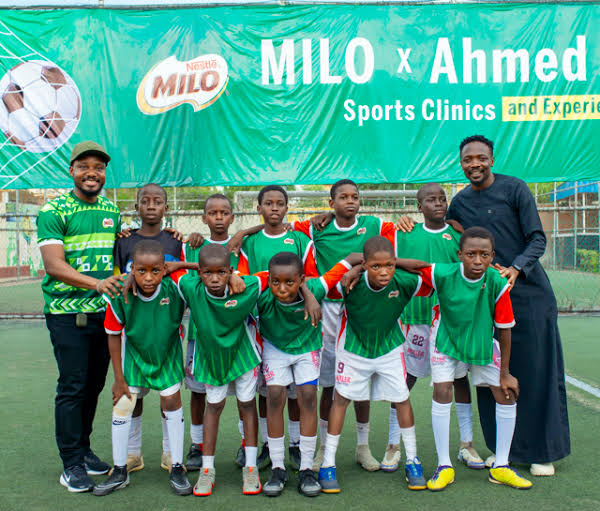
MILO Nigeria, in partnership with former Nigerian national team captain and MILO Brand Ambassador Ahmed Musa, has concluded the inaugural MILO × Ahmed Musa Sports Clinic and Tournament in Kano, providing 2,500 young footballers with professional coaching, mentorship and competitive football experience.
Over two weeks, participants took part in 10 coaching sessions and competed in matches under the guidance of Ahmed Musa and experienced coaches. The programme combined practical football training with lessons in teamwork, discipline, resilience and confidence, equipping participants with skills and values that extend beyond the pitch.
The initiative culminated in a tournament at the Ahmed Musa Sports Complex in Kano, where Khamis Football Academy emerged as champions of the inaugural edition. Participants also received cash prizes, certificates and football equipment.
Speaking on the initiative, Gilbert Tweneboah-Koduah, Category Lead, MILO, said: “At MILO, we believe sport is a powerful platform for young people to discover their abilities, build confidence and develop values that extend beyond the field of play. Our partnership with Ahmed Musa brings together MILO’s longstanding commitment to sports development and the experience of an athlete whose journey from grassroots football to the highest level of the game can inspire the next generation. By combining his experience with structured coaching and competition, this programme has given young footballers in Kano an opportunity to develop their skills, learn from experienced professionals and better understand the commitment required to pursue their aspirations.”
For the participants, the clinic offered an opportunity to learn from an athlete whose football journey began in northern Nigeria and progressed to the highest levels of the sport, making his experience a source of inspiration for aspiring players.
Commenting on the partnership, Ahmed Musa said: “Nigeria has incredible football talent, but talent alone is not enough. Young players need good coaching, regular competition and people who will guide them. I am proud to partner with MILO and share some of what football has taught me. My message to these players is simple: keep training, listen to your coaches and work hard every day to improve.”
Musa also called for greater investment in grassroots football, emphasizing the importance of giving young players access to quality coaching, structured development and regular competitive opportunities.
The MILO × Ahmed Musa Sports Clinic and Tournament builds on MILO’s longstanding commitment to youth development through sports in Nigeria. Through its school-based and grassroots sporting initiatives, MILO continues to create opportunities for young people to participate in sports, develop their abilities and embrace values that can support them both on and off the pitch.


