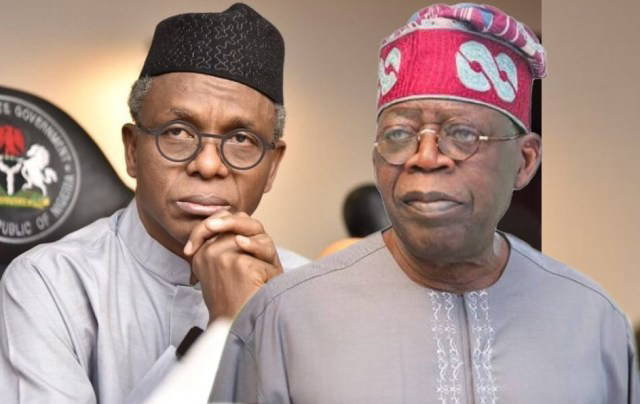
A former governor of Kaduna State, Mallam Nasir El-Rufai, has alleged that ministerial appointments in President Bola Tinubu’s administration were secured with cash payments.
Speaking in an interview with BBC Hausa, El-Rufai dismissed claims that he left the All Progressives Congress (APC) for the Social Democratic Party (SDP) as a result of being denied a ministerial position.
“But did I even look for the ministerial position? I know those who even paid money to be appointed as ministers.
“Yes, I was at the screening because the President begged me. It was in the public glare, not just between the two of us, for him to say he had never begged me.
“It was in Kaduna where he begged me to come and work with him. Even then, I did not agree until we sat down and he told me what he wanted. That the problem of electricity had hindered the country’s progress. He said he would like to be the President that would finally resolve the power problem and begged me to come and help him achieve that.
“I told him that I would look at the challenge he gave me and would consider working with him. I thought he meant it,” El-Rufai added.
He revealed that some individuals paid for their appointments, insisting he was not interested in the role despite Tinubu’s personal appeal.
El-Rufai further criticised the APC, stating that the party had abandoned its founding principles and become driven by self-interest and financial gain.
He claimed governance has been commercialized, adding that those who worked for the party were sidelined in favour of cronies.
He also disclosed that he informed former President Muhammadu Buhari before leaving the APC, seeking his blessing and support.
According to El-Rufai, the APC had strayed from its original vision, prompting him to sever ties with the party.
He said: “The APC has derailed; the party is no longer abiding by its founding principles. Everyone is working for themselves, looking for money. The government is commercialized; everything has a price tag.
“Justice has been kept at bay; those who worked for the party were ignored instead of being compensated. If there is any position or appointment, they give it to a Lagos boy, etc.
“That is why we’ve been speaking. We said this is not the party we know. The party is dead. I said the only option is for me to meet Pastor Tunde Bakare because he dragged me into APC. He took me to Buhari. I did not join the APC because of Buhari; it was Pastor Bakare who brought me into APC, and courtesy demands I should let him know.”
“Buhari too, I told him I was leaving the party. I sought his blessings and prayers. He said he has given me his blessings and prayers. We are the ones in politics, while he (Buhari) is now the father of the land and has been praying for us, so what remains?
“I’ve publicly denounced my membership of the party. They can go and hold on to the party; they can eat the party alone like food. We’ve given up.”
Asked if he decided to leave the party to avoid being expelled, El-Rufai said it would have been much better for him to be expelled from the APC.
“That would’ve been much easier for me, but look at it, as I kept on saying, I did not leave the party; it’s the party that dumped me. Why did it leave me? First of all, I was marginalized, not involved in all party activities. Not that I was invited and refused to honor the invite – I was completely sidelined.
“Secondly, what we had planned to implement when we formed the government is not what’s being implemented,” he further alleged.
Following the opening of applications from eligible candidates living with disabilities, for scholarships to pursue legal qualifications, the Opeoluwa Sotonwa Foundation (OSF), a not-for-profit organisation, founded by US-based philanthropist, Mr. Opeoluwa Sotonwa, and dedicated to expanding educational opportunity, leadership and inclusion, has announced the recipients of its 2026 scholarships, fellowships and academic awards.
Now in its fourth year, OSF has continued to deepen its investment in Nigeria’s deaf and hard-of-hearing community while expanding pathways for students with disabilities in the legal profession.
The 2026 awards also mark a new milestone with the introduction of the Prof. Konyinsola Ajayi, SAN Scholar-Practitioner Award, supporting a legal practitioner pursuing doctoral studies in Law.
Founded in 2022, OSF is grounded in a simple but enduring conviction: talent is universal, but opportunity is not. The Foundation seeks to close that gap by investing not merely in education, but in people whose knowledge, leadership and service can create opportunities for others.
PROF. KONYINSOLA AJAYI, SAN SCHOLAR-PRACTITIONER AWARD
For the first time, OSF is extending its investment in legal education beyond the undergraduate level through the Prof. Konyinsola Ajayi, SAN Scholar-Practitioner Award.
The new award recognizes a legal practitioner pursuing a Ph.D. in Law, bridging two worlds essential to the future of justice: the practical experience of the legal profession and the rigorous inquiry of advanced legal scholarship.
Isioma Osakuni — Ph.D. in Law, University of Ibadan — Inaugural Recipient
The establishment of the Scholar-Practitioner Award represents a natural evolution of the Prof. Konyinsola Ajayi, SAN Fellowship. It broadens OSF’s vision from helping students enter the legal profession to supporting practitioners seeking to contribute to its intellectual development through advanced research and scholarship.
PROF. KONYINSOLA AJAYI, SAN FELLOWSHIP
The Prof. Konyinsola Ajayi, SAN Fellowship is OSF’s flagship investment in developing a more inclusive legal profession. Expanded in 2025 to include law students with disabilities beyond the Deaf and hard-of-hearing community, the fellowship recognizes that the pursuit of justice is strengthened when the legal profession reflects the breadth of the society it serves. The recipients are:
Abubakar Nura — Law, Bayero University Kano
Amala Njelita — Law, University of Calabar
OPEOLUWA SOTONWA FOUNDATION GENERAL SCHOLARSHIP
The Foundation’s core scholarship program continues OSF’s foundational commitment to Deaf and hard-of-hearing students pursuing higher education across Nigeria. The 2026 scholars represent a broad range of disciplines, from education and computer science to political science, entrepreneurship and the arts. The recipients are:
Auwalu Mohammed — English Education, Gombe State University
Wende Terungwa — Special Education/PHE, Federal University of Education Pankshin
Farida Dalhatu — Political Science, Umar Musa Yar’dua University, Katsina
Fuhad Abdulrasaq — History and International Studies, University of Ilorin
Irimiya Samaila — Special Education, University of Calabar
Amina Nasiru — Entrepreneurship, Kaduna State University
Abosede Josephine Akilo — Special Education, Federal College of Education in affiliation with University of Ibadan
Toheeb Olajuwon Balogun — Political Science, Federal College of Education (Special), Oyo
Mujahid Adamu — Education-English, Sule Lamido University Kafin Hausa
Inerepamo Maxwell Pounana — Special Education, Ignatius Ajuru University of Education
Precious Onyinyechi Okonkwo — Special Education, Ignatius Ajuru University of Education
Nneoma Happiness Agbo — Economic Education, Peaceland College of Education Enugu
Yusuf Anas — Educational Management, Abdulkadir Kure University, Minna
Omopariola Opeyemi — Educational Management, Kwara State University
Akinkunmi Sheriff Akinboade — Fine and Applied Arts, Federal College of Education (Special), Oyo
Royal Adeh Obi — Special Education/Tourism, University of Calabar
Oladipupo Emmanuel Adeyeri — Computer Science, Federal College of Education (Special), Oyo
Bello Abubakar — Islamic Studies, Aminu Salah College of Education
MOST OUTSTANDING SCHOLARS 2026
Introduced in 2025, the Most Outstanding Scholar distinction recognizes one female and one male scholar whose academic achievement, leadership and perseverance distinguish them within the OSF community.
Mutiyat Oreoluwa Raheem — Microbiology, University of Ilorin — Female Most Outstanding Scholar
John Nworie Nte — Medicine and Surgery, University of Calabar — Male Most Outstanding Scholar
GRADUATE SCHOLARS
OSF’s commitment does not end with undergraduate education. The Graduate Scholars program supports Deaf and hard-of-hearing scholars advancing into postgraduate study and developing expertise capable of influencing their professions, institutions and communities.
Godwin Agianpuye — PGD/M.Sc., Computer Science, Wesley University, Ondo
Auwalu Salisu Ismaila — M.Ed., Special Education, Bayero University, Kano
Caroline Nwugo Onu — Ph.D., Christian Leadership, The Nigerian Baptist Theological Seminary
VOICES BEYOND SOUND – SOCIAL AND BUSINESS SCHOLARSHIP
Established in partnership with Greg and Annette Hudson, Voices Beyond Sound recognizes Deaf and hard-of-hearing students pursuing studies connected to social and business leadership. First featured in the 2025 awards, the initiative reflects a shared belief that leadership is not defined by how a person communicates, but by the ideas, resilience and impact they bring to society.
Zulaihatu Sani — Business Administration, Gombe State University
Qudus Ajiboye — Economics, National Open University of Nigeria
Taiwo Eneyamire Abdul — Economics, Federal College of Education (Special), Oyo
Taiwo Hassan Alatilehin — Business Education, University of Ilorin
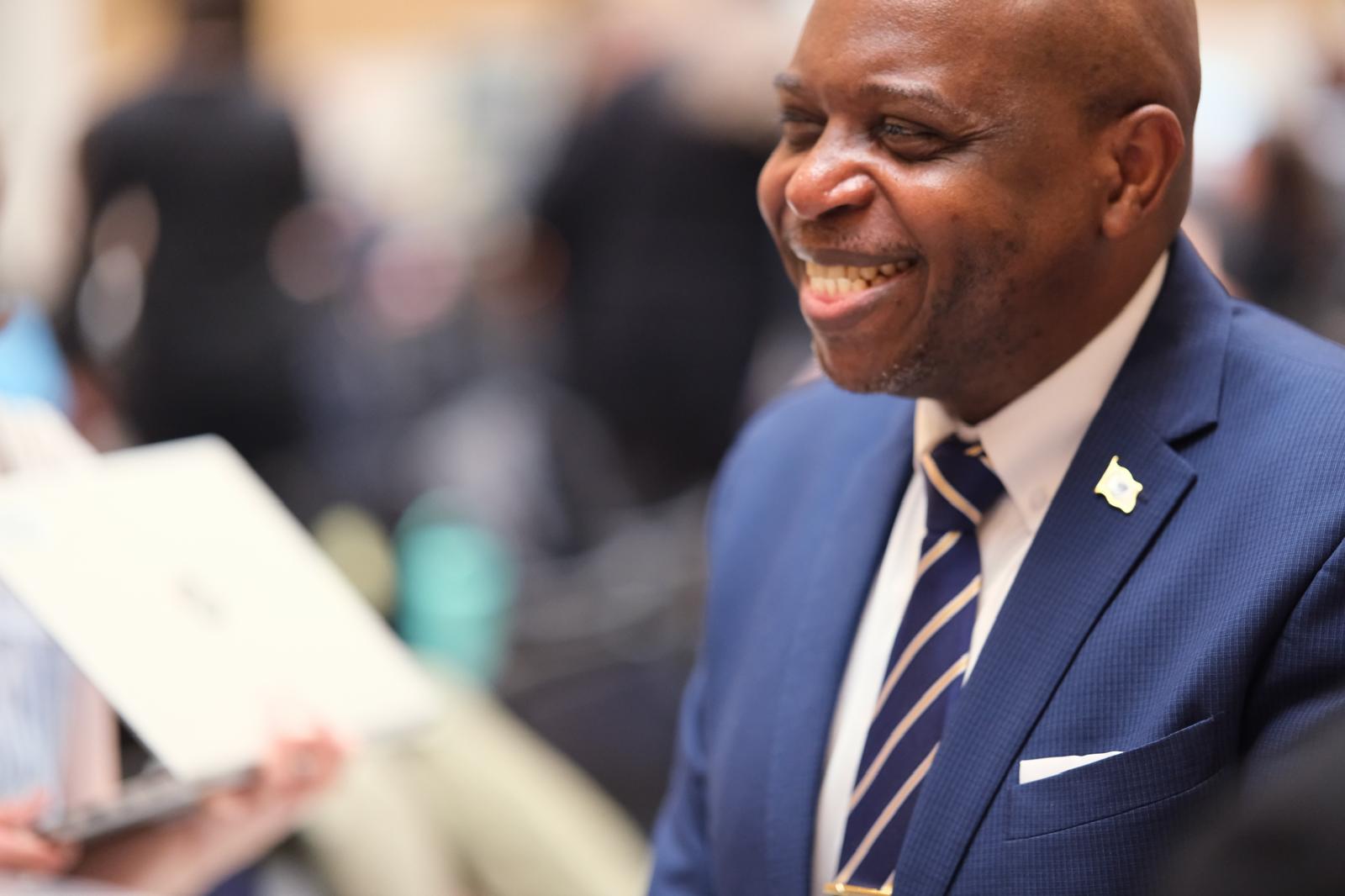
“Four years into this journey, we are seeing what becomes possible when opportunity meets determination,” said Dr. Opeoluwa Sotonwa, Founder of OSF. “Our scholars are studying medicine, law, education, science, technology, business, the arts and other disciplines. Some are beginning their higher-education journeys; others are advancing into master’s and doctoral study. What connects them is not disability, but possibility. Our responsibility as a Foundation is to ensure that talent is given room to become impact.”
“The introduction of the Prof. Konyinsola Ajayi, SAN Scholar-Practitioner Award is especially meaningful. Justice requires not only lawyers who practice the law, but scholars who interrogate it, strengthen it and help imagine what it can become. By investing across that continuum—from the undergraduate law student to the doctoral scholar-practitioner—we are investing in the future of the profession itself.”
For more information about the Opeoluwa Sotonwa Foundation and its programs, visit www.opeoluwasotonwafoundation.org.
About the Opeoluwa Sotonwa Foundation
Established in 2022, the Opeoluwa Sotonwa Foundation (OSF) is a nonprofit organization dedicated to unlocking educational and leadership opportunities for Nigeria’s Deaf and hard-of-hearing communities while advancing targeted opportunities for students with disabilities. Through scholarships, fellowships, mentorship and advocacy, OSF invests in students and emerging leaders with the potential to transform their professions, communities and society.
The Foundation can be reached via:
Cassandra Sotonwa Chief Operating Officer
Opeoluwa Sotonwa Foundation
opeoluwasotonwafoundation@gmail.com
The Foundation wishes all recipients a fruitful academic period.
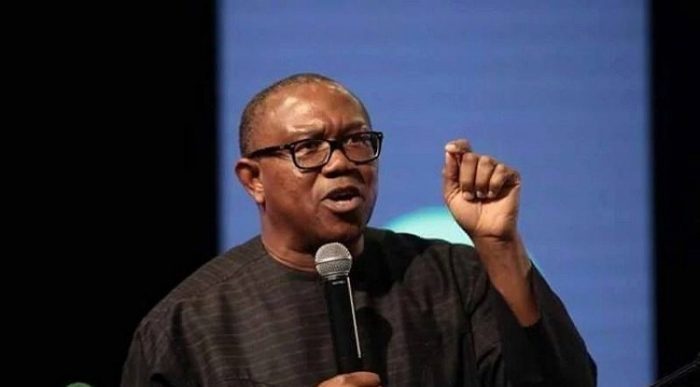
The Nigeria Democratic Congress (NDC) presidential candidate, Peter Obi, has clarified that he did not owe salaries, pensions, gratuities or any money during the period he was Governor of Anambra State.
Obi stated this in response to recent claims by the current government of Anambra State.
The Anambra State Government recently claimed that it is till repaying loans obtained by previous administrations, including those of former governors Obi and Willie Obiano.
According to the government, it has focused largely on paying existing obligations rather than accumulating new debts.
Obi served as the Governor of Anambra State from March 2006 to March 2014.
Reacting to the claim, Obi said: “I left office as Governor nearly 13 years ago. On the day I left office, I was not owing any salaries, pensions, gratuities or any money that the Anambra State Government was supposed to pay.
“I did not owe a single supplier or contractor. If you find even one person I owed, I will end my 2027 campaign today.”
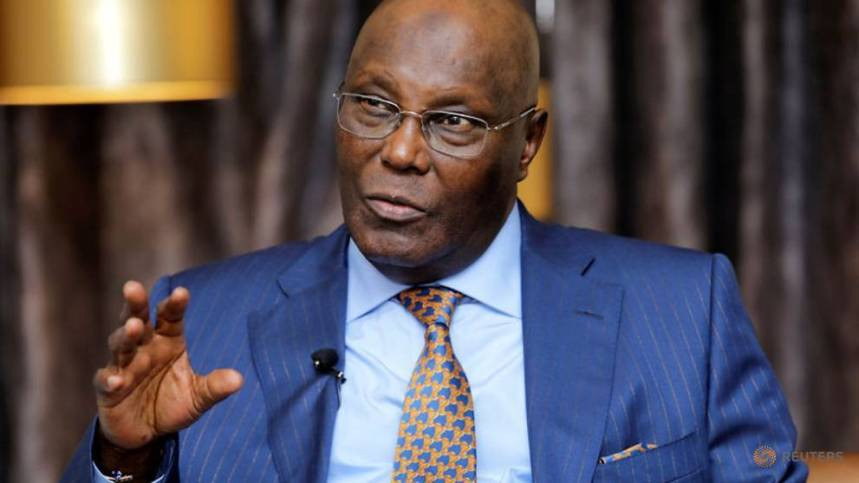
Former Vice President Atiku Abubakar has unveiled a 12-point policy agenda he says will guide his administration if he wins the 2027 presidential election on the platform of the African Democratic Congress (ADC).
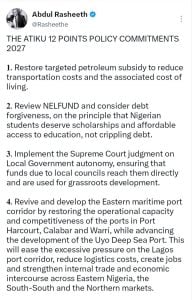
The policy commitments were published by AbdulRasheed Shehu, Special Assistant on Broadcast Media to Atiku, as part of the former vice-president’s campaign message ahead of the election.
The agenda focuses on the economy, education, local government autonomy, transportation, electricity, job creation, security, agriculture, healthcare and the restructuring of the federal system.
Atiku proposed the restoration of a targeted petroleum subsidy as part of measures to reduce transportation costs and ease the pressure of rising living expenses on Nigerians.
He also promised to review the operations of the Nigerian Education Loan Fund (NELFUND), including consideration of debt forgiveness for beneficiaries. The proposal is based on the position that Nigerian students should have access to affordable education and scholarships rather than being burdened with debts.
On local government administration, the former vice-president pledged to implement the Supreme Court judgment on local government autonomy. Under his proposal, funds meant for local councils would be paid directly to them and deployed for development at the grassroots.
Atiku also identified the development of Nigeria’s maritime infrastructure as a major part of his economic agenda. He proposed reviving the Eastern maritime port corridor by restoring the operational capacity and competitiveness of ports in Port Harcourt, Calabar and Warri, while supporting the development of the Uyo Deep Sea Port.
According to the policy document, strengthening the eastern and southern ports would reduce pressure on the Lagos port corridor, lower logistics costs, create employment and improve trade between the South-East, South-South and northern markets.
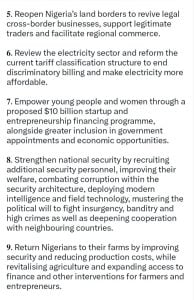
The former vice-president further promised to reopen Nigeria’s land borders to legitimate commercial activities. He said the move would help revive legal cross-border businesses, support traders and strengthen regional commerce.
Atiku also proposed changes to the electricity sector, including a review of the existing tariff classification system. His campaign said the reform would address what it described as discriminatory billing and make electricity more affordable to consumers.
Politics
Young Nigerians and women also feature prominently in the proposed agenda. Atiku plans to establish a $10 billion startup and entrepreneurship financing programme aimed at providing greater access to capital, while also increasing the participation of youths and women in government appointments and economic opportunities.
The security sector is another major focus of the policy commitments. Atiku proposed recruiting more security personnel, improving their welfare and strengthening the use of modern intelligence and field technology.
His plan also includes tackling corruption within the security system, confronting insurgency, banditry and other serious crimes with greater political will, and strengthening security cooperation with neighbouring countries.
In agriculture, Atiku said his administration would seek to encourage Nigerians to return to farming by improving security in farming communities and lowering production costs. The plan also includes greater access to financing and other forms of support for farmers and agricultural entrepreneurs.
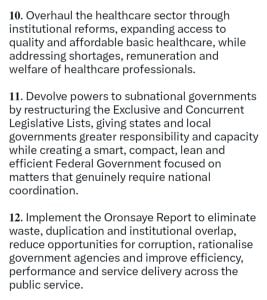
The former vice-president equally proposed a major overhaul of the healthcare sector through institutional reforms and increased access to quality and affordable basic healthcare. The agenda also promises to address shortages of medical personnel, as well as their remuneration and welfare.
On governance, Atiku proposed devolving more powers to states and local governments by restructuring the Exclusive and Concurrent Legislative Lists. He said the federal government should become smaller and more efficient, concentrating on responsibilities that require national coordination while giving subnational governments greater capacity to manage local affairs.
He also pledged to implement the Oronsaye Report as part of efforts to reduce government waste and eliminate duplication among federal institutions. The proposal is intended to rationalise government agencies, reduce institutional overlap and corruption opportunities, and improve efficiency and service delivery across the public service.
Atiku Unveils 12-Point Plan to Rescue NigeriaAtiku Unveils 12-Point Plan to Rescue Nigeria
The release of the 12-point agenda comes days after Atiku’s wife, Titi Abubakar, urged Nigerian youths to support her husband in the 2027 presidential election.
Speaking at the ADC All Support Groups Town Hall Meeting in Abuja, Titi said Atiku’s experience would enable him to begin governing without having to learn the responsibilities of the presidency on the job.
“Atiku is a sellable material. That is why I am so proud of my husband. Atiku is a philanthropist. Atiku has done it before. Atiku is not going to learn on the job. And Atiku is not a novice,” she said.
She also said Atiku was seeking the presidency to improve the lives of Nigerians rather than to enrich himself.
“Atiku is a man of honour, a man of his word. Atiku is not coming to chop government money. Atiku wants to give back to you people. Atiku wants you people to know what it is all about government,” Titi said.
She further highlighted Atiku’s proposed inclusion of young people and women in government, recalling his pledge to reserve 40 per cent of appointments for the two groups.
Titi also urged young voters to protect their votes and reject attempts to buy their support ahead of the election.
“Don’t allow them to come and give you money and you sell your conscience. If you sell your vote, you are selling the vote of your generation yet unborn,” she said.
She acknowledged that the ADC might not have the financial resources of some political opponents but urged youths not to exchange their votes for temporary financial benefits.
“ADC don’t have that money to give you. Don’t be a sellout. Because these people, they have all our money in their kitties,” she said.
Titi had also criticised the state of governance and the economy, saying, “Nothing is working. Our economy is in shambles.”